Connective tissue is one of the four tissue
types found throughout the body.
Connective tissue is the most abundant
and widely distributed tissue in the body.
Connective tissue develop from mesoderm
during embryonic development.
While some connective tissues are specialized
( bone , blood), all organs have some amount
of connective tissue in them which hold their
parenchyma together.
Major constituent is extracellular matrix,
composed of fibres, ground substance &
tissue fluid.
Embedded within the extracellular matrix
are the connective tissue cells.
Structurally, connective tissue can be
divided into 3 classes: cells, fibres &
ground substance.
More matrix than cells
Derived from mesoderm in embryo –
mesenchyme and mucous connective
tissue.
Vascular .
Can replicate (healing and repair).
Is not present on free surfaces or body
cavities
Enclosing and separating organs
Connecting tissues to one another
(ligaments and tendons).
Supporting and moving ( Joints and
cartilage)
Storing (adipose tissue and bones)
Cushioning and insulating (adipose
tissues).
Transport and protection (blood)
Protection
Connective tissues differ widely but still
made up of three fundamental components
 Cells
 Protein fibers
 Ground substance( amorphous gelatinous
material)
It actually consists of large molecules
called glycosoaminoglycans (GAGs)
(unbranched polysaccharide chains)which
link together to form even larger
molecules called proteoglycans
Protein fibers and ground substance are
collectively called as extracellular matrix
The composition and structure of
extracellular matrix determine function
and characteristic of connective tissue
Ground substance
• Medium through which solutes diffuse
between blood capillaries and cells.
• Components:
Interstitial fluid
Adhesion proteins (“glue”)
Proteoglycans
Three types of fibers
• Collagen (white fibers)
Strongest and most abundant type
Provides high tensile strength
It is a protein composed primarily of the
amino acids glycine & proline, and it also
contains sugar groups.
• Elastic
Networks of long, thin, elastin fibers
that allow for stretch.
• Reticular
 Short, fine, highly branched
Classification is based on the composition
and organization of cellular and
extracellular components and on special
functions.
CLASSIFICATION
CONNECTIVE TISSUE
PROPER
SPECIALIZED
CONNECTIVE TISSUES
EMBRYONIC
CONNECTIVE TISSUE
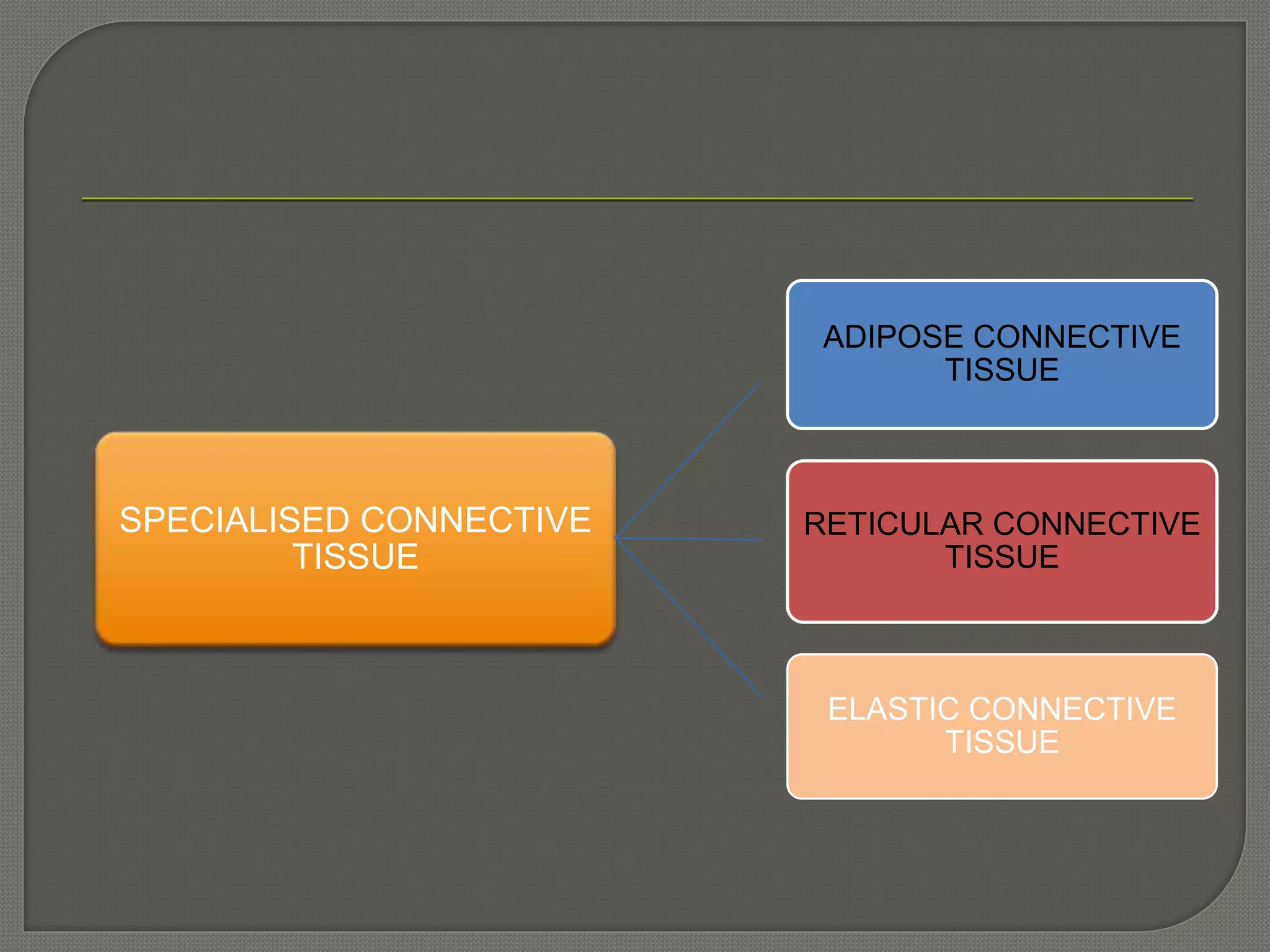
SPECIALISED CONNECTIVE
TISSUE
ADIPOSE CONNECTIVE
TISSUE
RETICULAR CONNECTIVE
TISSUE
ELASTIC CONNECTIVE
TISSUE
EMBRYONAL
CONNECTIVE TISSUE
MESENCHYMAL
CONNECTIVE TISSUE
MUCUOS
CONNECTIVE TISSUE
CONNECTIVE TISSUE
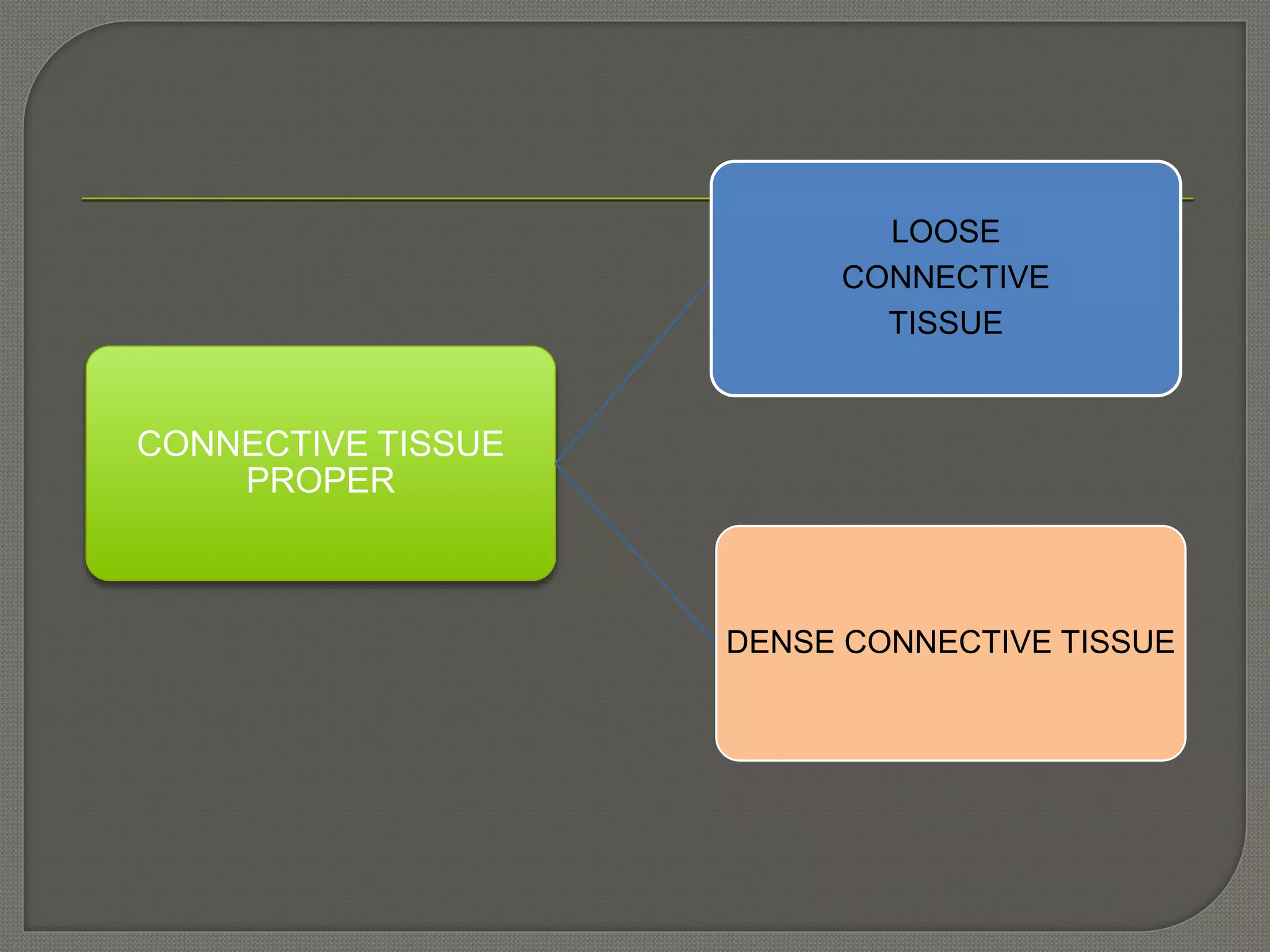
PROPER
LOOSE
CONNECTIVE
TISSUE
DENSE CONNECTIVE TISSUE
Dense connective
tissue
Dense regular
Dense irregular
Elastic
Loose connective
tissue
Areolar
Adipose
Reticular
Areolar connective tissue is highly
variable in appearance and the most
widespread of all the connective tissue
types specialized connective tissue in the
body .
consists of
fibers (collagen, elastic, reticular) arranged
randomly .
several kinds of cells (fibroblasts,
macrophages, plasma cells, adipocytes,
mast cells, and a few white blood cells)
semifluid ground substance (hyaluronic
acid, chondroitin sulfate, dermatan
sulfate, and keratan sulfate).
Its functions are connects ,strength,
elasticity, support.
Present everywhere in body including
subcutaneous layer deep to skin,
superficial region of dermis of skin,
mucous membranes, around blood
vessels, nerves, and body organs
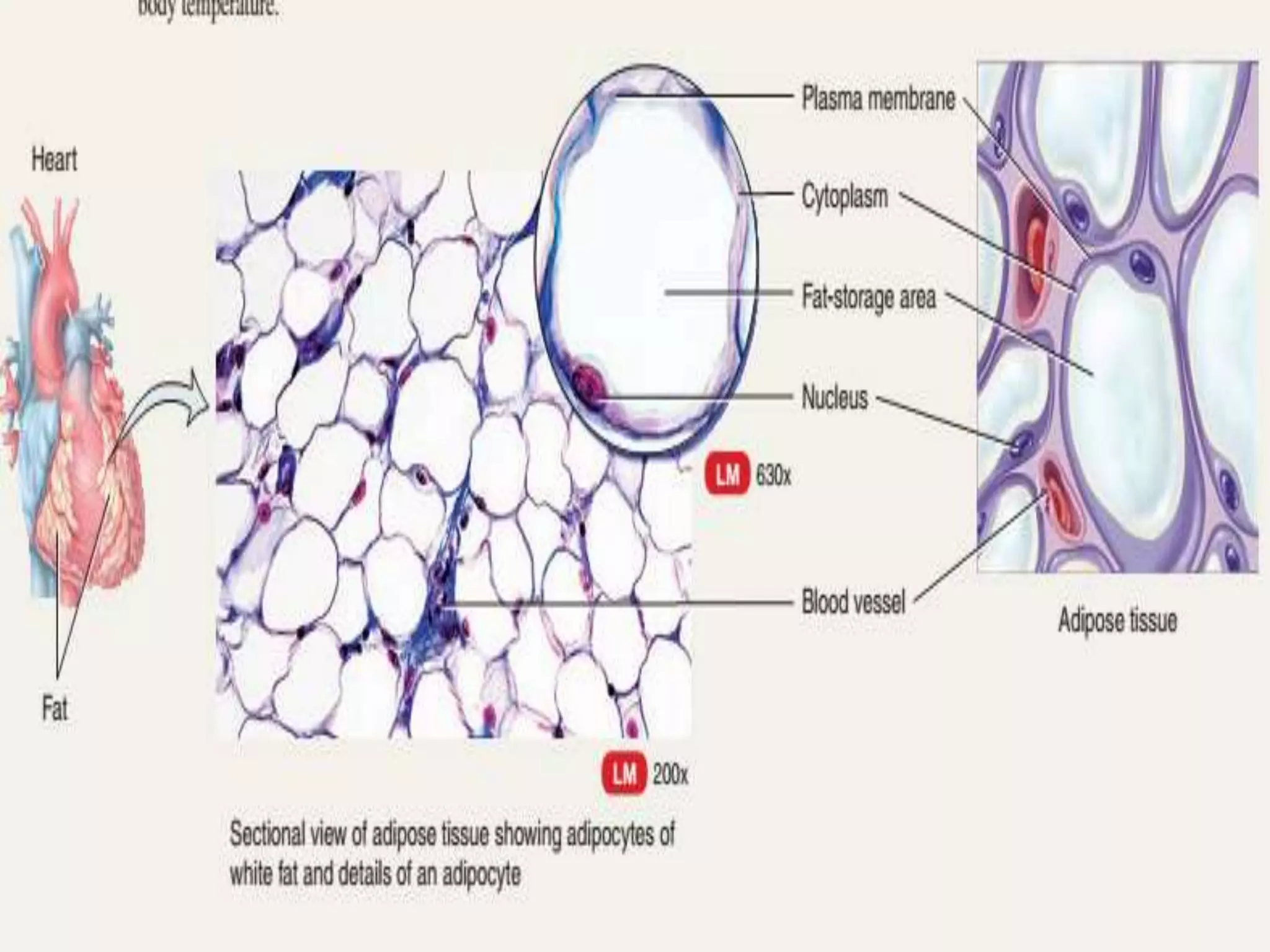
Made up of adipocytes that are
specialized for storage of triglycerides
(fats) as a large, centrally located droplet.
Function: Reduces heat loss through skin,
serves as an energy reserve, supports and
protects organs in newborns.
Present throughout the body;
abdominopelvic cavity, around kidney,
subcutaneous tissue.
Reticular connective tissue contains a
meshwork of reticular fibers, on which
fibroblast and leukocytes are suspended.
Has very little ground substance.
Mainly present in hematopoietic system;
spleen, lymph nodes, bone marrow
Functions: Forms stroma of organs, filters
and removes worn-out blood cells in
spleen and microbes in lymph nodes
Dense connective tissue consists of
densely packed fibers with relatively
little space between the fibers.
Has proportionately high protein fiber
than ground substance.
Also called collagenous connective tissue
because of abundance of collagen fibers.
Further divided into three categories.
 Dense regular connective tissue
 Dense irregular connective tissue
 Elastic connective tissue.
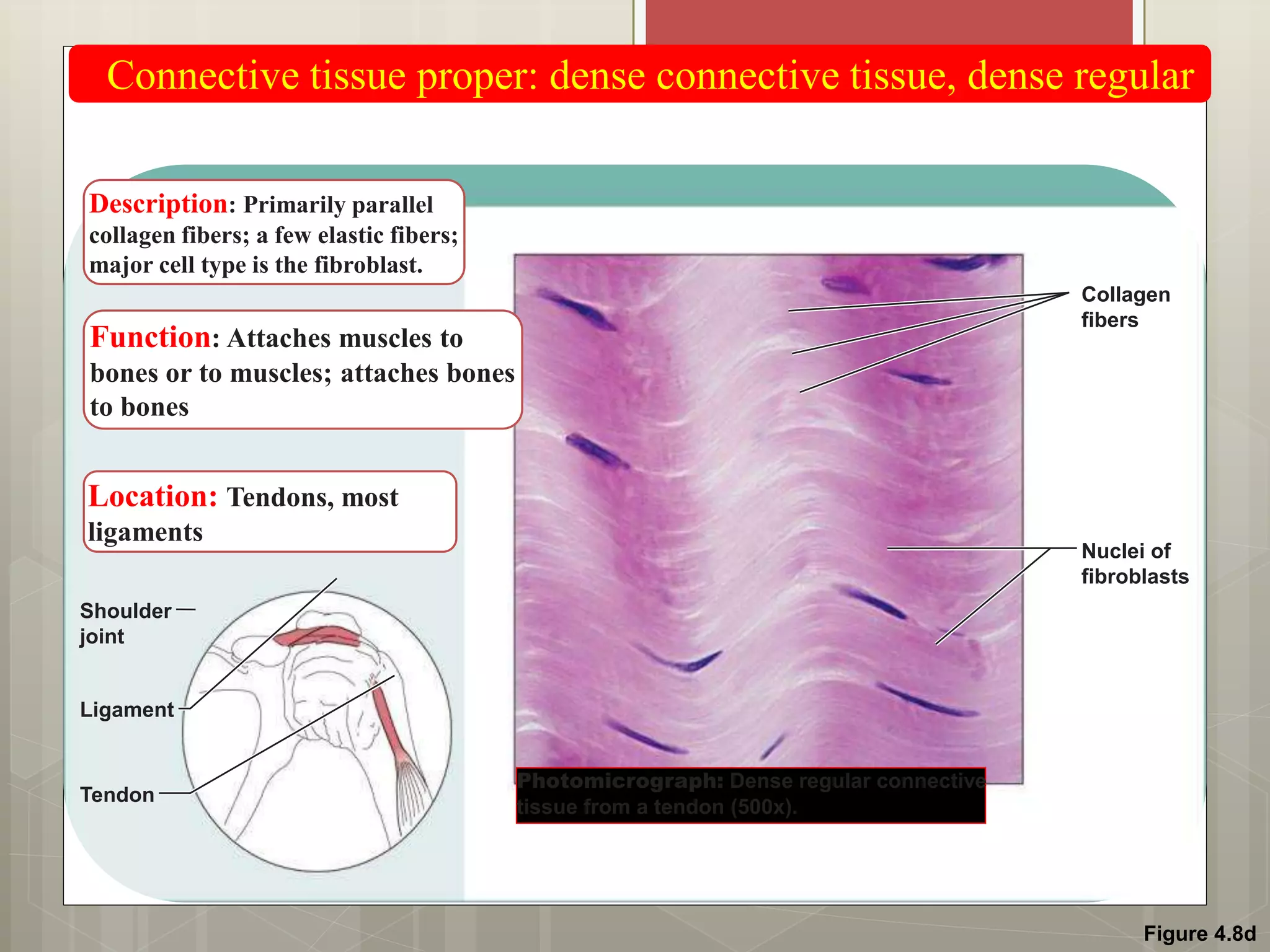
Figure 4.8d
Connective tissue proper: dense connective tissue, dense regular
Description: Primarily parallel
collagen fibers; a few elastic fibers;
major cell type is the fibroblast.
Function: Attaches muscles to
bones or to muscles; attaches bones
to bones
Location: Tendons, most
ligaments
Photomicrograph: Dense regular connective
tissue from a tendon (500x).
Shoulder
joint
Ligament
Tendon
Collagen
fibers
Nuclei of
fibroblasts
Figure 4.8e
Connective tissue proper: dense connective tissue, dense
irregular
Description: Primarily
irregularly arranged collagen
fibers; some elastic fibers;
major cell type is the fibroblast.
Function: Able to withstand
tension in many
directions; provides structural
strength.
Location: Fibrous capsules of
organs and of joints; dermis of
the skin; submucosa of
digestive tract.
Photomicrograph: Dense irregular
connective tissue from the dermis of the
skin (400x).
Collagen
fibers
Nuclei of
fibroblasts
Fibrous
joint
capsule
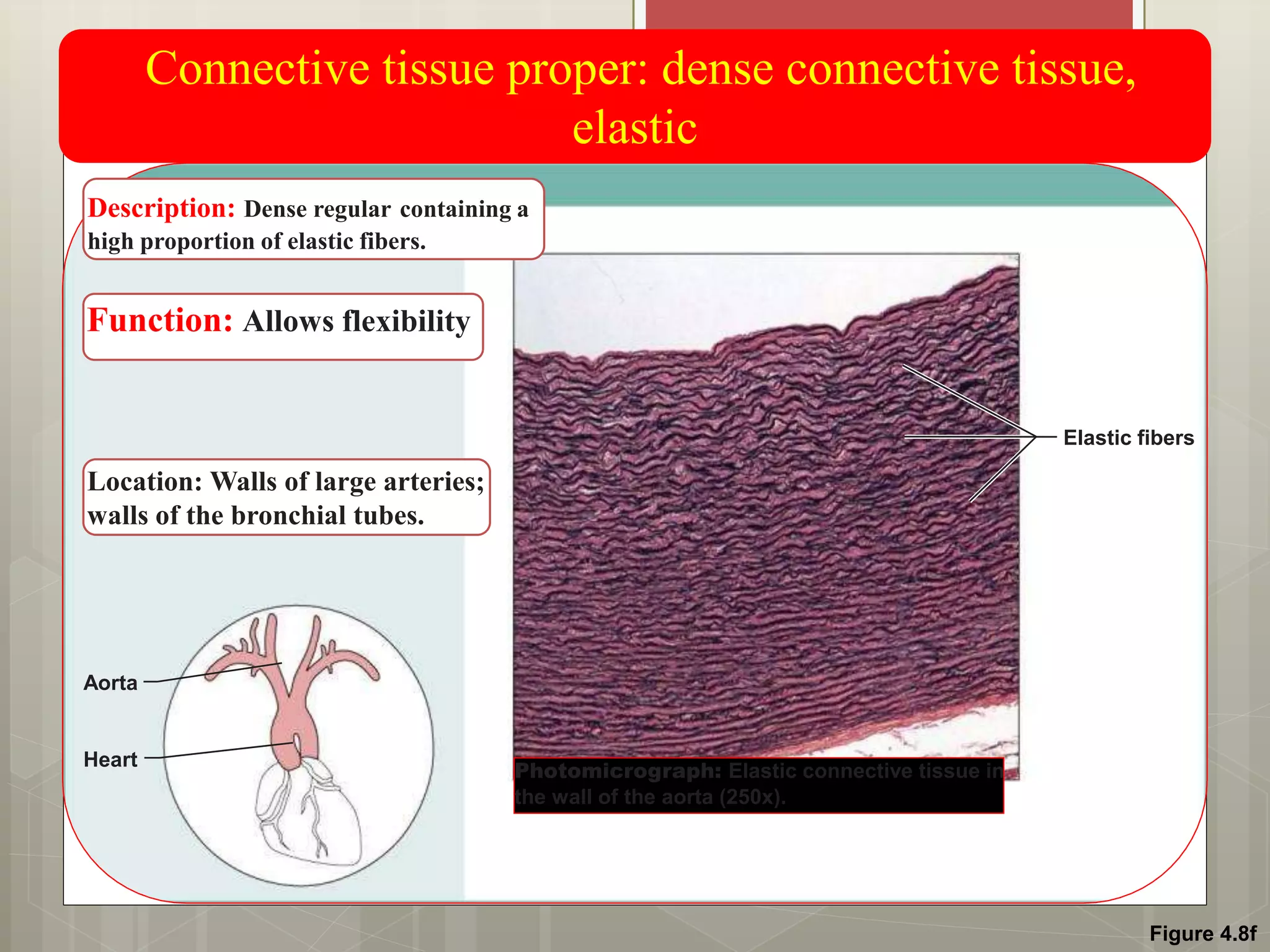
Figure 4.8f
Connective tissue proper: dense connective tissue,
elastic
Description: Dense regular containing a
high proportion of elastic fibers.
Function: Allows flexibility
Location: Walls of large arteries;
walls of the bronchial tubes.
Elastic fibers
Aorta
Heart
Photomicrograph: Elastic connective tissue in
the wall of the aorta (250x).
Three types of cartilage:
• Hyaline cartilage
• Elastic cartilage
• Fibro cartilage
Figure 4.8g
Cartilage: hyaline
Description: Amorphous but firm matrix; collagen fibers form
network; chondroblasts produce the matrix and when mature
(chondrocytes)
Function: Supports and
resists compressive stress.
Location: Forms most of the
embryonic skeleton; covers the ends
of long bones in joint cavities; forms
cartilages of the nose, trachea, and larynx.
Photomicrograph: Hyaline cartilage from the
trachea (750x).
Costal
cartilages
Chondrocyte
in lacuna
Matrix
Figure 4.8h
Cartilage: elastic
Description: Similar to hyaline
cartilage, but more elastic fibers
in matrix.
Function: Maintains the shape
of a structure while allowing
great flexibility.
Location: Supports the external
ear
Chondrocyte
in lacuna
Matrix
Figure 4.8i
Cartilage: fibrocartilage
Description: Matrix similar to
but less firm than that in hyaline
cartilage; thick collagen fibers
predominate.
Function: Tensile strength
with the ability to absorb
compressive shock.
Location: Intervertebral discs;
Photomicrograph: Fibrocartilage of an
intervertebral disc (125x). Special staining
produced the blue color seen.
Intervertebral
discs
Chondrocytes
in lacunae
Collagen
fiber
Figure 4.8j
Others: bone (osseous tissue)
Description: Hard, calcified
matrix containing many collagen
fibers; osteocytes lie in lacunae.
Function: Bone supports
provides levers for the muscles
to act on; stores calcium and fat;
marrow inside bones is the site for
blood cell formation
Location: Bones
Photomicrograph: Cross-sectional view
of bone (125x).
Lacunae
Lamella
Central
canal
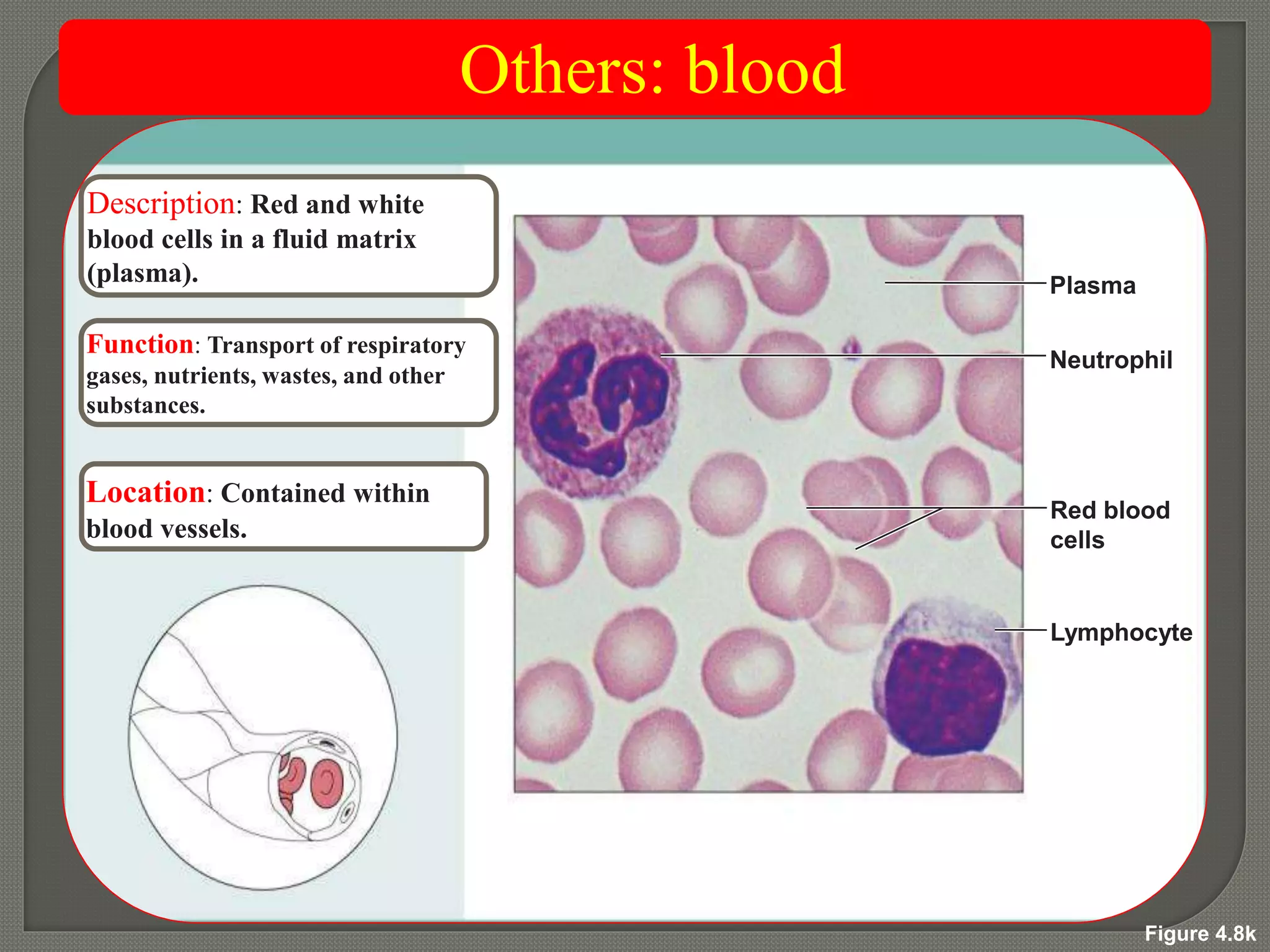
Figure 4.8k
Others: blood
Description: Red and white
blood cells in a fluid matrix
(plasma).
Function: Transport of respiratory
gases, nutrients, wastes, and other
substances.
Location: Contained within
blood vessels.
Neutrophil
Red blood
cells
Lymphocyte
Plasma
These are the most frequently
encountered of all the fibrous types of
intercellular substance, and are found in
large quantities in most sites in the body.
These are found in all types of connective
tissue and consist of protein collagen.
In the fresh state, e.g. in tendons, they
appear white, and hence also are termed
“white” fibers.
They may occur as individual fibers, as in
loose areolar tissues.
Or as large bundles of fibers clumped
together.
Within a bundle, fibers are held together
by a small amount of amorphous
substance (mucoprotein).
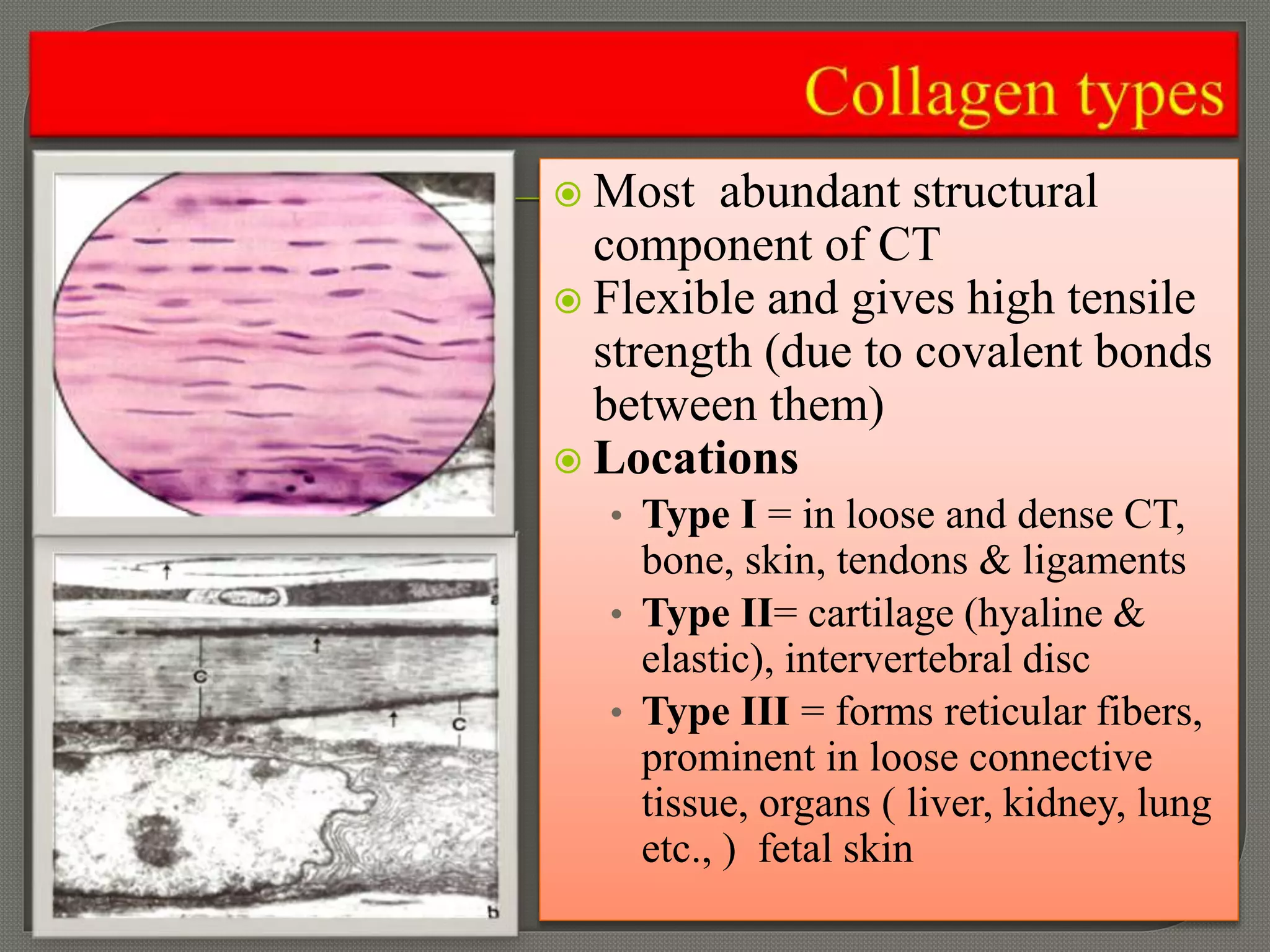
 Most abundant structural
component of CT
 Flexible and gives high tensile
strength (due to covalent bonds
between them)
 Locations
• Type I = in loose and dense CT,
bone, skin, tendons & ligaments
• Type II= cartilage (hyaline &
elastic), intervertebral disc
• Type III = forms reticular fibers,
prominent in loose connective
tissue, organs ( liver, kidney, lung
etc., ) fetal skin
Collagen types
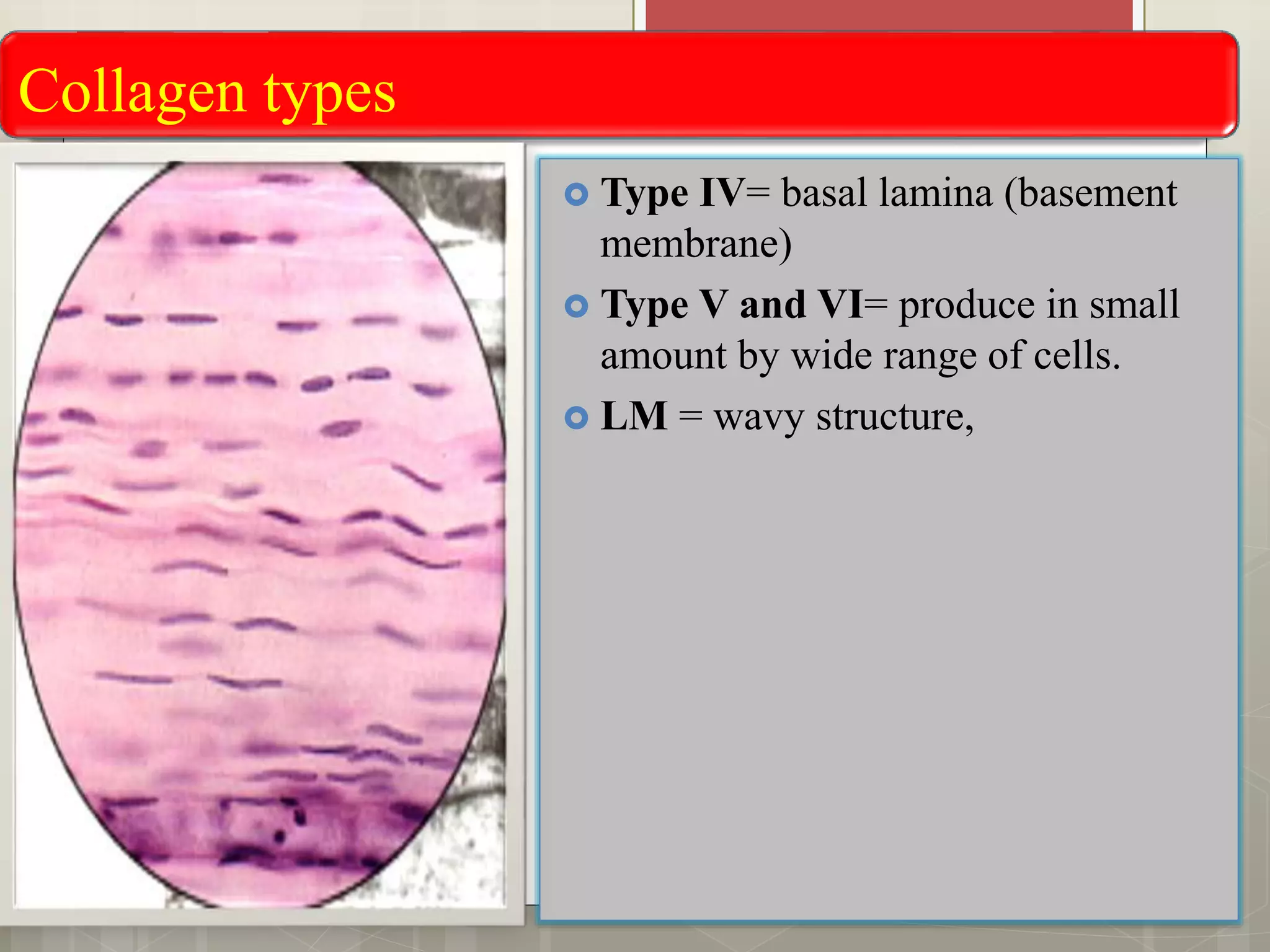
 Type IV= basal lamina (basement
membrane)
 Type V and VI= produce in small
amount by wide range of cells.
 LM = wavy structure,
Type I collagen stains strongly with acid
dyes, due to the affinity of the cationic
groups of the proteins for the anionic
reactive groups of the acid dyes.
Collagen may be demonstrated more
selectively by compound solutions of acid
dyes (e.g. van Gieson) or by sequential
combinations of acid dyes
e.g. Masson’s trichrome, Lendrum’s
MSB, etc.) The different types of collagen
may be differentiated
immunohistochemically
This stain is mainly used to evaluate the
type and amount of extracellular material
like- collagen, fibrin, muscle and elastic
fiber.
Various technique includes:
Masson trichrome stain
Van gieson stain (Routine stain)
Mallory, Phosphotungstic or
phosphomolybdic acid stain

The general rule in trichrome staining is
that the less porous tissues are colored by
the smallest dye molecule;
whenever a dye of large molecular size is
able to penetrate, it will always do so at
the expense of the smaller molecule.
1-Tissue permeability and dye molecular
size
Erythrocytes have density network(small
pores)
Muscles have medium pores
Collagens have large pores
2-PH
3-Heat
4-Effect of fixation
5-Nuclear stains for trichrome stains
Purpose: Used to differentiate between
collagen and smooth muscle in tumors, and
the increase of collagen in diseases such as
liver cirrhosis.
Routine stain for liver and kidney biopsies
Principle: As the name implies, three
dyes 1-Harris Haematoxylin 2- acid
fuchsin 3- methyl blue are employed
selectively staining muscle, collagen
fibers, fibrin, and erythrocytes.
 Results:
Nuclei: blue ( Harris H)
Cytoplasm, muscle, erythrocytes: red( Acid
fuchsin)
Collagen: blue ( methyl blue)
 It is used to differentiate between collagen
and smooth muscle in tumour.
 To identify increased collagen deposition in
condition like cirrhosis, , benign prostatic
hyperplasia, membranoproliferative
glomerulonephritis etc.
Principle
 When using combined solution of picric acid
and acid fuchsin, the small molecules of picric
acid penetrate all the tissue rapidly, but are
only firmly retained in the close textured red
blood cells and muscle
The larger molecules of acid fuchsin
displaces picric acid molecule from
collagen fibres, which has larger pores
and allow larger molecules to enter
It is used for detection of collagen.
Result -- Nuclei : Blue / Black
 Collagen : Red
 ssCytoplasm, muscle, fibrin, RBCs :
Yellow
• Results:
• Collagen – deep red
• Muscle, RBCs –
yellow
• Nuclei – blue to black
These are the fine delicate fibers that are
found connected to the coarser and stronger
collagenous fibers (Type I fibers)
They provide the bulk of the supporting
framework of the more cellular organs (e.g.
spleen, liver, lymph nodes, etc.),
Reticulin fibers composed of protein
called reticulin.
Reticular fibers are very fine with a
diameter (0.2-0.5 micrometer's
Synthesized by:
Reticular cell in hemopoietic and
lymphatic tissues
Fibroblasts in other sites
Schwann cell in peripheral nerve
Fibers are not visible in H & E
preparations.
Demonstrated by means of impregnation with
silver salts and by PAS technique.
 Fibers are argyrophilic because of affinity
with silver salts, when impregnated with
silver they appear black (Gomori and Wilder
methods).
This affinity with silver salts and positive
PAS . is due to high content of hexoses 6-
12% as opposed to 1%in collagen.
1. Diagnosis of liver cirrhosis.
2. To distinguish epithelial neoplasms from non-
epithelial neoplasms.
 Foci of carcinoma have reticulin around tumour
nest but not in between tumour cell, whereas in
most sarcomas and large cell lymphoma reticulin
separates single cells
To differentiate between in-situ and
invasive carcinoma
The elastic system fibers (i.e. oxytalan,
elaunin, and elastic fibers) have,
respectively, a fibrillar, amorphous, or
mixed structure
The elastic fibers may be found
throughout the body but are especially
associated with the respiratory,
circulatory, and integumentary
systems
Fibers are arranged mostly in parallel
though may join other bundle groups.
Fibers are elastic and may stretch at least
twice their length.
Oxytalan fibers may be distinguished
from mature elastic fibers by their failure
to stain with aldehyde fuchsin solutions,
unless they have been previously oxidized
by potassium permanganate
They have also been reported to remain
unstained following Verhöeff’s
hematoxylin, with or without prior
oxidation.
Elaunin fibers:Unlike oxytalan fibers,
elaunin fibers stain with orcein, aldehyde
fuchsin, and resorcin–fuchsin without
prior oxidation, but do not stain with
Verhöeff’shematoxylin
• Elastic fibres are composed of two components
MicrofibrilsElastin
•Occupies central portion
•Rich in proline and glycine
•Poor in hydroxyproline n
completely lacks
hydroxylysine
•Stains pale because it has
little affinity for heavy metal
salts
•A fibrillar glycoprotein
•Straight and thin
•Measuring12nm in
diameter
MARFAN SYNDROME:
In marfan syndrome, a complex connective
tissue disorder ,there is defect in fibril in
(a component of the micro fibril) protein.
Abnormal elastic tissue.
SCLERODERMA:
Skin diseases associated with accumulation
of elastin
This method is used for identifying elastic fiber
in tissue such as skin, aorta etc.
Result – Elastic fiber: Blue-black to black
- Nuclei: Blue to black
- Collagen: Red
- other tissue elements: Yellow
Basement membranes are found
throughout the body separating
connective tissues from epithelial,
endothelial or mesothelial cells, muscle
cells, fat cells, and nervous tissues
They support the epithelial cells of
mucosal surfaces, glands, and several
other structures, for example renal tubules
They also support the endothelial cells
lining blood vessels, capillaries
In H&E stained sections of most tissues,
basement membranes are difficult to
distinguish ,in the glomerulus hey are
more conspicuous, particularly in disorders
such as membranous nephropathy or
diabetes, where they can be markedly
thickened .
Basement membranes stain by PAS and
Periodic acid-methenamine silver
microwave method
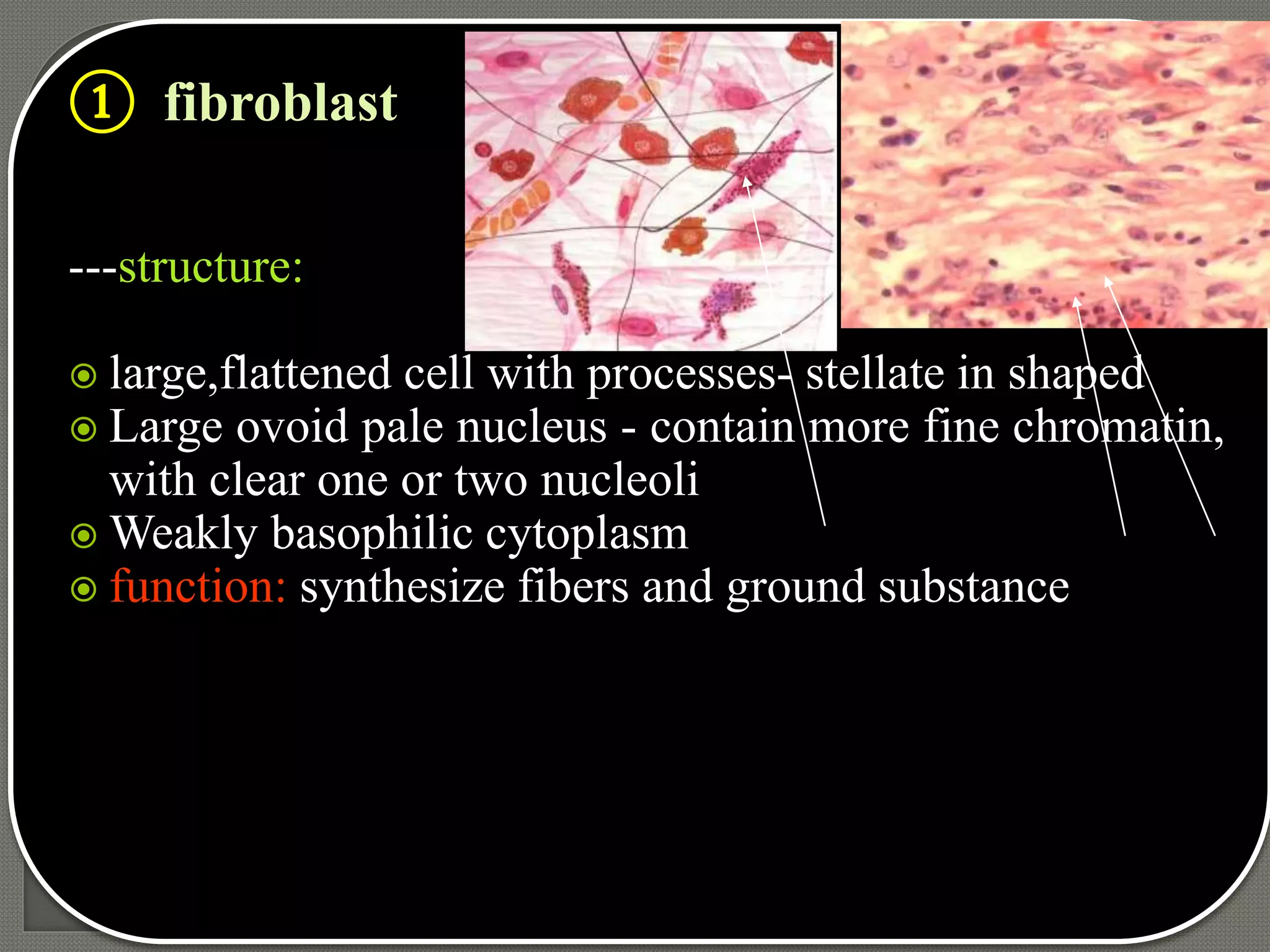
① fibroblast
---structure:
 large,flattened cell with processes- stellate in shaped
 Large ovoid pale nucleus - contain more fine chromatin,
with clear one or two nucleoli
 Weakly basophilic cytoplasm
 function: synthesize fibers and ground substance
fibrocyte: still state or inactive fibroblast
---structure:
spindle-shaped, small
N:small,dark stained
Acidophilic cytoplasm
---function: become into
fibroblast for repairing
fibrocyte
fibroblast
fibroblast fibrocyte
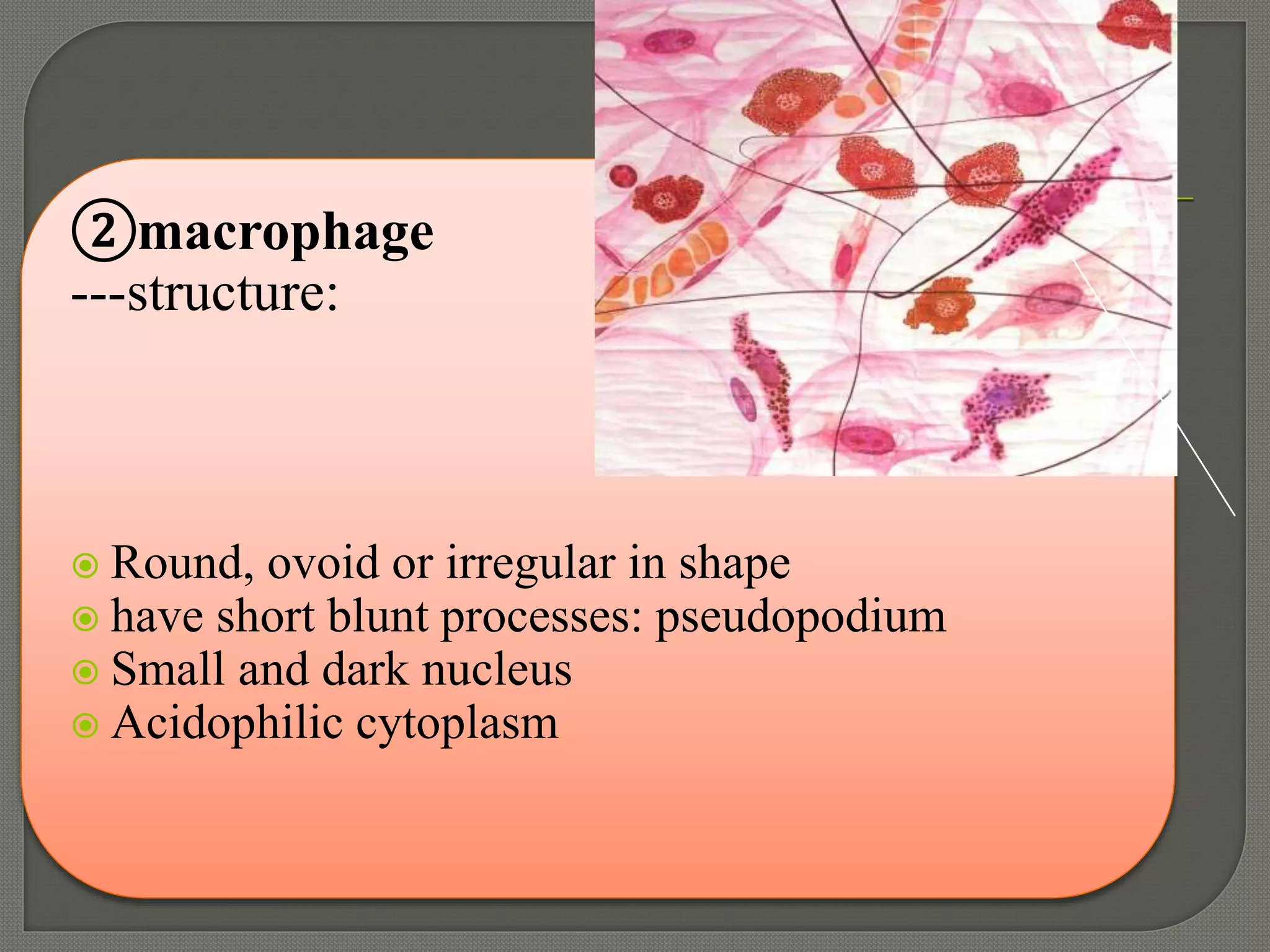
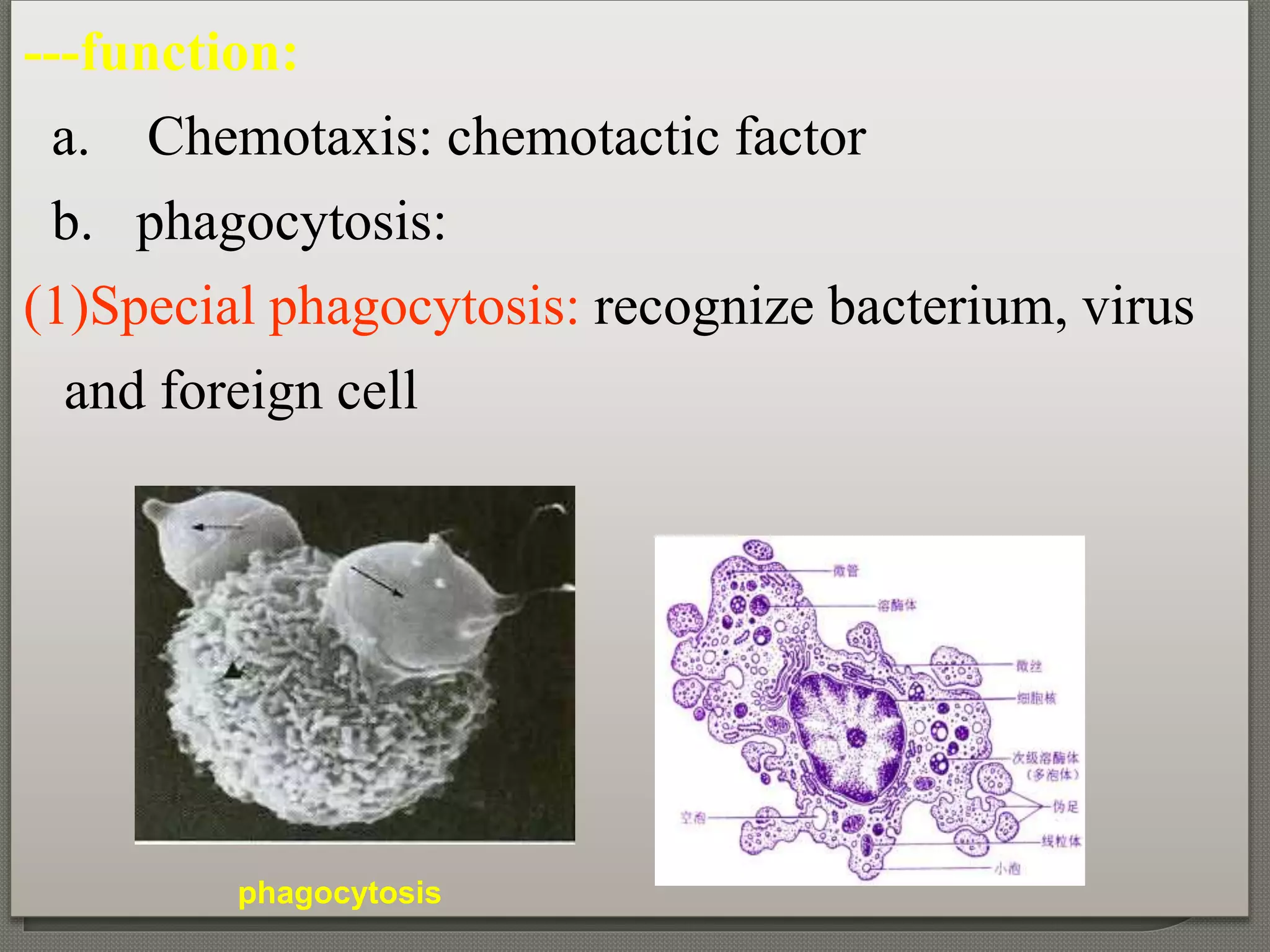
②macrophage
---structure:
 Round, ovoid or irregular in shape
 have short blunt processes: pseudopodium
 Small and dark nucleus
 Acidophilic cytoplasm
---function:
a. Chemotaxis: chemotactic factor
b. phagocytosis:
(1)Special phagocytosis: recognize bacterium, virus
and foreign cell
phagocytosis
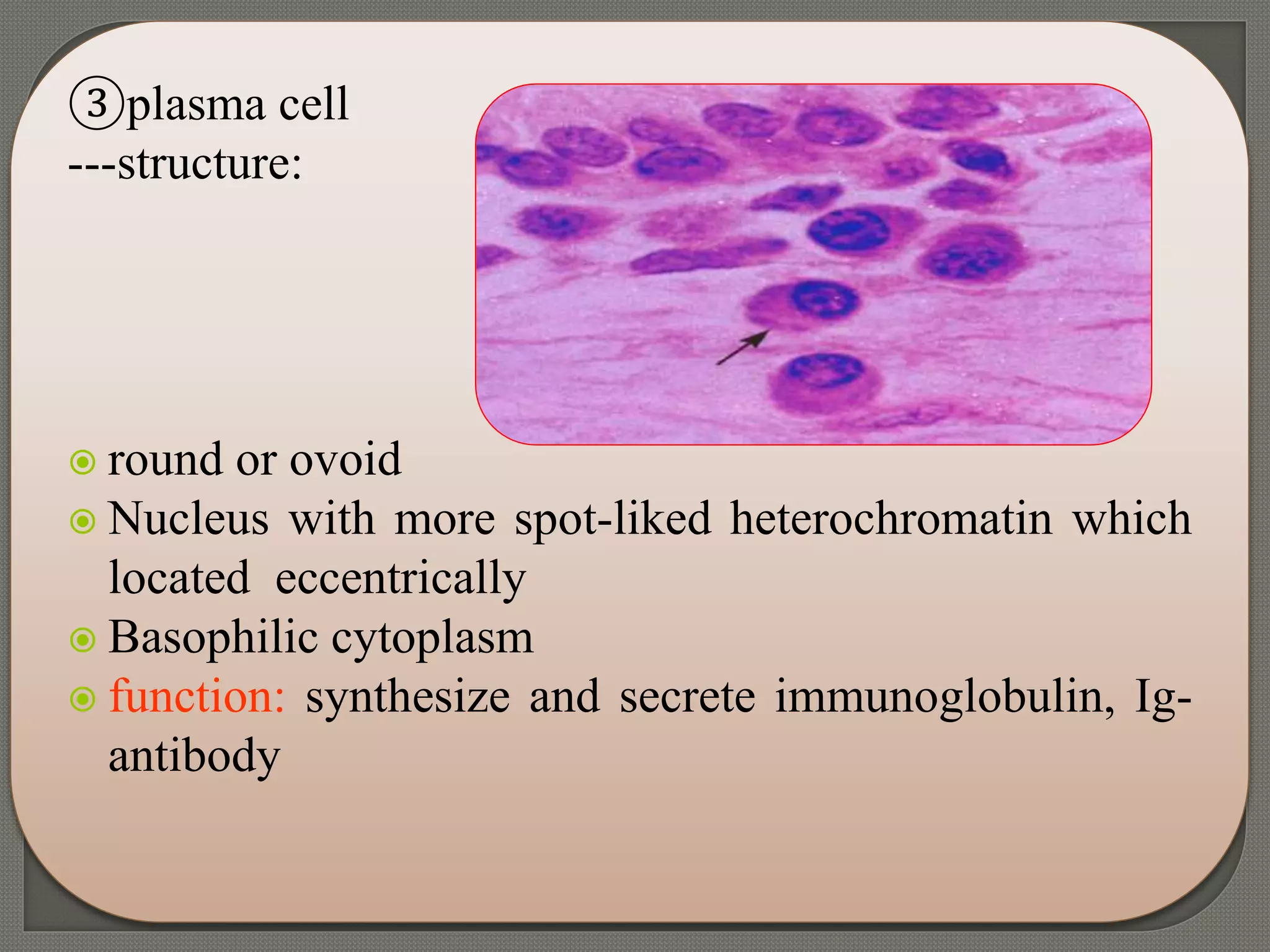
③plasma cell
---structure:
 round or ovoid
 Nucleus with more spot-liked heterochromatin which
located eccentrically
 Basophilic cytoplasm
 function: synthesize and secrete immunoglobulin, Ig-
antibody
④mast cell
---structure:
Round and large cell
Small dark-stained nucleus
Basophilic secreting granules
Basophilic secreting granules:
heparin: an anticoagulant
Histamine: cause cap. permeability↑, cap.
leakage to form edema and contraction of
SM
Eosinophil chemotactic factor
(chemotactic factor:
macrophage, leukocytes)
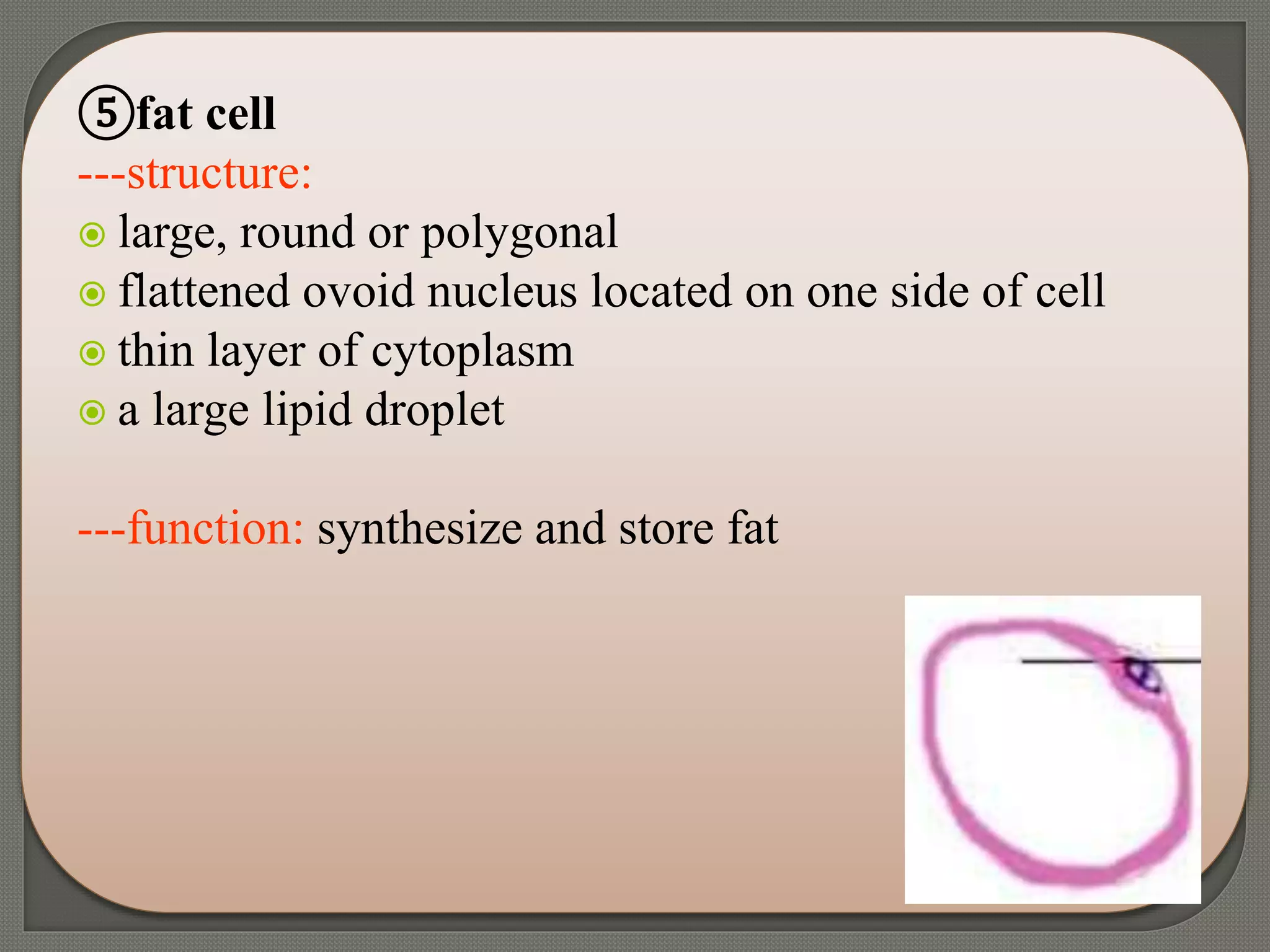
⑤fat cell
---structure:
 large, round or polygonal
 flattened ovoid nucleus located on one side of cell
 thin layer of cytoplasm
 a large lipid droplet
---function: synthesize and store fat
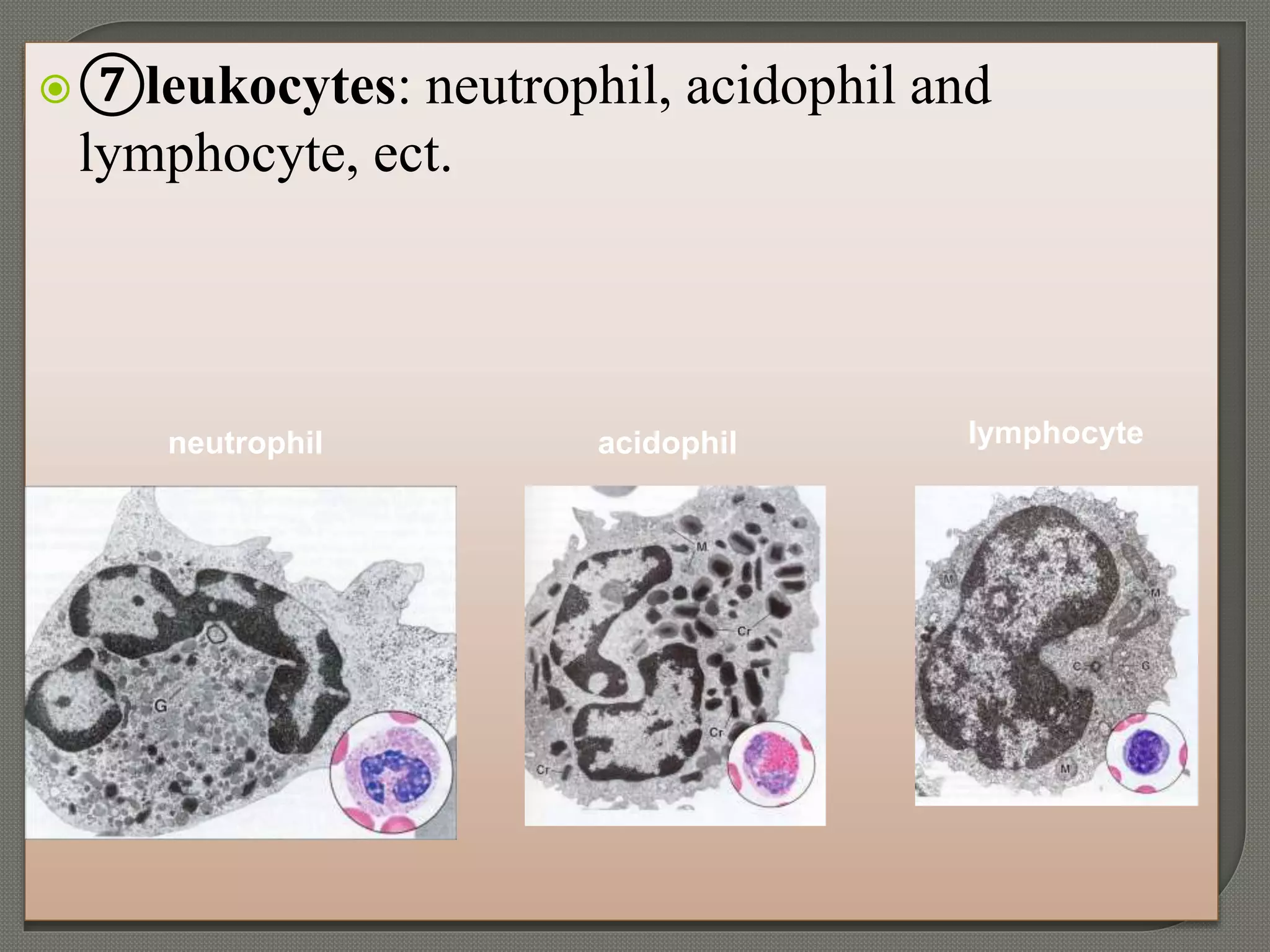
⑦leukocytes: neutrophil, acidophil and
lymphocyte, ect.
neutrophil acidophil lymphocyte

Connective tissues

  • 2.
    Connective tissue isone of the four tissue types found throughout the body. Connective tissue is the most abundant and widely distributed tissue in the body.
  • 3.
    Connective tissue developfrom mesoderm during embryonic development. While some connective tissues are specialized ( bone , blood), all organs have some amount of connective tissue in them which hold their parenchyma together.
  • 4.
    Major constituent isextracellular matrix, composed of fibres, ground substance & tissue fluid. Embedded within the extracellular matrix are the connective tissue cells.
  • 5.
    Structurally, connective tissuecan be divided into 3 classes: cells, fibres & ground substance.
  • 6.
    More matrix thancells Derived from mesoderm in embryo – mesenchyme and mucous connective tissue. Vascular .
  • 7.
    Can replicate (healingand repair). Is not present on free surfaces or body cavities
  • 8.
    Enclosing and separatingorgans Connecting tissues to one another (ligaments and tendons). Supporting and moving ( Joints and cartilage)
  • 9.
    Storing (adipose tissueand bones) Cushioning and insulating (adipose tissues). Transport and protection (blood) Protection
  • 10.
    Connective tissues differwidely but still made up of three fundamental components  Cells  Protein fibers  Ground substance( amorphous gelatinous material)
  • 11.
    It actually consistsof large molecules called glycosoaminoglycans (GAGs) (unbranched polysaccharide chains)which link together to form even larger molecules called proteoglycans
  • 12.
    Protein fibers andground substance are collectively called as extracellular matrix The composition and structure of extracellular matrix determine function and characteristic of connective tissue
  • 13.
    Ground substance • Mediumthrough which solutes diffuse between blood capillaries and cells.
  • 14.
    • Components: Interstitial fluid Adhesionproteins (“glue”) Proteoglycans
  • 15.
    Three types offibers • Collagen (white fibers) Strongest and most abundant type Provides high tensile strength
  • 16.
    It is aprotein composed primarily of the amino acids glycine & proline, and it also contains sugar groups.
  • 17.
    • Elastic Networks oflong, thin, elastin fibers that allow for stretch. • Reticular  Short, fine, highly branched
  • 18.
    Classification is basedon the composition and organization of cellular and extracellular components and on special functions.
  • 19.
  • 20.
    SPECIALISED CONNECTIVE TISSUE ADIPOSE CONNECTIVE TISSUE RETICULARCONNECTIVE TISSUE ELASTIC CONNECTIVE TISSUE
  • 21.
  • 22.
  • 23.
    Dense connective tissue Dense regular Denseirregular Elastic Loose connective tissue Areolar Adipose Reticular
  • 24.
    Areolar connective tissueis highly variable in appearance and the most widespread of all the connective tissue types specialized connective tissue in the body .
  • 25.
    consists of fibers (collagen,elastic, reticular) arranged randomly . several kinds of cells (fibroblasts, macrophages, plasma cells, adipocytes, mast cells, and a few white blood cells)
  • 26.
    semifluid ground substance(hyaluronic acid, chondroitin sulfate, dermatan sulfate, and keratan sulfate). Its functions are connects ,strength, elasticity, support.
  • 27.
    Present everywhere inbody including subcutaneous layer deep to skin, superficial region of dermis of skin, mucous membranes, around blood vessels, nerves, and body organs
  • 29.
    Made up ofadipocytes that are specialized for storage of triglycerides (fats) as a large, centrally located droplet.
  • 30.
    Function: Reduces heatloss through skin, serves as an energy reserve, supports and protects organs in newborns.
  • 31.
    Present throughout thebody; abdominopelvic cavity, around kidney, subcutaneous tissue.
  • 33.
    Reticular connective tissuecontains a meshwork of reticular fibers, on which fibroblast and leukocytes are suspended.
  • 34.
    Has very littleground substance. Mainly present in hematopoietic system; spleen, lymph nodes, bone marrow
  • 35.
    Functions: Forms stromaof organs, filters and removes worn-out blood cells in spleen and microbes in lymph nodes
  • 37.
    Dense connective tissueconsists of densely packed fibers with relatively little space between the fibers. Has proportionately high protein fiber than ground substance.
  • 38.
    Also called collagenousconnective tissue because of abundance of collagen fibers.
  • 39.
    Further divided intothree categories.  Dense regular connective tissue  Dense irregular connective tissue  Elastic connective tissue.
  • 40.
    Figure 4.8d Connective tissueproper: dense connective tissue, dense regular Description: Primarily parallel collagen fibers; a few elastic fibers; major cell type is the fibroblast. Function: Attaches muscles to bones or to muscles; attaches bones to bones Location: Tendons, most ligaments Photomicrograph: Dense regular connective tissue from a tendon (500x). Shoulder joint Ligament Tendon Collagen fibers Nuclei of fibroblasts
  • 41.
    Figure 4.8e Connective tissueproper: dense connective tissue, dense irregular Description: Primarily irregularly arranged collagen fibers; some elastic fibers; major cell type is the fibroblast. Function: Able to withstand tension in many directions; provides structural strength. Location: Fibrous capsules of organs and of joints; dermis of the skin; submucosa of digestive tract. Photomicrograph: Dense irregular connective tissue from the dermis of the skin (400x). Collagen fibers Nuclei of fibroblasts Fibrous joint capsule
  • 42.
    Figure 4.8f Connective tissueproper: dense connective tissue, elastic Description: Dense regular containing a high proportion of elastic fibers. Function: Allows flexibility Location: Walls of large arteries; walls of the bronchial tubes. Elastic fibers Aorta Heart Photomicrograph: Elastic connective tissue in the wall of the aorta (250x).
  • 43.
    Three types ofcartilage: • Hyaline cartilage • Elastic cartilage • Fibro cartilage
  • 44.
    Figure 4.8g Cartilage: hyaline Description:Amorphous but firm matrix; collagen fibers form network; chondroblasts produce the matrix and when mature (chondrocytes) Function: Supports and resists compressive stress. Location: Forms most of the embryonic skeleton; covers the ends of long bones in joint cavities; forms cartilages of the nose, trachea, and larynx. Photomicrograph: Hyaline cartilage from the trachea (750x). Costal cartilages Chondrocyte in lacuna Matrix
  • 45.
    Figure 4.8h Cartilage: elastic Description:Similar to hyaline cartilage, but more elastic fibers in matrix. Function: Maintains the shape of a structure while allowing great flexibility. Location: Supports the external ear Chondrocyte in lacuna Matrix
  • 46.
    Figure 4.8i Cartilage: fibrocartilage Description:Matrix similar to but less firm than that in hyaline cartilage; thick collagen fibers predominate. Function: Tensile strength with the ability to absorb compressive shock. Location: Intervertebral discs; Photomicrograph: Fibrocartilage of an intervertebral disc (125x). Special staining produced the blue color seen. Intervertebral discs Chondrocytes in lacunae Collagen fiber
  • 47.
    Figure 4.8j Others: bone(osseous tissue) Description: Hard, calcified matrix containing many collagen fibers; osteocytes lie in lacunae. Function: Bone supports provides levers for the muscles to act on; stores calcium and fat; marrow inside bones is the site for blood cell formation Location: Bones Photomicrograph: Cross-sectional view of bone (125x). Lacunae Lamella Central canal
  • 48.
    Figure 4.8k Others: blood Description:Red and white blood cells in a fluid matrix (plasma). Function: Transport of respiratory gases, nutrients, wastes, and other substances. Location: Contained within blood vessels. Neutrophil Red blood cells Lymphocyte Plasma
  • 49.
    These are themost frequently encountered of all the fibrous types of intercellular substance, and are found in large quantities in most sites in the body.
  • 50.
    These are foundin all types of connective tissue and consist of protein collagen. In the fresh state, e.g. in tendons, they appear white, and hence also are termed “white” fibers.
  • 51.
    They may occuras individual fibers, as in loose areolar tissues. Or as large bundles of fibers clumped together. Within a bundle, fibers are held together by a small amount of amorphous substance (mucoprotein).
  • 52.
     Most abundantstructural component of CT  Flexible and gives high tensile strength (due to covalent bonds between them)  Locations • Type I = in loose and dense CT, bone, skin, tendons & ligaments • Type II= cartilage (hyaline & elastic), intervertebral disc • Type III = forms reticular fibers, prominent in loose connective tissue, organs ( liver, kidney, lung etc., ) fetal skin
  • 53.
    Collagen types  TypeIV= basal lamina (basement membrane)  Type V and VI= produce in small amount by wide range of cells.  LM = wavy structure,
  • 54.
    Type I collagenstains strongly with acid dyes, due to the affinity of the cationic groups of the proteins for the anionic reactive groups of the acid dyes.
  • 55.
    Collagen may bedemonstrated more selectively by compound solutions of acid dyes (e.g. van Gieson) or by sequential combinations of acid dyes
  • 56.
    e.g. Masson’s trichrome,Lendrum’s MSB, etc.) The different types of collagen may be differentiated immunohistochemically
  • 57.
    This stain ismainly used to evaluate the type and amount of extracellular material like- collagen, fibrin, muscle and elastic fiber.
  • 58.
    Various technique includes: Massontrichrome stain Van gieson stain (Routine stain) Mallory, Phosphotungstic or phosphomolybdic acid stain 
  • 59.
    The general rulein trichrome staining is that the less porous tissues are colored by the smallest dye molecule;
  • 60.
    whenever a dyeof large molecular size is able to penetrate, it will always do so at the expense of the smaller molecule.
  • 61.
    1-Tissue permeability anddye molecular size Erythrocytes have density network(small pores) Muscles have medium pores Collagens have large pores
  • 62.
  • 63.
    Purpose: Used todifferentiate between collagen and smooth muscle in tumors, and the increase of collagen in diseases such as liver cirrhosis. Routine stain for liver and kidney biopsies
  • 64.
    Principle: As thename implies, three dyes 1-Harris Haematoxylin 2- acid fuchsin 3- methyl blue are employed selectively staining muscle, collagen fibers, fibrin, and erythrocytes.
  • 65.
     Results: Nuclei: blue( Harris H) Cytoplasm, muscle, erythrocytes: red( Acid fuchsin) Collagen: blue ( methyl blue)
  • 67.
     It isused to differentiate between collagen and smooth muscle in tumour.  To identify increased collagen deposition in condition like cirrhosis, , benign prostatic hyperplasia, membranoproliferative glomerulonephritis etc.
  • 69.
    Principle  When usingcombined solution of picric acid and acid fuchsin, the small molecules of picric acid penetrate all the tissue rapidly, but are only firmly retained in the close textured red blood cells and muscle
  • 70.
    The larger moleculesof acid fuchsin displaces picric acid molecule from collagen fibres, which has larger pores and allow larger molecules to enter
  • 71.
    It is usedfor detection of collagen. Result -- Nuclei : Blue / Black  Collagen : Red  ssCytoplasm, muscle, fibrin, RBCs : Yellow
  • 72.
    • Results: • Collagen– deep red • Muscle, RBCs – yellow • Nuclei – blue to black
  • 73.
    These are thefine delicate fibers that are found connected to the coarser and stronger collagenous fibers (Type I fibers) They provide the bulk of the supporting framework of the more cellular organs (e.g. spleen, liver, lymph nodes, etc.),
  • 74.
    Reticulin fibers composedof protein called reticulin. Reticular fibers are very fine with a diameter (0.2-0.5 micrometer's
  • 75.
    Synthesized by: Reticular cellin hemopoietic and lymphatic tissues Fibroblasts in other sites Schwann cell in peripheral nerve Fibers are not visible in H & E preparations.
  • 76.
    Demonstrated by meansof impregnation with silver salts and by PAS technique.  Fibers are argyrophilic because of affinity with silver salts, when impregnated with silver they appear black (Gomori and Wilder methods).
  • 77.
    This affinity withsilver salts and positive PAS . is due to high content of hexoses 6- 12% as opposed to 1%in collagen.
  • 78.
    1. Diagnosis ofliver cirrhosis. 2. To distinguish epithelial neoplasms from non- epithelial neoplasms.  Foci of carcinoma have reticulin around tumour nest but not in between tumour cell, whereas in most sarcomas and large cell lymphoma reticulin separates single cells
  • 79.
    To differentiate betweenin-situ and invasive carcinoma
  • 81.
    The elastic systemfibers (i.e. oxytalan, elaunin, and elastic fibers) have, respectively, a fibrillar, amorphous, or mixed structure
  • 82.
    The elastic fibersmay be found throughout the body but are especially associated with the respiratory, circulatory, and integumentary systems
  • 83.
    Fibers are arrangedmostly in parallel though may join other bundle groups. Fibers are elastic and may stretch at least twice their length.
  • 84.
    Oxytalan fibers maybe distinguished from mature elastic fibers by their failure to stain with aldehyde fuchsin solutions, unless they have been previously oxidized by potassium permanganate
  • 85.
    They have alsobeen reported to remain unstained following Verhöeff’s hematoxylin, with or without prior oxidation.
  • 86.
    Elaunin fibers:Unlike oxytalanfibers, elaunin fibers stain with orcein, aldehyde fuchsin, and resorcin–fuchsin without prior oxidation, but do not stain with Verhöeff’shematoxylin
  • 87.
    • Elastic fibresare composed of two components MicrofibrilsElastin •Occupies central portion •Rich in proline and glycine •Poor in hydroxyproline n completely lacks hydroxylysine •Stains pale because it has little affinity for heavy metal salts •A fibrillar glycoprotein •Straight and thin •Measuring12nm in diameter
  • 88.
    MARFAN SYNDROME: In marfansyndrome, a complex connective tissue disorder ,there is defect in fibril in (a component of the micro fibril) protein. Abnormal elastic tissue.
  • 89.
    SCLERODERMA: Skin diseases associatedwith accumulation of elastin
  • 90.
    This method isused for identifying elastic fiber in tissue such as skin, aorta etc. Result – Elastic fiber: Blue-black to black - Nuclei: Blue to black - Collagen: Red - other tissue elements: Yellow
  • 92.
    Basement membranes arefound throughout the body separating connective tissues from epithelial, endothelial or mesothelial cells, muscle cells, fat cells, and nervous tissues
  • 93.
    They support theepithelial cells of mucosal surfaces, glands, and several other structures, for example renal tubules They also support the endothelial cells lining blood vessels, capillaries
  • 94.
    In H&E stainedsections of most tissues, basement membranes are difficult to distinguish ,in the glomerulus hey are more conspicuous, particularly in disorders such as membranous nephropathy or diabetes, where they can be markedly thickened .
  • 95.
    Basement membranes stainby PAS and Periodic acid-methenamine silver microwave method
  • 97.
    ① fibroblast ---structure:  large,flattenedcell with processes- stellate in shaped  Large ovoid pale nucleus - contain more fine chromatin, with clear one or two nucleoli  Weakly basophilic cytoplasm  function: synthesize fibers and ground substance
  • 98.
    fibrocyte: still stateor inactive fibroblast ---structure: spindle-shaped, small N:small,dark stained Acidophilic cytoplasm ---function: become into fibroblast for repairing
  • 99.
  • 100.
    ②macrophage ---structure:  Round, ovoidor irregular in shape  have short blunt processes: pseudopodium  Small and dark nucleus  Acidophilic cytoplasm
  • 101.
    ---function: a. Chemotaxis: chemotacticfactor b. phagocytosis: (1)Special phagocytosis: recognize bacterium, virus and foreign cell phagocytosis
  • 102.
    ③plasma cell ---structure:  roundor ovoid  Nucleus with more spot-liked heterochromatin which located eccentrically  Basophilic cytoplasm  function: synthesize and secrete immunoglobulin, Ig- antibody
  • 103.
    ④mast cell ---structure: Round andlarge cell Small dark-stained nucleus Basophilic secreting granules
  • 104.
    Basophilic secreting granules: heparin:an anticoagulant Histamine: cause cap. permeability↑, cap. leakage to form edema and contraction of SM Eosinophil chemotactic factor (chemotactic factor: macrophage, leukocytes)
  • 105.
    ⑤fat cell ---structure:  large,round or polygonal  flattened ovoid nucleus located on one side of cell  thin layer of cytoplasm  a large lipid droplet ---function: synthesize and store fat
  • 106.
    ⑦leukocytes: neutrophil, acidophiland lymphocyte, ect. neutrophil acidophil lymphocyte