Anatomy of orbital 
cavity 
Dr. Othman Al-Abbadi, M.D
Introduction 
 The orbit is the cavity or socket of the skull, that 
contain the eye ball and muscles ,nerve, vessels, fat 
and lacrimal apparatus. 
 Each cavity is pear shaped ,and its apex is directed 
posteriorly ,medially ,and slightly upward. 
 The medial wall runs antero-posterior parallel to 
sagittal plane ,lateral wall diverges at angle 45degrees. 
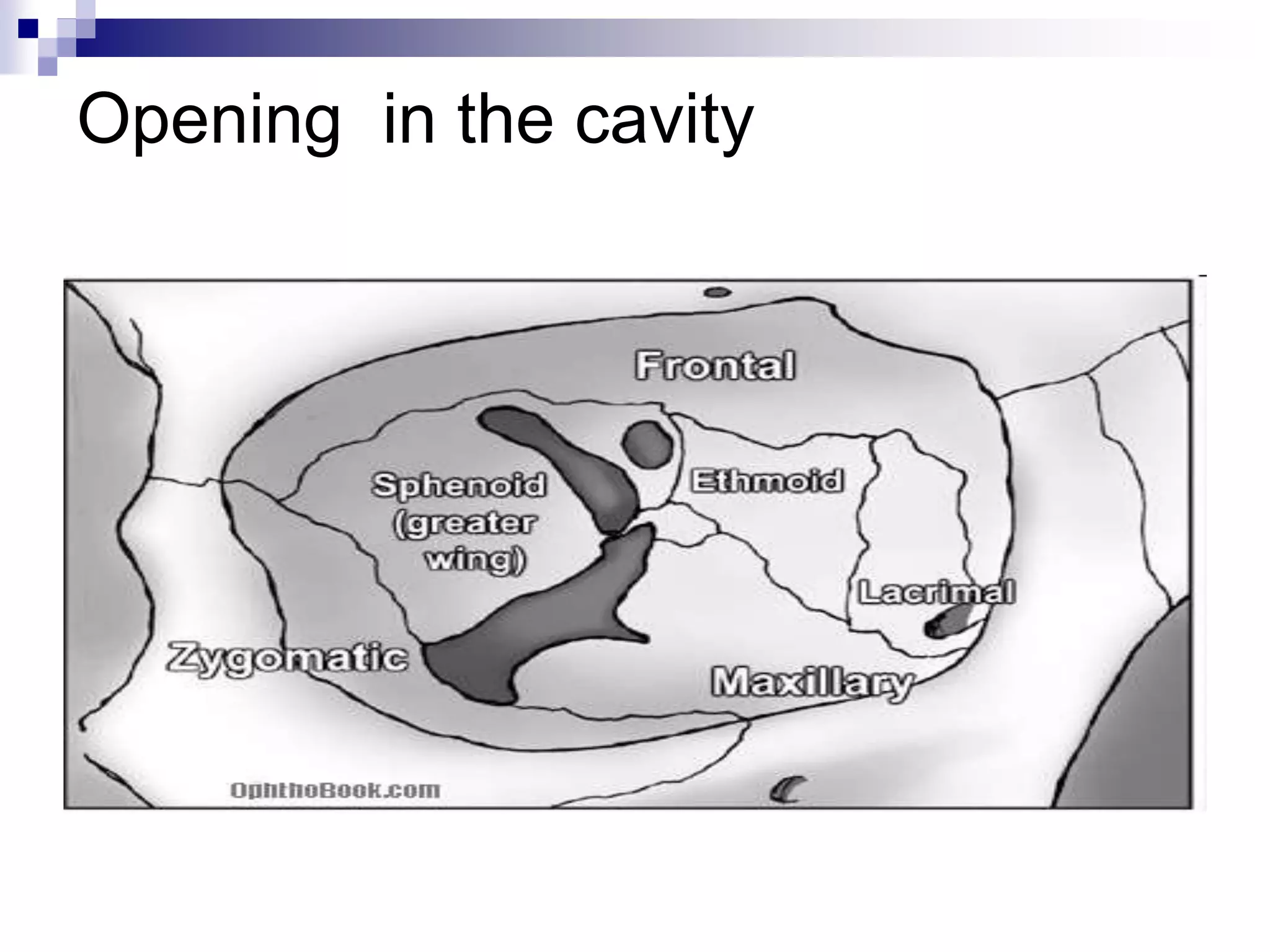
 Seven individual bones form the orbit (maxilla ,palatine 
,zygomatic , sphenoid ,frontal ,ethmoid ,and lacrimal ).
O
Orbital dimensions 
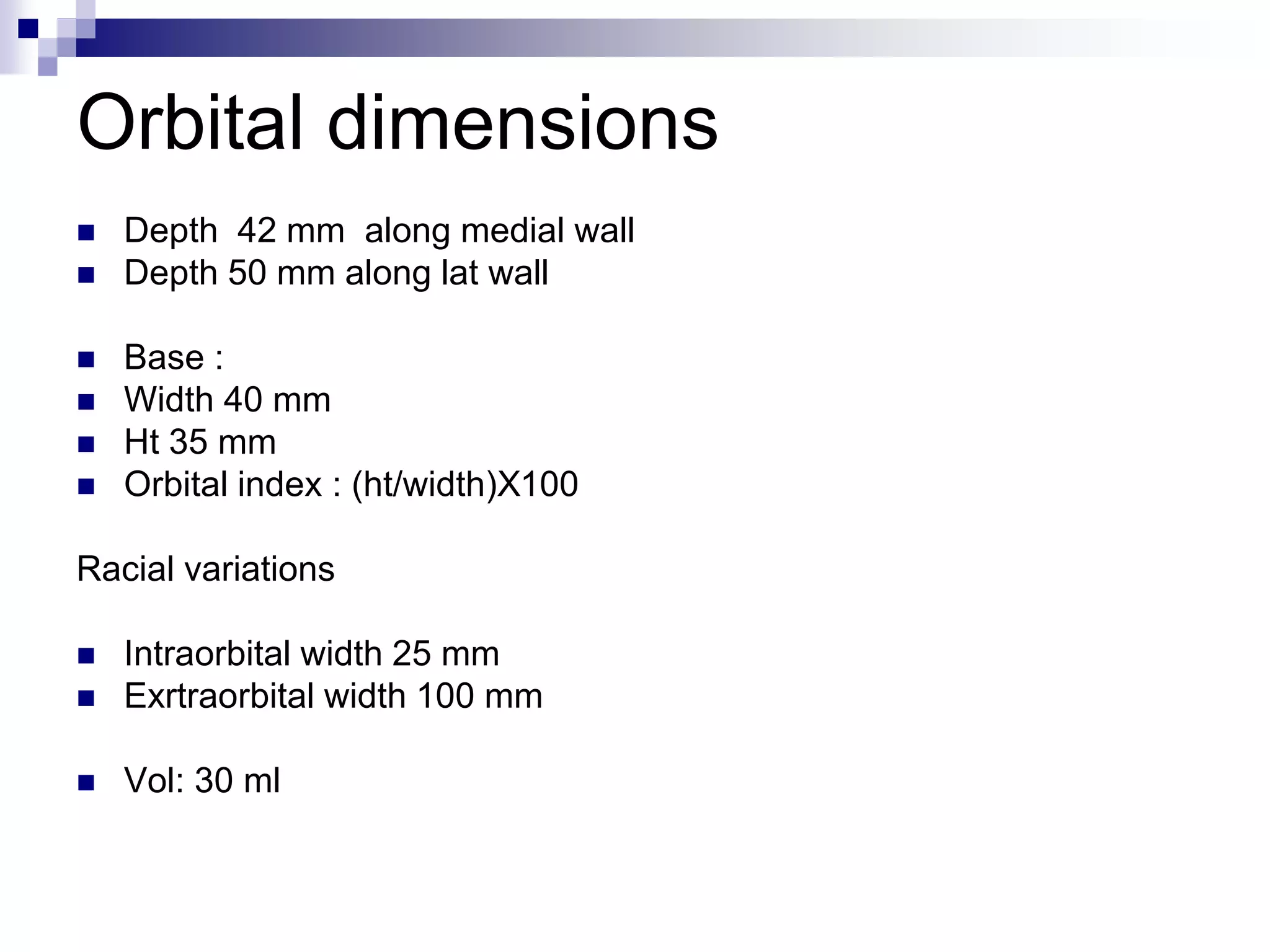
 Depth 42 mm along medial wall 
 Depth 50 mm along lat wall 
 Base : 
 Width 40 mm 
 Ht 35 mm 
 Orbital index : (ht/width)X100 
Racial variations 
 Intraorbital width 25 mm 
 Exrtraorbital width 100 mm 
 Vol: 30 ml
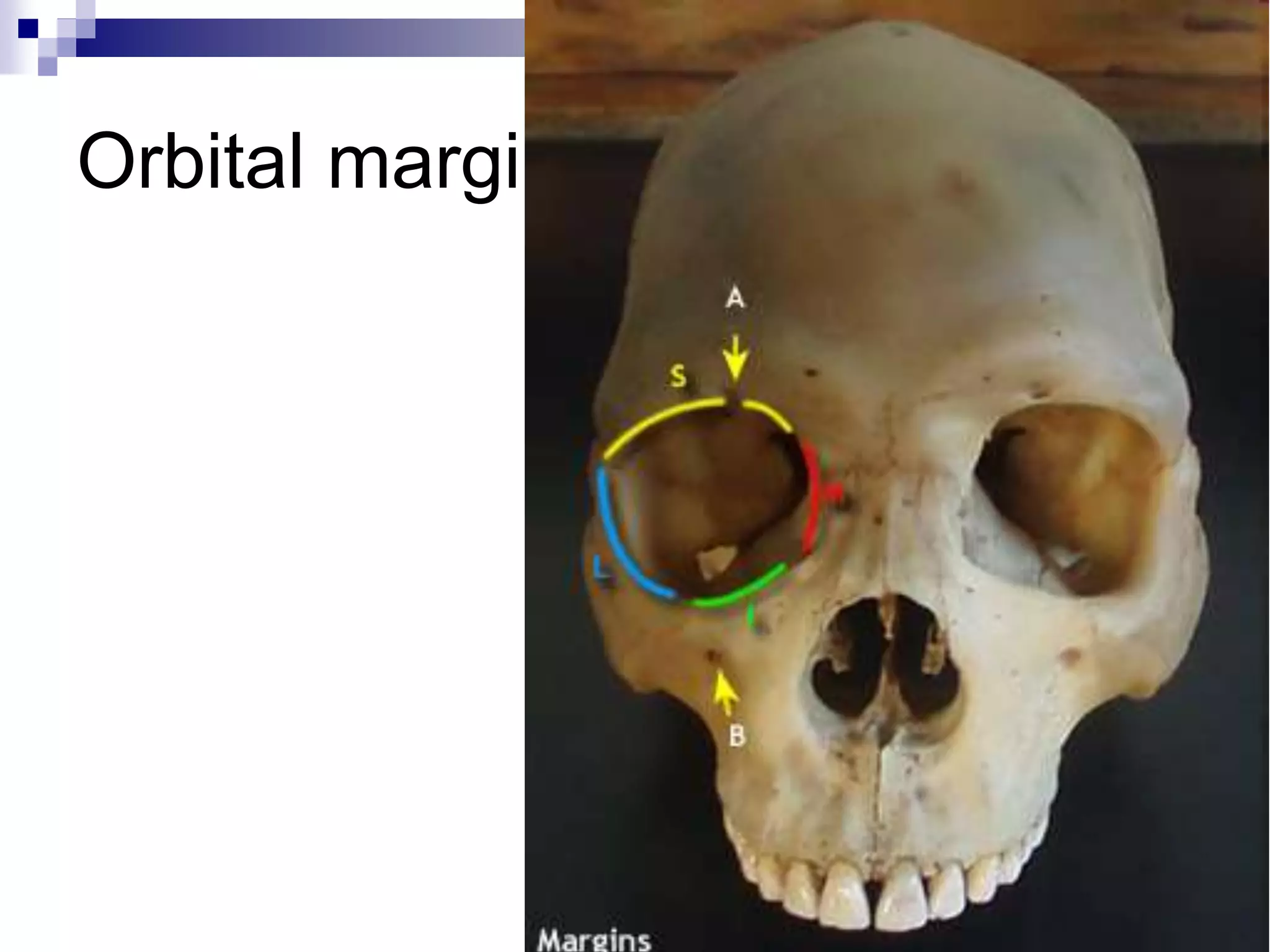
Orbital margin 
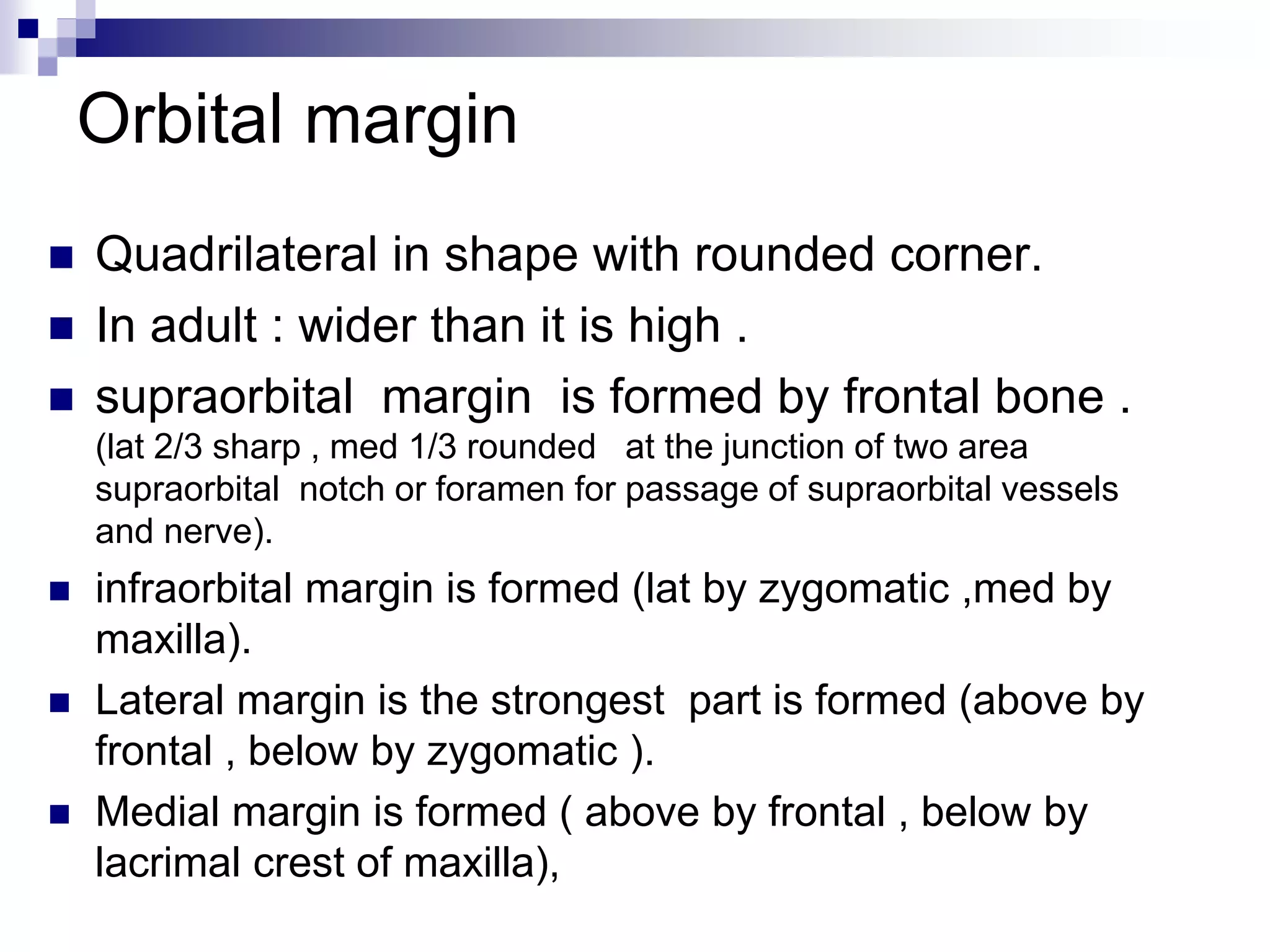
 Quadrilateral in shape with rounded corner. 
 In adult : wider than it is high . 
 supraorbital margin is formed by frontal bone . 
(lat 2/3 sharp , med 1/3 rounded at the junction of two area 
supraorbital notch or foramen for passage of supraorbital vessels 
and nerve). 
 infraorbital margin is formed (lat by zygomatic ,med by 
maxilla). 
 Lateral margin is the strongest part is formed (above by 
frontal , below by zygomatic ). 
 Medial margin is formed ( above by frontal , below by 
lacrimal crest of maxilla),
Orbital margin
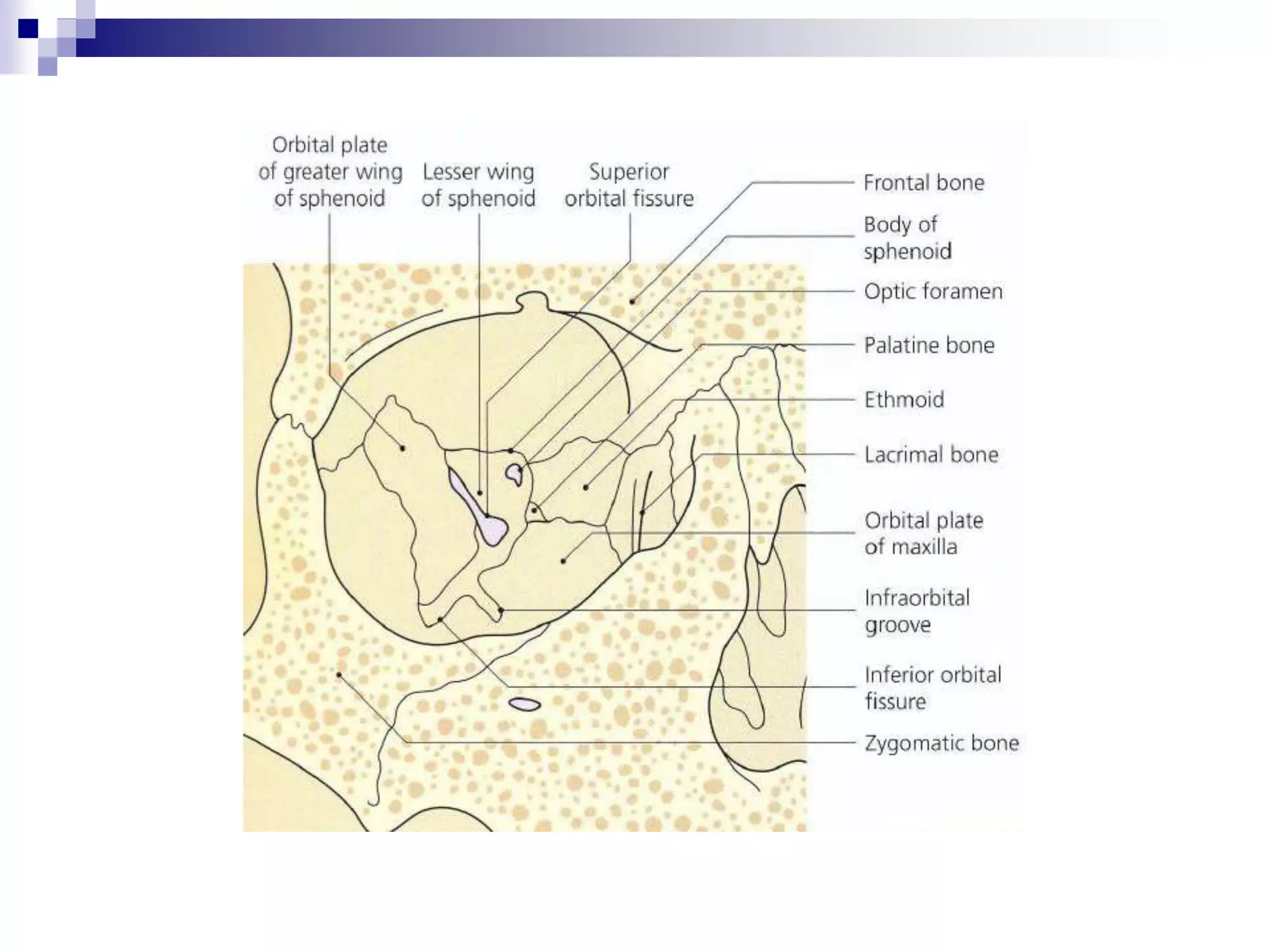
Walls of orbital cavity 
 Walls are lined with periosteum ,and consist of roof ,floor 
,medial, lateral wall. 
 Apex is at medial end of superior orbital fissure. 
 Roof 
formed by orbital plate of frontal bone and small extent of lesser 
wing of sphenoid posteriorly. 
anterolaterally there is slight depression ( lacrimal fossa )for orbital 
part of lacrimal gland . 
Roof is thin and fragile ,in old age portion of roof may be absorbed. 
Roof separates orbital cavity from anterior crainal fossa and frontal 
lobe.
 Lateral wall 
is the thickest wall. 
anterior 1/3 is formed by zygomatic bone, separate orbit 
from temporal fossa. 
posterior 2/3 is formed by greater wing of sphenoid 
,separate orbit from temperal lobe of brain. 
it is continuous with roof anteriorly but seperated 
posteriorly by superior orbital fissure . 
marginal tubercle : a small prominence just 
posterior to orbital margin on frontal process of zygoma , 
give attachment to aponeurosis of levator palpebrae 
superioris ,lateral palpebral ligament ,lateral check 
ligament .
 Floor 
Formed largely by orbital plate of maxilla , 
orbital surface of zygomatic ,small orbital 
process of palatine. 
separate cavity from maxillary sinus. 
Floor is continuous with lateral wall 
anteriorly, but seperated posteriorly by 
inferior orbital fissure .
 Medial wall 
very thin wall, Formed by four bone from anterior to posterior : 
frontal process of maxilla, 
lacrimal bone, 
Orbital plate of ethmoid (largest part, very thin separate cavity from 
ethmoid sinus), 
Small part of body of sphenoid. 
Lacrimal groove: on anterior part of medial wall ,for lacrimal 
sac , formed by lacrimal bone posterior ,frontal process of maxilla 
anterior,bounded by lacrimal crests, continuous below with 
nasolacrimal canal.
Opening in the cavity
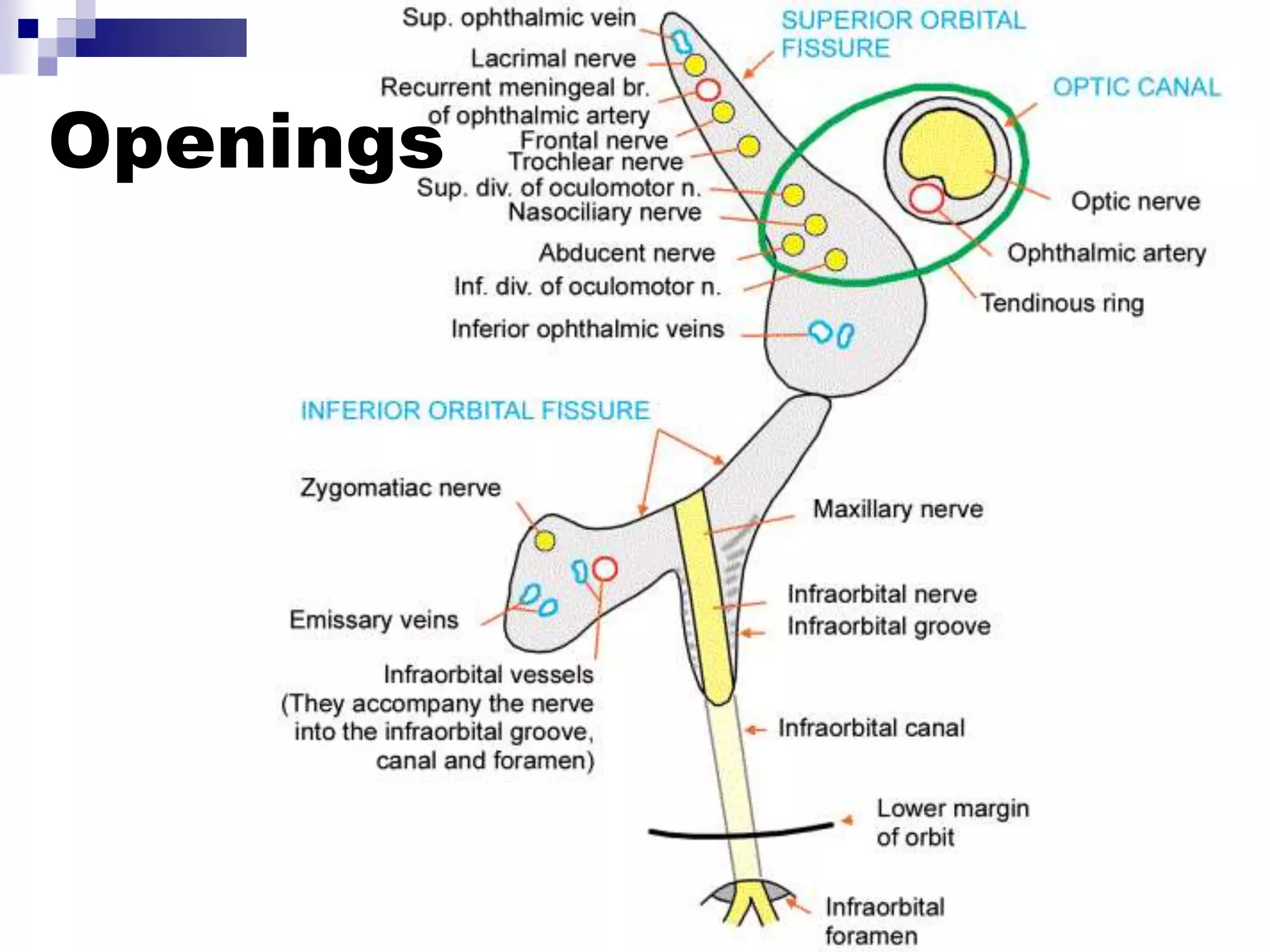
Openings
Openings  Optic canal: 
lies in the lesser wing of sphenoid. 
related medially to body of sphenoid. 
connect orbital cavity to middle cranial fossa . 
transmit optic nerve, ophthalamic artery with surrounding sympathetic 
plexus . 
 Superior orbital fissure: 
Lying between lesser and greater wing of sphenoid. 
connect orbital cavity to middle crainal fossa . 
widest part at its medial end. 
midway on the lower edge of fissure is a small sharp spine give attachment 
to common tendinous ring of origin for four rectus muscle. 
transmit from lateral to medial (lacrimal nerve ,frontal nerve, trochlear nerve, 
upper and lower division of oculmotor nerve , nasociliary nerve, abducent 
nerve ,superior ophthalamic vein) .
 Inferior orbital fissure : 
lies between greater wing of sphenoid and maxilla. 
Connect pterygiopalatine and infratemperal fossa to orbital cavity . 
transmit maxillary nerve, zygomatic nerve ,branches of pterygiopalatine ganglion, 
inferior ophthalamic vein . 
 Ethamoidal foramina: 
lies in frontoethmoidal suture or in frontal bone. 
anterior foramen open in anterior cranial fossa at lateral edge of cribriform plate 
transmit anterior ethamoidal artery and nerve. 
posterior foramen traverse ethamoidal bone transmit posterior ethamiodal artery 
and nerve. 
 Zygomaticofacial and zygomaticotemperal 
foramen: 
lies on the lateral wall of orbit. 
zygomaticofacial foramen transmit zygomaticofacial nerve. 
zygomaticotemperal foramen transmit zygomaticotemperal nerve.
Relation 
 Superior 
anteromedially : frontal air sinus. 
anterior cranial fossa . 
 inferior 
maxillary air sinus 
 Lateral 
anteriorly : temperal fossa. 
posteriorly :middle cranial fossa. 
 Medially 
nasal cavity ,ethmoidal sinus , sphenoid sinus.
Orbital periosteum( orbital fascia) 
Periorbita: is the periosteum of the bone that form the wall 
of orbit, loosely attached to bone . 
At orbital margin, the periorbita is continuous with 
periosteum on external surface of skull, ive attachment 
to the orbital septum. 
At lacrimal groove it splits to enclose lacrimal sac and 
continue inferior to form periosteum of nasolacrimal 
canal. 
Posteriorly, around optic canal and medial end of superior 
palpebral fissure, it thickens to form a fibrous ring 
(common tendinous ring). 
periorbita receive its sensory innervations from branch of 
trigeminal nerve.
Orbital muscle 
Muscle of Müller (Orbitalis muscle) 
Thin layer of smooth muscle that bridge the 
inferior orbital fissure .(vestigeal muscle) 
Nerve supply : sympathetic 
Function : unknown
Effect of age on orbital cavity 
 At birth : 
Relatively large and ossified margins 
 Young children : 
Look more lat than adult 
Superior & inferior orbital fissure are wider become 
narrowed by growth of greater wing of sphenoid . 
Distance between the orbit are small and increases by 
growth of frontal& ethamoidal sinuses 
 Old age : 
Bony absorption >>> holes in roof , med & lat walls
Surface Anatomy 
 Superciliary ridges: prominent ridge above upper margin, deep to 
ridge frontal sinus. 
 Eyebrows 
 Orbital margins ( frontal ,maxillary, zygomatic ) 
Frontozygomatic suture 
Supraorbital notch 
trochlea 
Lat and med palpebral ligament 
Ant lacrimal crest 
Lac groove 
Post lacrimal crest 
Infraorbital foramen (5mmbelow lower margin)
Trauma to the orbit: 
the orbit margin is very strong and not easily fractured . 
Sever injury may cause fracture eg: automobile accident. 
fracture of superior margin give symptom of superior oblique paralysis. 
fracture of lateral margin >>>>depression & prominence of cheek. 
comminuted fracture lower margin >>>blow out fracture. 
Penetrating wound 
surgical instrument, pointed metal object pierce thin roof of orbit 
enter crainal cavity and frontal lobe . 
Air sinuses 
infection of sinus is commonest causes of orbital cellulitis

Anatomy of orbital cavity

  • 1.
    Anatomy of orbital cavity Dr. Othman Al-Abbadi, M.D
  • 2.
    Introduction  Theorbit is the cavity or socket of the skull, that contain the eye ball and muscles ,nerve, vessels, fat and lacrimal apparatus.  Each cavity is pear shaped ,and its apex is directed posteriorly ,medially ,and slightly upward.  The medial wall runs antero-posterior parallel to sagittal plane ,lateral wall diverges at angle 45degrees.  Seven individual bones form the orbit (maxilla ,palatine ,zygomatic , sphenoid ,frontal ,ethmoid ,and lacrimal ).
  • 3.
  • 4.
    Orbital dimensions Depth 42 mm along medial wall  Depth 50 mm along lat wall  Base :  Width 40 mm  Ht 35 mm  Orbital index : (ht/width)X100 Racial variations  Intraorbital width 25 mm  Exrtraorbital width 100 mm  Vol: 30 ml
  • 5.
    Orbital margin Quadrilateral in shape with rounded corner.  In adult : wider than it is high .  supraorbital margin is formed by frontal bone . (lat 2/3 sharp , med 1/3 rounded at the junction of two area supraorbital notch or foramen for passage of supraorbital vessels and nerve).  infraorbital margin is formed (lat by zygomatic ,med by maxilla).  Lateral margin is the strongest part is formed (above by frontal , below by zygomatic ).  Medial margin is formed ( above by frontal , below by lacrimal crest of maxilla),
  • 6.
  • 8.
    Walls of orbitalcavity  Walls are lined with periosteum ,and consist of roof ,floor ,medial, lateral wall.  Apex is at medial end of superior orbital fissure.  Roof formed by orbital plate of frontal bone and small extent of lesser wing of sphenoid posteriorly. anterolaterally there is slight depression ( lacrimal fossa )for orbital part of lacrimal gland . Roof is thin and fragile ,in old age portion of roof may be absorbed. Roof separates orbital cavity from anterior crainal fossa and frontal lobe.
  • 9.
     Lateral wall is the thickest wall. anterior 1/3 is formed by zygomatic bone, separate orbit from temporal fossa. posterior 2/3 is formed by greater wing of sphenoid ,separate orbit from temperal lobe of brain. it is continuous with roof anteriorly but seperated posteriorly by superior orbital fissure . marginal tubercle : a small prominence just posterior to orbital margin on frontal process of zygoma , give attachment to aponeurosis of levator palpebrae superioris ,lateral palpebral ligament ,lateral check ligament .
  • 10.
     Floor Formedlargely by orbital plate of maxilla , orbital surface of zygomatic ,small orbital process of palatine. separate cavity from maxillary sinus. Floor is continuous with lateral wall anteriorly, but seperated posteriorly by inferior orbital fissure .
  • 11.
     Medial wall very thin wall, Formed by four bone from anterior to posterior : frontal process of maxilla, lacrimal bone, Orbital plate of ethmoid (largest part, very thin separate cavity from ethmoid sinus), Small part of body of sphenoid. Lacrimal groove: on anterior part of medial wall ,for lacrimal sac , formed by lacrimal bone posterior ,frontal process of maxilla anterior,bounded by lacrimal crests, continuous below with nasolacrimal canal.
  • 12.
  • 13.
  • 14.
    Openings  Opticcanal: lies in the lesser wing of sphenoid. related medially to body of sphenoid. connect orbital cavity to middle cranial fossa . transmit optic nerve, ophthalamic artery with surrounding sympathetic plexus .  Superior orbital fissure: Lying between lesser and greater wing of sphenoid. connect orbital cavity to middle crainal fossa . widest part at its medial end. midway on the lower edge of fissure is a small sharp spine give attachment to common tendinous ring of origin for four rectus muscle. transmit from lateral to medial (lacrimal nerve ,frontal nerve, trochlear nerve, upper and lower division of oculmotor nerve , nasociliary nerve, abducent nerve ,superior ophthalamic vein) .
  • 15.
     Inferior orbitalfissure : lies between greater wing of sphenoid and maxilla. Connect pterygiopalatine and infratemperal fossa to orbital cavity . transmit maxillary nerve, zygomatic nerve ,branches of pterygiopalatine ganglion, inferior ophthalamic vein .  Ethamoidal foramina: lies in frontoethmoidal suture or in frontal bone. anterior foramen open in anterior cranial fossa at lateral edge of cribriform plate transmit anterior ethamoidal artery and nerve. posterior foramen traverse ethamoidal bone transmit posterior ethamiodal artery and nerve.  Zygomaticofacial and zygomaticotemperal foramen: lies on the lateral wall of orbit. zygomaticofacial foramen transmit zygomaticofacial nerve. zygomaticotemperal foramen transmit zygomaticotemperal nerve.
  • 17.
    Relation  Superior anteromedially : frontal air sinus. anterior cranial fossa .  inferior maxillary air sinus  Lateral anteriorly : temperal fossa. posteriorly :middle cranial fossa.  Medially nasal cavity ,ethmoidal sinus , sphenoid sinus.
  • 18.
    Orbital periosteum( orbitalfascia) Periorbita: is the periosteum of the bone that form the wall of orbit, loosely attached to bone . At orbital margin, the periorbita is continuous with periosteum on external surface of skull, ive attachment to the orbital septum. At lacrimal groove it splits to enclose lacrimal sac and continue inferior to form periosteum of nasolacrimal canal. Posteriorly, around optic canal and medial end of superior palpebral fissure, it thickens to form a fibrous ring (common tendinous ring). periorbita receive its sensory innervations from branch of trigeminal nerve.
  • 19.
    Orbital muscle Muscleof Müller (Orbitalis muscle) Thin layer of smooth muscle that bridge the inferior orbital fissure .(vestigeal muscle) Nerve supply : sympathetic Function : unknown
  • 20.
    Effect of ageon orbital cavity  At birth : Relatively large and ossified margins  Young children : Look more lat than adult Superior & inferior orbital fissure are wider become narrowed by growth of greater wing of sphenoid . Distance between the orbit are small and increases by growth of frontal& ethamoidal sinuses  Old age : Bony absorption >>> holes in roof , med & lat walls
  • 21.
    Surface Anatomy Superciliary ridges: prominent ridge above upper margin, deep to ridge frontal sinus.  Eyebrows  Orbital margins ( frontal ,maxillary, zygomatic ) Frontozygomatic suture Supraorbital notch trochlea Lat and med palpebral ligament Ant lacrimal crest Lac groove Post lacrimal crest Infraorbital foramen (5mmbelow lower margin)
  • 22.
    Trauma to theorbit: the orbit margin is very strong and not easily fractured . Sever injury may cause fracture eg: automobile accident. fracture of superior margin give symptom of superior oblique paralysis. fracture of lateral margin >>>>depression & prominence of cheek. comminuted fracture lower margin >>>blow out fracture. Penetrating wound surgical instrument, pointed metal object pierce thin roof of orbit enter crainal cavity and frontal lobe . Air sinuses infection of sinus is commonest causes of orbital cellulitis