GAMETOGENESIS AND
INFERTILITY
CHOYTOO Shiksha
17
OVERVIEW
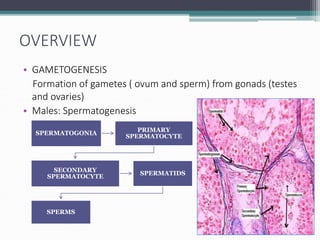
• GAMETOGENESIS
Formation of gametes ( ovum and sperm) from gonads (testes
and ovaries)
• Males: Spermatogenesis
SPERMATOGONIA
PRIMARY
SPERMATOCYTE
SECONDARY
SPERMATOCYTE
SPERMATIDS
SPERMS
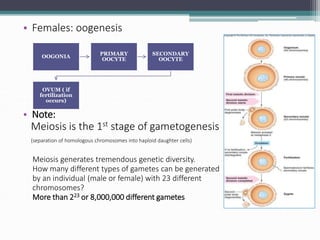
• Females: oogenesis
• Note:
Meiosis is the 1st stage of gametogenesis
(separation of homologous chromosomes into haploid daughter cells)
Meiosis generates tremendous genetic diversity.
How many different types of gametes can be generated
by an individual (male or female) with 23 different
chromosomes?
More than 223 or 8,000,000 different gametes
OOGONIA
PRIMARY
OOCYTE
SECONDARY
OOCYTE
OVUM ( if
fertilization
occurs)
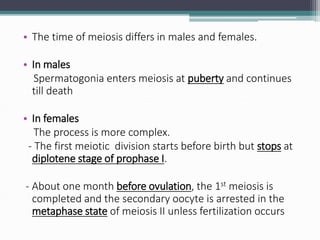
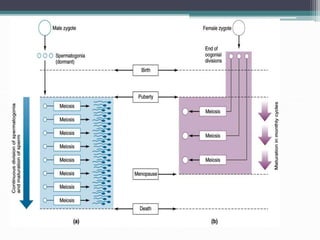
• The time of meiosis differs in males and females.
• In males
Spermatogonia enters meiosis at puberty and continues
till death
• In females
The process is more complex.
- The first meiotic division starts before birth but stops at
diplotene stage of prophase I.
- About one month before ovulation, the 1st meiosis is
completed and the secondary oocyte is arrested in the
metaphase state of meiosis II unless fertilization occurs
SPERMATOGENESIS
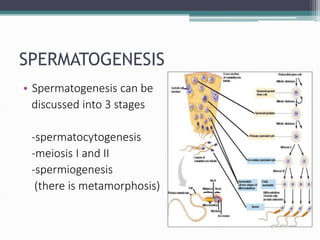
• Spermatogenesis can be
discussed into 3 stages
-spermatocytogenesis
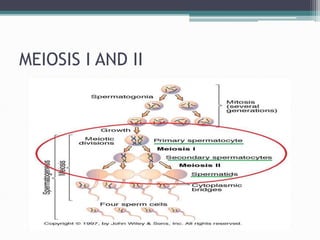
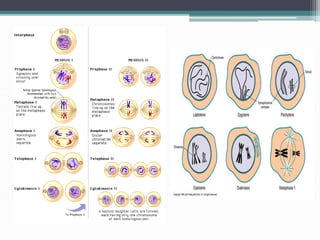
-meiosis I and II
-spermiogenesis
(there is metamorphosis)
SPERMATOCYTOGENESIS
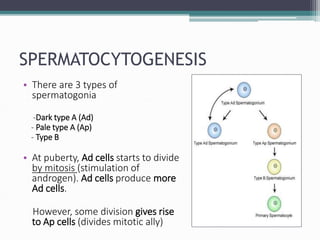
• There are 3 types of
spermatogonia
-Dark type A (Ad)
- Pale type A (Ap)
- Type B
• At puberty, Ad cells starts to divide
by mitosis (stimulation of
androgen). Ad cells produce more
Ad cells.
However, some division gives rise
to Ap cells (divides mitotic ally)
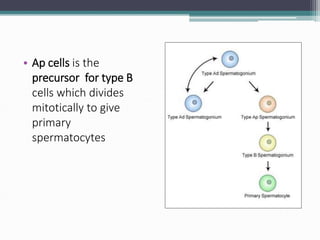
• Ap cells is the
precursor for type B
cells which divides
mitotically to give
primary
spermatocytes
MEIOSIS I AND II
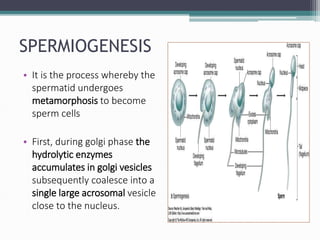
SPERMIOGENESIS
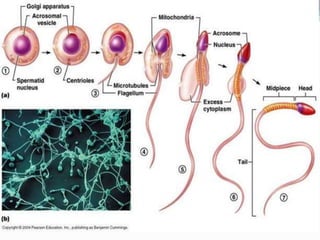
• It is the process whereby the
spermatid undergoes
metamorphosis to become
sperm cells
• First, during golgi phase the
hydrolytic enzymes
accumulates in golgi vesicles
subsequently coalesce into a
single large acrosomal vesicle
close to the nucleus.
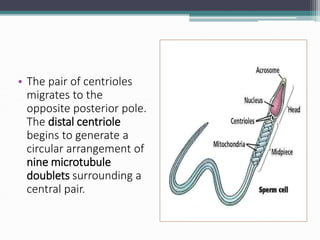
• The pair of centrioles
migrates to the
opposite posterior pole.
The distal centriole
begins to generate a
circular arrangement of
nine microtubule
doublets surrounding a
central pair.
• In the cap phase, the acrosomal vesicle flattens and
envelops the anterior half of the nucleus to form an
acrosomal cap.
• The axonemal complex continues to extend into the
developing tail region
CAPACITATION
• When sperms are first expelled in the semen, they are
unable to perform their duties in fertilizing the ovum.
• On coming in contact with the fluids of the female genital
tract, multiple changes occur that activate the sperm for
the final processes of fertilization.
• These collective changes are called capacitation of the
spermatozoa.
ACROSOMAL REACTION
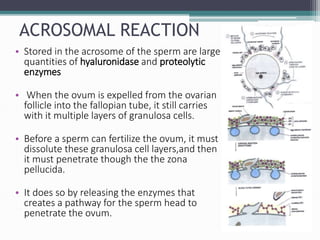
• Stored in the acrosome of the sperm are large
quantities of hyaluronidase and proteolytic
enzymes
• When the ovum is expelled from the ovarian
follicle into the fallopian tube, it still carries
with it multiple layers of granulosa cells.
• Before a sperm can fertilize the ovum, it must
dissolute these granulosa cell layers,and then
it must penetrate though the the zona
pellucida.
• It does so by releasing the enzymes that
creates a pathway for the sperm head to
penetrate the ovum.
OOGENESIS
• The formation of secondary oocyte from oogania
• The process starts before birth.
• Oogenesis can also be described into 3 phases:
1. follicular phase
2. ovulation
3. Luteal phase
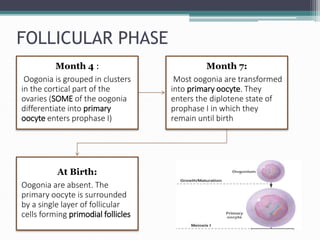
FOLLICULAR PHASE
Month 4 :
Oogonia is grouped in clusters
in the cortical part of the
ovaries (SOME of the oogonia
differentiate into primary
oocyte enters prophase I)
Month 7:
Most oogonia are transformed
into primary oocyte. They
enters the diplotene state of
prophase I in which they
remain until birth
At Birth:
Oogonia are absent. The
primary oocyte is surrounded
by a single layer of follicular
cells forming primodial follicles
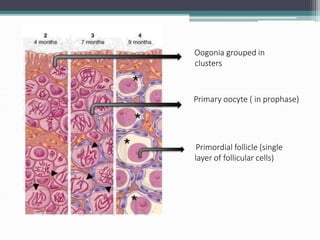
Oogonia grouped in
clusters
Primary oocyte ( in prophase)
Primordial follicle (single
layer of follicular cells)
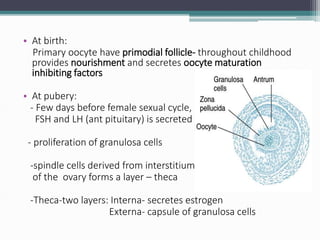
• At birth:
Primary oocyte have primodial follicle- throughout childhood
provides nourishment and secretes oocyte maturation
inhibiting factors
• At pubery:
- Few days before female sexual cycle,
FSH and LH (ant pituitary) is secreted
- proliferation of granulosa cells
-spindle cells derived from interstitium
of the ovary forms a layer – theca
-Theca-two layers: Interna- secretes estrogen
Externa- capsule of granulosa cells
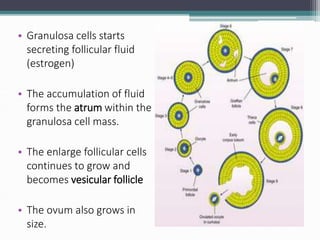
• Granulosa cells starts
secreting follicular fluid
(estrogen)
• The accumulation of fluid
forms the atrum within the
granulosa cell mass.
• The enlarge follicular cells
continues to grow and
becomes vesicular follicle
• The ovum also grows in
size.
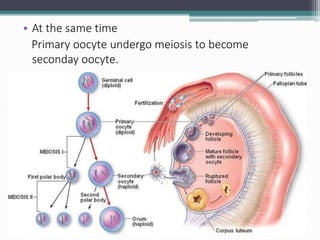
• At the same time
Primary oocyte undergo meiosis to become
seconday oocyte.
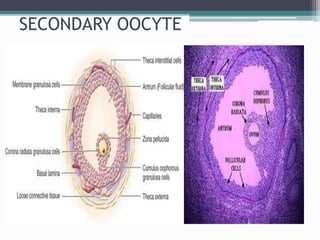
SECONDARY OOCYTE
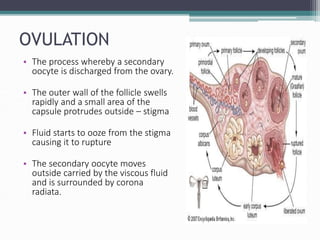
OVULATION
• The process whereby a secondary
oocyte is discharged from the ovary.
• The outer wall of the follicle swells
rapidly and a small area of the
capsule protrudes outside – stigma
• Fluid starts to ooze from the stigma
causing it to rupture
• The secondary oocyte moves
outside carried by the viscous fluid
and is surrounded by corona
radiata.
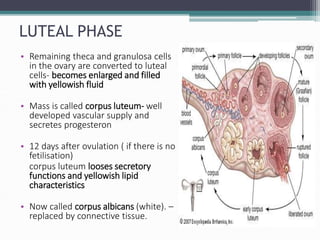
LUTEAL PHASE
• Remaining theca and granulosa cells
in the ovary are converted to luteal
cells- becomes enlarged and filled
with yellowish fluid
• Mass is called corpus luteum- well
developed vascular supply and
secretes progesteron
• 12 days after ovulation ( if there is no
fetilisation)
corpus luteum looses secretory
functions and yellowish lipid
characteristics
• Now called corpus albicans (white). –
replaced by connective tissue.
Male Infertility
• Inflamation of testes – bilateral orchitis
Caused by mumps and it results in sterility
• Effect of temperature
Inc. in temp cause degradation of most of cells
of seminiferous tubules (excpt spermatogonia)
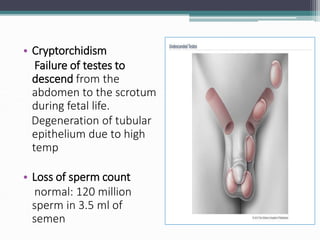
• Cryptorchidism
Failure of testes to
descend from the
abdomen to the scrotum
during fetal life.
Degeneration of tubular
epithelium due to high
temp
• Loss of sperm count
normal: 120 million
sperm in 3.5 ml of
semen
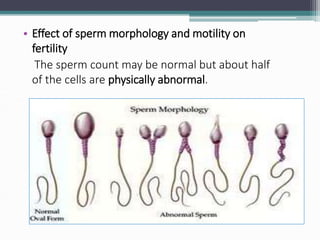
• Effect of sperm morphology and motility on
fertility
The sperm count may be normal but about half
of the cells are physically abnormal.
Loose motility
Female Infertility
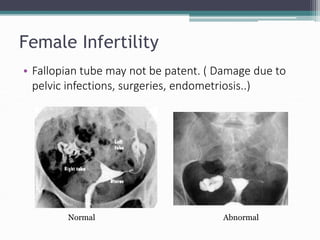
• Fallopian tube may not be patent. ( Damage due to
pelvic infections, surgeries, endometriosis..)
Normal Abnormal
• Failure to ovulate due to hormonal disturbances
• Cervical problems
Abnormal mucous secretion in cervix- sperm
cannot pass and fertilisation does not occur
• Uterine causes
Abnormal anatomy of the uterus; the presence of
polyps and fibroids
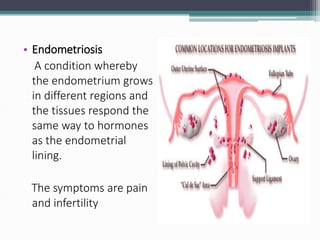
• Endometriosis
A condition whereby
the endometrium grows
in different regions and
the tissues respond the
same way to hormones
as the endometrial
lining.
The symptoms are pain
and infertility
THANK YOU

Gametogenesis

  • 1.
  • 2.
    OVERVIEW • GAMETOGENESIS Formation ofgametes ( ovum and sperm) from gonads (testes and ovaries) • Males: Spermatogenesis SPERMATOGONIA PRIMARY SPERMATOCYTE SECONDARY SPERMATOCYTE SPERMATIDS SPERMS
  • 3.
    • Females: oogenesis •Note: Meiosis is the 1st stage of gametogenesis (separation of homologous chromosomes into haploid daughter cells) Meiosis generates tremendous genetic diversity. How many different types of gametes can be generated by an individual (male or female) with 23 different chromosomes? More than 223 or 8,000,000 different gametes OOGONIA PRIMARY OOCYTE SECONDARY OOCYTE OVUM ( if fertilization occurs)
  • 4.
    • The timeof meiosis differs in males and females. • In males Spermatogonia enters meiosis at puberty and continues till death • In females The process is more complex. - The first meiotic division starts before birth but stops at diplotene stage of prophase I. - About one month before ovulation, the 1st meiosis is completed and the secondary oocyte is arrested in the metaphase state of meiosis II unless fertilization occurs
  • 6.
    SPERMATOGENESIS • Spermatogenesis canbe discussed into 3 stages -spermatocytogenesis -meiosis I and II -spermiogenesis (there is metamorphosis)
  • 7.
    SPERMATOCYTOGENESIS • There are3 types of spermatogonia -Dark type A (Ad) - Pale type A (Ap) - Type B • At puberty, Ad cells starts to divide by mitosis (stimulation of androgen). Ad cells produce more Ad cells. However, some division gives rise to Ap cells (divides mitotic ally)
  • 8.
    • Ap cellsis the precursor for type B cells which divides mitotically to give primary spermatocytes
  • 9.
  • 11.
    SPERMIOGENESIS • It isthe process whereby the spermatid undergoes metamorphosis to become sperm cells • First, during golgi phase the hydrolytic enzymes accumulates in golgi vesicles subsequently coalesce into a single large acrosomal vesicle close to the nucleus.
  • 12.
    • The pairof centrioles migrates to the opposite posterior pole. The distal centriole begins to generate a circular arrangement of nine microtubule doublets surrounding a central pair.
  • 13.
    • In thecap phase, the acrosomal vesicle flattens and envelops the anterior half of the nucleus to form an acrosomal cap. • The axonemal complex continues to extend into the developing tail region
  • 15.
    CAPACITATION • When spermsare first expelled in the semen, they are unable to perform their duties in fertilizing the ovum. • On coming in contact with the fluids of the female genital tract, multiple changes occur that activate the sperm for the final processes of fertilization. • These collective changes are called capacitation of the spermatozoa.
  • 16.
    ACROSOMAL REACTION • Storedin the acrosome of the sperm are large quantities of hyaluronidase and proteolytic enzymes • When the ovum is expelled from the ovarian follicle into the fallopian tube, it still carries with it multiple layers of granulosa cells. • Before a sperm can fertilize the ovum, it must dissolute these granulosa cell layers,and then it must penetrate though the the zona pellucida. • It does so by releasing the enzymes that creates a pathway for the sperm head to penetrate the ovum.
  • 17.
    OOGENESIS • The formationof secondary oocyte from oogania • The process starts before birth. • Oogenesis can also be described into 3 phases: 1. follicular phase 2. ovulation 3. Luteal phase
  • 18.
    FOLLICULAR PHASE Month 4: Oogonia is grouped in clusters in the cortical part of the ovaries (SOME of the oogonia differentiate into primary oocyte enters prophase I) Month 7: Most oogonia are transformed into primary oocyte. They enters the diplotene state of prophase I in which they remain until birth At Birth: Oogonia are absent. The primary oocyte is surrounded by a single layer of follicular cells forming primodial follicles
  • 19.
    Oogonia grouped in clusters Primaryoocyte ( in prophase) Primordial follicle (single layer of follicular cells)
  • 20.
    • At birth: Primaryoocyte have primodial follicle- throughout childhood provides nourishment and secretes oocyte maturation inhibiting factors • At pubery: - Few days before female sexual cycle, FSH and LH (ant pituitary) is secreted - proliferation of granulosa cells -spindle cells derived from interstitium of the ovary forms a layer – theca -Theca-two layers: Interna- secretes estrogen Externa- capsule of granulosa cells
  • 21.
    • Granulosa cellsstarts secreting follicular fluid (estrogen) • The accumulation of fluid forms the atrum within the granulosa cell mass. • The enlarge follicular cells continues to grow and becomes vesicular follicle • The ovum also grows in size.
  • 22.
    • At thesame time Primary oocyte undergo meiosis to become seconday oocyte.
  • 23.
  • 24.
    OVULATION • The processwhereby a secondary oocyte is discharged from the ovary. • The outer wall of the follicle swells rapidly and a small area of the capsule protrudes outside – stigma • Fluid starts to ooze from the stigma causing it to rupture • The secondary oocyte moves outside carried by the viscous fluid and is surrounded by corona radiata.
  • 25.
    LUTEAL PHASE • Remainingtheca and granulosa cells in the ovary are converted to luteal cells- becomes enlarged and filled with yellowish fluid • Mass is called corpus luteum- well developed vascular supply and secretes progesteron • 12 days after ovulation ( if there is no fetilisation) corpus luteum looses secretory functions and yellowish lipid characteristics • Now called corpus albicans (white). – replaced by connective tissue.
  • 27.
    Male Infertility • Inflamationof testes – bilateral orchitis Caused by mumps and it results in sterility • Effect of temperature Inc. in temp cause degradation of most of cells of seminiferous tubules (excpt spermatogonia)
  • 28.
    • Cryptorchidism Failure oftestes to descend from the abdomen to the scrotum during fetal life. Degeneration of tubular epithelium due to high temp • Loss of sperm count normal: 120 million sperm in 3.5 ml of semen
  • 29.
    • Effect ofsperm morphology and motility on fertility The sperm count may be normal but about half of the cells are physically abnormal. Loose motility
  • 30.
    Female Infertility • Fallopiantube may not be patent. ( Damage due to pelvic infections, surgeries, endometriosis..) Normal Abnormal
  • 31.
    • Failure toovulate due to hormonal disturbances • Cervical problems Abnormal mucous secretion in cervix- sperm cannot pass and fertilisation does not occur • Uterine causes Abnormal anatomy of the uterus; the presence of polyps and fibroids
  • 32.
    • Endometriosis A conditionwhereby the endometrium grows in different regions and the tissues respond the same way to hormones as the endometrial lining. The symptoms are pain and infertility
  • 33.