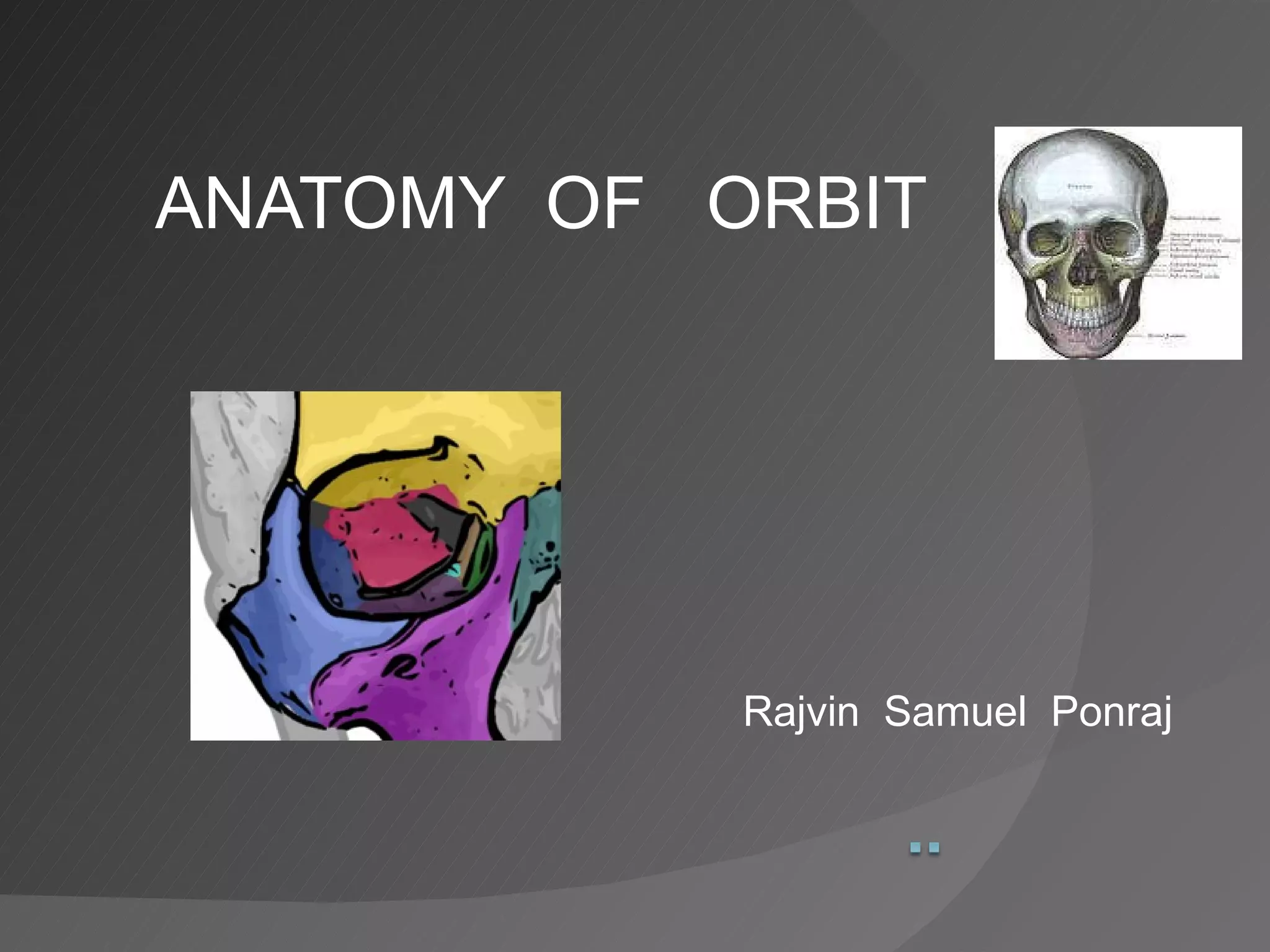
ANATOMY  OF  ORBIT  Rajvin  Samuel  Ponraj
Development  of  orbit Develops  from  mesenchyme  by ossification 6 th to 7 th week  laying down of bones  starting with maxilla bone  around the Optic  vesicle  During this time  optic vesicle  170 degree apart  rotates  anteriorly
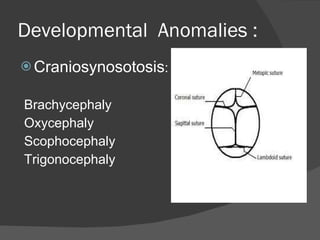
Developmental  Anomalies : Craniosynosotosis : Brachycephaly Oxycephaly Scophocephaly Trigonocephaly
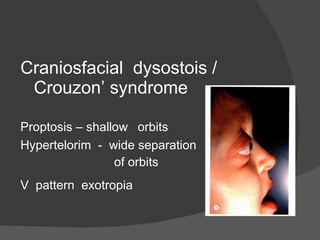
Craniosfacial  dysostois / Crouzon’ syndrome Proptosis – shallow   orbits Hypertelorim  -  wide separation  of orbits V  pattern  exotropia
Oxycephaly-syndactlye / Apert’ syndrome : Flattened  occiput  ,  steep forehead , supra orbital  ridge Midfacial  hypoplasia  , parrot beak  nose
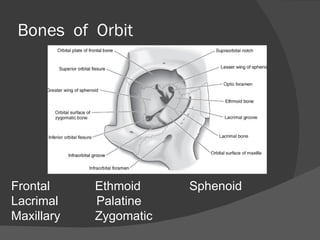
Bones  of  Orbit Frontal  Ethmoid  Sphenoid Lacrimal  Palatine Maxillary  Zygomatic
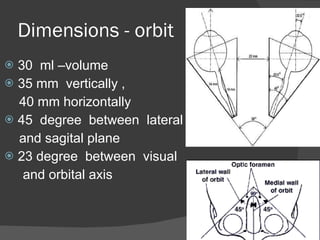
Dimensions - orbit 30  ml –volume 35 mm  vertically , 40 mm horizontally 45  degree  between  lateral  wall and sagital plane 23 degree  between  visual  and orbital axis
Boundaries  of Orbit Roof  Floor Side walls Orbital  apex
Roof  of  orbit Frontal bone [Orbital plate]  &  lesser wing of sphenoid Separated from frontal sinus  and  anterior cranial fossa above Lacrimal  gland fossa  and  trochlear  fossa behind  orbital rim
Orbital  roof  anomaly /  fracture CSF  pulsation  pulsatile  exophthalmos Orbital  meningocele / encephalocele
Medial  wall Body of  sphenoid Ethmoid Lacrimal Maxilla[frontal  process]
Orbital  cellulitis Extremely  thin wall  Prone  for  damage  &  sinusitis  spread Infection  across  Orbital  cellulitis
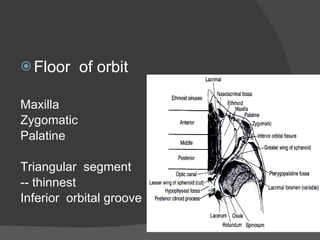
Floor  of orbit Maxilla Zygomatic Palatine Triangular  segment -- thinnest Inferior  orbital groove
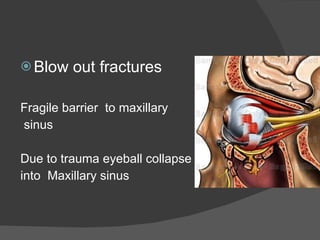
Blow out fractures Fragile barrier  to maxillary sinus Due to trauma eyeball collapse  into  Maxillary sinus
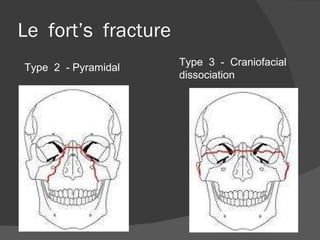
Le  fort’s  fracture Type  2  - Pyramidal Type  3  -  Craniofacial  dissociation
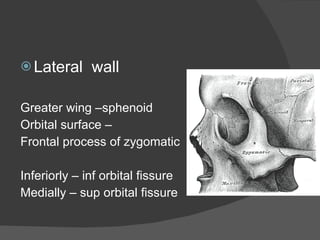
Lateral  wall Greater wing –sphenoid Orbital surface – Frontal process of zygomatic Inferiorly – inf orbital fissure Medially – sup orbital fissure
Behind  Zygomatic  sphenoidal  suture lateral  orbitotomy of  greater wing  ( thin wall )  cancellous  bone  middle cranial fossa dura matter
At frontal  sphenoidal  suture -- meningeal  foramen  Site of anastomosis  of Lacrimal artery and  meningeal  artery collaterals Periosteal  elevation  at this site  Brisk bleeding
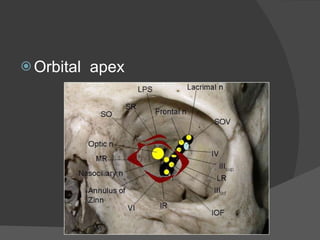
Orbital  apex
Orbital  apex  syndrome /  Tolosa -  hunt  syndrome : Damage to structures at apex  2 nd, 3 rd, 4 th ,6 th nerves Symptoms : visual loss, ophthalmoplegia periorbital &  facial  pain
Other causes: Inflammatory Infectious Neoplastic Iatrogenic /  traumatic Vascular
Superior  orbital  fissure syndrome  /  Rochon – Duvigneaud  syndrome : Lesion  anterior  to orbital apex  excluding optic nerve pathology
Contents of  orbit Eye ball Orbital fat Connective tissue system Blood vessels Nerves Extraocular muscles
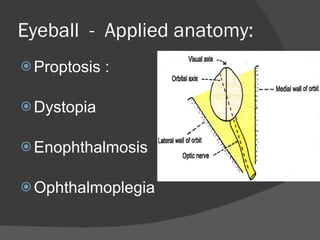
Eyeball  -  Applied anatomy: Proptosis : Dystopia Enophthalmosis Ophthalmoplegia
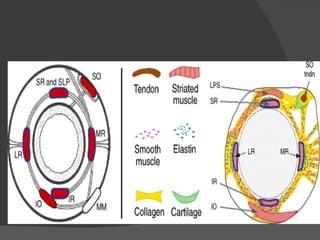
Connective  tissue system Periorbita Orbital  septum Tenon’s  capsule
Periorbita : Loosely attached to  orbital bone Attached firmly  to Arcus marginalis Trochlea Lateral orbital tubercle Optic foramen Orbital fissures Dura and optic canal margins
Orbital septum : Interconnecting / circumferential radial webs of  fascial system support  and transmit forces in trauma Compressive optic neuropathy  following trauma
Anterior  fascial system  Formed  by condensation of  fibrous septa Lockwood lig,  whitnall sup susp lig  Lacrimal lig Intermuscular septum Posterior  Fascial  system  Incompletely formed
Tenon’s  capsule Dense  elastic , vascular Extent :  from  perilimbal  sclera  to optic nerve meninges with bursa  within Sleeve like  extensions for  extra  ocular  muscles  continues as  fibrous  capsule  along its length
 
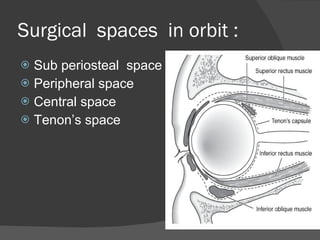
Surgical  spaces  in orbit : Sub periosteal  space  Peripheral space  Central space Tenon’s space
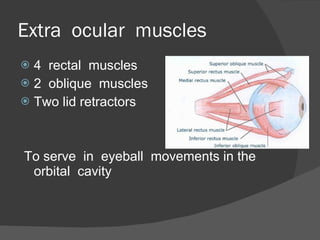
Extra  ocular  muscles 4  rectal  muscles 2  oblique  muscles Two lid retractors To serve  in  eyeball  movements in the orbital  cavity
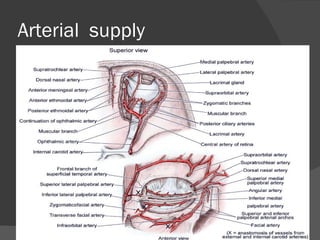
Arterial  supply
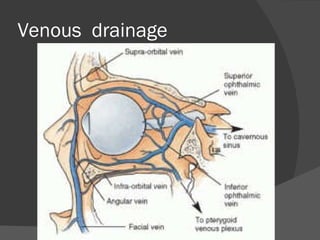
Venous  drainage
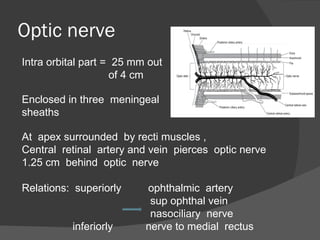
Optic nerve Intra orbital part =  25 mm out  of 4 cm Enclosed in three  meningeal  sheaths  At  apex surrounded  by recti muscles , Central  retinal  artery and vein  pierces  optic nerve  1.25 cm  behind  optic  nerve Relations:  superiorly  ophthalmic  artery sup ophthal vein nasociliary  nerve inferiorly  nerve to medial  rectus
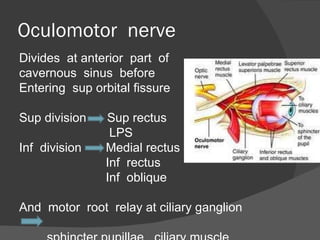
Oculomotor  nerve Divides  at anterior  part  of  cavernous  sinus  before  Entering  sup orbital fissure Sup division  Sup rectus LPS Inf  division  Medial rectus Inf  rectus Inf  oblique And  motor  root  relay at ciliary ganglion  sphincter pupillae , ciliary muscle
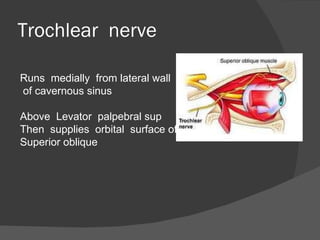
Trochlear  nerve Runs  medially  from lateral wall of cavernous sinus  Above  Levator  palpebral sup Then  supplies  orbital  surface of  Superior oblique
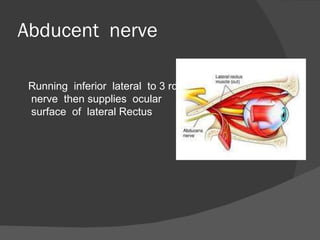
Abducent  nerve Running  inferior  lateral  to 3 rd nerve  then supplies  ocular surface  of  lateral Rectus
Trigeminal  nerve Three  terminal  branches  of  ophthalmic  division: Frontal  nerve  supratrochlear  supraorbital Lacrimal  nerve  Sensory and  secretomotor  fibres  to lacrimal gland  tru  zygomaticotemporal nerve
Nasociliary  nerve: Communicating branch to sensory root of ciliary ganglion Long ciliary  nerves -  dilator  pupillae Posterior  and anterior  ethmoidal  branches Infratrochlear  nerve
THANK  YOU

Orbit anatomy

  • 1.
    ANATOMY OF ORBIT Rajvin Samuel Ponraj
  • 2.
    Development of orbit Develops from mesenchyme by ossification 6 th to 7 th week laying down of bones starting with maxilla bone around the Optic vesicle During this time optic vesicle 170 degree apart rotates anteriorly
  • 3.
    Developmental Anomalies: Craniosynosotosis : Brachycephaly Oxycephaly Scophocephaly Trigonocephaly
  • 4.
    Craniosfacial dysostois/ Crouzon’ syndrome Proptosis – shallow orbits Hypertelorim - wide separation of orbits V pattern exotropia
  • 5.
    Oxycephaly-syndactlye / Apert’syndrome : Flattened occiput , steep forehead , supra orbital ridge Midfacial hypoplasia , parrot beak nose
  • 6.
    Bones of Orbit Frontal Ethmoid Sphenoid Lacrimal Palatine Maxillary Zygomatic
  • 7.
    Dimensions - orbit30 ml –volume 35 mm vertically , 40 mm horizontally 45 degree between lateral wall and sagital plane 23 degree between visual and orbital axis
  • 8.
    Boundaries ofOrbit Roof Floor Side walls Orbital apex
  • 9.
    Roof of orbit Frontal bone [Orbital plate] & lesser wing of sphenoid Separated from frontal sinus and anterior cranial fossa above Lacrimal gland fossa and trochlear fossa behind orbital rim
  • 10.
    Orbital roof anomaly / fracture CSF pulsation pulsatile exophthalmos Orbital meningocele / encephalocele
  • 11.
    Medial wallBody of sphenoid Ethmoid Lacrimal Maxilla[frontal process]
  • 12.
    Orbital cellulitisExtremely thin wall Prone for damage & sinusitis spread Infection across Orbital cellulitis
  • 13.
    Floor oforbit Maxilla Zygomatic Palatine Triangular segment -- thinnest Inferior orbital groove
  • 14.
    Blow out fracturesFragile barrier to maxillary sinus Due to trauma eyeball collapse into Maxillary sinus
  • 15.
    Le fort’s fracture Type 2 - Pyramidal Type 3 - Craniofacial dissociation
  • 16.
    Lateral wallGreater wing –sphenoid Orbital surface – Frontal process of zygomatic Inferiorly – inf orbital fissure Medially – sup orbital fissure
  • 17.
    Behind Zygomatic sphenoidal suture lateral orbitotomy of greater wing ( thin wall ) cancellous bone middle cranial fossa dura matter
  • 18.
    At frontal sphenoidal suture -- meningeal foramen Site of anastomosis of Lacrimal artery and meningeal artery collaterals Periosteal elevation at this site Brisk bleeding
  • 19.
  • 20.
    Orbital apex syndrome / Tolosa - hunt syndrome : Damage to structures at apex 2 nd, 3 rd, 4 th ,6 th nerves Symptoms : visual loss, ophthalmoplegia periorbital & facial pain
  • 21.
    Other causes: InflammatoryInfectious Neoplastic Iatrogenic / traumatic Vascular
  • 22.
    Superior orbital fissure syndrome / Rochon – Duvigneaud syndrome : Lesion anterior to orbital apex excluding optic nerve pathology
  • 23.
    Contents of orbit Eye ball Orbital fat Connective tissue system Blood vessels Nerves Extraocular muscles
  • 24.
    Eyeball - Applied anatomy: Proptosis : Dystopia Enophthalmosis Ophthalmoplegia
  • 25.
    Connective tissuesystem Periorbita Orbital septum Tenon’s capsule
  • 26.
    Periorbita : Looselyattached to orbital bone Attached firmly to Arcus marginalis Trochlea Lateral orbital tubercle Optic foramen Orbital fissures Dura and optic canal margins
  • 27.
    Orbital septum :Interconnecting / circumferential radial webs of fascial system support and transmit forces in trauma Compressive optic neuropathy following trauma
  • 28.
    Anterior fascialsystem Formed by condensation of fibrous septa Lockwood lig, whitnall sup susp lig Lacrimal lig Intermuscular septum Posterior Fascial system Incompletely formed
  • 29.
    Tenon’s capsuleDense elastic , vascular Extent : from perilimbal sclera to optic nerve meninges with bursa within Sleeve like extensions for extra ocular muscles continues as fibrous capsule along its length
  • 30.
  • 31.
    Surgical spaces in orbit : Sub periosteal space Peripheral space Central space Tenon’s space
  • 32.
    Extra ocular muscles 4 rectal muscles 2 oblique muscles Two lid retractors To serve in eyeball movements in the orbital cavity
  • 33.
  • 34.
  • 35.
    Optic nerve Intraorbital part = 25 mm out of 4 cm Enclosed in three meningeal sheaths At apex surrounded by recti muscles , Central retinal artery and vein pierces optic nerve 1.25 cm behind optic nerve Relations: superiorly ophthalmic artery sup ophthal vein nasociliary nerve inferiorly nerve to medial rectus
  • 36.
    Oculomotor nerveDivides at anterior part of cavernous sinus before Entering sup orbital fissure Sup division Sup rectus LPS Inf division Medial rectus Inf rectus Inf oblique And motor root relay at ciliary ganglion sphincter pupillae , ciliary muscle
  • 37.
    Trochlear nerveRuns medially from lateral wall of cavernous sinus Above Levator palpebral sup Then supplies orbital surface of Superior oblique
  • 38.
    Abducent nerveRunning inferior lateral to 3 rd nerve then supplies ocular surface of lateral Rectus
  • 39.
    Trigeminal nerveThree terminal branches of ophthalmic division: Frontal nerve supratrochlear supraorbital Lacrimal nerve Sensory and secretomotor fibres to lacrimal gland tru zygomaticotemporal nerve
  • 40.
    Nasociliary nerve:Communicating branch to sensory root of ciliary ganglion Long ciliary nerves - dilator pupillae Posterior and anterior ethmoidal branches Infratrochlear nerve
  • 41.