Anatomy of the orbit
Presenter: Dr. Mlaluko Rajabu (SHO 1)
MMed Ophthalmology
10/7/2023 1
 Case presentation
 Introduction
 Embryology
 Dimensions
 Orbital Rim and Wall
 Orbital Apertures
 Orbital fat pad
 Innervation, drainage, vasculature
 Radiological findings
Contents
10/7/2023 2
24 years old male bodaboda guy presented at the emergency
department after getting an accident and sustaining injury on the
face a/w loss of consciousness for few minutes and bleeding per
nose but no bleeding per ears. On the examination, he was alert,
GCS 13/15. Ocular exam
RE: Bruises on the eyelids, hyperemic conjunctiva, normal cornea,
D/Q AC, pupil round and reactive.
LE: Ecchymosis, droopy eyelid, chemosis, clear cornea, D/Q AC,
pupil dilated and unresponsive to light
Case presentation
10/7/2023 3
VA OD: 6/9 OS: NPL
IOP OD: 12mmHg OS: 11mmHg
Extraocular movement
OD: Normal all extraocular movement
OS: Restricted extraocular movement
Pdx??
Ddx??
Case presentation
10/7/2023 4
Introduction
• The orbital cavities are a pair of large bony sockets that
contain the eyeballs, their associated muscles, nerves, vessels,
fat, and most of the lacrimal apparatus.
• The shape of the orbit is Truncated-pyramid.
• It has four walls, base and the apex.
10/7/2023 5
Embryology
• Orbital bones - derived from cranial neural crest cells
• First bone - Maxillary (at 6 wks of intrauterine life).
• Other bones develop at around 7 wks of intrauterine life.
• Lesser wing of sphenoid at 7 weeks
• Greater wing of sphenoid at 10 weeks
• They fuse at 16 weeks
10/7/2023 6
Cont…
10/7/2023 7
• Ethmoidal and sphenoidal bones are by endochondral
ossification. Greater wing of sphenoid bone and
others are by intramembranous type.
• NB: Ossification is complete at birth except at the
apex
Bony Orbit
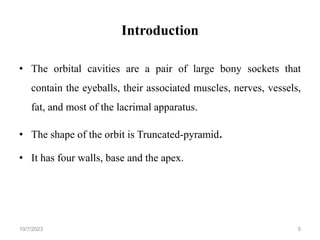
• Composed of 7 bones:
1. Frontal Bone
2. Zygomatic Bone
3. Maxillary Bone
4. Ethmoid Bone
5. Sphenoid Bone
6. Lacrimal Bone
7. Palatine Bone
10/7/2023 8
Cont…
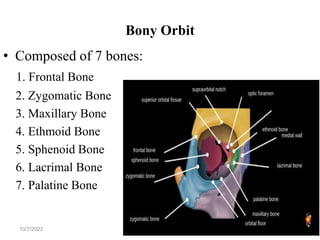
The orbital brim is made up by only maxilla, zygoma
and frontal bone. The frontal bone as major part.
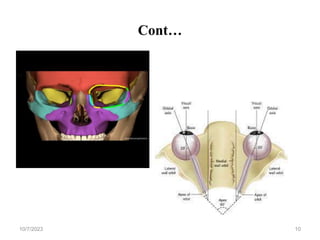
 The medial walls are parallel and 25mm apart,
The lateral walls are at 90 degree to each other,
 Horizontal walls of individual orbit are at 45 degree.
10/7/2023 9
Cont…
10/7/2023 10
Dimensions
• Volume of orbital cavity ≈ 30 cc in adults.
• Rim:
- Horizontally ≈ 30-45mm
- Vertically ≈ 35 mm
• Depth
– Medial wall ≈ 30-45mm
– Laterally ≈10 mm less
• The cavity; widest; 1-1.5cm from the base
10/7/2023 11
Walls of the Orbital Cavity
• The orbit has four walls; 2 lateral walls, 1 roof
and 1 floor
• The walls are covered by periorbita except at
the foramina, fissures and canals.
• It continues with periostium of the scalp as
well as dura matter of the optic nerve sheath.
10/7/2023 12
Roof
• Triangular, concave, flat posteriorly.
• Underlies frontal sinus & Anterior cranial fossa
• Orbital plate of the frontal bone and the lesser wing of
the sphenoid posteriorly.
• Thin and fragile and in old age portions of the roof
may be absorbed.
10/7/2023 13
Important landmarks
I. The fossa for the lacrimal gland, lying anterolaterally
behind the zygomatic process of the frontal bone,
resides within the orbital roof.
II. Medially, the trochlear fossa is located on the frontal
bone approximately 4 mm from the orbital margin
and is the site of the pulley of the SOM, where the
trochlea, a curved plate of hyaline cartilage, is
attached.
10/7/2023 14
III. Supra-orbital foramen and supratrochlear notch: passes supra
orbital vessels and supra orbital branch of frontal nerves – site of
nerve block
10/7/2023 15
Orbital Roof Fractures
• Orbital roof fractures are usually caused by
penetrating trauma or missile injuries. In older
patients, frontal trauma is partially absorbed by the
frontal sinus, which diffuses the force and prevents
extension of the fracture along the orbital roof.
10/7/2023 16
Roof fractures
• Roof fractures are more common in young children
because the frontal sinus has not yet pneumatized and
also because the ratio of the cranial vault to the
midface is greater in children than in adults, making
frontal impact more likely with a fall.
10/7/2023 17
Cont…
• Complications of orbital roof fractures include
intracranial injuries, cerebrospinal fluid rhinorrhea,
pneumocephalus, subperiosteal hematoma, ptosis, and
extraocular muscle imbalance.
10/7/2023 18
Floor
• Shortest of orbital wall
• The floor of the orbit is composed of 3 bones:
1. Maxillary bone (major)
2. Palatine bone
3. Orbital plate of the zygomatic bone.
• Overlies maxillary sinus.
• Bordered laterally by IOF and medially by maxilloethmoidal
suture
• Only wall without sphenoid bone contribution
10/7/2023 19
10/7/2023 20
Important Landmarks Floor
10/7/2023 21
 The infraorbital groove and infraorbital foramina,
which transmit the infraorbital nerve and vessels & the
maxillary division of the trigeminal nerve.
Clinical importance
• The orbital floor being quite thin is commonly
involved in blow-out fractures and is easily invaded
by tumours of the maxillary antrum.
• The floor of the orbit is best visualized with standard
of posterior anterior radiographs.
10/7/2023 22
Clinical finding
.
• The fracture will result to the injury of
infratrochlear/infraorbital nerve. Nose, cheek, upper
teeth
10/7/2023 23
Lateral Wall
• The thickest and strongest of the orbital walls
o Zygomatic bone and the greater wing of the sphenoid
bone.
• It is related to; middle cranial fossa and temporal
fossa
• Zygomatic groove and foramina -( nerve and vessels)
10/7/2023 24
Whitnall tubecle
10/7/2023 25
• This important landmark is the site of attachment for
the following structures:
• Suspensory ligament of the eyeball (Lockwood
suspensory ligament) of the globe
• Lateral canthal ligament
• Lateral horn of lateral rectus muscle
• Check ligament of levator superioris muscle
• Whitnall ligament
10/7/2023 26
10/7/2023 27
Clinical importance
• The lateral wall of orbit protects only the posterior half of
the eyeball.
• The anterior half of the globe is not covered by bone on
the lateral side.
• Hence palpation of the retrobulbar tumours is easier from
the lateral
• Corneal foreign body removal is easier from lateral
side.
10/7/2023 28
Medial Wall
1. Frontal process of the maxillary bone
2. Lacrimal bone
3. Orbital plate of the ethmoid bone
4. Body of the sphenoid bone
• Located adjacent to the ethmoid and sphenoid sinuses and
nasal cavity
• The thinnest walls of the orbit are the lamina papyracea;
ethmoid sinuses with septa.
10/7/2023 29
Cont…
10/7/2023 30
Landmarks
 The lacrimal fossa: is formed by the
 Frontal process of the maxilla
 Lacrimal bone.
 Below, the lacrimal fossa is continuous with the bony
nasolacrimal canal, which extends into the inferior
meatus (the space beneath the inferior turbinate) of
the nose.
10/7/2023 31
Boundaries :
• Anterior- anterior Lacrimal crest
• Pos- posterior lacrimal crest
Dimensions:
• Length: 14mm
• Depth: 5mm
Content:
• Lacrimal sac
10/7/2023 32
Ethmoidal Foramina
• Between roof and medial wall
• Are in the frontoethmoidal suture or in frontal bone;
• Anterior ethmoidal foramen; opens in anterior cranial
fossa, at side of cribriform plate; Transmits: anterior
ethmoidal nerve and artery
• Posterior ethmoidal foramen; transmits posterior
ethmoidal nerve and artery
10/7/2023 33
Weber’s suture
10/7/2023 34
• In the frontal process of maxilla just anterior to the
lacrimal fossa a fine groove known as the sutura
longitudinalis imperfecta of Weber
• This suture runs parallel to the anterior lacrimal crest.
Small branches of infraorbital artery pass through this
groove to supply the nasal mucosa.
• This should be anticipated in any lacrimal sac surgery
to avoid unnecessary troublesome bleeding.
Sutura longitudinalis imperfecta..
10/7/2023 35
• .
Superior Orbital (Sphenoidal) Fissure)
• Lies between the roof and the lateral wall of orbit;
separating the lesser and greater wings of sphenoid
• “Comma-shaped”; 22mm long; wider medial, narrow
laterally
• Largest communication between orbit and middle cranial
fossa
10/7/2023 36
10/7/2023 37
Cont…
• The SOF is divided into 3 compartments by annulus
ring of Zinn.
10/7/2023 38
Cont..
• Superior compartment: frontal and lacrimal
branches of CNV1, trochlear nerve, superior
ophthalmic vein
• Middle compartment: Superior and inferior
branches of the CNIII, abducens nerve, nasociliary
branch of CNV1, inferior ophthalmic vein
• Inferior compartment: Inferior ophthalmic vein
10/7/2023 39
Superior orbital fissure syndrome
• Also known as Rochon Duvigneaud syndrome.
• It is due to lesions on the components of the SOF just
anterior to the orbital apex.
• It involve other nerves and sparing optic nerve.
10/7/2023 40
Clinical presentations
• External ophthalmoplegia; impaired EOM
movements
• Internal ophthalmoplegia is fixed dilated
pupils.
• Double vision (horizontal, vertical or oblique)
• Ptosis of upper eyelid.
10/7/2023 41
Cont…
• As affected eye does not move whereas contralateral
normal eyeball moves focal axis gets
disturbedDiplopia.
10/7/2023 42
Inferior Orbital (Sphenomaxillary) Fissure
• Lies between the lateral wall and floor of the orbit,
joins orbits to the pterygopalatine and infratemporal
fossae; lies between the greater wing of sphenoid and
the maxilla
• Runs inferolaterally to the optic foramen, at the medial
end of the superior orbital fissure, and runs
anterolaterally for 22 mm to end about 2 cm from the
inferior orbital margin.
10/7/2023 43
Cont…
Transmits of structures:
• Infra orbital nerve and Zygomatic nerve (from the
Maxillary division of Trigeminal nerve)
• Inferior ophthalmic vein leading to the
• Infra orbital artery (from the maxillary artery & vein)
• Symphathetic nerves
10/7/2023 44
Optic Foramen (a.k.a Optic Canal)
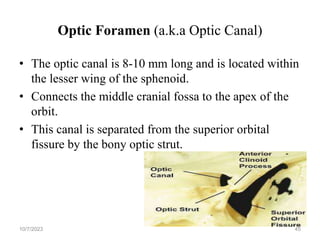
• The optic canal is 8-10 mm long and is located within
the lesser wing of the sphenoid.
• Connects the middle cranial fossa to the apex of the
orbit.
• This canal is separated from the superior orbital
fissure by the bony optic strut.
10/7/2023 45
Cont…
• Close to: sphenoidal air sinus and sometimes to a
posterior ethmoidal sinus;
• The longer the optic canal, the narrower it is.
• Transmits: optic nerve and ophthalmic artery.
10/7/2023 46
Orbital fat
10/7/2023 47
 Located posterior to the orbital septum and
anterior to the levator palpebral aponeurosis of
UL and capsulopalpebral fascia of lower eye lid
 It acts as cushion to the globe
 Infra trochlear nerve and medial palpebral artery
branches of ophthalmic artery courses thru the
medial fat
Orbital fat
10/7/2023 48
Orbital vasculature
10/7/2023 49
• Mainly by ICA with some contribution from internal
maxillary and facial branches of ECA.
• ICA gives its first big branch ophthalmic artery as it
exits the cavernous sinus
Orbital vasculature
10/7/2023 50
• Mainly by ICA with some contribution from internal
maxillary and facial branches of ECA.
• ICA gives its first big branch ophthalmic artery as it
exits the cavernous sinus
Venous drainage
10/7/2023 51
• Superior ophthalmic veincavernous sinus
• Inferior ophthalmic veinpterygoid plexus
• Vortex vein drain from choroid to either of the above
• Central retina vein
Lymphatic drainage
10/7/2023 52
• Pre-auricular lymphnodes
• Submandibular lymphnodes
• Retropharyngeal lymphnodes
Innervation
10/7/2023 53
 Optic nerve
 Infra-orbital nerve
 Zygomatic nerve
 Lacrimal nerve
 Frontal nerve
 Supra-orbital nerve
 Supra-trochlear nerve
 Infraorbital nerve
 Symphathetic and parasymphathetic nerves
 CN III, IV and VI
Radiological studies
• CT
• MRI
• Ultrasonography (B-Scan)
• X ray
10/7/2023 54
10/7/2023 55
10/7/2023 56
10/7/2023 57
SPA
10/7/2023 58
G.O
10/7/2023 59
RB
10/7/2023 60
IVFB
10/7/2023 61
Cont..
10/7/2023 62
Cont…
10/7/2023 63
References
• Clinical Anatomy of the Eye, 2nd Edition, by Snell.
Richard S et al
• Wolff’s Anatomy of the Eye and orbit, 8th edition, by
Anthony J. Brown et al
• Fundamentals and Principles of ophthalmology,
2022-2023 edition, AAO
• EyeWiki
10/7/2023 64

Orbit anatomy.ppt

  • 1.
    Anatomy of theorbit Presenter: Dr. Mlaluko Rajabu (SHO 1) MMed Ophthalmology 10/7/2023 1
  • 2.
     Case presentation Introduction  Embryology  Dimensions  Orbital Rim and Wall  Orbital Apertures  Orbital fat pad  Innervation, drainage, vasculature  Radiological findings Contents 10/7/2023 2
  • 3.
    24 years oldmale bodaboda guy presented at the emergency department after getting an accident and sustaining injury on the face a/w loss of consciousness for few minutes and bleeding per nose but no bleeding per ears. On the examination, he was alert, GCS 13/15. Ocular exam RE: Bruises on the eyelids, hyperemic conjunctiva, normal cornea, D/Q AC, pupil round and reactive. LE: Ecchymosis, droopy eyelid, chemosis, clear cornea, D/Q AC, pupil dilated and unresponsive to light Case presentation 10/7/2023 3
  • 4.
    VA OD: 6/9OS: NPL IOP OD: 12mmHg OS: 11mmHg Extraocular movement OD: Normal all extraocular movement OS: Restricted extraocular movement Pdx?? Ddx?? Case presentation 10/7/2023 4
  • 5.
    Introduction • The orbitalcavities are a pair of large bony sockets that contain the eyeballs, their associated muscles, nerves, vessels, fat, and most of the lacrimal apparatus. • The shape of the orbit is Truncated-pyramid. • It has four walls, base and the apex. 10/7/2023 5
  • 6.
    Embryology • Orbital bones- derived from cranial neural crest cells • First bone - Maxillary (at 6 wks of intrauterine life). • Other bones develop at around 7 wks of intrauterine life. • Lesser wing of sphenoid at 7 weeks • Greater wing of sphenoid at 10 weeks • They fuse at 16 weeks 10/7/2023 6
  • 7.
    Cont… 10/7/2023 7 • Ethmoidaland sphenoidal bones are by endochondral ossification. Greater wing of sphenoid bone and others are by intramembranous type. • NB: Ossification is complete at birth except at the apex
  • 8.
    Bony Orbit • Composedof 7 bones: 1. Frontal Bone 2. Zygomatic Bone 3. Maxillary Bone 4. Ethmoid Bone 5. Sphenoid Bone 6. Lacrimal Bone 7. Palatine Bone 10/7/2023 8
  • 9.
    Cont… The orbital brimis made up by only maxilla, zygoma and frontal bone. The frontal bone as major part.  The medial walls are parallel and 25mm apart, The lateral walls are at 90 degree to each other,  Horizontal walls of individual orbit are at 45 degree. 10/7/2023 9
  • 10.
  • 11.
    Dimensions • Volume oforbital cavity ≈ 30 cc in adults. • Rim: - Horizontally ≈ 30-45mm - Vertically ≈ 35 mm • Depth – Medial wall ≈ 30-45mm – Laterally ≈10 mm less • The cavity; widest; 1-1.5cm from the base 10/7/2023 11
  • 12.
    Walls of theOrbital Cavity • The orbit has four walls; 2 lateral walls, 1 roof and 1 floor • The walls are covered by periorbita except at the foramina, fissures and canals. • It continues with periostium of the scalp as well as dura matter of the optic nerve sheath. 10/7/2023 12
  • 13.
    Roof • Triangular, concave,flat posteriorly. • Underlies frontal sinus & Anterior cranial fossa • Orbital plate of the frontal bone and the lesser wing of the sphenoid posteriorly. • Thin and fragile and in old age portions of the roof may be absorbed. 10/7/2023 13
  • 14.
    Important landmarks I. Thefossa for the lacrimal gland, lying anterolaterally behind the zygomatic process of the frontal bone, resides within the orbital roof. II. Medially, the trochlear fossa is located on the frontal bone approximately 4 mm from the orbital margin and is the site of the pulley of the SOM, where the trochlea, a curved plate of hyaline cartilage, is attached. 10/7/2023 14
  • 15.
    III. Supra-orbital foramenand supratrochlear notch: passes supra orbital vessels and supra orbital branch of frontal nerves – site of nerve block 10/7/2023 15
  • 16.
    Orbital Roof Fractures •Orbital roof fractures are usually caused by penetrating trauma or missile injuries. In older patients, frontal trauma is partially absorbed by the frontal sinus, which diffuses the force and prevents extension of the fracture along the orbital roof. 10/7/2023 16
  • 17.
    Roof fractures • Rooffractures are more common in young children because the frontal sinus has not yet pneumatized and also because the ratio of the cranial vault to the midface is greater in children than in adults, making frontal impact more likely with a fall. 10/7/2023 17
  • 18.
    Cont… • Complications oforbital roof fractures include intracranial injuries, cerebrospinal fluid rhinorrhea, pneumocephalus, subperiosteal hematoma, ptosis, and extraocular muscle imbalance. 10/7/2023 18
  • 19.
    Floor • Shortest oforbital wall • The floor of the orbit is composed of 3 bones: 1. Maxillary bone (major) 2. Palatine bone 3. Orbital plate of the zygomatic bone. • Overlies maxillary sinus. • Bordered laterally by IOF and medially by maxilloethmoidal suture • Only wall without sphenoid bone contribution 10/7/2023 19
  • 20.
  • 21.
    Important Landmarks Floor 10/7/202321  The infraorbital groove and infraorbital foramina, which transmit the infraorbital nerve and vessels & the maxillary division of the trigeminal nerve.
  • 22.
    Clinical importance • Theorbital floor being quite thin is commonly involved in blow-out fractures and is easily invaded by tumours of the maxillary antrum. • The floor of the orbit is best visualized with standard of posterior anterior radiographs. 10/7/2023 22
  • 23.
    Clinical finding . • Thefracture will result to the injury of infratrochlear/infraorbital nerve. Nose, cheek, upper teeth 10/7/2023 23
  • 24.
    Lateral Wall • Thethickest and strongest of the orbital walls o Zygomatic bone and the greater wing of the sphenoid bone. • It is related to; middle cranial fossa and temporal fossa • Zygomatic groove and foramina -( nerve and vessels) 10/7/2023 24
  • 25.
  • 26.
    • This importantlandmark is the site of attachment for the following structures: • Suspensory ligament of the eyeball (Lockwood suspensory ligament) of the globe • Lateral canthal ligament • Lateral horn of lateral rectus muscle • Check ligament of levator superioris muscle • Whitnall ligament 10/7/2023 26
  • 27.
  • 28.
    Clinical importance • Thelateral wall of orbit protects only the posterior half of the eyeball. • The anterior half of the globe is not covered by bone on the lateral side. • Hence palpation of the retrobulbar tumours is easier from the lateral • Corneal foreign body removal is easier from lateral side. 10/7/2023 28
  • 29.
    Medial Wall 1. Frontalprocess of the maxillary bone 2. Lacrimal bone 3. Orbital plate of the ethmoid bone 4. Body of the sphenoid bone • Located adjacent to the ethmoid and sphenoid sinuses and nasal cavity • The thinnest walls of the orbit are the lamina papyracea; ethmoid sinuses with septa. 10/7/2023 29
  • 30.
  • 31.
    Landmarks  The lacrimalfossa: is formed by the  Frontal process of the maxilla  Lacrimal bone.  Below, the lacrimal fossa is continuous with the bony nasolacrimal canal, which extends into the inferior meatus (the space beneath the inferior turbinate) of the nose. 10/7/2023 31
  • 32.
    Boundaries : • Anterior-anterior Lacrimal crest • Pos- posterior lacrimal crest Dimensions: • Length: 14mm • Depth: 5mm Content: • Lacrimal sac 10/7/2023 32
  • 33.
    Ethmoidal Foramina • Betweenroof and medial wall • Are in the frontoethmoidal suture or in frontal bone; • Anterior ethmoidal foramen; opens in anterior cranial fossa, at side of cribriform plate; Transmits: anterior ethmoidal nerve and artery • Posterior ethmoidal foramen; transmits posterior ethmoidal nerve and artery 10/7/2023 33
  • 34.
    Weber’s suture 10/7/2023 34 •In the frontal process of maxilla just anterior to the lacrimal fossa a fine groove known as the sutura longitudinalis imperfecta of Weber • This suture runs parallel to the anterior lacrimal crest. Small branches of infraorbital artery pass through this groove to supply the nasal mucosa. • This should be anticipated in any lacrimal sac surgery to avoid unnecessary troublesome bleeding.
  • 35.
  • 36.
    Superior Orbital (Sphenoidal)Fissure) • Lies between the roof and the lateral wall of orbit; separating the lesser and greater wings of sphenoid • “Comma-shaped”; 22mm long; wider medial, narrow laterally • Largest communication between orbit and middle cranial fossa 10/7/2023 36
  • 37.
  • 38.
    Cont… • The SOFis divided into 3 compartments by annulus ring of Zinn. 10/7/2023 38
  • 39.
    Cont.. • Superior compartment:frontal and lacrimal branches of CNV1, trochlear nerve, superior ophthalmic vein • Middle compartment: Superior and inferior branches of the CNIII, abducens nerve, nasociliary branch of CNV1, inferior ophthalmic vein • Inferior compartment: Inferior ophthalmic vein 10/7/2023 39
  • 40.
    Superior orbital fissuresyndrome • Also known as Rochon Duvigneaud syndrome. • It is due to lesions on the components of the SOF just anterior to the orbital apex. • It involve other nerves and sparing optic nerve. 10/7/2023 40
  • 41.
    Clinical presentations • Externalophthalmoplegia; impaired EOM movements • Internal ophthalmoplegia is fixed dilated pupils. • Double vision (horizontal, vertical or oblique) • Ptosis of upper eyelid. 10/7/2023 41
  • 42.
    Cont… • As affectedeye does not move whereas contralateral normal eyeball moves focal axis gets disturbedDiplopia. 10/7/2023 42
  • 43.
    Inferior Orbital (Sphenomaxillary)Fissure • Lies between the lateral wall and floor of the orbit, joins orbits to the pterygopalatine and infratemporal fossae; lies between the greater wing of sphenoid and the maxilla • Runs inferolaterally to the optic foramen, at the medial end of the superior orbital fissure, and runs anterolaterally for 22 mm to end about 2 cm from the inferior orbital margin. 10/7/2023 43
  • 44.
    Cont… Transmits of structures: •Infra orbital nerve and Zygomatic nerve (from the Maxillary division of Trigeminal nerve) • Inferior ophthalmic vein leading to the • Infra orbital artery (from the maxillary artery & vein) • Symphathetic nerves 10/7/2023 44
  • 45.
    Optic Foramen (a.k.aOptic Canal) • The optic canal is 8-10 mm long and is located within the lesser wing of the sphenoid. • Connects the middle cranial fossa to the apex of the orbit. • This canal is separated from the superior orbital fissure by the bony optic strut. 10/7/2023 45
  • 46.
    Cont… • Close to:sphenoidal air sinus and sometimes to a posterior ethmoidal sinus; • The longer the optic canal, the narrower it is. • Transmits: optic nerve and ophthalmic artery. 10/7/2023 46
  • 47.
    Orbital fat 10/7/2023 47 Located posterior to the orbital septum and anterior to the levator palpebral aponeurosis of UL and capsulopalpebral fascia of lower eye lid  It acts as cushion to the globe  Infra trochlear nerve and medial palpebral artery branches of ophthalmic artery courses thru the medial fat
  • 48.
  • 49.
    Orbital vasculature 10/7/2023 49 •Mainly by ICA with some contribution from internal maxillary and facial branches of ECA. • ICA gives its first big branch ophthalmic artery as it exits the cavernous sinus
  • 50.
    Orbital vasculature 10/7/2023 50 •Mainly by ICA with some contribution from internal maxillary and facial branches of ECA. • ICA gives its first big branch ophthalmic artery as it exits the cavernous sinus
  • 51.
    Venous drainage 10/7/2023 51 •Superior ophthalmic veincavernous sinus • Inferior ophthalmic veinpterygoid plexus • Vortex vein drain from choroid to either of the above • Central retina vein
  • 52.
    Lymphatic drainage 10/7/2023 52 •Pre-auricular lymphnodes • Submandibular lymphnodes • Retropharyngeal lymphnodes
  • 53.
    Innervation 10/7/2023 53  Opticnerve  Infra-orbital nerve  Zygomatic nerve  Lacrimal nerve  Frontal nerve  Supra-orbital nerve  Supra-trochlear nerve  Infraorbital nerve  Symphathetic and parasymphathetic nerves  CN III, IV and VI
  • 54.
    Radiological studies • CT •MRI • Ultrasonography (B-Scan) • X ray 10/7/2023 54
  • 55.
  • 56.
  • 57.
  • 58.
  • 59.
  • 60.
  • 61.
  • 62.
  • 63.
  • 64.
    References • Clinical Anatomyof the Eye, 2nd Edition, by Snell. Richard S et al • Wolff’s Anatomy of the Eye and orbit, 8th edition, by Anthony J. Brown et al • Fundamentals and Principles of ophthalmology, 2022-2023 edition, AAO • EyeWiki 10/7/2023 64