Ophthalmic artery
Under supervision of :-
Prof/ Manal EL-Sawaf
-:students
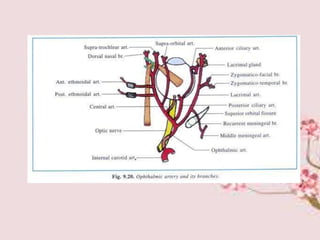
Ophthalmic artery
Origin:-
branch of internal carotid artery as it leaves
cavernous sinus
course and relation
1-passes forward through optic canal , inferolateral to
optic nerve
2-In the orbit it crosses above optic nerve obliquely
from lateral to medial accompanied by nasocilliary
nerve
3- runs in the medial wall of the orbit
termination
ends at the upper eyelid by dividing into
supratrochlear and dorsal nasal arteries
Branches
1-central artery of the retina
- arise in the optic canal
-pierce the nerve inferomedially 1 cm behind and
run within its substance.
-divides into superior and inferior branches each one
divide into temporal and nasal branches
- It is an end artery i.e. it’s occlusion leads to complete
blindness
-only artery can be seen by naked eye during funds
examination
Branches
2-lacrimal artery
Runs forward along upper border of lateral rectus to
reach lacrimal gland
-acompanied by lacrimal nerve
-gives off :-
-supirior and inferior lateral palpebral
-zygomatic branches
-muscular branches
-Recurrent meningeal branches
branches
3-supraorbital
-arise where the ophthalmic artery crosses the optic
nerve
-runs with corresponding nerves above levator
balpebrea supirioris
-leaves the orbit through supraorbital foramen to
supply forehead and scalp
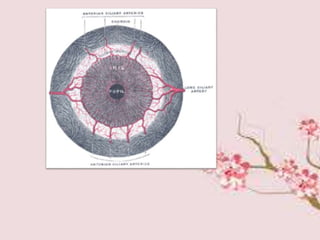
Anterior cilliaryShort posterior cilliaryLong posterior cilliary
Pierce the anterior part of
sclera near the limbus
Terminate in circulus
arteriosus major
7branches pierce the sclera
around the optic
Nerve
Supply choroid and cilliary
process
2 branches pierce the sclera
on either side if
optic nerve
They form circulus arteriosus
major which supply the iris
branches
4-ciliary arteies
They are divided into three groups
Branches
5-ethmoidal branches
Anterior ethmoidal
-Enter through anterior
ethmoidal canal to
reach anterior cranial
fossa
-gives :-
-meningeal to durra
-nasal mucosa
-anterior, middle
ethmoidal air sinus
Posterior ethmoidal
Passes through posterior
ethmoidal canal
-gives branches to:-
-meningeal to durra
-nasal mucosa
-posterior ethmoidal air
sinus
branches
6-meningeal branch
passes backward to enter middle cranial fossa
though superior orbital fissure
7-musular branches
Accompany nerves to extraocular muscles
8-medial palpebral branch
Superior and inferior branches to medial part of
both eyelid
Branches
two terminal branches
9-dorsal nasal
-leaves the orbit below
the trochlea to supply
dorsum of the nose
-Anastomose with
angular of facial
10-supratrochlear
Leave the orbit above the
trochlea to supply the
forehead and scalp
Thank you

Ophthalmic artery

  • 1.
  • 2.
    Under supervision of:- Prof/ Manal EL-Sawaf
  • 3.
  • 4.
    Ophthalmic artery Origin:- branch ofinternal carotid artery as it leaves cavernous sinus
  • 5.
    course and relation 1-passesforward through optic canal , inferolateral to optic nerve 2-In the orbit it crosses above optic nerve obliquely from lateral to medial accompanied by nasocilliary nerve 3- runs in the medial wall of the orbit
  • 6.
    termination ends at theupper eyelid by dividing into supratrochlear and dorsal nasal arteries
  • 8.
    Branches 1-central artery ofthe retina - arise in the optic canal -pierce the nerve inferomedially 1 cm behind and run within its substance. -divides into superior and inferior branches each one divide into temporal and nasal branches
  • 9.
    - It isan end artery i.e. it’s occlusion leads to complete blindness -only artery can be seen by naked eye during funds examination
  • 10.
    Branches 2-lacrimal artery Runs forwardalong upper border of lateral rectus to reach lacrimal gland -acompanied by lacrimal nerve -gives off :- -supirior and inferior lateral palpebral -zygomatic branches -muscular branches -Recurrent meningeal branches
  • 12.
    branches 3-supraorbital -arise where theophthalmic artery crosses the optic nerve -runs with corresponding nerves above levator balpebrea supirioris -leaves the orbit through supraorbital foramen to supply forehead and scalp
  • 14.
    Anterior cilliaryShort posteriorcilliaryLong posterior cilliary Pierce the anterior part of sclera near the limbus Terminate in circulus arteriosus major 7branches pierce the sclera around the optic Nerve Supply choroid and cilliary process 2 branches pierce the sclera on either side if optic nerve They form circulus arteriosus major which supply the iris branches 4-ciliary arteies They are divided into three groups
  • 16.
    Branches 5-ethmoidal branches Anterior ethmoidal -Enterthrough anterior ethmoidal canal to reach anterior cranial fossa -gives :- -meningeal to durra -nasal mucosa -anterior, middle ethmoidal air sinus Posterior ethmoidal Passes through posterior ethmoidal canal -gives branches to:- -meningeal to durra -nasal mucosa -posterior ethmoidal air sinus
  • 19.
    branches 6-meningeal branch passes backwardto enter middle cranial fossa though superior orbital fissure 7-musular branches Accompany nerves to extraocular muscles 8-medial palpebral branch Superior and inferior branches to medial part of both eyelid
  • 21.
    Branches two terminal branches 9-dorsalnasal -leaves the orbit below the trochlea to supply dorsum of the nose -Anastomose with angular of facial 10-supratrochlear Leave the orbit above the trochlea to supply the forehead and scalp
  • 23.