CRANIAL
&
SPINAL NERVES
MAJ DR RISHI POKHREL
DEPT OF ANATOMY
NAIHS
Sensory ReceptorsSensory Receptors
Motor EndingsMotor Endings
Cranial NervesCranial Nerves
The Four PlexusesThe Four Plexuses
ExtremitiesExtremities
Peripheral Nervous System
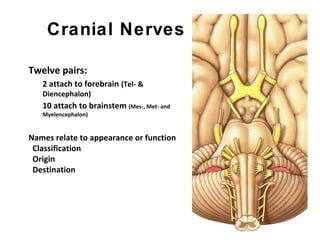
Cranial Nerves
Twelve pairs:
2 attach to forebrain (Tel- &
Diencephalon)
10 attach to brainstem (Mes-, Met- and
Myelencephalon)
Names relate to appearance or function
Classification
Origin
Destination
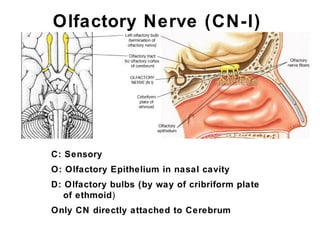
Olfactory Nerve (CN-I)
C: Sensory
O: Olfactory Epithelium in nasal cavity
D: Olfactory bulbs (by way of cribriform plate
of ethmoid)
Only CN directly attached to Cerebrum
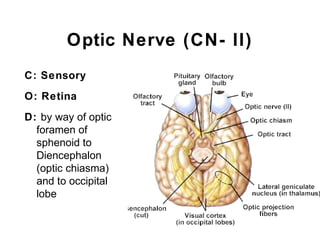
Optic Nerve (CN- II)
C: Sensory
O: Retina
D: by way of optic
foramen of
sphenoid to
Diencephalon
(optic chiasma)
and to occipital
lobe
Oculomotor (CN III)
C: Motor
O: Mesencephalon
D: Somatic motor to superior, inferior, medial
recti and inferior oblique; visceral motor to
intrinsic eye muscles by way of superior
orbital fissure
Trochlear (CN IV)
C: Motor
O: Mesencephalon
D: superior oblique muscle
by way of superior
orbital fissure
Trochlear Nerve (N
IV)
Oculomotor (CN III)Oculomotor (CN III)
Lateral view
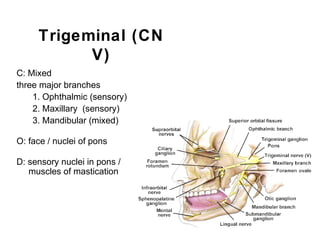
Trigeminal (CN
V)
C: Mixed
three major branches
1. Ophthalmic (sensory)
2. Maxillary (sensory)
3. Mandibular (mixed)
O: face / nuclei of pons
D: sensory nuclei in pons /
muscles of mastication
Abducens
(CN VI)
C: Motor
O: Pons
D: Lateral rectus eye muscle
Facial (CN
VII)
C: Mixed
O: sensory from taste receptors
of anterior 2/3 of tongue /
motor from pons
D: Sensory to sensory nuclei of
pons / motor muscles of facial
expression, visceral motor to
tear gland.
Facial (CN VII), cont’d
Bell’s Palsy
Vestibulocochlear (CN VIII)
• C: Sensory
• O: Receptors of inner Ear
• D: Nuclei in Pons and medulla
oblongata
• AKA acoustic nerve
Vestibulocochlear (CN VIII)
Glossopharyngeal (CN IX)
C: mixedC: mixed
O: sensory from posteriorO: sensory from posterior
1/3 of tongue / motor from1/3 of tongue / motor from
medulla oblongatamedulla oblongata
D: medulla / muscles forD: medulla / muscles for
swallowing, parotid glandswallowing, parotid gland
Vagus (CN X)
C: Mixed
O: Sensation from pharyngeal area and outer
ear / motor from medulla
D: Sensory to medulla / visceral
(autonomic) motor to thoracic and
abdominal cavities and their organs.
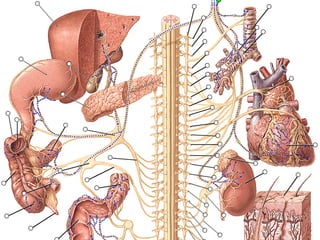
Major motor pathway for ANS
Most important Cranial Nerve!
Accessory (CN XI) AKA Spinal Accessory
C: Motor
O: Motor nuclei of medulla and spinal cord
D: Swallowing, Trapezius & SCM
Hypoglossal (N XII)
C: Motor
O: Motor nuclei of medulla
D: Tongue musculature
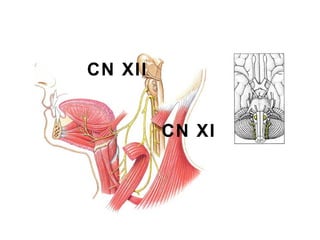
CN XII
CN XI
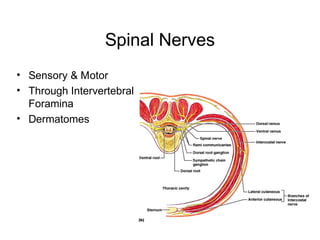
Spinal Nerves
• Sensory & Motor
• Through Intervertebral
Foramina
• Dermatomes
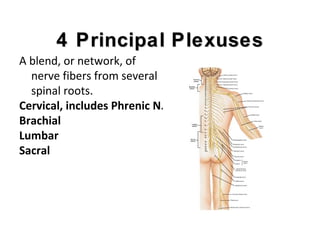
4 Principal4 Principal PlexusesPlexuses
A blend, or network, of
nerve fibers from several
spinal roots.
Cervical, includes Phrenic N.
Brachial
Lumbar
Sacral
Cervical PlexusCervical Plexus
PhrenicPhrenic
nervenerve --
innervatesinnervates
diaphragmdiaphragm
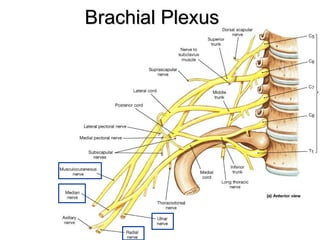
Brachial PlexusBrachial Plexus
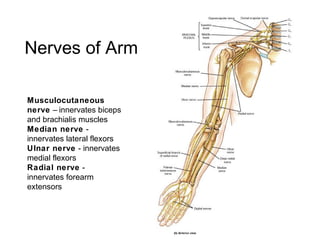
Nerves of Arm
Musculocutaneous
nerve – innervates biceps
and brachialis muscles
Median nerve -
innervates lateral flexors
Ulnar nerve - innervates
medial flexors
Radial nerve -
innervates forearm
extensors
Lumbar Plexus
Femoral Nerve
Lumbosacral
Trunk (to
Sciatic Nerve)
Obturator
Nerve
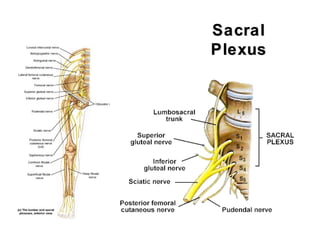
SacralSacral
PlexusPlexus
Nerves of the LegNerves of the Leg
•Sciatic N.Sciatic N.
•Thickest and LongestThickest and Longest
•Branches to Tibial andBranches to Tibial and
Fibular NervesFibular Nerves
•Femoral N.Femoral N.
•Posterior aspect of legPosterior aspect of leg
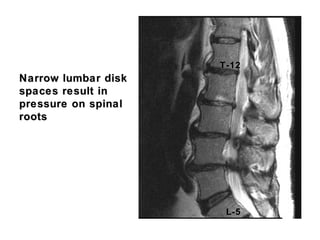
Narrow lumbar diskNarrow lumbar disk
spaces result inspaces result in
pressure on spinalpressure on spinal
rootsroots
L-5
T-12
The white oval
is a
postsurgical
cyst or
abscess
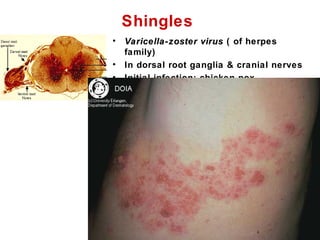
Shingles
• Varicella-zoster virusVaricella-zoster virus ( of herpes
family)
• In dorsal root ganglia & cranial nerves
• Initial infection: chicken pox

Cranial and spinal nerve

Editor's Notes