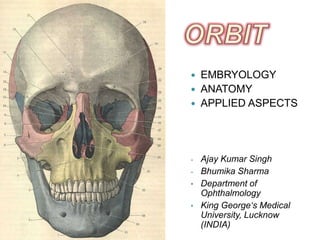
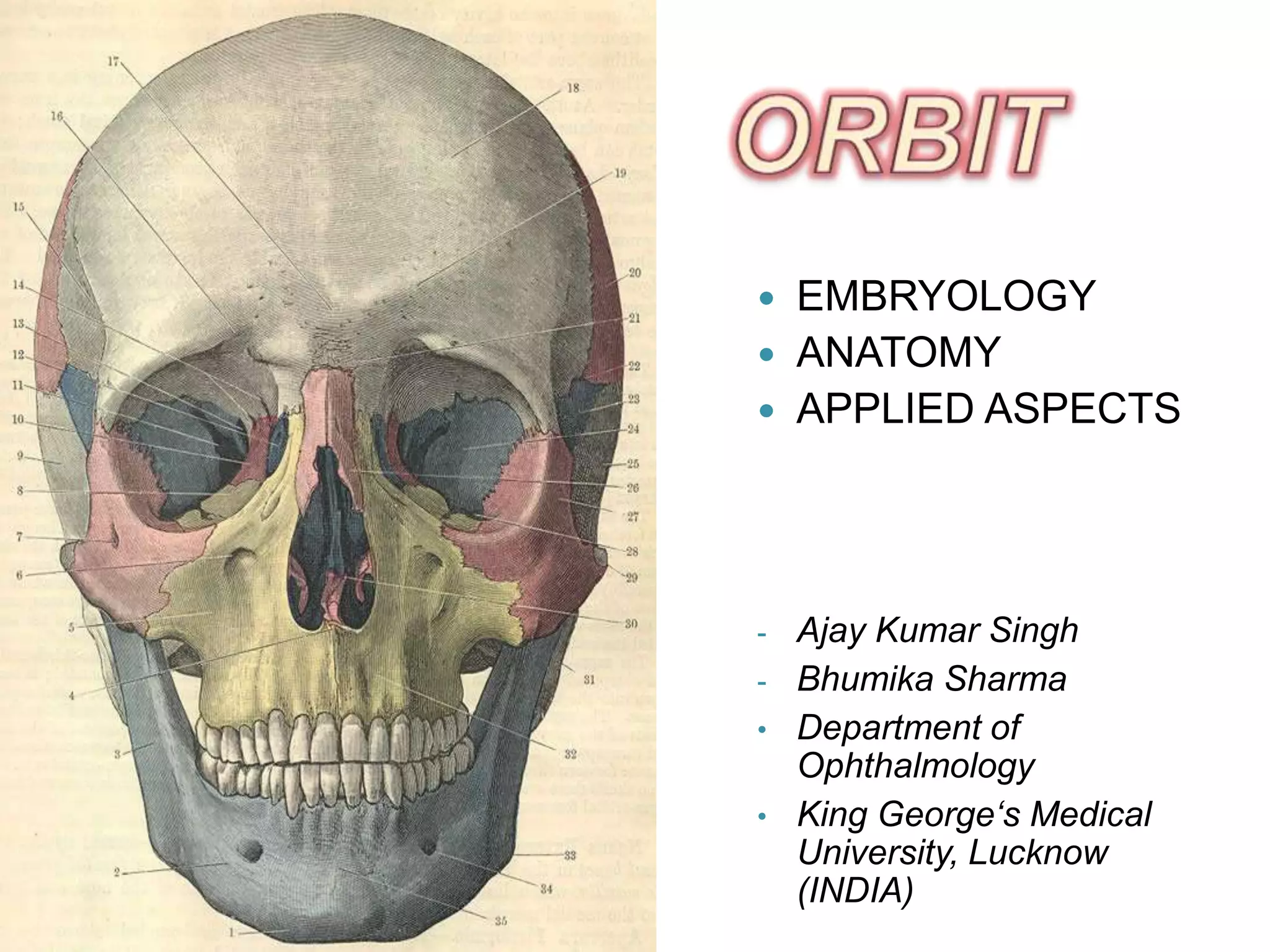
   EMBRYOLOGY
   ANATOMY
   APPLIED ASPECTS


-   Ajay Kumar Singh
-   Bhumika Sharma
•   Department of
    Ophthalmology
•   King George‘s Medical
    University, Lucknow
    (INDIA)
INTRODUCTION
   Orbit is the anatomical space bounded:


        Superiorly – Anterior cranial fossa
        Medially - Nasal cavity & Ethmoidal air sinuses
        Inferiorly - Maxillary sinus
        Laterally - Middle cranial fossa & Temporal fossa
EMBRYOLOGY
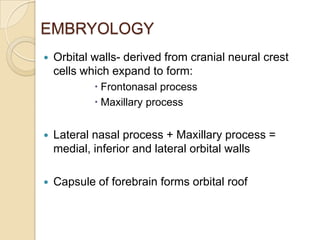
   Orbital walls- derived from cranial neural crest
    cells which expand to form:
             Frontonasal process
             Maxillary process


   Lateral nasal process + Maxillary process =
    medial, inferior and lateral orbital walls

   Capsule of forebrain forms orbital roof
EMBRYOLOG
                                   Y
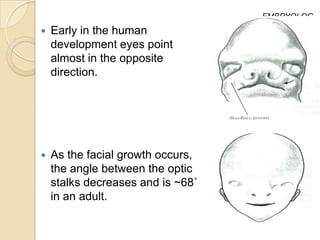
   Early in the human
    development eyes point
    almost in the opposite
    direction.


   As the facial growth occurs,
    the angle between the optic
    stalks decreases and is ~68˚
    in an adult.
EMBRYOLOG


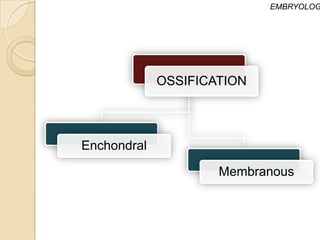
             OSSIFICATION


Enchondral

                     Membranous
EMBRYOLOG

   Frontal, Zygomatic, Maxillary and Palatine bones-
    Intramembranous origin

   First bone- Maxillary (at 6 wks of intrauterine life)


    - develops from elements in the region of the canine tooth
    - secondary ossification centres in the orbitonasal and
      premaxillary regions


   Other bones develop at around 7 wks of intrauterine
    life
EMBRYOLOG


   Sphenoid bone- both enchondral and
    intramembranous origins


    Lesser wing of the sphenoid- 7 wks (Enchondral)
    Greater wing of the sphenoid- 10 wks
     (Intramembranous)
    Both wings join- 16 wks


   Ossification is complete at birth (except orbital apex)
CLINICAL SIGNIFICANCE

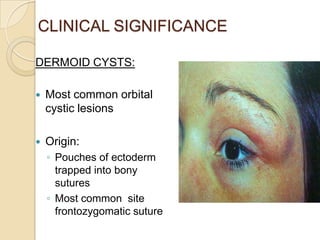
DERMOID CYSTS:

   Most common orbital
    cystic lesions

   Origin:
    ◦ Pouches of ectoderm
      trapped into bony
      sutures
    ◦ Most common site
      frontozygomatic suture
EMBRYOLOG

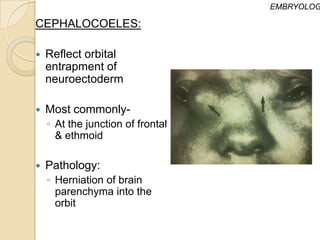
CEPHALOCOELES:

   Reflect orbital
    entrapment of
    neuroectoderm

   Most commonly-
    ◦ At the junction of frontal
      & ethmoid

   Pathology:
    ◦ Herniation of brain
      parenchyma into the
      orbit
EMBRYOLOG
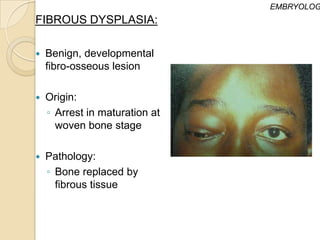
FIBROUS DYSPLASIA:

   Benign, developmental
    fibro-osseous lesion

   Origin:
    ◦ Arrest in maturation at
      woven bone stage

   Pathology:
    ◦ Bone replaced by
      fibrous tissue
DIMENSIONS
    Quadrilateral pyramid


      Base - forwards, laterally, downwards
      Apex - optic foramen


    Volume of orbital cavity ≈ 30 cc in adults
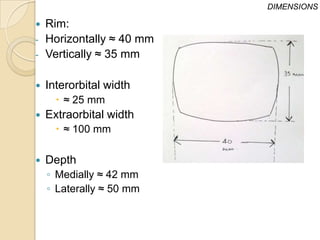
DIMENSIONS

   Rim:
-   Horizontally ≈ 40 mm
-   Vertically ≈ 35 mm

   Interorbital width
       ≈ 25 mm
   Extraorbital width
       ≈ 100 mm

   Depth
    ◦ Medially ≈ 42 mm
    ◦ Laterally ≈ 50 mm
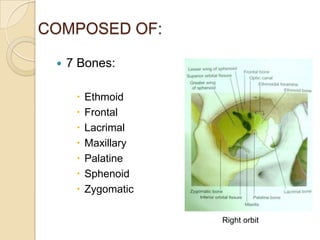
COMPOSED OF:

    7 Bones:

         Ethmoid
         Frontal
         Lacrimal
         Maxillary
         Palatine
         Sphenoid
         Zygomatic

                      Right orbit
BOUNDARIES
BOUNDARIES


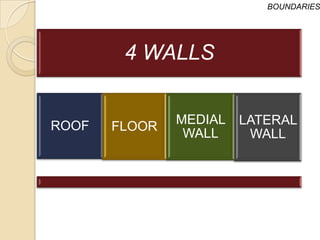
        4 WALLS


ROOF           MEDIAL   LATERAL
       FLOOR
                WALL     WALL
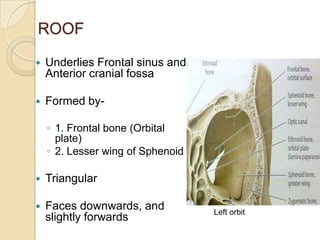
ROOF

   Underlies Frontal sinus and
    Anterior cranial fossa

   Formed by-

    ◦ 1. Frontal bone (Orbital
      plate)
    ◦ 2. Lesser wing of Sphenoid

   Triangular

   Faces downwards, and           Left orbit
    slightly forwards
ROOF


   Concave anteriorly, almost flat posteriorly

   The anterior concavity is greatest about 1.5 cm from
    the orbital margin & corresponds to the equator of
    the globe.

   Thin, transluscent and fragile (except the lesser
    wing of the sphenoid)
ROOF


LANDMARKS

•   1. FOSSA FOR THE LACRIMAL GLAND-

     LOCATION:
     behind the zygomatic process of the frontal bone

     CONTENTS:
     lacrimal gland
     some orbital fat (accessory fossa of Rochon-
       Duvigneaud)
ROOF

2. TROCHLEAR FOSSA (FOVEA)

 LOCATION:
  4 mm from the orbital margin
 CONTENTS:
  insertion of tendinous pulley of Superior Oblique

o   sometimes (≈10%) surmounted by a spicule of bone
    (Spina trochlearis)
o   Extremely rarely trochlea completely ossified
    cracks easily

   SURFACE ANATOMY:
    Palpable just within the supero-medial angle
ROOF

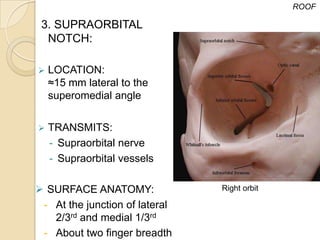
 3. SUPRAORBITAL
  NOTCH:

   LOCATION:
    ≈15 mm lateral to the
    superomedial angle


   TRANSMITS:
    - Supraorbital nerve
    - Supraorbital vessels

 SURFACE ANATOMY:              Right orbit

 - At the junction of lateral
   2/3rd and medial 1/3rd
 - About two finger breadth
ROOF
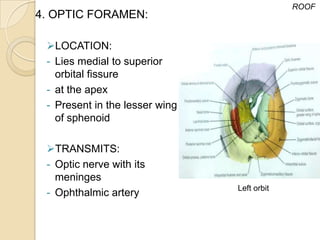
4. OPTIC FORAMEN:

 LOCATION:
 - Lies medial to superior
   orbital fissure
 - at the apex
 - Present in the lesser wing
   of sphenoid

 TRANSMITS:
 - Optic nerve with its
   meninges
                                Left orbit
 - Ophthalmic artery
ROOF

   Cribra orbitalia:

    - apertures apparent on the medial side of anterior
      portion of the lacrimal fossa
    - for veins from diploë to the orbit
    - Best marked in the fetus and infant


   Frontosphenoidal suture:

    - between frontal and the lesser wing of the sphenoid
    - usually obliterated in the adults
ROOF


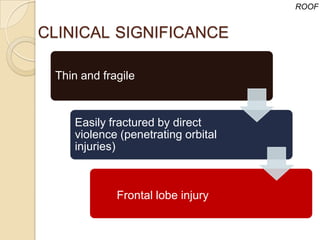
CLINICAL SIGNIFICANCE

 Thin and fragile


    Easily fractured by direct
    violence (penetrating orbital
    injuries)


             Frontal lobe injury
ROOF


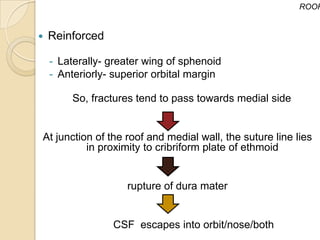
   Reinforced

    - Laterally- greater wing of sphenoid
    - Anteriorly- superior orbital margin

        So, fractures tend to pass towards medial side


At junction of the roof and medial wall, the suture line lies
          in proximity to cribriform plate of ethmoid


                    rupture of dura mater


                 CSF escapes into orbit/nose/both
ROOF


   Since the roof is perforated neither by major
    nerves nor by blood vessels, so it can be easily
    nibbled away in transfrontal orbitotomy.
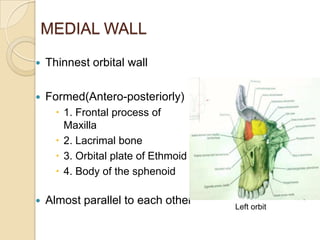
MEDIAL WALL

   Thinnest orbital wall

   Formed(Antero-posteriorly)
       1. Frontal process of
        Maxilla
       2. Lacrimal bone
       3. Orbital plate of Ethmoid
       4. Body of the sphenoid

   Almost parallel to each other     Left orbit
LANDMARKS
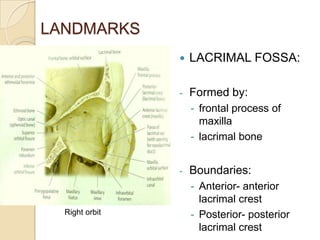
                   LACRIMAL FOSSA:

                -   Formed by:
                    - frontal process of
                      maxilla
                    - lacrimal bone


                -   Boundaries:
                    - Anterior- anterior
                      lacrimal crest
  Right orbit       - Posterior- posterior
                      lacrimal crest
MEDIAL
                                                WALL

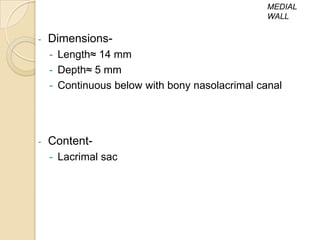
-   Dimensions-
    - Length≈ 14 mm
    - Depth≈ 5 mm
    - Continuous below with bony nasolacrimal canal


-   Content-
    - Lacrimal sac
MEDIAL WALL
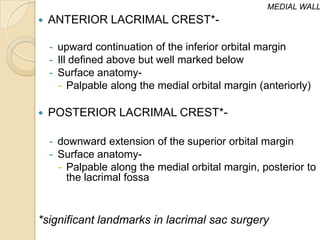
   ANTERIOR LACRIMAL CREST*-

    - upward continuation of the inferior orbital margin
    - Ill defined above but well marked below
    - Surface anatomy-
      - Palpable along the medial orbital margin (anteriorly)

   POSTERIOR LACRIMAL CREST*-

    - downward extension of the superior orbital margin
    - Surface anatomy-
      - Palpable along the medial orbital margin, posterior to
        the lacrimal fossa


*significant landmarks in lacrimal sac surgery
MEDIAL WALL


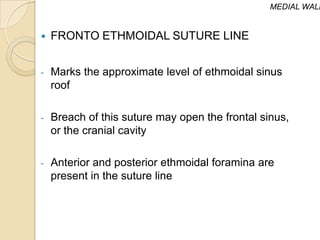
   FRONTO ETHMOIDAL SUTURE LINE


-   Marks the approximate level of ethmoidal sinus
    roof

-   Breach of this suture may open the frontal sinus,
    or the cranial cavity

-   Anterior and posterior ethmoidal foramina are
    present in the suture line
MEDIAL WAL


   Anterior ethmoidal foramen

    - 20-25 mm posterior from the anterior lacrimal crest

    - Opens in the anterior cranial fossa at the side of the
      cribriform plate of ethmoid


    - Transmits-
      - anterior ethmoidal nerve & vessels
MEDIAL
                                        WALL

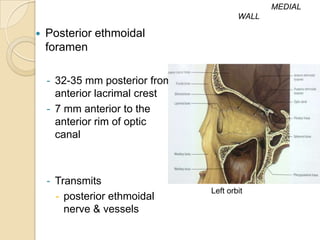
   Posterior ethmoidal
    foramen

    - 32-35 mm posterior from
      anterior lacrimal crest
    - 7 mm anterior to the
      anterior rim of optic
      canal


    - Transmits
                                Left orbit
      - posterior ethmoidal
        nerve & vessels
MEDIAL WAL


Weber’s suture
   Lies anterior to lacrimal fossa

   Also known as sutura longitudinalis imperfecta

   Runs parallel to anterior lacrimal crest

   Branches of infraorbital artery pass through this
    groove to supply the nasal mucosa

   Bleeding may occur from these vessels during
    DCR surgeries
MEDIAL
                                             WALL
CLINICAL SIGNIFICANCE
     Anteriorly located suture indicates predominance
      of lacrimal bone

     Posteriorly located suture indicates the
      predominance of maxillary bone*

       *If maxillary component is predominant, it
      becomes difficult to perform osteotomy to reach
      the sac during DCR, because the maxillary bone
      is very thick.
MEDIAL WALL


   Medial wall extremely fragile (presence of
    ethmoidal air cells and nasal cavity)

   Accidental lateral displacement of medial wall-
    traumatic hypertelorism

   Medial wall provides alternate access route to
    the orbit through the sinus
MEDIAL WAL
   Ethmoid


    - Thinnest bone of the orbit
    - Vascular connections with ethmoid sinus through foramina
    - Inflammation in the ethmoid sinus spreads readily to the
      orbit


   Tumours of the nasal cavity can breach the lamina
    papyracea to involve the orbit

   Lacrimal bone can be easily penetrated during
    endoscopic DCR

   During surgery, hemorrhage is most troublesome due to
    injury to ethmoidal vessels.
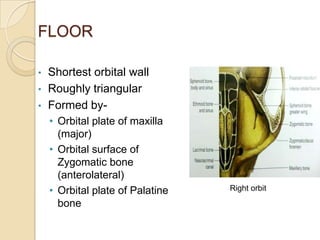
FLOOR

•   Shortest orbital wall
•   Roughly triangular
•   Formed by-
    • Orbital plate of maxilla
      (major)
    • Orbital surface of
      Zygomatic bone
      (anterolateral)
    • Orbital plate of Palatine   Right orbit
      bone
FLOOR


   Bordered laterally by inferior orbital fissure and
    medially by maxilloethmoidal suture

   Overlies maxillary sinus
FLOOR

LANDMARKS
     Infraorbital        Infraorbital      Infraorbital
       groove               canal           foramen
   ≈4 mm inferior to the inferior orbital margin
   Transmits
    - Infraorbital nerve
    - Infraorbital vessels
FLOOR

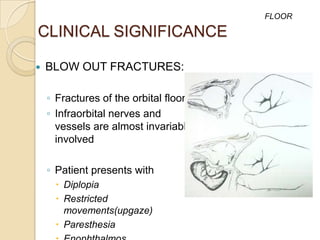
CLINICAL SIGNIFICANCE

   BLOW OUT FRACTURES:

    ◦ Fractures of the orbital floor
    ◦ Infraorbital nerves and
      vessels are almost invariably
      involved

    ◦ Patient presents with
      Diplopia
      Restricted
       movements(upgaze)
      Paresthesia
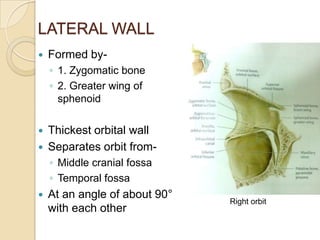
LATERAL WALL
   Formed by-
    ◦ 1. Zygomatic bone
    ◦ 2. Greater wing of
      sphenoid

   Thickest orbital wall
   Separates orbit from-
    ◦ Middle cranial fossa
    ◦ Temporal fossa
   At an angle of about 90°
                               Right orbit
    with each other
LATERAL
                                            WALL
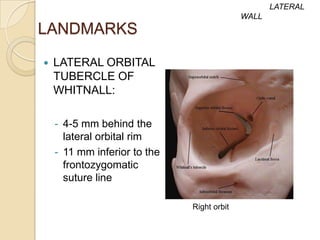
LANDMARKS

   LATERAL ORBITAL
    TUBERCLE OF
    WHITNALL:

    - 4-5 mm behind the
      lateral orbital rim
    - 11 mm inferior to the
      frontozygomatic
      suture line

                              Right orbit
LATERAL
                                      WALL


- Gives attachment to:


 - Check ligament of lateral rectus
 - Lockwood’s ligament
 - Lateral canthal tendon
 - The aponeurosis of the levator palpebrae
   superioris
 - Orbital septum
 - Lacrimal fascia
LATERAL
                                             WALL
    CLINICAL SIGNIFICANCE

   In resection of maxilla, the Whitnall’s tubercle is
    spared, otherwise

             Damage to Lockwood’s ligament

                Inferior dystopia of eye ball

                           Diplopia
LATERAL WAL


   SPINA RECTI LATERALIS:


    - at the junction of wide & narrow portions of the
      superior orbital fissure

    - Produced by a groove lodging superior ophthalmic
      vein

    - Gives origin to a part of Lateral Rectus
LATERAL WAL


   ZYGOMATIC GROOVE:


-   EXTENT:
    - From the anterior end of the inferior orbital fissure to a
      foramen in the zygomatic bone


-   CONTENTS:
    - Zygomatic nerve
    - Zygomatic vessels
LATERAL WAL


CLINICAL SIGNIFICANCE

   Lateral wall protects only the posterior half of the
    eyeball, hence palpation of retrobulbar tumours is
    easier.

   Frontal process of zygoma & zygomatic process of
    frontal bone protect the globe from lateral trauma-
    known as facial buttress area.

   Just behind the facial buttress area, is the
    zygomaticosphenoid suture, which is the preferred
    site for lateral orbitotomy.
LATERAL WAL


Anteriorly, superior margin of inferior
Orbital fissure joins suture between
zygomatic and greater wing of sphenoid
(line of relative weakness)


    extends to frontozygomatic suture


         Frequently involved in zygomatic bone
         fracture
ORBITAL MARGINS
SUPERIOR ORBITAL MARGIN

-   formed by- Frontal bone

-   concave downwards, convex forwards

-    sharp in lateral 2/3rd ,rounded in medial 1/3rd
    - at the junction- supraorbital notch (sometimes
       foramen)*


-   *Site for nerve block.
SUPERIOR ORBITAL
                                         MARGIN
 Sometimes-


o   Arnold’s notch/foramen
    Present medial to supraorbital notch
    Transmits
     medial branches of supraorbital nerve & vessels


o   Supraciliary canal
    Near the supraorbital notch
    Transmits
     nutrient artery
     a branch of supraorbital nerve to frontal air sinus
SUPERIOR ORBITAL
                                    MARGIN

 SURFACE ANATOMY:


 - Well marked prominence
   - More prominent laterally than medially


 - Eyebrow corresponds to the margin only in a part
   - Head- under the margin
   - Body- along the margin
   - Tail- above the margin
LATERAL ORBITAL MARGIN:

 - formed by
  - zygomatic process of frontal
  - the zygomatic bone


 - strongest portion of margin
LATERAL ORBITAL
                                         MARGIN


CLINICAL SIGNIFICANCE

   Lateral orbital rim is recessed on its deep aspect ≈
    0.75 cm above the rim margin to accommodate the
    lacrimal gland


                     Prone to fracture
LATERAL ORBITAL MAR


   Narrowest and weakest part- frontozygomatic
                     suture


    Prone for separation following blunt trauma
INFERIOR ORBITAL MARGIN:

   Formed by-
    - Zygomatic
    - Maxilla

    - suture between the two is sometimes marked by a
      tubercle- felt 4-5 mm above the infraorbital foramen


 SURFACE ANATOMY:


- Palpable as a sharp ridge, beyond which the finger can
    pass into the orbit
INFERIOR ORBITAL MAR

CLINICAL SIGNIFICANCE
   At the junction of lateral 2/3rd & medial 1/3rd just within
    the rim- small depression- origin of Inferior oblique
                        Prone to fracture

                  Disruption of Inferior oblique

                             Diplopia

   Penetrating injuries may severe lacrimal passages
MEDIAL ORBITAL MARGIN:

-   Formed by
    - Frontal process of maxilla (anterior lacrimal crest)
    - Lacrimal bone (posterior lacrimal crest)
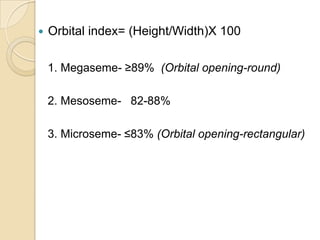
   Orbital index= (Height/Width)X 100

    1. Megaseme- ≥89% (Orbital opening-round)

    2. Mesoseme- 82-88%

    3. Microseme- ≤83% (Orbital opening-rectangular)
FISSURES
AND
FORAMINA
OPTIC CANAL
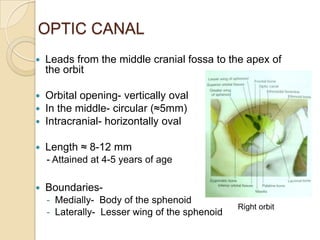
   Leads from the middle cranial fossa to the apex of
    the orbit

   Orbital opening- vertically oval
   In the middle- circular (≈5mm)
   Intracranial- horizontally oval

   Length ≈ 8-12 mm
    - Attained at 4-5 years of age

   Boundaries-
    - Medially- Body of the sphenoid
                                               Right orbit
    - Laterally- Lesser wing of the sphenoid
OPTIC
                                    CANAL


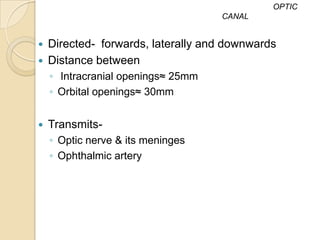
   Directed- forwards, laterally and downwards
   Distance between
    ◦ Intracranial openings≈ 25mm
    ◦ Orbital openings≈ 30mm


   Transmits-
    ◦ Optic nerve & its meninges
    ◦ Ophthalmic artery
OPTIC CANA


   Processus falciformis: The roof of the canal
    reaches farther forwards than the floor
    anteriorly, while posteriorly, the floor projects
    beyond the roof. Fold of dura mater filling the
    gap in the roof is called Processus falciformis.
OPTIC CANA


CLINICAL SIGNIFICANCE

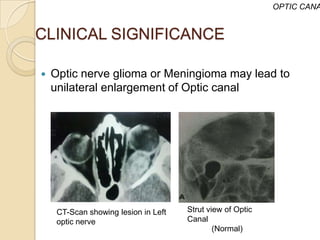
   Optic nerve glioma or Meningioma may lead to
    unilateral enlargement of Optic canal


     CT-Scan showing lesion in Left   Strut view of Optic
     optic nerve                      Canal
                                              (Normal)
SUPERIOR ORBITAL FISSURE
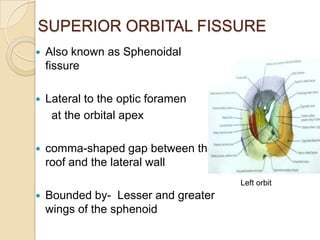
   Also known as Sphenoidal
    fissure

   Lateral to the optic foramen
     at the orbital apex

   comma-shaped gap between the
    roof and the lateral wall
                                     Left orbit
   Bounded by- Lesser and greater
    wings of the sphenoid
SUPERIOR ORBITAL
                                 FISSURE


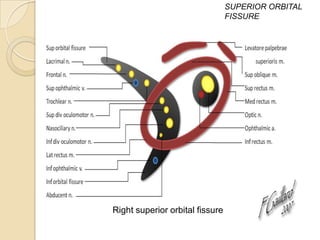
Right superior orbital fissure
SUPERIOR ORBITAL
                                   FISSURE


   22 mm long

   Largest communication between the orbit and
    the middle cranial fossa

   Its tip lies 30-40 mm from the frontozygomatic
    suture
SUPERIOR ORBITAL
                                    FISSURE


   Lateral superior part of the fissure is narrower
    than the medial inferior part.

-   At the junction of the two lies spina recti
    lateralis
SUPERIOR ORBITAL
                                       FISSURE


LANDMARK

    Annulus of Zinn


     - Spans both superior orbital fissure & the optic
       canal

     - Gives origin to the four recti muscles
SUPERIOR ORBITAL
                                     FISSURE


CLINICAL SIGNIFANCE
     Inflammation of the superior orbital fissure and
      apex may result in a multitude of signs
      including ophthalmoplegia and venous outflow
      obstruction


                 TOLOSA HUNT SYNDROME
SUPERIOR ORBITAL
                                       FISSURE

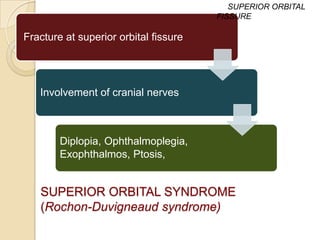
Fracture at superior orbital fissure


   Involvement of cranial nerves


        Diplopia, Ophthalmoplegia,
        Exophthalmos, Ptosis,


   SUPERIOR ORBITAL SYNDROME
   (Rochon-Duvigneaud syndrome)
SUPERIOR ORBITAL
                                        FISSURE
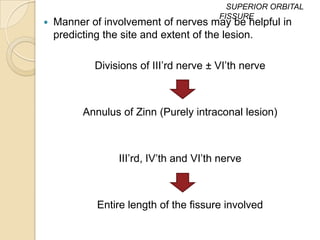
   Manner of involvement of nerves may be helpful in
    predicting the site and extent of the lesion.

            Divisions of III’rd nerve ± VI’th nerve


          Annulus of Zinn (Purely intraconal lesion)


                 III’rd, IV’th and VI’th nerve


             Entire length of the fissure involved
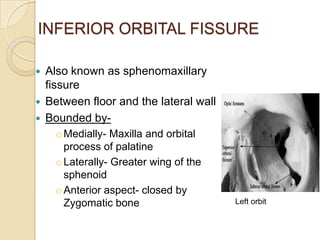
INFERIOR ORBITAL FISSURE

   Also known as sphenomaxillary
    fissure
   Between floor and the lateral wall
   Bounded by-
      o Medially- Maxilla and orbital
        process of palatine
      o Laterally- Greater wing of the
        sphenoid
      o Anterior aspect- closed by
        Zygomatic bone                   Left orbit
INFERIOR ORBITAL
                                           FISSURE


   Transmits-
    - Venous drainage from the inferior part of the
      orbit to the pterygoid plexus
    - neural branches from the pterygopalatine
      ganglion
    - the zygomatic nerve
    - the infraorbital nerve


   Closed in the living by the periorbita & the
    Muller’s muscle

   Serves as the posterior limit of surgical
    subperiosteal dissection along the orbital floor
CONNECTIVE TISSUE SYSTEM


    Periorbita

    Orbital septal system

    Tenon’s capsule
PERIORBITA (Orbital periosteum)

   Loosely adherent to the bones

   Sensory innervation by branches of V’th nerve

   Fixed firmly at
    -   Orbital margins (Arcus marginale)
    -   Suture lines
    -   Various fissures & foramina
    -   Lacrimal fossa
PERIORBITA


CLINICAL SIGNIFICANCE

   Surgery in the orbital roof in the areas of
    fissures and suture lines may be complicated
    by cerebrospinal fluid leakage .
ORBITAL SEPTAL SYSTEM

   Includes the connective tissue septa which are
    suspended from the periorbita to form a
    complex radial and circumferential
    interconnecting slings.

   These septa surround Extraocular muscles,
    Optic nerve, neuro-vascular elements and the
    fat lobules.
TENON’S CAPSULE
   Also known as Fascia bulbi or bulbar sheath.

   Dense, elastic and vascular connective tissue that
    surrounds the globe (except over the cornea).

   Begins anteriorly at the perilimbal sclera, extends around
    the globe to the optic nerve, and fuses with the dural
    sheath and the sclera.

   Separated from the sclera by periscleral lymph space,
    which is in continuation with subdural and subarachnoid
    spaces.
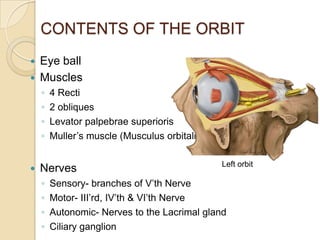
CONTENTS OF THE ORBIT
   Eye ball
   Muscles
    ◦   4 Recti
    ◦   2 obliques
    ◦   Levator palpebrae superioris
    ◦   Muller’s muscle (Musculus orbitalis)

                                               Left orbit
   Nerves
    ◦   Sensory- branches of V’th Nerve
    ◦   Motor- III’rd, IV’th & VI’th Nerve
    ◦   Autonomic- Nerves to the Lacrimal gland
    ◦   Ciliary ganglion
CONTENTS OF THE
                                      ORBIT
   Vessels
    ◦ Arteries-
       Internal carotid system- branches of ophthalmic artery
       External carotid system- a branch of internal maxillary
        artery
    ◦ Veins-
       Superior ophthalmic vein
       Inferior ophthalmic vein
    ◦ Lymphatics-
       none


   Lacrimal gland
   Lacrimal sac
   Orbital fat, reticular tissue & orbital fascia
NERVES
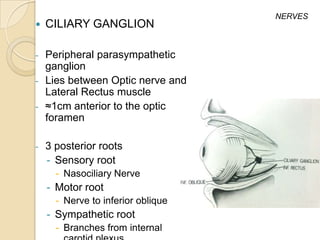
   CILIARY GANGLION

-   Peripheral parasympathetic
    ganglion
-   Lies between Optic nerve and
    Lateral Rectus muscle
-   ≈1cm anterior to the optic
    foramen

-   3 posterior roots
    - Sensory root
      - Nasociliary Nerve
    - Motor root
      - Nerve to inferior oblique
    - Sympathetic root
      - Branches from internal
SURGICAL SPACES

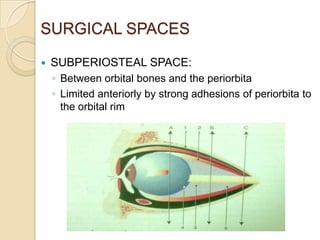
   SUBPERIOSTEAL SPACE:
    ◦ Between orbital bones and the periorbita
    ◦ Limited anteriorly by strong adhesions of periorbita to
      the orbital rim
SURGICAL
                                                    SPACES
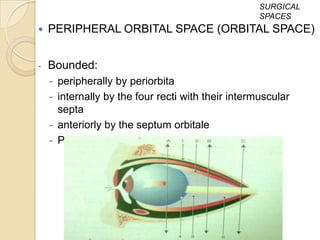
   PERIPHERAL ORBITAL SPACE (ORBITAL SPACE)


-   Bounded:
    - peripherally by periorbita
    - internally by the four recti with their intermuscular
      septa
    - anteriorly by the septum orbitale
    - Posteriorly, it merges with the central space
SURGICAL
   CONTENTS:                        SPACES


   Peripheral orbital fat
   Muscles
    ◦ Superior oblique
    ◦ Inferior oblique
    ◦ Levator palpebrae superioris
   Nerves
    ◦   Lacrimal
    ◦   Frontal
    ◦   Trochlear
    ◦   Anterior ethmoidal
    ◦   Posterior ethmoidal
   Veins
    ◦ Superior ophthalmic
    ◦ Inferior ophthalmic
   Lacrimal gland
   Lacrimal sac
SURGICAL
                                                      SPACES
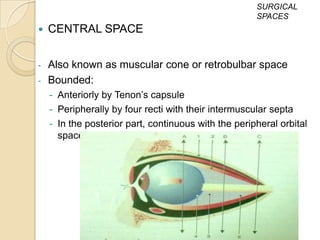
   CENTRAL SPACE


-   Also known as muscular cone or retrobulbar space
-   Bounded:
    - Anteriorly by Tenon’s capsule
    - Peripherally by four recti with their intermuscular septa
    - In the posterior part, continuous with the peripheral orbital
      space
SURGICAL
   CONTENTS:                             SPACES


   Central orbital fat
   Nerves
    ◦ Optic nerve (with its meninges)
    ◦ Oculomotor
       Superior and inferior divisions
    ◦ Abducent
    ◦ Nasociliary
    ◦ Ciliary ganglion
   Vessels
    ◦ Ophthalmic artery
    ◦ Superior ophthalmic vein
SURGICAL
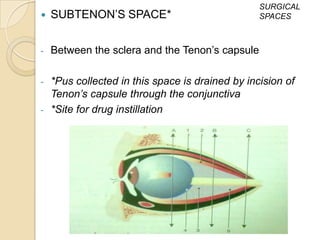
   SUBTENON’S SPACE*                             SPACES


-   Between the sclera and the Tenon’s capsule

-   *Pus collected in this space is drained by incision of
    Tenon’s capsule through the conjunctiva
-   *Site for drug instillation
AGE RELATED VARIATIONS


   Infantile orbits are more divergent (≈115°) than
    those of adults (≈40-45°)

   Orbital axes
-   Lie in horizontal plane in infants
-   slope downwards (≈15-20°) in adults
AGE RELATED
                                         VARIATIONS

   Orbital fissures are relatively larger in childhood than
    in adults (owing to the narrowness of the greater
    wing of sphenoid)

   Orbital index- higher in children than in adults
     (transverse diameter increases relatively more in
    the later life)

   Interorbital distance is smaller in children- may give
    false impression of squint
AGE RELATED
                                         VARIATIONS

   Roof much larger than floor in infancy

   Optic canal has no length at birth- a foramen
    - at 1 year of age≈ 4 mm

   Periorbita much thicker and stronger at birth than in
    adults
AGE RELATED
                                         VARIATIONS

   SENILE CHANGES-


 Holes,   particularly in the roof due to absorption of
    the bony wall

 Orbital   fissures become wider
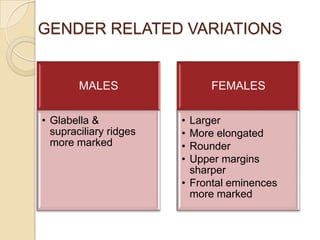
GENDER RELATED VARIATIONS


        MALES                FEMALES

• Glabella &            • Larger
  supraciliary ridges   • More elongated
  more marked           • Rounder
                        • Upper margins
                          sharper
                        • Frontal eminences
                          more marked
TAKE HOME
MESSAGE…………………...
   Knowledge of orbital anatomy and its variations
    helps to determine the pathology as well as the
    site, direction and extent of the incision during
    elective exploration of the orbit.

   It is also must for understanding the clinical
    course and planning the management in cases
    of accidental incisions/explorations.
Orbit

Orbit

  • 1.
    EMBRYOLOGY  ANATOMY  APPLIED ASPECTS - Ajay Kumar Singh - Bhumika Sharma • Department of Ophthalmology • King George‘s Medical University, Lucknow (INDIA)
  • 2.
    INTRODUCTION  Orbit is the anatomical space bounded:  Superiorly – Anterior cranial fossa  Medially - Nasal cavity & Ethmoidal air sinuses  Inferiorly - Maxillary sinus  Laterally - Middle cranial fossa & Temporal fossa
  • 4.
    EMBRYOLOGY  Orbital walls- derived from cranial neural crest cells which expand to form:  Frontonasal process  Maxillary process  Lateral nasal process + Maxillary process = medial, inferior and lateral orbital walls  Capsule of forebrain forms orbital roof
  • 5.
    EMBRYOLOG Y  Early in the human development eyes point almost in the opposite direction.  As the facial growth occurs, the angle between the optic stalks decreases and is ~68˚ in an adult.
  • 6.
    EMBRYOLOG OSSIFICATION Enchondral Membranous
  • 7.
    EMBRYOLOG  Frontal, Zygomatic, Maxillary and Palatine bones- Intramembranous origin  First bone- Maxillary (at 6 wks of intrauterine life) - develops from elements in the region of the canine tooth - secondary ossification centres in the orbitonasal and premaxillary regions  Other bones develop at around 7 wks of intrauterine life
  • 8.
    EMBRYOLOG  Sphenoid bone- both enchondral and intramembranous origins Lesser wing of the sphenoid- 7 wks (Enchondral) Greater wing of the sphenoid- 10 wks (Intramembranous) Both wings join- 16 wks  Ossification is complete at birth (except orbital apex)
  • 9.
    CLINICAL SIGNIFICANCE DERMOID CYSTS:  Most common orbital cystic lesions  Origin: ◦ Pouches of ectoderm trapped into bony sutures ◦ Most common site frontozygomatic suture
  • 10.
    EMBRYOLOG CEPHALOCOELES:  Reflect orbital entrapment of neuroectoderm  Most commonly- ◦ At the junction of frontal & ethmoid  Pathology: ◦ Herniation of brain parenchyma into the orbit
  • 11.
    EMBRYOLOG FIBROUS DYSPLASIA:  Benign, developmental fibro-osseous lesion  Origin: ◦ Arrest in maturation at woven bone stage  Pathology: ◦ Bone replaced by fibrous tissue
  • 13.
    DIMENSIONS  Quadrilateral pyramid  Base - forwards, laterally, downwards  Apex - optic foramen  Volume of orbital cavity ≈ 30 cc in adults
  • 14.
    DIMENSIONS  Rim: - Horizontally ≈ 40 mm - Vertically ≈ 35 mm  Interorbital width  ≈ 25 mm  Extraorbital width  ≈ 100 mm  Depth ◦ Medially ≈ 42 mm ◦ Laterally ≈ 50 mm
  • 15.
    COMPOSED OF:  7 Bones:  Ethmoid  Frontal  Lacrimal  Maxillary  Palatine  Sphenoid  Zygomatic Right orbit
  • 16.
  • 17.
    BOUNDARIES 4 WALLS ROOF MEDIAL LATERAL FLOOR WALL WALL
  • 18.
    ROOF  Underlies Frontal sinus and Anterior cranial fossa  Formed by- ◦ 1. Frontal bone (Orbital plate) ◦ 2. Lesser wing of Sphenoid  Triangular  Faces downwards, and Left orbit slightly forwards
  • 19.
    ROOF  Concave anteriorly, almost flat posteriorly  The anterior concavity is greatest about 1.5 cm from the orbital margin & corresponds to the equator of the globe.  Thin, transluscent and fragile (except the lesser wing of the sphenoid)
  • 20.
    ROOF LANDMARKS • 1. FOSSA FOR THE LACRIMAL GLAND-  LOCATION: behind the zygomatic process of the frontal bone  CONTENTS: lacrimal gland some orbital fat (accessory fossa of Rochon- Duvigneaud)
  • 21.
    ROOF 2. TROCHLEAR FOSSA(FOVEA)  LOCATION: 4 mm from the orbital margin  CONTENTS: insertion of tendinous pulley of Superior Oblique o sometimes (≈10%) surmounted by a spicule of bone (Spina trochlearis) o Extremely rarely trochlea completely ossified cracks easily  SURFACE ANATOMY: Palpable just within the supero-medial angle
  • 22.
    ROOF 3. SUPRAORBITAL NOTCH:  LOCATION: ≈15 mm lateral to the superomedial angle  TRANSMITS: - Supraorbital nerve - Supraorbital vessels  SURFACE ANATOMY: Right orbit - At the junction of lateral 2/3rd and medial 1/3rd - About two finger breadth
  • 23.
    ROOF 4. OPTIC FORAMEN: LOCATION: - Lies medial to superior orbital fissure - at the apex - Present in the lesser wing of sphenoid TRANSMITS: - Optic nerve with its meninges Left orbit - Ophthalmic artery
  • 24.
    ROOF  Cribra orbitalia: - apertures apparent on the medial side of anterior portion of the lacrimal fossa - for veins from diploë to the orbit - Best marked in the fetus and infant  Frontosphenoidal suture: - between frontal and the lesser wing of the sphenoid - usually obliterated in the adults
  • 25.
    ROOF CLINICAL SIGNIFICANCE Thinand fragile Easily fractured by direct violence (penetrating orbital injuries) Frontal lobe injury
  • 26.
    ROOF  Reinforced - Laterally- greater wing of sphenoid - Anteriorly- superior orbital margin So, fractures tend to pass towards medial side At junction of the roof and medial wall, the suture line lies in proximity to cribriform plate of ethmoid rupture of dura mater CSF escapes into orbit/nose/both
  • 27.
    ROOF  Since the roof is perforated neither by major nerves nor by blood vessels, so it can be easily nibbled away in transfrontal orbitotomy.
  • 28.
    MEDIAL WALL  Thinnest orbital wall  Formed(Antero-posteriorly)  1. Frontal process of Maxilla  2. Lacrimal bone  3. Orbital plate of Ethmoid  4. Body of the sphenoid  Almost parallel to each other Left orbit
  • 29.
    LANDMARKS  LACRIMAL FOSSA: - Formed by: - frontal process of maxilla - lacrimal bone - Boundaries: - Anterior- anterior lacrimal crest Right orbit - Posterior- posterior lacrimal crest
  • 30.
    MEDIAL WALL - Dimensions- - Length≈ 14 mm - Depth≈ 5 mm - Continuous below with bony nasolacrimal canal - Content- - Lacrimal sac
  • 31.
    MEDIAL WALL  ANTERIOR LACRIMAL CREST*- - upward continuation of the inferior orbital margin - Ill defined above but well marked below - Surface anatomy- - Palpable along the medial orbital margin (anteriorly)  POSTERIOR LACRIMAL CREST*- - downward extension of the superior orbital margin - Surface anatomy- - Palpable along the medial orbital margin, posterior to the lacrimal fossa *significant landmarks in lacrimal sac surgery
  • 32.
    MEDIAL WALL  FRONTO ETHMOIDAL SUTURE LINE - Marks the approximate level of ethmoidal sinus roof - Breach of this suture may open the frontal sinus, or the cranial cavity - Anterior and posterior ethmoidal foramina are present in the suture line
  • 33.
    MEDIAL WAL  Anterior ethmoidal foramen - 20-25 mm posterior from the anterior lacrimal crest - Opens in the anterior cranial fossa at the side of the cribriform plate of ethmoid - Transmits- - anterior ethmoidal nerve & vessels
  • 34.
    MEDIAL WALL  Posterior ethmoidal foramen - 32-35 mm posterior from anterior lacrimal crest - 7 mm anterior to the anterior rim of optic canal - Transmits Left orbit - posterior ethmoidal nerve & vessels
  • 35.
    MEDIAL WAL Weber’s suture  Lies anterior to lacrimal fossa  Also known as sutura longitudinalis imperfecta  Runs parallel to anterior lacrimal crest  Branches of infraorbital artery pass through this groove to supply the nasal mucosa  Bleeding may occur from these vessels during DCR surgeries
  • 36.
    MEDIAL WALL CLINICAL SIGNIFICANCE  Anteriorly located suture indicates predominance of lacrimal bone  Posteriorly located suture indicates the predominance of maxillary bone* *If maxillary component is predominant, it becomes difficult to perform osteotomy to reach the sac during DCR, because the maxillary bone is very thick.
  • 37.
    MEDIAL WALL  Medial wall extremely fragile (presence of ethmoidal air cells and nasal cavity)  Accidental lateral displacement of medial wall- traumatic hypertelorism  Medial wall provides alternate access route to the orbit through the sinus
  • 38.
    MEDIAL WAL  Ethmoid - Thinnest bone of the orbit - Vascular connections with ethmoid sinus through foramina - Inflammation in the ethmoid sinus spreads readily to the orbit  Tumours of the nasal cavity can breach the lamina papyracea to involve the orbit  Lacrimal bone can be easily penetrated during endoscopic DCR  During surgery, hemorrhage is most troublesome due to injury to ethmoidal vessels.
  • 39.
    FLOOR • Shortest orbital wall • Roughly triangular • Formed by- • Orbital plate of maxilla (major) • Orbital surface of Zygomatic bone (anterolateral) • Orbital plate of Palatine Right orbit bone
  • 40.
    FLOOR  Bordered laterally by inferior orbital fissure and medially by maxilloethmoidal suture  Overlies maxillary sinus
  • 41.
    FLOOR LANDMARKS Infraorbital Infraorbital Infraorbital groove canal foramen  ≈4 mm inferior to the inferior orbital margin  Transmits - Infraorbital nerve - Infraorbital vessels
  • 42.
    FLOOR CLINICAL SIGNIFICANCE  BLOW OUT FRACTURES: ◦ Fractures of the orbital floor ◦ Infraorbital nerves and vessels are almost invariably involved ◦ Patient presents with  Diplopia  Restricted movements(upgaze)  Paresthesia
  • 43.
    LATERAL WALL  Formed by- ◦ 1. Zygomatic bone ◦ 2. Greater wing of sphenoid  Thickest orbital wall  Separates orbit from- ◦ Middle cranial fossa ◦ Temporal fossa  At an angle of about 90° Right orbit with each other
  • 44.
    LATERAL WALL LANDMARKS  LATERAL ORBITAL TUBERCLE OF WHITNALL: - 4-5 mm behind the lateral orbital rim - 11 mm inferior to the frontozygomatic suture line Right orbit
  • 45.
    LATERAL WALL - Gives attachment to: - Check ligament of lateral rectus - Lockwood’s ligament - Lateral canthal tendon - The aponeurosis of the levator palpebrae superioris - Orbital septum - Lacrimal fascia
  • 46.
    LATERAL WALL CLINICAL SIGNIFICANCE  In resection of maxilla, the Whitnall’s tubercle is spared, otherwise Damage to Lockwood’s ligament Inferior dystopia of eye ball Diplopia
  • 47.
    LATERAL WAL  SPINA RECTI LATERALIS: - at the junction of wide & narrow portions of the superior orbital fissure - Produced by a groove lodging superior ophthalmic vein - Gives origin to a part of Lateral Rectus
  • 48.
    LATERAL WAL  ZYGOMATIC GROOVE: - EXTENT: - From the anterior end of the inferior orbital fissure to a foramen in the zygomatic bone - CONTENTS: - Zygomatic nerve - Zygomatic vessels
  • 49.
    LATERAL WAL CLINICAL SIGNIFICANCE  Lateral wall protects only the posterior half of the eyeball, hence palpation of retrobulbar tumours is easier.  Frontal process of zygoma & zygomatic process of frontal bone protect the globe from lateral trauma- known as facial buttress area.  Just behind the facial buttress area, is the zygomaticosphenoid suture, which is the preferred site for lateral orbitotomy.
  • 50.
    LATERAL WAL Anteriorly, superiormargin of inferior Orbital fissure joins suture between zygomatic and greater wing of sphenoid (line of relative weakness) extends to frontozygomatic suture Frequently involved in zygomatic bone fracture
  • 51.
  • 52.
    SUPERIOR ORBITAL MARGIN - formed by- Frontal bone - concave downwards, convex forwards - sharp in lateral 2/3rd ,rounded in medial 1/3rd - at the junction- supraorbital notch (sometimes foramen)* - *Site for nerve block.
  • 53.
    SUPERIOR ORBITAL MARGIN  Sometimes- o Arnold’s notch/foramen Present medial to supraorbital notch Transmits medial branches of supraorbital nerve & vessels o Supraciliary canal Near the supraorbital notch Transmits nutrient artery a branch of supraorbital nerve to frontal air sinus
  • 54.
    SUPERIOR ORBITAL MARGIN  SURFACE ANATOMY: - Well marked prominence - More prominent laterally than medially - Eyebrow corresponds to the margin only in a part - Head- under the margin - Body- along the margin - Tail- above the margin
  • 55.
    LATERAL ORBITAL MARGIN: - formed by - zygomatic process of frontal - the zygomatic bone - strongest portion of margin
  • 56.
    LATERAL ORBITAL MARGIN CLINICAL SIGNIFICANCE  Lateral orbital rim is recessed on its deep aspect ≈ 0.75 cm above the rim margin to accommodate the lacrimal gland Prone to fracture
  • 57.
    LATERAL ORBITAL MAR  Narrowest and weakest part- frontozygomatic suture Prone for separation following blunt trauma
  • 58.
    INFERIOR ORBITAL MARGIN:  Formed by- - Zygomatic - Maxilla - suture between the two is sometimes marked by a tubercle- felt 4-5 mm above the infraorbital foramen  SURFACE ANATOMY: - Palpable as a sharp ridge, beyond which the finger can pass into the orbit
  • 59.
    INFERIOR ORBITAL MAR CLINICALSIGNIFICANCE  At the junction of lateral 2/3rd & medial 1/3rd just within the rim- small depression- origin of Inferior oblique Prone to fracture Disruption of Inferior oblique Diplopia  Penetrating injuries may severe lacrimal passages
  • 60.
    MEDIAL ORBITAL MARGIN: - Formed by - Frontal process of maxilla (anterior lacrimal crest) - Lacrimal bone (posterior lacrimal crest)
  • 61.
    Orbital index= (Height/Width)X 100 1. Megaseme- ≥89% (Orbital opening-round) 2. Mesoseme- 82-88% 3. Microseme- ≤83% (Orbital opening-rectangular)
  • 62.
  • 63.
    OPTIC CANAL  Leads from the middle cranial fossa to the apex of the orbit  Orbital opening- vertically oval  In the middle- circular (≈5mm)  Intracranial- horizontally oval  Length ≈ 8-12 mm - Attained at 4-5 years of age  Boundaries- - Medially- Body of the sphenoid Right orbit - Laterally- Lesser wing of the sphenoid
  • 64.
    OPTIC CANAL  Directed- forwards, laterally and downwards  Distance between ◦ Intracranial openings≈ 25mm ◦ Orbital openings≈ 30mm  Transmits- ◦ Optic nerve & its meninges ◦ Ophthalmic artery
  • 65.
    OPTIC CANA  Processus falciformis: The roof of the canal reaches farther forwards than the floor anteriorly, while posteriorly, the floor projects beyond the roof. Fold of dura mater filling the gap in the roof is called Processus falciformis.
  • 66.
    OPTIC CANA CLINICAL SIGNIFICANCE  Optic nerve glioma or Meningioma may lead to unilateral enlargement of Optic canal CT-Scan showing lesion in Left Strut view of Optic optic nerve Canal (Normal)
  • 67.
    SUPERIOR ORBITAL FISSURE  Also known as Sphenoidal fissure  Lateral to the optic foramen at the orbital apex  comma-shaped gap between the roof and the lateral wall Left orbit  Bounded by- Lesser and greater wings of the sphenoid
  • 68.
    SUPERIOR ORBITAL FISSURE Right superior orbital fissure
  • 69.
    SUPERIOR ORBITAL FISSURE  22 mm long  Largest communication between the orbit and the middle cranial fossa  Its tip lies 30-40 mm from the frontozygomatic suture
  • 70.
    SUPERIOR ORBITAL FISSURE  Lateral superior part of the fissure is narrower than the medial inferior part. - At the junction of the two lies spina recti lateralis
  • 71.
    SUPERIOR ORBITAL FISSURE LANDMARK  Annulus of Zinn - Spans both superior orbital fissure & the optic canal - Gives origin to the four recti muscles
  • 72.
    SUPERIOR ORBITAL FISSURE CLINICAL SIGNIFANCE  Inflammation of the superior orbital fissure and apex may result in a multitude of signs including ophthalmoplegia and venous outflow obstruction TOLOSA HUNT SYNDROME
  • 73.
    SUPERIOR ORBITAL FISSURE Fracture at superior orbital fissure Involvement of cranial nerves Diplopia, Ophthalmoplegia, Exophthalmos, Ptosis, SUPERIOR ORBITAL SYNDROME (Rochon-Duvigneaud syndrome)
  • 74.
    SUPERIOR ORBITAL FISSURE  Manner of involvement of nerves may be helpful in predicting the site and extent of the lesion. Divisions of III’rd nerve ± VI’th nerve Annulus of Zinn (Purely intraconal lesion) III’rd, IV’th and VI’th nerve Entire length of the fissure involved
  • 75.
    INFERIOR ORBITAL FISSURE  Also known as sphenomaxillary fissure  Between floor and the lateral wall  Bounded by- o Medially- Maxilla and orbital process of palatine o Laterally- Greater wing of the sphenoid o Anterior aspect- closed by Zygomatic bone Left orbit
  • 76.
    INFERIOR ORBITAL FISSURE  Transmits- - Venous drainage from the inferior part of the orbit to the pterygoid plexus - neural branches from the pterygopalatine ganglion - the zygomatic nerve - the infraorbital nerve  Closed in the living by the periorbita & the Muller’s muscle  Serves as the posterior limit of surgical subperiosteal dissection along the orbital floor
  • 77.
    CONNECTIVE TISSUE SYSTEM  Periorbita  Orbital septal system  Tenon’s capsule
  • 78.
    PERIORBITA (Orbital periosteum)  Loosely adherent to the bones  Sensory innervation by branches of V’th nerve  Fixed firmly at - Orbital margins (Arcus marginale) - Suture lines - Various fissures & foramina - Lacrimal fossa
  • 79.
    PERIORBITA CLINICAL SIGNIFICANCE  Surgery in the orbital roof in the areas of fissures and suture lines may be complicated by cerebrospinal fluid leakage .
  • 80.
    ORBITAL SEPTAL SYSTEM  Includes the connective tissue septa which are suspended from the periorbita to form a complex radial and circumferential interconnecting slings.  These septa surround Extraocular muscles, Optic nerve, neuro-vascular elements and the fat lobules.
  • 81.
    TENON’S CAPSULE  Also known as Fascia bulbi or bulbar sheath.  Dense, elastic and vascular connective tissue that surrounds the globe (except over the cornea).  Begins anteriorly at the perilimbal sclera, extends around the globe to the optic nerve, and fuses with the dural sheath and the sclera.  Separated from the sclera by periscleral lymph space, which is in continuation with subdural and subarachnoid spaces.
  • 82.
    CONTENTS OF THEORBIT  Eye ball  Muscles ◦ 4 Recti ◦ 2 obliques ◦ Levator palpebrae superioris ◦ Muller’s muscle (Musculus orbitalis) Left orbit  Nerves ◦ Sensory- branches of V’th Nerve ◦ Motor- III’rd, IV’th & VI’th Nerve ◦ Autonomic- Nerves to the Lacrimal gland ◦ Ciliary ganglion
  • 83.
    CONTENTS OF THE ORBIT  Vessels ◦ Arteries-  Internal carotid system- branches of ophthalmic artery  External carotid system- a branch of internal maxillary artery ◦ Veins-  Superior ophthalmic vein  Inferior ophthalmic vein ◦ Lymphatics-  none  Lacrimal gland  Lacrimal sac  Orbital fat, reticular tissue & orbital fascia
  • 84.
    NERVES  CILIARY GANGLION - Peripheral parasympathetic ganglion - Lies between Optic nerve and Lateral Rectus muscle - ≈1cm anterior to the optic foramen - 3 posterior roots - Sensory root - Nasociliary Nerve - Motor root - Nerve to inferior oblique - Sympathetic root - Branches from internal
  • 85.
    SURGICAL SPACES  SUBPERIOSTEAL SPACE: ◦ Between orbital bones and the periorbita ◦ Limited anteriorly by strong adhesions of periorbita to the orbital rim
  • 86.
    SURGICAL SPACES  PERIPHERAL ORBITAL SPACE (ORBITAL SPACE) - Bounded: - peripherally by periorbita - internally by the four recti with their intermuscular septa - anteriorly by the septum orbitale - Posteriorly, it merges with the central space
  • 87.
    SURGICAL  CONTENTS: SPACES  Peripheral orbital fat  Muscles ◦ Superior oblique ◦ Inferior oblique ◦ Levator palpebrae superioris  Nerves ◦ Lacrimal ◦ Frontal ◦ Trochlear ◦ Anterior ethmoidal ◦ Posterior ethmoidal  Veins ◦ Superior ophthalmic ◦ Inferior ophthalmic  Lacrimal gland  Lacrimal sac
  • 88.
    SURGICAL SPACES  CENTRAL SPACE - Also known as muscular cone or retrobulbar space - Bounded: - Anteriorly by Tenon’s capsule - Peripherally by four recti with their intermuscular septa - In the posterior part, continuous with the peripheral orbital space
  • 89.
    SURGICAL  CONTENTS: SPACES  Central orbital fat  Nerves ◦ Optic nerve (with its meninges) ◦ Oculomotor  Superior and inferior divisions ◦ Abducent ◦ Nasociliary ◦ Ciliary ganglion  Vessels ◦ Ophthalmic artery ◦ Superior ophthalmic vein
  • 90.
    SURGICAL  SUBTENON’S SPACE* SPACES - Between the sclera and the Tenon’s capsule - *Pus collected in this space is drained by incision of Tenon’s capsule through the conjunctiva - *Site for drug instillation
  • 92.
    AGE RELATED VARIATIONS  Infantile orbits are more divergent (≈115°) than those of adults (≈40-45°)  Orbital axes - Lie in horizontal plane in infants - slope downwards (≈15-20°) in adults
  • 93.
    AGE RELATED VARIATIONS  Orbital fissures are relatively larger in childhood than in adults (owing to the narrowness of the greater wing of sphenoid)  Orbital index- higher in children than in adults (transverse diameter increases relatively more in the later life)  Interorbital distance is smaller in children- may give false impression of squint
  • 94.
    AGE RELATED VARIATIONS  Roof much larger than floor in infancy  Optic canal has no length at birth- a foramen - at 1 year of age≈ 4 mm  Periorbita much thicker and stronger at birth than in adults
  • 95.
    AGE RELATED VARIATIONS  SENILE CHANGES-  Holes, particularly in the roof due to absorption of the bony wall  Orbital fissures become wider
  • 96.
    GENDER RELATED VARIATIONS MALES FEMALES • Glabella & • Larger supraciliary ridges • More elongated more marked • Rounder • Upper margins sharper • Frontal eminences more marked
  • 97.
    TAKE HOME MESSAGE…………………...  Knowledge of orbital anatomy and its variations helps to determine the pathology as well as the site, direction and extent of the incision during elective exploration of the orbit.  It is also must for understanding the clinical course and planning the management in cases of accidental incisions/explorations.