ANAPHYLAXIS
Causes of anaphylaxis Immunologic mechanisms IgE-mediated -  drugs -  foods -  hymenoptera (stinging insects) -  latex Non-IgE mediated -  anaphylotoxins-mediated  e.g.  mismatched blood
Causes of anaphylaxis Direct activation of mast cells -  opiates, tubocurare, dextran, radiocontrast dyes Mediators of arachidonic acid metabolism -  Aspirin (ASA) -  Nonsteroidal anti-inflammatory drugs (NSAIDs) Mechanism unknown -  Sulphites
Causes of anaphylaxis Exercise-induced food-dependent, exercise-induced cold-induced idiopathic
Risk of anaphylaxis Yocum etal. (Rochester Epidemiology Project)  1983-1987: incidence:  21/100,000 patient-years food allergy 36%, medications 17%,  insect sting 15%
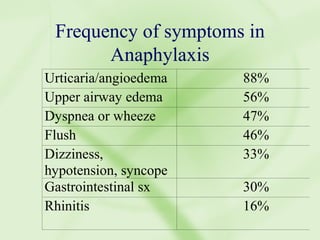
Frequency of symptoms in Anaphylaxis
Anaphylaxis Onset of symptoms of anaphylaxis:  usually in 5 to 30 minutes;  can be hours later A more prolonged latent period has been thought to be associated with a more benign course. Mortality:  due to respiratory events (70%), cardiovascular events (24%)
Prevention of anaphylaxis Avoid the responsible allergen (e.g. food, drug, latex, etc.). Keep an adrenaline kit (e.g. Epipen) and Benadryl on hand at all times. Medic Alert bracelets should be worn. Venom immunotherapy is highly effective in protecting insect-allergic individuals.
Treatment of anaphylaxis EPINEPHRINE (1:1000) SC or IM -  0.01 mg/kg (maximal dose 0.3-0.5 ml) -  administer in a proximal extremity -  may repeat every 10-15 min, p.r.n. EPINEPHRINE intravenously (IV) -  used for anaphylactic shock not responding to therapy -  monitor for cardiac arrhythmias EPINEPHRINE via endotracheal tube
Treatment of anaphylaxis Place patient in Trendelenburg position. Establish and maintain airway. Give oxygen via nasal cannula as needed. Place a tourniquet above the reaction site  (insect sting or injection site). Epinephrine (1:1000) 0.1-0.3 ml at the site of antigen injection Start IV with normal saline.
Treatment of anaphylaxis Benadryl (diphenhydramine) -  H1 antagonist Tagamet (cimetidine) -  H2 antagonist Corticosteroid therapy:  hydrocortisone IV or prednisone po
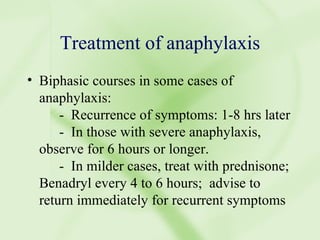
Treatment of anaphylaxis Biphasic courses in some cases of anaphylaxis: -  Recurrence of symptoms: 1-8 hrs later -  In those with severe anaphylaxis, observe for 6 hours or longer. -  In milder cases, treat with prednisone;  Benadryl every 4 to 6 hours;  advise to return immediately for recurrent symptoms
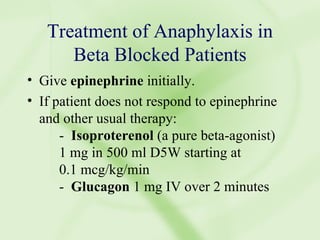
Treatment of Anaphylaxis in Beta Blocked Patients Give  epinephrine  initially. If patient does not respond to epinephrine and other usual therapy: -  Isoproterenol  (a pure beta-agonist)  1 mg in 500 ml D5W starting at  0.1 mcg/kg/min -  Glucagon  1 mg IV over 2 minutes
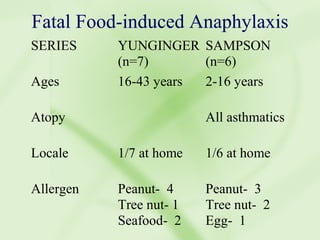
Fatal Food-induced Anaphylaxis
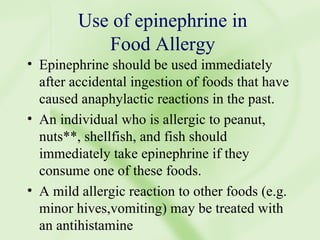
Use of epinephrine in Food Allergy Epinephrine should be used immediately after accidental ingestion of foods that have caused anaphylactic reactions in the past. An individual who is allergic to peanut, nuts**, shellfish, and fish should immediately take epinephrine if they consume one of these foods. A mild allergic reaction to other foods (e.g. minor hives,vomiting) may be treated with an antihistamine
Exercise-induced anaphylaxis  Exercise induces warmth, pruritus, urticaria. Hypotension and upper airway obstruction may follow. Some types:  associated with food allergies  (e.g. celery, nuts, shellfish, wheat) In other patients, anaphylaxis may occur after eating any meal (mechanism has not been identified)
Cold-induced anaphylaxis Cold exposure leads to urticaria. Drastic lowering of the whole body temperature (e.g. swimming in a cold lake):  hypotensive event in addition to urticaria mechanism:  unknown
DRUG ALLERGY
DRUG ALLERGY Adverse drug reactions -  majority of iatrogenic illnesses -  1% to 15% of drug courses Non-immunologic (90-95%):  side effects, toxic reactions, drug interactions, secondary or indirect effects (eg. bacterial overgrowth) pseudoallergic drug rx (e.g. opiate reactions, ASA/NSAID reactions) Immunologic (5-10%)
Drugs as immunogens Complete antigens - insulin, ACTH, PTH -  enzymes:  chymopapain, streptokinase -  foreign antisera e.g. tetanus antitoxin Incomplete antigens -  drugs with MW < 1000 -  drugs acting as haptens bind to macromolecules (e.g. proteins, polysaccharides, cell membranes)
Factors that influence the  development of drug allergy Route of administration: -  parenteral route more likely than oral route to cause sensitization and anaphylaxis -  inhalational route:  respiratory or conjunctival manifestations only -  topical: high incidence of sensitization Scheduling of administration: -intermittent courses: predispose to sensitization
Factors that influence the  development of drug allergy Nature of the drug: -  80% of allergic drug reactions due to: -  penicillin -  cephalosporins -  sulphonamides (sulpha drugs)  -  ASA/NSAIDs
Gell and Coombs reactions Type 1:  Immediate Hypersensitivity -  IgE-mediated -  occurs within minutes  to 4-6 hours of drug exposure Type 2:  Cytotoxic reactions -  antibody-drug interaction on the cell surface results in destruction of the cell eg.  hemolytic anemia due to penicillin, quinidine, quinine,cephalosporins
Gell and Coombs reactions Type 3:  Serum sickness -  fever, rash (urticaria, angioedema, palpable purpura), lymphadenopathy, splenomegaly, arthralgias -  onset:  2 days up to 4 weeks -  penicillin commonest cause Type 4:  Delayed type hypersensitivity -  sensitized to drug, the vehicle, or preservative (e.g. PABA, parabens, thimerosal)
Penicillin Allergy beta lactam antibiotic Type 1 reactions:  2% of penicillin courses Penicillin metabolites: -  95%:  benzylpenicilloyl moiety (the “major determinant”) -  5%:  benzyl penicillin G, penilloates, penicilloates (the “minor determinants”)
Penicillin Allergy Skin tests:  Penicillin G, Prepen (benzyl-penicilloyl-polylysine):  false negative rate of up to 7% Resolution of penicillin allergy -  50% lose penicillin allergy in 5 yr -  80-90% lose penicillin allergy in 10 yr
Cephalosporin allergy beta-lactam  ring and amide side chain similar to penicillin degree of cross-reactivity in those with penicillin allergy:  5% to 16% skin testing with penicillin determinants detects most but not all patients with cephalsporin allergy
“ Ampicillin rash” non-immunologic rash maculopapular, non-pruritic rash onsets 3 to 8 days into the antibiotic course incidence:  5% to 9% of ampicillin or amoxicillin courses;  69% to 100% in those with infectious mononucleosis or acute lymphocytic leukemia must be distinguished from hives secondary to ampicillin or amoxicillin
Sulphonamide hypersensitivity sulpha drugs more antigenic than beta lactam antibiotics common reactions:  drug eruptions (e.g. maculopapular or morbilliform rashes, erythema multiforme, etc.) Type 1 reactions:  urticaria, anaphylaxis, etc. no reliable skin tests for sulpha drugs re-exposure:  may cause exfoliative dermatitis, Stevens-Johnson syndrome
ASA and NSAID sensitivity Pseudoallergic reactions -  urticaria/angioedema -  asthma -  anaphylactoid reaction prevalence: 0.2%  general population 8-19%  asthmatics 30-40%  polyps & sinusitis ASA quatrad:  A sthma,  S inuitis,  A SA sensitivity, nasal  P olyps (ASAP syndrome)
ASA & NSAID sensitivity ASA sensitivity:  cross-reactive with all NSAIDs that inhibit cyclo-oxygenase
ASA & NSAID sensitivity no skin test or in vitro test to detect ASA or NSAID sensitivity to prove or disprove ASA sensitivity:  oral challenge to ASA (in hospital setting) ASA desensitization:  highly successful with ASA-induced asthma;  less successful with ASA-induced urticaria
Allergy skin testing Skin tests to detect IgE-mediated drug reactions is limited to: Complete antigens - insulin, ACTH, PTH - chymopapain, streptokinase -  foreign antisera  Incomplete antigens (drugs acting as  haptens) -  penicillins -  local anesthetics  -  general anesthetics
Management of drug allergy Identify most likely drugs (based on history). Perform allergy skin tests (if available). Avoidance of identified drug or suspected drug(s) is essential. Avoid potential cross-reacting drugs (e.g. avoid cephalosporins in penicillin-allergic individuals).
Management of drug allergy A Medic-Alert bracelet is recommended. Use alternative medications, if at all possible. Desensitize to implicated drug, if this drug is deemed essential.
Desensitization to medications Basic approach:  administer gradually increasing doses of the drug over a period of hours to days, typically beginning with one ten-thousandth of a conventional dose

Anaphylaxis

  • 1.
  • 2.
    Causes of anaphylaxisImmunologic mechanisms IgE-mediated - drugs - foods - hymenoptera (stinging insects) - latex Non-IgE mediated - anaphylotoxins-mediated e.g. mismatched blood
  • 3.
    Causes of anaphylaxisDirect activation of mast cells - opiates, tubocurare, dextran, radiocontrast dyes Mediators of arachidonic acid metabolism - Aspirin (ASA) - Nonsteroidal anti-inflammatory drugs (NSAIDs) Mechanism unknown - Sulphites
  • 4.
    Causes of anaphylaxisExercise-induced food-dependent, exercise-induced cold-induced idiopathic
  • 5.
    Risk of anaphylaxisYocum etal. (Rochester Epidemiology Project) 1983-1987: incidence: 21/100,000 patient-years food allergy 36%, medications 17%, insect sting 15%
  • 6.
    Frequency of symptomsin Anaphylaxis
  • 7.
    Anaphylaxis Onset ofsymptoms of anaphylaxis: usually in 5 to 30 minutes; can be hours later A more prolonged latent period has been thought to be associated with a more benign course. Mortality: due to respiratory events (70%), cardiovascular events (24%)
  • 8.
    Prevention of anaphylaxisAvoid the responsible allergen (e.g. food, drug, latex, etc.). Keep an adrenaline kit (e.g. Epipen) and Benadryl on hand at all times. Medic Alert bracelets should be worn. Venom immunotherapy is highly effective in protecting insect-allergic individuals.
  • 9.
    Treatment of anaphylaxisEPINEPHRINE (1:1000) SC or IM - 0.01 mg/kg (maximal dose 0.3-0.5 ml) - administer in a proximal extremity - may repeat every 10-15 min, p.r.n. EPINEPHRINE intravenously (IV) - used for anaphylactic shock not responding to therapy - monitor for cardiac arrhythmias EPINEPHRINE via endotracheal tube
  • 10.
    Treatment of anaphylaxisPlace patient in Trendelenburg position. Establish and maintain airway. Give oxygen via nasal cannula as needed. Place a tourniquet above the reaction site (insect sting or injection site). Epinephrine (1:1000) 0.1-0.3 ml at the site of antigen injection Start IV with normal saline.
  • 11.
    Treatment of anaphylaxisBenadryl (diphenhydramine) - H1 antagonist Tagamet (cimetidine) - H2 antagonist Corticosteroid therapy: hydrocortisone IV or prednisone po
  • 12.
    Treatment of anaphylaxisBiphasic courses in some cases of anaphylaxis: - Recurrence of symptoms: 1-8 hrs later - In those with severe anaphylaxis, observe for 6 hours or longer. - In milder cases, treat with prednisone; Benadryl every 4 to 6 hours; advise to return immediately for recurrent symptoms
  • 13.
    Treatment of Anaphylaxisin Beta Blocked Patients Give epinephrine initially. If patient does not respond to epinephrine and other usual therapy: - Isoproterenol (a pure beta-agonist) 1 mg in 500 ml D5W starting at 0.1 mcg/kg/min - Glucagon 1 mg IV over 2 minutes
  • 14.
  • 15.
    Use of epinephrinein Food Allergy Epinephrine should be used immediately after accidental ingestion of foods that have caused anaphylactic reactions in the past. An individual who is allergic to peanut, nuts**, shellfish, and fish should immediately take epinephrine if they consume one of these foods. A mild allergic reaction to other foods (e.g. minor hives,vomiting) may be treated with an antihistamine
  • 16.
    Exercise-induced anaphylaxis Exercise induces warmth, pruritus, urticaria. Hypotension and upper airway obstruction may follow. Some types: associated with food allergies (e.g. celery, nuts, shellfish, wheat) In other patients, anaphylaxis may occur after eating any meal (mechanism has not been identified)
  • 17.
    Cold-induced anaphylaxis Coldexposure leads to urticaria. Drastic lowering of the whole body temperature (e.g. swimming in a cold lake): hypotensive event in addition to urticaria mechanism: unknown
  • 18.
  • 19.
    DRUG ALLERGY Adversedrug reactions - majority of iatrogenic illnesses - 1% to 15% of drug courses Non-immunologic (90-95%): side effects, toxic reactions, drug interactions, secondary or indirect effects (eg. bacterial overgrowth) pseudoallergic drug rx (e.g. opiate reactions, ASA/NSAID reactions) Immunologic (5-10%)
  • 20.
    Drugs as immunogensComplete antigens - insulin, ACTH, PTH - enzymes: chymopapain, streptokinase - foreign antisera e.g. tetanus antitoxin Incomplete antigens - drugs with MW < 1000 - drugs acting as haptens bind to macromolecules (e.g. proteins, polysaccharides, cell membranes)
  • 21.
    Factors that influencethe development of drug allergy Route of administration: - parenteral route more likely than oral route to cause sensitization and anaphylaxis - inhalational route: respiratory or conjunctival manifestations only - topical: high incidence of sensitization Scheduling of administration: -intermittent courses: predispose to sensitization
  • 22.
    Factors that influencethe development of drug allergy Nature of the drug: - 80% of allergic drug reactions due to: - penicillin - cephalosporins - sulphonamides (sulpha drugs) - ASA/NSAIDs
  • 23.
    Gell and Coombsreactions Type 1: Immediate Hypersensitivity - IgE-mediated - occurs within minutes to 4-6 hours of drug exposure Type 2: Cytotoxic reactions - antibody-drug interaction on the cell surface results in destruction of the cell eg. hemolytic anemia due to penicillin, quinidine, quinine,cephalosporins
  • 24.
    Gell and Coombsreactions Type 3: Serum sickness - fever, rash (urticaria, angioedema, palpable purpura), lymphadenopathy, splenomegaly, arthralgias - onset: 2 days up to 4 weeks - penicillin commonest cause Type 4: Delayed type hypersensitivity - sensitized to drug, the vehicle, or preservative (e.g. PABA, parabens, thimerosal)
  • 25.
    Penicillin Allergy betalactam antibiotic Type 1 reactions: 2% of penicillin courses Penicillin metabolites: - 95%: benzylpenicilloyl moiety (the “major determinant”) - 5%: benzyl penicillin G, penilloates, penicilloates (the “minor determinants”)
  • 26.
    Penicillin Allergy Skintests: Penicillin G, Prepen (benzyl-penicilloyl-polylysine): false negative rate of up to 7% Resolution of penicillin allergy - 50% lose penicillin allergy in 5 yr - 80-90% lose penicillin allergy in 10 yr
  • 27.
    Cephalosporin allergy beta-lactam ring and amide side chain similar to penicillin degree of cross-reactivity in those with penicillin allergy: 5% to 16% skin testing with penicillin determinants detects most but not all patients with cephalsporin allergy
  • 28.
    “ Ampicillin rash”non-immunologic rash maculopapular, non-pruritic rash onsets 3 to 8 days into the antibiotic course incidence: 5% to 9% of ampicillin or amoxicillin courses; 69% to 100% in those with infectious mononucleosis or acute lymphocytic leukemia must be distinguished from hives secondary to ampicillin or amoxicillin
  • 29.
    Sulphonamide hypersensitivity sulphadrugs more antigenic than beta lactam antibiotics common reactions: drug eruptions (e.g. maculopapular or morbilliform rashes, erythema multiforme, etc.) Type 1 reactions: urticaria, anaphylaxis, etc. no reliable skin tests for sulpha drugs re-exposure: may cause exfoliative dermatitis, Stevens-Johnson syndrome
  • 30.
    ASA and NSAIDsensitivity Pseudoallergic reactions - urticaria/angioedema - asthma - anaphylactoid reaction prevalence: 0.2% general population 8-19% asthmatics 30-40% polyps & sinusitis ASA quatrad: A sthma, S inuitis, A SA sensitivity, nasal P olyps (ASAP syndrome)
  • 31.
    ASA & NSAIDsensitivity ASA sensitivity: cross-reactive with all NSAIDs that inhibit cyclo-oxygenase
  • 32.
    ASA & NSAIDsensitivity no skin test or in vitro test to detect ASA or NSAID sensitivity to prove or disprove ASA sensitivity: oral challenge to ASA (in hospital setting) ASA desensitization: highly successful with ASA-induced asthma; less successful with ASA-induced urticaria
  • 33.
    Allergy skin testingSkin tests to detect IgE-mediated drug reactions is limited to: Complete antigens - insulin, ACTH, PTH - chymopapain, streptokinase - foreign antisera Incomplete antigens (drugs acting as haptens) - penicillins - local anesthetics - general anesthetics
  • 34.
    Management of drugallergy Identify most likely drugs (based on history). Perform allergy skin tests (if available). Avoidance of identified drug or suspected drug(s) is essential. Avoid potential cross-reacting drugs (e.g. avoid cephalosporins in penicillin-allergic individuals).
  • 35.
    Management of drugallergy A Medic-Alert bracelet is recommended. Use alternative medications, if at all possible. Desensitize to implicated drug, if this drug is deemed essential.
  • 36.
    Desensitization to medicationsBasic approach: administer gradually increasing doses of the drug over a period of hours to days, typically beginning with one ten-thousandth of a conventional dose