ANAPHYLAXIS
BY DR MRIDUL MURALI KRISHNA
DNB FAMILY MEDICINE RESIDENT
Atopy
 The term ATOPY implies a tendency to manifest asthma, rhinitis, urticaria, and
atopic dermatitis alone or in combination, in association with the presence of
allergen-specific IgE.
 However, individuals without an atopic background may also develop
hypersensitivity reactions, particularly urticaria and anaphylaxis, associated with
the presence of IgE.
Risk Factors
 Mild Asthma: Relative Risk 2
 Severe Asthma: Relative Risk 3
 Known Food Allergy, Hymenoptera Sting allergy or medication allergy
 Risk factors for a poor outcome include
 Older age,
 Use of beta blockers
 Presence of preexisting asthma.
 Some individuals suffering from recurrent episodes of idiopathic anaphylaxis
possess morphologically aberrant mast cells in their bone marrow that express
a mutant, constitutively active form of c-kit, even without evidence of frank
mastocytosis
Precautions
 Anaphylaxis is a life threatening condition that requires
 Immediate ABC Management
 Epinephrine injection IM
 Biphasic reactions occur in up to 20% of cases
 Second acute anaphylactic reaction despite no repeat exposure to the original allergen
 May be delayed up to 8 hours later (24-72 hour delay has been reported in atypical
cases)
Causes
 Idiopathic
 Consider mastocytosis
 Hymenoptera Allergy (Bees, wasps, fire ants)
 Food Allergy (30% of anaphylactic episodes, especially in children under age 4 years)
 Cow's Milk
 Egg whites
 Fish
 Peanuts
 Tree nuts
 Sesame
 Food additives
 Shellfish
Causes (continued)
 Medications (most common in age over 55 years)
 Penicillin Allergy (75% of anaphylactic deaths)
 NSAIDs or Aspirin
 Radiographic Intravenous Contrast Material
 Allopurinol
 ACE Inhibitors
 Opioids
 Interferon
 Allergic Contact Dermatits
 Latex Allergy
 Misc – Animal Dander
Signs – Typical Presentation
 Urticaria and Angioedema (90% of cases)
 Respiratory distress
 Upper airway obstruction (70% of cases)
 Lower airway obstruction may occur, especially in Asthma
 Cardiovascular collapse with Hypotension (45% of cases)
 Gastrointestinal symptoms such as Vomiting (45% of cases)
 Neurologic symptoms such as Headache or Dizziness (15% of cases)
Signs - MILD
 General
 Feeling impending doom
 Pruritus (uncommon without rash)
 Metallic Taste in mouth
 Naso-ocular
 Itchy nose or eyes
 Sneezing
 Clear, watery Eye Discharge or Nasal discharge
 Skin (occurs)
 Urticaria: Hives
 Angioedema: Facial swelling and Lip swelling
Sign - MODERATE
 Neurologic
 Dizziness
 Weakness
 Gastrointestinal
 Nausea, Vomiting
 Bloody Diarrhea
 Abdominal Pain
 Fecal urgency or Incontinence
 Genitourinary
 Uterine cramps
 Urinary urgency or Incontinence
Signs – SEVERE (ANAPHYLAXIS)
 Airway Compromise
 Hoarseness or Dysphonia
 Stridor
 Inability to manage own secretions
 Airway posturing (sniffing position)
 Breathing Compromise
 Wheezing and bronchospasm
 Dyspnea
 Tachypnea
 Hypoxia
 Increased work of breathing
Signs – SEVERE (ANAPHYLAXIS)
 Circulatory compromise
 Hypotension
 Tachycardia
 Hypoperfusion
 Syncope
Labs: Confirms diagnosis
 Do not rely on labs to make or treat acute episode
 Serum histamine
 Requires special handling for accuracy
 Obtain first level within 1 hour of symptom onset
 Compare to baseline level
 Serum tryptase
 Levels rise 30 minutes after onset and peak at 1-2 hours
 Obtain level on presentation, in 1-2 hours and 24 hours after presentation
Diagnosis – If 1 of the Criteria met
 Criteria 1:
 Acute illness onset within minutes to hours AND
 Skin or mucosal effects (e.g. Hives, Pruritus, Flushing, swollen lips/Tongue/uvula)
AND
 Respiratory distress (e.g. Dyspnea, bronchospasm) or Cardiovascular collapse
(e.g. Hypotension, Syncope)
Diagnosis – If 1 of the Criteria met
 Criteria 2:
 Acute illness onset within minutes to hours after likely allergen exposure
AND atleast TWO of the following
 Skin or mucosal effects (e.g. Hives, Pruritus, Flushing, swollen lips/Tongue/uvula)
 Respiratory distress (e.g. Dyspnea, bronchospasm)
 Cardiovascular collapse (e.g. Hypotension, Syncope)
 Gastrointestinal symptoms persist (e.g. abdominal cramping, Vomiting)
Diagnosis – If 1 of the Criteria met
 Criteria 3:
 Hypotension within minutes to hours after likely allergen exposure
 Systolic Blood Pressure with 30% decrease from baseline or <90 mmHg (adults)
 SUMMARY
 Anaphylaxis is present if allergen exposure and Hypotension or two
compromised organ systems
GENERAL MEASURES
 1. ABC MANAGEMENT
 2. SUPPLEMENTAL OXYGEN
Anaphylaxis with Airway compromise
 Epinephrine is the mainstay of Anaphylaxis management and must not be
delayed
 Administer within 5 minutes of presentation
 Narrow window of opportunity with Epinephrine
 Prior to complete airway obstruction and cardiovascular collapse
 Vasoconstricts, bronchodilates and decreases airway edema
 Epinephrine IM is safe EVEN IN OLDER PATIENTS and should not be withheld
when Anaphylaxis criteria are met
Anaphylaxis with Airway compromise
 Epinephrine (1:1000 concentration = 1 mg/ml)
 Intramuscular dosing preferred over subcutaneous
 Due to more reliable and faster rise in blood levels
 Typically injected in lateral thigh
 Repeat every 5 to 15 minutes prn up to 3 doses
 Cardiac monitoring required for repeat dosing
 Epinephrine via vial
 Adult: 0.5 mg (0.5 ml) of 1:1000 Epinephrine IM
 Child: 0.01 mg/kg (0.01 ml/kg) IM up to 0.3 mg (0.3 ml)
 Epinephrine Autoinjector (preferred if available, as reduces errors and speeds delivery)
 Adult and children over 30 kg or 66 pounds: 0.3 mg autoinjector
 Children under 30 kg or 66 pounds: 0.15 autoinjector
Anaphylaxis with Airway compromise
 Anaphylaxis "Dirty" Epinephrine drip ("dirty epi drip")
o Indicated if repeat intramuscular Epinephrine dosing is required for Anaphylaxis
o Order at the time of second Epinephrine injection
o Preparation:
o Aim - Epinephrine 1 mcg/ml solution
o Draw up 1 mg of Epinephrine (1 ml of 1:1000 or 10 ml of 1:10000)
o Inject 1 mg Epinephrine into 1 Liter bag of Normal Saline (now 1 mcg/ml Epinephrine)
o Given 1 cc/20 drops AND 1 mcg/ml Epinephrine
o Goal rate: 6 mcg/min
o Equates to 2 drops per second
Anaphylaxis with Airway compromise
 Protocol 1: Hypotensive, unstable patient
 Draw into syringe, 10 ml (10 mcg) from 1 mcg/ml Epinephrine solution
prepared above
 Inject 5 ml (5 mcg) IV (may repeat second 5 ml/5 mcg dose)
Anaphylaxis with Airway compromise
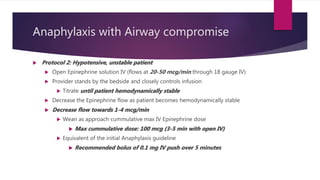
 Protocol 2: Hypotensive, unstable patient
 Open Epinephrine solution IV (flows at 20-50 mcg/min through 18 gauge IV)
 Provider stands by the bedside and closely controls infusion
 Titrate until patient hemodynamically stable
 Decrease the Epinephrine flow as patient becomes hemodynamically stable
 Decrease flow towards 1-4 mcg/min
 Wean as approach cummulative max IV Epinephrine dose
 Max cummulative dose: 100 mcg (3-5 min with open IV)
 Equivalent of the initial Anaphylaxis guideline
 Recommended bolus of 0.1 mg IV push over 5 minutes
Anaphylaxis with Airway compromise
 Protocol 3: Cautious titration
 Start infusion at 1 mcg/min and titrate to effect (typically 1-4 mcg/min)
Anaphylaxis with Airway compromise
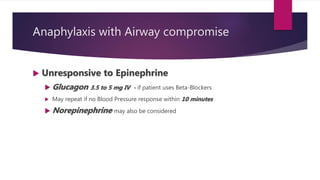
 Unresponsive to Epinephrine
 Glucagon 3.5 to 5 mg IV - if patient uses Beta-Blockers
 May repeat if no Blood Pressure response within 10 minutes
 Norepinephrine may also be considered
Hypotension
 Due to Vasodilitation and third spacing
 Fluid Resuscitation with isotonic saline (NS, LR)
 Adult: 2 Liters Normal Saline
 Child: 10-20 ml/kg per bolus until Hypotension improves
 Large volumes may be required
 Pressors (e.g. Norepinephrine, Dopamine) may be required
 Consider Epinephrine by continuous IV infusion
Respiratory Distress
 Nebulized Beta adrenergic agonist (e.g. Albuterol)
 Consider for signs of lower airway obstruction
 Consider Endotracheal Intubation
Urticaria, Pruritus or Flushing
 General: H1 Antagonists
 NOT a first-line agent in Anaphylaxis management
 Use ONLY as an ADJUNCT TO EPINEPHRINE and ABC Management
 Effects are delayed 1-2 hours from delivery
 Does not reverse upper airway obstruction or improve Hypotension
 Diphenhydramine (Benadryl)
 Chlorpheniramine Maleate
 1 mg/kg intramuscular or intravenous is indicated in children even if less than
1 year of age
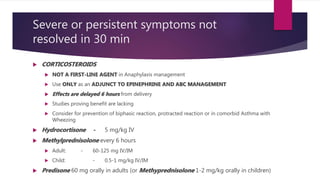
Severe or persistent symptoms not
resolved in 30 min
 CORTICOSTEROIDS
 NOT A FIRST-LINE AGENT in Anaphylaxis management
 Use ONLY as an ADJUNCT TO EPINEPHRINE AND ABC MANAGEMENT
 Effects are delayed 6 hours from delivery
 Studies proving benefit are lacking
 Consider for prevention of biphasic reaction, protracted reaction or in comorbid Asthma with
Wheezing
 Hydrocortisone - 5 mg/kg IV
 Methylprednisolone every 6 hours
 Adult: - 60-125 mg IV/IM
 Child: - 0.5-1 mg/kg IV/IM
 Predisone 60 mg orally in adults (or Methyprednisolone 1-2 mg/kg orally in children)
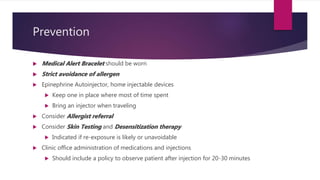
Prevention
 Medical Alert Bracelet should be worn
 Strict avoidance of allergen
 Epinephrine Autoinjector, home injectable devices
 Keep one in place where most of time spent
 Bring an injector when traveling
 Consider Allergist referral
 Consider Skin Testing and Desensitization therapy
 Indicated if re-exposure is likely or unavoidable
 Clinic office administration of medications and injections
 Should include a policy to observe patient after injection for 20-30 minutes
Anaphylaxis

Anaphylaxis

  • 1.
    ANAPHYLAXIS BY DR MRIDULMURALI KRISHNA DNB FAMILY MEDICINE RESIDENT
  • 2.
    Atopy  The termATOPY implies a tendency to manifest asthma, rhinitis, urticaria, and atopic dermatitis alone or in combination, in association with the presence of allergen-specific IgE.  However, individuals without an atopic background may also develop hypersensitivity reactions, particularly urticaria and anaphylaxis, associated with the presence of IgE.
  • 3.
    Risk Factors  MildAsthma: Relative Risk 2  Severe Asthma: Relative Risk 3  Known Food Allergy, Hymenoptera Sting allergy or medication allergy  Risk factors for a poor outcome include  Older age,  Use of beta blockers  Presence of preexisting asthma.  Some individuals suffering from recurrent episodes of idiopathic anaphylaxis possess morphologically aberrant mast cells in their bone marrow that express a mutant, constitutively active form of c-kit, even without evidence of frank mastocytosis
  • 4.
    Precautions  Anaphylaxis isa life threatening condition that requires  Immediate ABC Management  Epinephrine injection IM  Biphasic reactions occur in up to 20% of cases  Second acute anaphylactic reaction despite no repeat exposure to the original allergen  May be delayed up to 8 hours later (24-72 hour delay has been reported in atypical cases)
  • 5.
    Causes  Idiopathic  Considermastocytosis  Hymenoptera Allergy (Bees, wasps, fire ants)  Food Allergy (30% of anaphylactic episodes, especially in children under age 4 years)  Cow's Milk  Egg whites  Fish  Peanuts  Tree nuts  Sesame  Food additives  Shellfish
  • 6.
    Causes (continued)  Medications(most common in age over 55 years)  Penicillin Allergy (75% of anaphylactic deaths)  NSAIDs or Aspirin  Radiographic Intravenous Contrast Material  Allopurinol  ACE Inhibitors  Opioids  Interferon  Allergic Contact Dermatits  Latex Allergy  Misc – Animal Dander
  • 7.
    Signs – TypicalPresentation  Urticaria and Angioedema (90% of cases)  Respiratory distress  Upper airway obstruction (70% of cases)  Lower airway obstruction may occur, especially in Asthma  Cardiovascular collapse with Hypotension (45% of cases)  Gastrointestinal symptoms such as Vomiting (45% of cases)  Neurologic symptoms such as Headache or Dizziness (15% of cases)
  • 8.
    Signs - MILD General  Feeling impending doom  Pruritus (uncommon without rash)  Metallic Taste in mouth  Naso-ocular  Itchy nose or eyes  Sneezing  Clear, watery Eye Discharge or Nasal discharge  Skin (occurs)  Urticaria: Hives  Angioedema: Facial swelling and Lip swelling
  • 9.
    Sign - MODERATE Neurologic  Dizziness  Weakness  Gastrointestinal  Nausea, Vomiting  Bloody Diarrhea  Abdominal Pain  Fecal urgency or Incontinence  Genitourinary  Uterine cramps  Urinary urgency or Incontinence
  • 10.
    Signs – SEVERE(ANAPHYLAXIS)  Airway Compromise  Hoarseness or Dysphonia  Stridor  Inability to manage own secretions  Airway posturing (sniffing position)  Breathing Compromise  Wheezing and bronchospasm  Dyspnea  Tachypnea  Hypoxia  Increased work of breathing
  • 11.
    Signs – SEVERE(ANAPHYLAXIS)  Circulatory compromise  Hypotension  Tachycardia  Hypoperfusion  Syncope
  • 12.
    Labs: Confirms diagnosis Do not rely on labs to make or treat acute episode  Serum histamine  Requires special handling for accuracy  Obtain first level within 1 hour of symptom onset  Compare to baseline level  Serum tryptase  Levels rise 30 minutes after onset and peak at 1-2 hours  Obtain level on presentation, in 1-2 hours and 24 hours after presentation
  • 13.
    Diagnosis – If1 of the Criteria met  Criteria 1:  Acute illness onset within minutes to hours AND  Skin or mucosal effects (e.g. Hives, Pruritus, Flushing, swollen lips/Tongue/uvula) AND  Respiratory distress (e.g. Dyspnea, bronchospasm) or Cardiovascular collapse (e.g. Hypotension, Syncope)
  • 14.
    Diagnosis – If1 of the Criteria met  Criteria 2:  Acute illness onset within minutes to hours after likely allergen exposure AND atleast TWO of the following  Skin or mucosal effects (e.g. Hives, Pruritus, Flushing, swollen lips/Tongue/uvula)  Respiratory distress (e.g. Dyspnea, bronchospasm)  Cardiovascular collapse (e.g. Hypotension, Syncope)  Gastrointestinal symptoms persist (e.g. abdominal cramping, Vomiting)
  • 15.
    Diagnosis – If1 of the Criteria met  Criteria 3:  Hypotension within minutes to hours after likely allergen exposure  Systolic Blood Pressure with 30% decrease from baseline or <90 mmHg (adults)  SUMMARY  Anaphylaxis is present if allergen exposure and Hypotension or two compromised organ systems
  • 16.
    GENERAL MEASURES  1.ABC MANAGEMENT  2. SUPPLEMENTAL OXYGEN
  • 17.
    Anaphylaxis with Airwaycompromise  Epinephrine is the mainstay of Anaphylaxis management and must not be delayed  Administer within 5 minutes of presentation  Narrow window of opportunity with Epinephrine  Prior to complete airway obstruction and cardiovascular collapse  Vasoconstricts, bronchodilates and decreases airway edema  Epinephrine IM is safe EVEN IN OLDER PATIENTS and should not be withheld when Anaphylaxis criteria are met
  • 18.
    Anaphylaxis with Airwaycompromise  Epinephrine (1:1000 concentration = 1 mg/ml)  Intramuscular dosing preferred over subcutaneous  Due to more reliable and faster rise in blood levels  Typically injected in lateral thigh  Repeat every 5 to 15 minutes prn up to 3 doses  Cardiac monitoring required for repeat dosing  Epinephrine via vial  Adult: 0.5 mg (0.5 ml) of 1:1000 Epinephrine IM  Child: 0.01 mg/kg (0.01 ml/kg) IM up to 0.3 mg (0.3 ml)  Epinephrine Autoinjector (preferred if available, as reduces errors and speeds delivery)  Adult and children over 30 kg or 66 pounds: 0.3 mg autoinjector  Children under 30 kg or 66 pounds: 0.15 autoinjector
  • 20.
    Anaphylaxis with Airwaycompromise  Anaphylaxis "Dirty" Epinephrine drip ("dirty epi drip") o Indicated if repeat intramuscular Epinephrine dosing is required for Anaphylaxis o Order at the time of second Epinephrine injection o Preparation: o Aim - Epinephrine 1 mcg/ml solution o Draw up 1 mg of Epinephrine (1 ml of 1:1000 or 10 ml of 1:10000) o Inject 1 mg Epinephrine into 1 Liter bag of Normal Saline (now 1 mcg/ml Epinephrine) o Given 1 cc/20 drops AND 1 mcg/ml Epinephrine o Goal rate: 6 mcg/min o Equates to 2 drops per second
  • 21.
    Anaphylaxis with Airwaycompromise  Protocol 1: Hypotensive, unstable patient  Draw into syringe, 10 ml (10 mcg) from 1 mcg/ml Epinephrine solution prepared above  Inject 5 ml (5 mcg) IV (may repeat second 5 ml/5 mcg dose)
  • 22.
    Anaphylaxis with Airwaycompromise  Protocol 2: Hypotensive, unstable patient  Open Epinephrine solution IV (flows at 20-50 mcg/min through 18 gauge IV)  Provider stands by the bedside and closely controls infusion  Titrate until patient hemodynamically stable  Decrease the Epinephrine flow as patient becomes hemodynamically stable  Decrease flow towards 1-4 mcg/min  Wean as approach cummulative max IV Epinephrine dose  Max cummulative dose: 100 mcg (3-5 min with open IV)  Equivalent of the initial Anaphylaxis guideline  Recommended bolus of 0.1 mg IV push over 5 minutes
  • 23.
    Anaphylaxis with Airwaycompromise  Protocol 3: Cautious titration  Start infusion at 1 mcg/min and titrate to effect (typically 1-4 mcg/min)
  • 24.
    Anaphylaxis with Airwaycompromise  Unresponsive to Epinephrine  Glucagon 3.5 to 5 mg IV - if patient uses Beta-Blockers  May repeat if no Blood Pressure response within 10 minutes  Norepinephrine may also be considered
  • 25.
    Hypotension  Due toVasodilitation and third spacing  Fluid Resuscitation with isotonic saline (NS, LR)  Adult: 2 Liters Normal Saline  Child: 10-20 ml/kg per bolus until Hypotension improves  Large volumes may be required  Pressors (e.g. Norepinephrine, Dopamine) may be required  Consider Epinephrine by continuous IV infusion
  • 26.
    Respiratory Distress  NebulizedBeta adrenergic agonist (e.g. Albuterol)  Consider for signs of lower airway obstruction  Consider Endotracheal Intubation
  • 27.
    Urticaria, Pruritus orFlushing  General: H1 Antagonists  NOT a first-line agent in Anaphylaxis management  Use ONLY as an ADJUNCT TO EPINEPHRINE and ABC Management  Effects are delayed 1-2 hours from delivery  Does not reverse upper airway obstruction or improve Hypotension  Diphenhydramine (Benadryl)  Chlorpheniramine Maleate  1 mg/kg intramuscular or intravenous is indicated in children even if less than 1 year of age
  • 28.
    Severe or persistentsymptoms not resolved in 30 min  CORTICOSTEROIDS  NOT A FIRST-LINE AGENT in Anaphylaxis management  Use ONLY as an ADJUNCT TO EPINEPHRINE AND ABC MANAGEMENT  Effects are delayed 6 hours from delivery  Studies proving benefit are lacking  Consider for prevention of biphasic reaction, protracted reaction or in comorbid Asthma with Wheezing  Hydrocortisone - 5 mg/kg IV  Methylprednisolone every 6 hours  Adult: - 60-125 mg IV/IM  Child: - 0.5-1 mg/kg IV/IM  Predisone 60 mg orally in adults (or Methyprednisolone 1-2 mg/kg orally in children)
  • 29.
    Prevention  Medical AlertBracelet should be worn  Strict avoidance of allergen  Epinephrine Autoinjector, home injectable devices  Keep one in place where most of time spent  Bring an injector when traveling  Consider Allergist referral  Consider Skin Testing and Desensitization therapy  Indicated if re-exposure is likely or unavoidable  Clinic office administration of medications and injections  Should include a policy to observe patient after injection for 20-30 minutes