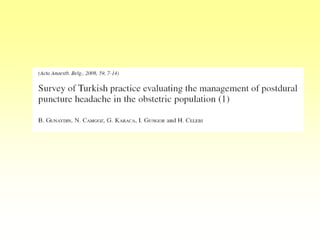
SURVEY OF TURKISH PRACTICE
EVALUATING THE MANAGEMENT OF
POSTDURAL PUNCTURE HEADACHE
IN THE OBSTETRIC POPULATION
Berrin Günaydın, MD, PhD
Department of Anesthesiology
Gazi University Faculty of Medicine
ANKARA-TURKEY
GAZI UNIVERSITY
FACULTY OF MEDICINE
Background
• Surveys and meta-analysis concerning
the management of PDPH in the
obstetric population have been published
– Choi et al. Examining the evidence in anaesthesia literature: a
survey and evaluation of obstetrical Postdural puncture
headache reports. Can. J. Anesth., 49, 49–56, 2002.
– Baraz and Collis. The management of accidental dural
puncture during labour epidural analgesia: a survey of UK
practice. Anaesthesia, 60, 673-679, 2005.
Aim
• Primarily to determine the current practice in the
management of PDPH in a small sample
reflecting roughly the commonly preferred
approaches
• Secondly to provide awareness of the
responders with this particular entity
Methods
• Questionnaire including 24 questions similar to
Baraz and Collis’s were given to the
participants
• Participants were asked to submit their
surveys either to the surveyors or send it via e-
mail to the contact person later
• Microsoft Excel® software was used for data
analysis
• Results were presented as n and/or %
Questionnaire
Results
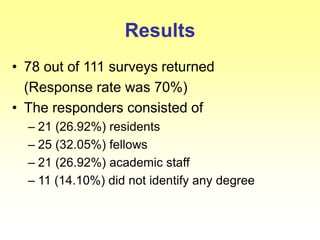
• 78 out of 111 surveys returned
(Response rate was 70%)
• The responders consisted of
– 21 (26.92%) residents
– 25 (32.05%) fellows
– 21 (26.92%) academic staff
– 11 (14.10%) did not identify any degree
Results
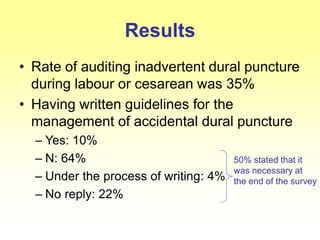
• Rate of auditing inadvertent dural puncture
during labour or cesarean was 35%
• Having written guidelines for the
management of accidental dural puncture
– Yes: 10%
– N: 64%
– Under the process of writing: 4%
– No reply: 22%
50% stated that it
was necessary at
the end of the survey
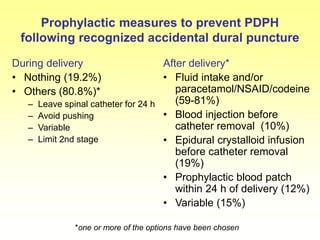
Prophylactic measures to prevent PDPH
following recognized accidental dural puncture
During delivery
• Nothing (19.2%)
• Others (80.8%)*
– Leave spinal catheter for 24 h
– Avoid pushing
– Variable
– Limit 2nd stage
After delivery*
• Fluid intake and/or
paracetamol/NSAID/codeine
(59-81%)
• Blood injection before
catheter removal (10%)
• Epidural crystalloid infusion
before catheter removal
(19%)
• Prophylactic blood patch
within 24 h of delivery (12%)
• Variable (15%)
*one or more of the options have been chosen
Results - During delivery
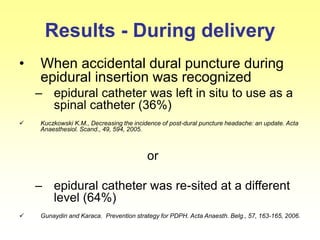
• When accidental dural puncture during
epidural insertion was recognized
– epidural catheter was left in situ to use as a
spinal catheter (36%)
 Kuczkowski K.M., Decreasing the incidence of post-dural puncture headache: an update. Acta
Anaesthesiol. Scand., 49, 594, 2005.
or
– epidural catheter was re-sited at a different
level (64%)
 Gunaydin and Karaca. Prevention strategy for PDPH. Acta Anaesth. Belg., 57, 163-165, 2006.
Possible reasons for using an epidural
catheter as an intrathecal catheter
 No recommendation (62%)
 Possible reasons according to preferance order (38%)*
 Allow immediate analgesia for labour
 Avoid another dural puncture
 Reduce the incidence and/or severity of PDPH
 Only in difficult cases (e.g. obesity & multiple attempts)
 Kuczkowski K.M., Post-dural puncture headache in the obstetric patient: an old problem. New solutions.
Minerva Anestesiol., 70, 823-830, 2004.
 Kuczkowski and Benumof. Decrease in the incidence of post-dural puncture headache: maintaining CSF
pressure. Acta Anaesthesiol. Scand., 47, 98-100, 2003.
*one or more of the options have been chosen
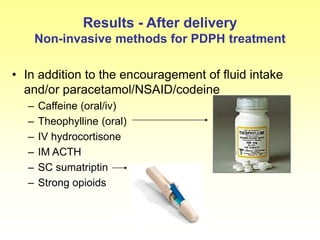
Results - After delivery
Non-invasive methods for PDPH treatment
• In addition to the encouragement of fluid intake
and/or paracetamol/NSAID/codeine
– Caffeine (oral/iv)
– Theophylline (oral)
– IV hydrocortisone
– IM ACTH
– SC sumatriptin
– Strong opioids
Ambulation after delivery following
accidental dural puncture
• As early as possible: 7%
• Bed rest:6 h (3%),12 h (15%) or 24 h (36%)
• No idea: 49%
Methods routinely used for PDPH treatment
• 1st option is the conservative treatment
• Blood patch was mostly preferred after failed
conservative treatment
• Blood patch as soon as PDPH diagnosed is less
preferred
• Different measures can be selected
 History (Gormley 1960, DiGiovanni & Dunbar 1970)
 Mechanism of action
Plug theory
Clot is formed by injecting 15-20 ml autologous
blood in the epidural space to provide adherence
to the dura mater and directly patches the hole
Pressure patch hypothesis
Volume of blood injected into epidural space
increases CSF pressure leading to reduction in
the traction of the pain sensitive brain structures
Epidural Blood Patch (EBP)
EBP
Contraindications
 Infection on the back
 Sepsis
 Coagulopathy
 Raised white cell
count
 Prexia
 Patient refusal
Timing
 Beyond 24 h after
dural puncture
Recumbent
positioning
 For 2 h after patching
may improve the
efficacy
EBP
 Complication rate is rare
 ~35% backache
 Success rate is ~94% (70-98%)
 90% initial relief
 61-75% persistent relief
 Repeat EBP has a similar success rate
 Reverse complications of dural puncture
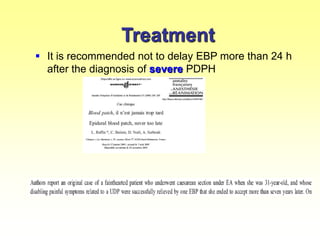
Treatment
 It is recommended not to delay EBP more than 24 h
after the diagnosis of severe PDPH
EBP
• Mostly performed in the recovery room
• Sometimes in the labour ward
• Rarely in the patient’s room
• Generally performed with the help of a
resident or a staff member
• Rarely performed by one person
Gunaydin et al. Acta Anaesthesiol Belg 2008
EBP
• Intravenous access before EBP (69%)
• ECG (58%)
• Blood pressure (65%) and
• Pulse oxymeter (63%) were performed by the
majority of the responders
Gunaydin et al. Acta Anaesthesiol Belg 2008
Advices at discharge after a
successfull EBP
• Discharge
– After EBP 1 (4%), 2 (15%) or 3-6 hours (44%)
• Follow-up
– Before full mobilization 2 (47%) or 4 hours (23%)
of bed rest
– Increase fluid intake
– Keep intervention side clean
– Contact whenever headache reoccurs and report
fever, weakness or numbness
Gunaydin et al. Acta Anaesthesiol Belg 2008
After an unsuccessfull EBP
• Rate of never considering another EBP (36%)
• Rate of repeating EBP (37%)
• No recommendation (27%)
• If two EBPs were unsuccessfull, further
investigations were considered (63%)
Gunaydin et al. Acta Anaesthesiol Belg 2008
Conclusion
• According to the present survey, re-siting
epidural catheter at a different intervertebral
space or using epidural catheter as an
intrathecal catheter was preferred for the
prevention of PDPH in case of recognized
accidental dural puncture
• Non-invasive methods consisting of
encouragement of fluid intake and drugs were
routinely used for the treatment of PDPH
Conclusion
• Although these results showed the current
practice of this small sample, in order to
follow the change in these strategies and
to catch almost a standard approach for
the prevention and management of PDPH,
further surveys including most of the
centers are required.
Thank you

2882survey bg

  • 1.
    SURVEY OF TURKISHPRACTICE EVALUATING THE MANAGEMENT OF POSTDURAL PUNCTURE HEADACHE IN THE OBSTETRIC POPULATION Berrin Günaydın, MD, PhD Department of Anesthesiology Gazi University Faculty of Medicine ANKARA-TURKEY
  • 2.
  • 4.
    Background • Surveys andmeta-analysis concerning the management of PDPH in the obstetric population have been published – Choi et al. Examining the evidence in anaesthesia literature: a survey and evaluation of obstetrical Postdural puncture headache reports. Can. J. Anesth., 49, 49–56, 2002. – Baraz and Collis. The management of accidental dural puncture during labour epidural analgesia: a survey of UK practice. Anaesthesia, 60, 673-679, 2005.
  • 5.
    Aim • Primarily todetermine the current practice in the management of PDPH in a small sample reflecting roughly the commonly preferred approaches • Secondly to provide awareness of the responders with this particular entity
  • 6.
    Methods • Questionnaire including24 questions similar to Baraz and Collis’s were given to the participants • Participants were asked to submit their surveys either to the surveyors or send it via e- mail to the contact person later • Microsoft Excel® software was used for data analysis • Results were presented as n and/or %
  • 7.
  • 8.
    Results • 78 outof 111 surveys returned (Response rate was 70%) • The responders consisted of – 21 (26.92%) residents – 25 (32.05%) fellows – 21 (26.92%) academic staff – 11 (14.10%) did not identify any degree
  • 9.
    Results • Rate ofauditing inadvertent dural puncture during labour or cesarean was 35% • Having written guidelines for the management of accidental dural puncture – Yes: 10% – N: 64% – Under the process of writing: 4% – No reply: 22% 50% stated that it was necessary at the end of the survey
  • 10.
    Prophylactic measures toprevent PDPH following recognized accidental dural puncture During delivery • Nothing (19.2%) • Others (80.8%)* – Leave spinal catheter for 24 h – Avoid pushing – Variable – Limit 2nd stage After delivery* • Fluid intake and/or paracetamol/NSAID/codeine (59-81%) • Blood injection before catheter removal (10%) • Epidural crystalloid infusion before catheter removal (19%) • Prophylactic blood patch within 24 h of delivery (12%) • Variable (15%) *one or more of the options have been chosen
  • 11.
    Results - Duringdelivery • When accidental dural puncture during epidural insertion was recognized – epidural catheter was left in situ to use as a spinal catheter (36%)  Kuczkowski K.M., Decreasing the incidence of post-dural puncture headache: an update. Acta Anaesthesiol. Scand., 49, 594, 2005. or – epidural catheter was re-sited at a different level (64%)  Gunaydin and Karaca. Prevention strategy for PDPH. Acta Anaesth. Belg., 57, 163-165, 2006.
  • 12.
    Possible reasons forusing an epidural catheter as an intrathecal catheter  No recommendation (62%)  Possible reasons according to preferance order (38%)*  Allow immediate analgesia for labour  Avoid another dural puncture  Reduce the incidence and/or severity of PDPH  Only in difficult cases (e.g. obesity & multiple attempts)  Kuczkowski K.M., Post-dural puncture headache in the obstetric patient: an old problem. New solutions. Minerva Anestesiol., 70, 823-830, 2004.  Kuczkowski and Benumof. Decrease in the incidence of post-dural puncture headache: maintaining CSF pressure. Acta Anaesthesiol. Scand., 47, 98-100, 2003. *one or more of the options have been chosen
  • 13.
    Results - Afterdelivery Non-invasive methods for PDPH treatment • In addition to the encouragement of fluid intake and/or paracetamol/NSAID/codeine – Caffeine (oral/iv) – Theophylline (oral) – IV hydrocortisone – IM ACTH – SC sumatriptin – Strong opioids
  • 14.
    Ambulation after deliveryfollowing accidental dural puncture • As early as possible: 7% • Bed rest:6 h (3%),12 h (15%) or 24 h (36%) • No idea: 49%
  • 15.
    Methods routinely usedfor PDPH treatment • 1st option is the conservative treatment • Blood patch was mostly preferred after failed conservative treatment • Blood patch as soon as PDPH diagnosed is less preferred • Different measures can be selected
  • 16.
     History (Gormley1960, DiGiovanni & Dunbar 1970)  Mechanism of action Plug theory Clot is formed by injecting 15-20 ml autologous blood in the epidural space to provide adherence to the dura mater and directly patches the hole Pressure patch hypothesis Volume of blood injected into epidural space increases CSF pressure leading to reduction in the traction of the pain sensitive brain structures Epidural Blood Patch (EBP)
  • 17.
    EBP Contraindications  Infection onthe back  Sepsis  Coagulopathy  Raised white cell count  Prexia  Patient refusal Timing  Beyond 24 h after dural puncture Recumbent positioning  For 2 h after patching may improve the efficacy
  • 18.
    EBP  Complication rateis rare  ~35% backache  Success rate is ~94% (70-98%)  90% initial relief  61-75% persistent relief  Repeat EBP has a similar success rate  Reverse complications of dural puncture
  • 19.
    Treatment  It isrecommended not to delay EBP more than 24 h after the diagnosis of severe PDPH
  • 20.
    EBP • Mostly performedin the recovery room • Sometimes in the labour ward • Rarely in the patient’s room • Generally performed with the help of a resident or a staff member • Rarely performed by one person Gunaydin et al. Acta Anaesthesiol Belg 2008
  • 21.
    EBP • Intravenous accessbefore EBP (69%) • ECG (58%) • Blood pressure (65%) and • Pulse oxymeter (63%) were performed by the majority of the responders Gunaydin et al. Acta Anaesthesiol Belg 2008
  • 22.
    Advices at dischargeafter a successfull EBP • Discharge – After EBP 1 (4%), 2 (15%) or 3-6 hours (44%) • Follow-up – Before full mobilization 2 (47%) or 4 hours (23%) of bed rest – Increase fluid intake – Keep intervention side clean – Contact whenever headache reoccurs and report fever, weakness or numbness Gunaydin et al. Acta Anaesthesiol Belg 2008
  • 23.
    After an unsuccessfullEBP • Rate of never considering another EBP (36%) • Rate of repeating EBP (37%) • No recommendation (27%) • If two EBPs were unsuccessfull, further investigations were considered (63%) Gunaydin et al. Acta Anaesthesiol Belg 2008
  • 24.
    Conclusion • According tothe present survey, re-siting epidural catheter at a different intervertebral space or using epidural catheter as an intrathecal catheter was preferred for the prevention of PDPH in case of recognized accidental dural puncture • Non-invasive methods consisting of encouragement of fluid intake and drugs were routinely used for the treatment of PDPH
  • 25.
    Conclusion • Although theseresults showed the current practice of this small sample, in order to follow the change in these strategies and to catch almost a standard approach for the prevention and management of PDPH, further surveys including most of the centers are required.
  • 26.