ANAPHYLAXIS
HYPERSENSITIVITY
Hypersensitivity is an altered immune
response that results in harm to the client.
TYPES OF HYPERSENSTIVITY
• Immediate hypersensitivity
• Type 1 IgE – Mediated hypersensitivity
• Type 2 Cytotoxic hypersensitivity
• Type 3 immune complex – mediated
hypersensitivity
• Delayed hypersensitivity
• Type 4 hypersensitivity
Type 2 Cytotoxic hypersensitivity
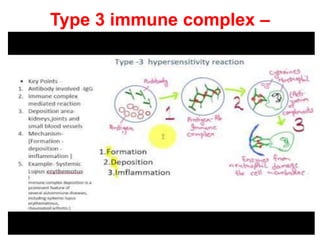
Type 3 immune complex –
mediated hypersensitivity
Type 4 hypersensitivity
Anaphylaxis (Type 1 IgE –
Mediated hypersensitivity)
Definition
Incidence
• 4–100 per 100,000 persons per year
• The risk is greatest in young people and
females
• Death from anaphylaxis is most commonly
triggered by medications.
Substances Known To Trigger
Anaphylaxis In Sensitized Persons
Hormones
• Insulin
• Vasopressin
• Parathormone
Enzymes
• Trypsin
• Chymotrypsin
• Penicillinase
Substances Known To Trigger
Anaphylaxis In Sensitized Persons
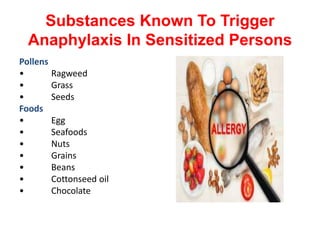
Pollens
• Ragweed
• Grass
• Seeds
Foods
• Egg
• Seafoods
• Nuts
• Grains
• Beans
• Cottonseed oil
• Chocolate
Substances Known To Trigger
Anaphylaxis In Sensitized Persons
Vitamins
• Thiamine
• Folic acid
Insect venom
• Yellow jacket
• Hornet
• Paper wasp
• Honey bee
Substances Known To Trigger
Anaphylaxis In Sensitized Persons
Occupational agents
• Rubber products
• Industrial chemicals
Antibiotics
• Penicillins
• Cephalosporins
• Amphotericin b
• Nitrofurantain
Substances Known To Trigger
Anaphylaxis In Sensitized Persons
Local anaesthetics
• Procaine
• Lidocaine
Medical diagnostic agents
• Sodium dehydrocholate
• Sulfabromophthalein
Antiserum
• Antilimphocyte gamma globulin
Pathophysiology
Sensitization stage
Antigen (allergens) invades the body
Plasma cells produce large amounts of class IgE
antibodies against allergen
IgE antibodies attach to mast cells in body
tissues
Pathophysiology
Subsequent sensory response
More of same allergen invades body
Allergen combines with IgE attached to mast cells, which
triggers release of histamine from mast cell granules
Histamine causes blood vessels to dilate and become
leaky which promotes edema; stimulate release of large
amounts of mucus and causes smooth muscles to
contract
Pathophysiology
classification
Anaphylactic shock
Biphasic anaphylaxis
Pseudoanaphylaxis or anaphylactoid reactions
Clinical manifestations
Diagnostic evaluation
• Health history
• Physical examination
• Allergy testing
• White blood cell count
• Radioallergosorbent test (RAST)
Management
Immediate treatment for anaphylaxis
Parenteral epinephrine
An adrenergic agonist (sympathomimetic) drug
that has both vasoconstricting and
bronchodialating effects
mild reactions subcutaneous injection of 0.3ml
to 0.5ml of 1:1000 epinephrine
Management
With injected toxins such as a bee sting, an
additional amount equivalent to one half the
above may be injected directly into the site of
sting and a tourniquet is applied above it to
prevent further systemic absorption.
Intravenous epinephrine is using a 1:100000
concentrations may be used in the client with a
more severe anaphylactic reaction.
Management
• Corticosteroids
• Antihisatmines
• Combination of antihistamines and
sympathomimetic agents
Other treatment
• Airway management takes the highest
priority for clients with an acute anaphylactic
reaction. Insertion of an endotracheal tube or
emergency tracheostomy may be required to
maintain airway patency with severe laryngospasm
• Plasmapheresis: Removal of harmful
components in the plasma may be used to treat
immune complex responses such as
glomerulonephritis.
Nursing Management
Ineffective airway clearance related to bronchospasm or
laryngeal edema
• Administer oxygen
• Assess respiratory rate and pattern, level of
consciousness and anxiety, use of accessory muscles for
respiration, chest wall movement, audible stridor;
auscultate lung soundsand any adventitious sounds.
• Insert a nasopharyngeal tube or oropharyngeal
airway and arrange for immediate intubation if indicated
• Administer subcutaneous epinephrine as
prescribed.
• Provide calm reassurance
Nursing Management
Decreased cardiac output related to peripheral
vasodialation and increased capillary permeability from
the release of histamine
• Monitor vital signs frequently
• Assess skin colour, temperature, capillary refill,
edema and other indicators of peripheral perfusion
• Monitor level of consciousness
• Administer warmed intravenous solutions of ringer
lactate or normal saline as prescribed
• Insert an indwelling catheter and monitor urinary
output frequently
• Once breathing is established place the client with
legs elevated
SEPTICAEMIA
Introduction
Septicemia is bacteria in the blood that often
occurs with severe infection.
Septicemia is a serious and even life threatening
infection of the blood Usually it is caused by
bacterial infection, but fungi and other
organisms also cause this wide spread infection
of the blood stream
DEFINITION
Invasion of the bloodstream by virulent
microorganisms and especially bacteria along
with their toxins from a local seat of infection
accompanied especially by chills, fever, and
prostration
INCIDENCE
• 18 million cases per year
• Sepsis occurs in 1–2% of all hospitalizations
• Due to it rarely being reported as a primary
diagnosis (often being a complication of
cancer or other illness), the incidence,
mortality, and morbidity rates of sepsis are
likely underestimated
INCIDENCE
RISK FACTORS
• The very young and the elderly
• infections
• People in an intensive care unit
• People with weakened immune systems
• People with pre-existing medical conditions
• People with devices such as IV catheters,
breathing tubes, or other devices
• People with extensive burns
• People with severe trauma
ETIOLOGY
Bacteria usually spill over from the primary
infection site into the blood and are carried
throughout the body thereby spreading
infection to various systems of the body.
• Osteomyelitis
• Meningitis
• Endocarditis
• UTI
• Peritonitis
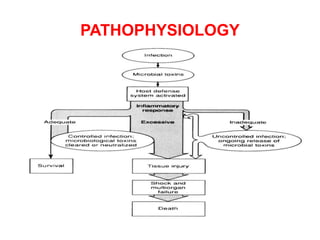
PATHOPHYSIOLOGY
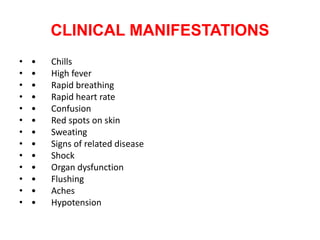
CLINICAL MANIFESTATIONS
• • Chills
• • High fever
• • Rapid breathing
• • Rapid heart rate
• • Confusion
• • Red spots on skin
• • Sweating
• • Signs of related disease
• • Shock
• • Organ dysfunction
• • Flushing
• • Aches
• • Hypotension
DIAGNOSTIC EVALUATION
• History collection
• Physical examination
• Blood culture
• Blood gases
• CBC
• Clotting studies
• CSF culture
• Platelet count
• Urine culture
MANAGEMENT
• Broad spectrum Antibiotics
• IV fluids
• Oxygen inhalation
• Plasma and other blood products
• Vasopressors
• Steroids
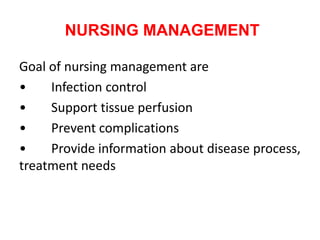
NURSING MANAGEMENT
Goal of nursing management are
• Infection control
• Support tissue perfusion
• Prevent complications
• Provide information about disease process,
treatment needs
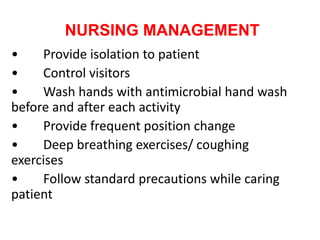
NURSING MANAGEMENT
• Provide isolation to patient
• Control visitors
• Wash hands with antimicrobial hand wash
before and after each activity
• Provide frequent position change
• Deep breathing exercises/ coughing
exercises
• Follow standard precautions while caring
patient
NURSING MANAGEMENT
• Wear mask and gown and gloves when providing direct
care to prevent cross infection
• Dress wound with aseptic technique if present
• Limit use of invasive devices/ procedures if possible
• Maintain TPR and BP
• Maintain intake output chart
• Obtain blood, sputum, urine, and wound culture
initially
• Initiate broad spectrum antibiotics as prescription
• Assess patient’s hemodynamic parameters every
hour
EVIDENCE BASED
PRACTICE
EVIDENCE BASED PRACTICE
Umbilical cord-derived mesenchymal stem
(stromal) cells for treatment of severe sepsis: a
phase 1 clinical trial.
A single intravenous infusion of allogeneic MSCs
up to a dose of 3 × 10⁶ cells/kg was safe and well
tolerated in 15 patients with severe sepsis.
EVIDENCE BASED PRACTICE
Recurring acute urticaria and abdominal pain:
Consider a diagnosis of alpha-galactose
anaphylaxis
EVIDENCE BASED PRACTICE
BACKGROUND:
Food urticaria is common and generally benign, and it may be of viral or
idiopathic aetiology. A food origin of the allergy is frequently sought but
rarely found. Mammalian meat anaphylaxis, or alpha-galactose (α-gal)
anaphylaxis, is a rare and recently discovered entity.
PATIENTS AND METHODS:
Herein, we report a case of alpha-galactose (α-gal) anaphylaxis in a 60-
year-old woman presenting four episodes of acute urticaria with signs
of anaphylaxis occurring a few hours after meals containing mammalian
meat (beef meat, pork meat and offal). The diagnosis was confirmed by
a positive gelatine prick-test and the presence of α-gal IgE.
EVIDENCE BASED PRACTICE
DISCUSSION:
In the event of acute urticaria associated with
systemic symptoms, in particular gastrointestinal
signs, allergy to α-galactose should be considered.

Anaphylaxis

  • 1.
  • 2.
    HYPERSENSITIVITY Hypersensitivity is analtered immune response that results in harm to the client.
  • 3.
    TYPES OF HYPERSENSTIVITY •Immediate hypersensitivity • Type 1 IgE – Mediated hypersensitivity • Type 2 Cytotoxic hypersensitivity • Type 3 immune complex – mediated hypersensitivity • Delayed hypersensitivity • Type 4 hypersensitivity
  • 4.
    Type 2 Cytotoxichypersensitivity
  • 5.
    Type 3 immunecomplex – mediated hypersensitivity
  • 6.
  • 7.
    Anaphylaxis (Type 1IgE – Mediated hypersensitivity)
  • 8.
  • 9.
    Incidence • 4–100 per100,000 persons per year • The risk is greatest in young people and females • Death from anaphylaxis is most commonly triggered by medications.
  • 10.
    Substances Known ToTrigger Anaphylaxis In Sensitized Persons Hormones • Insulin • Vasopressin • Parathormone Enzymes • Trypsin • Chymotrypsin • Penicillinase
  • 11.
    Substances Known ToTrigger Anaphylaxis In Sensitized Persons Pollens • Ragweed • Grass • Seeds Foods • Egg • Seafoods • Nuts • Grains • Beans • Cottonseed oil • Chocolate
  • 12.
    Substances Known ToTrigger Anaphylaxis In Sensitized Persons Vitamins • Thiamine • Folic acid Insect venom • Yellow jacket • Hornet • Paper wasp • Honey bee
  • 13.
    Substances Known ToTrigger Anaphylaxis In Sensitized Persons Occupational agents • Rubber products • Industrial chemicals Antibiotics • Penicillins • Cephalosporins • Amphotericin b • Nitrofurantain
  • 14.
    Substances Known ToTrigger Anaphylaxis In Sensitized Persons Local anaesthetics • Procaine • Lidocaine Medical diagnostic agents • Sodium dehydrocholate • Sulfabromophthalein Antiserum • Antilimphocyte gamma globulin
  • 15.
    Pathophysiology Sensitization stage Antigen (allergens)invades the body Plasma cells produce large amounts of class IgE antibodies against allergen IgE antibodies attach to mast cells in body tissues
  • 16.
    Pathophysiology Subsequent sensory response Moreof same allergen invades body Allergen combines with IgE attached to mast cells, which triggers release of histamine from mast cell granules Histamine causes blood vessels to dilate and become leaky which promotes edema; stimulate release of large amounts of mucus and causes smooth muscles to contract
  • 17.
  • 18.
  • 19.
  • 20.
  • 21.
    Diagnostic evaluation • Healthhistory • Physical examination • Allergy testing • White blood cell count • Radioallergosorbent test (RAST)
  • 22.
    Management Immediate treatment foranaphylaxis Parenteral epinephrine An adrenergic agonist (sympathomimetic) drug that has both vasoconstricting and bronchodialating effects mild reactions subcutaneous injection of 0.3ml to 0.5ml of 1:1000 epinephrine
  • 23.
    Management With injected toxinssuch as a bee sting, an additional amount equivalent to one half the above may be injected directly into the site of sting and a tourniquet is applied above it to prevent further systemic absorption. Intravenous epinephrine is using a 1:100000 concentrations may be used in the client with a more severe anaphylactic reaction.
  • 24.
    Management • Corticosteroids • Antihisatmines •Combination of antihistamines and sympathomimetic agents
  • 25.
    Other treatment • Airwaymanagement takes the highest priority for clients with an acute anaphylactic reaction. Insertion of an endotracheal tube or emergency tracheostomy may be required to maintain airway patency with severe laryngospasm • Plasmapheresis: Removal of harmful components in the plasma may be used to treat immune complex responses such as glomerulonephritis.
  • 26.
    Nursing Management Ineffective airwayclearance related to bronchospasm or laryngeal edema • Administer oxygen • Assess respiratory rate and pattern, level of consciousness and anxiety, use of accessory muscles for respiration, chest wall movement, audible stridor; auscultate lung soundsand any adventitious sounds. • Insert a nasopharyngeal tube or oropharyngeal airway and arrange for immediate intubation if indicated • Administer subcutaneous epinephrine as prescribed. • Provide calm reassurance
  • 27.
    Nursing Management Decreased cardiacoutput related to peripheral vasodialation and increased capillary permeability from the release of histamine • Monitor vital signs frequently • Assess skin colour, temperature, capillary refill, edema and other indicators of peripheral perfusion • Monitor level of consciousness • Administer warmed intravenous solutions of ringer lactate or normal saline as prescribed • Insert an indwelling catheter and monitor urinary output frequently • Once breathing is established place the client with legs elevated
  • 28.
  • 29.
    Introduction Septicemia is bacteriain the blood that often occurs with severe infection. Septicemia is a serious and even life threatening infection of the blood Usually it is caused by bacterial infection, but fungi and other organisms also cause this wide spread infection of the blood stream
  • 30.
    DEFINITION Invasion of thebloodstream by virulent microorganisms and especially bacteria along with their toxins from a local seat of infection accompanied especially by chills, fever, and prostration
  • 31.
    INCIDENCE • 18 millioncases per year • Sepsis occurs in 1–2% of all hospitalizations • Due to it rarely being reported as a primary diagnosis (often being a complication of cancer or other illness), the incidence, mortality, and morbidity rates of sepsis are likely underestimated
  • 32.
  • 33.
    RISK FACTORS • Thevery young and the elderly • infections • People in an intensive care unit • People with weakened immune systems • People with pre-existing medical conditions • People with devices such as IV catheters, breathing tubes, or other devices • People with extensive burns • People with severe trauma
  • 34.
    ETIOLOGY Bacteria usually spillover from the primary infection site into the blood and are carried throughout the body thereby spreading infection to various systems of the body. • Osteomyelitis • Meningitis • Endocarditis • UTI • Peritonitis
  • 36.
  • 37.
    CLINICAL MANIFESTATIONS • •Chills • • High fever • • Rapid breathing • • Rapid heart rate • • Confusion • • Red spots on skin • • Sweating • • Signs of related disease • • Shock • • Organ dysfunction • • Flushing • • Aches • • Hypotension
  • 38.
    DIAGNOSTIC EVALUATION • Historycollection • Physical examination • Blood culture • Blood gases • CBC • Clotting studies • CSF culture • Platelet count • Urine culture
  • 39.
    MANAGEMENT • Broad spectrumAntibiotics • IV fluids • Oxygen inhalation • Plasma and other blood products • Vasopressors • Steroids
  • 40.
    NURSING MANAGEMENT Goal ofnursing management are • Infection control • Support tissue perfusion • Prevent complications • Provide information about disease process, treatment needs
  • 41.
    NURSING MANAGEMENT • Provideisolation to patient • Control visitors • Wash hands with antimicrobial hand wash before and after each activity • Provide frequent position change • Deep breathing exercises/ coughing exercises • Follow standard precautions while caring patient
  • 42.
    NURSING MANAGEMENT • Wearmask and gown and gloves when providing direct care to prevent cross infection • Dress wound with aseptic technique if present • Limit use of invasive devices/ procedures if possible • Maintain TPR and BP • Maintain intake output chart • Obtain blood, sputum, urine, and wound culture initially • Initiate broad spectrum antibiotics as prescription • Assess patient’s hemodynamic parameters every hour
  • 43.
  • 44.
    EVIDENCE BASED PRACTICE Umbilicalcord-derived mesenchymal stem (stromal) cells for treatment of severe sepsis: a phase 1 clinical trial. A single intravenous infusion of allogeneic MSCs up to a dose of 3 × 10⁶ cells/kg was safe and well tolerated in 15 patients with severe sepsis.
  • 45.
    EVIDENCE BASED PRACTICE Recurringacute urticaria and abdominal pain: Consider a diagnosis of alpha-galactose anaphylaxis
  • 46.
    EVIDENCE BASED PRACTICE BACKGROUND: Foodurticaria is common and generally benign, and it may be of viral or idiopathic aetiology. A food origin of the allergy is frequently sought but rarely found. Mammalian meat anaphylaxis, or alpha-galactose (α-gal) anaphylaxis, is a rare and recently discovered entity. PATIENTS AND METHODS: Herein, we report a case of alpha-galactose (α-gal) anaphylaxis in a 60- year-old woman presenting four episodes of acute urticaria with signs of anaphylaxis occurring a few hours after meals containing mammalian meat (beef meat, pork meat and offal). The diagnosis was confirmed by a positive gelatine prick-test and the presence of α-gal IgE.
  • 47.
    EVIDENCE BASED PRACTICE DISCUSSION: Inthe event of acute urticaria associated with systemic symptoms, in particular gastrointestinal signs, allergy to α-galactose should be considered.