Practice Management Workshop July 9-11, 2004 The Westin O’Hare     Rosemont, IL
Compensation and Benefit Distribution for Allergists in Larger Single Specialty Practices Robert J. Holzhauer, MD, MBA, FAAAAI and Michael J. Caruso, CPA

Part One Basic Principals of Compensation Systems   Michael J. Caruso, CPA
No Compensation System is Perfect
No Compensation System Lasts Forever
No Two Compensation Systems are Alike: “Once you’ve seen one compensation system, you’ve seen one compensation system.”
The Ideal Compensation System for a Practice is one in which each Physician is Equally Unhappy
The Compensation Formula Should Fit the Group’s Goals and Objectives
Need to Define the Goals and Objectives of the Group (i.e., mission statement or practice vision, a good starting point)
The System should be Simple and Understandable
The System should be Fair and Equitable
Types of Compensation Systems Equal Productivity Based Hybrid  (pros and cons)
Understanding Expenses Direct/Allocated Equal Production Based
Outside Constraints Stark IRS
Part Two Physician Compensation Formulas: Robert J. Holzhauer, MD, MBA, FAAAAI
Physician Compensation Formulas:  Straight Salary   Advantages to Employee No worry about how much you will be making (assuming practice solvent).  Can plan personal budget with degree of certainty Less need to work very hard   Disadvantages to Employee: Salary is limited Ownership position in practice less likely
Physician Compensation Formulas:  Straight Salary  continued….   Advantages to Employer: Salary obligation is known & limited.  Can plan  practice budget with degree of certainty Would not be expected to share ownership or  profit of practice Disadvantages to Employer: At risk for salary regardless of performance of  employed physician (could lose money) Salaried physician has little incentive to work  hard, limit costs and improve practice profit
Physician Compensation Formulas:  Salary  Plus Productivity Advantages to Employee Less worry about how much you will be making.  Can plan personal budget with fair degree of  certainty Can earn larger share of fruits of labor May be able to become a practice owner, sharing  more fully in its profit Disadvantages to Employee: Will have to work harder and probably longer  hours to maximize income
Physician Compensation Formulas:  Salary  Plus Productivity  continued…. Advantages to Employer Employed physician has strong incentive to work  harder and longer hours to maximize practice  income and profit Disadvantages to Employer: Remains at risk for guaranteed portion In most Salary Plus Productivity formulas the non- owner physician has little financial incentive to limit  costs to help increase practice profit
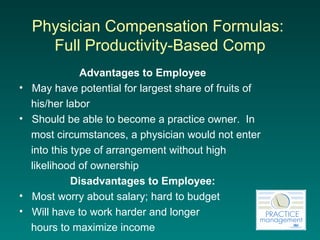
Physician Compensation Formulas:  Full  Productivity-Based Comp Advantages to Employee May have potential for largest share of fruits of  his/her labor Should be able to become a practice owner.  In  most circumstances, a physician would not enter  into this type of arrangement without high  likelihood of ownership Disadvantages to Employee: Most worry about salary; hard to budget Will have to work harder and longer  hours to maximize income
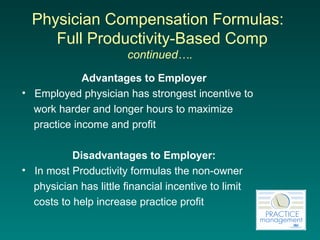
Physician Compensation Formulas:   Full  Productivity-Based Comp  continued…. Advantages to Employer Employed physician has strongest incentive to  work harder and longer hours to maximize  practice income and profit Disadvantages to Employer: In most Productivity formulas the non-owner  physician has little financial incentive to limit  costs to help increase practice profit
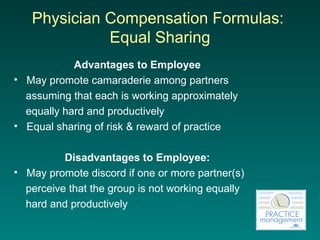
Physician Compensation Formulas:  Equal Sharing Advantages to Employee May promote camaraderie among partners  assuming that each is working approximately  equally hard and productively Equal sharing of risk & reward of practice Disadvantages to Employee: May promote discord if one or more partner(s)  perceive that the group is not working equally  hard and productively
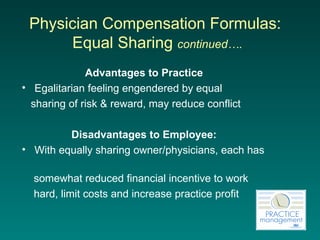
Physician Compensation Formulas:  Equal Sharing  continued…. Advantages to Practice Egalitarian feeling engendered by equal  sharing of risk & reward, may reduce conflict Disadvantages to Employee: With equally sharing owner/physicians, each has  somewhat reduced financial incentive to work  hard, limit costs and increase practice profit
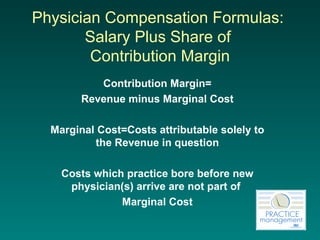
Physician Compensation Formulas:  Salary Plus Share of  Contribution Margin Contribution Margin= Revenue minus Marginal Cost Marginal Cost=Costs attributable solely to the Revenue in question Costs which practice bore before new physician(s) arrive are not part of  Marginal Cost
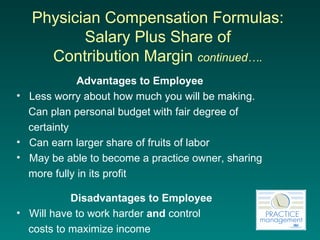
Physician Compensation Formulas:  Salary Plus Share of  Contribution Margin  continued….   Advantages to Employee   Less worry about how much you will be making.  Can plan personal budget with fair degree of  certainty Can earn larger share of fruits of labor May be able to become a practice owner, sharing  more fully in its profit Disadvantages to Employee Will have to work harder  and  control  costs to maximize income
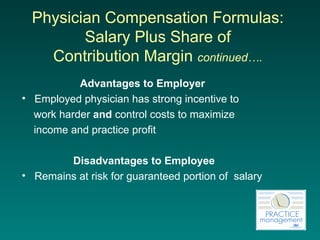
Physician Compensation Formulas:  Salary Plus Share of  Contribution Margin  continued….   Advantages to Employer   Employed physician has strong incentive to  work harder  and  control costs to maximize  income and practice profit Disadvantages to Employee Remains at risk for guaranteed portion of  salary
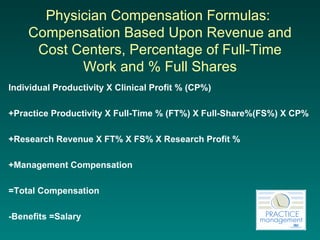
Physician Compensation Formulas:  Compensation Based Upon Revenue and Cost Centers, Percentage of Full-Time Work and % Full Shares Individual Productivity X Clinical Profit % (CP%) +Practice Productivity X Full-Time % (FT%) X Full-Share%(FS%) X CP% +Research Revenue X FT% X FS% X Research Profit % +Management Compensation =Total Compensation -Benefits =Salary
Physician Compensation Formulas:  Compensation Based Upon Revenue and Cost Centers, Percentage of Full-Time Work and % Full Shares   continued….   Advantages to Shareholder Employee   Reasonably equitable way to share  risk and rewards of practice Does not severely punish physicians spending time seeing  less remunerative patients, e.g., rheumatology & young kids Disadvantages to Shareholder Employee Physicians rewarded less for spending many  hours seeing patients than with a compensation  system solely based on patient revenue production
Physician Compensation Formulas:  Compensation Based Upon Revenue and Cost Centers, Percentage of Full-Time Work and % Full Shares  continued…. Advantages to Practice   Shareholder physicians have some incentive to  work hard and control costs to maximize practice  profit Disadvantages to Practice Incentives for shareholder physicians to work  hard and control costs are weaker than in a  compensation system  based upon contribution  margin
Part Three Structuring a Compensation System to Balance Group Goals with Individual Physician Needs
Define the Goals and Objectives of the Group (i.e., mission statement or practice vision)
Expression by Physicians of Individual Goals and Objectives
Appointment of Compensation Committee and/or Outside  Assistance Team (i.e., CPA, Consultant, Attorney)
Review of Equal versus Productivity Based Systems, and applicability relative to Balancing Group and Individual Objectives
Definition of Equal, Production and Direct Expenses (for your group)
System Proposals   (Based upon Prior Year and/or Pro-Forma Data)
Group Discussion
Approval
Implementation and Documentation

Compensation Larger Practices

  • 1.
    Practice Management WorkshopJuly 9-11, 2004 The Westin O’Hare  Rosemont, IL
  • 2.
    Compensation and BenefitDistribution for Allergists in Larger Single Specialty Practices Robert J. Holzhauer, MD, MBA, FAAAAI and Michael J. Caruso, CPA
  • 3.
    Part One BasicPrincipals of Compensation Systems Michael J. Caruso, CPA
  • 4.
  • 5.
  • 6.
    No Two CompensationSystems are Alike: “Once you’ve seen one compensation system, you’ve seen one compensation system.”
  • 7.
    The Ideal CompensationSystem for a Practice is one in which each Physician is Equally Unhappy
  • 8.
    The Compensation FormulaShould Fit the Group’s Goals and Objectives
  • 9.
    Need to Definethe Goals and Objectives of the Group (i.e., mission statement or practice vision, a good starting point)
  • 10.
    The System shouldbe Simple and Understandable
  • 11.
    The System shouldbe Fair and Equitable
  • 12.
    Types of CompensationSystems Equal Productivity Based Hybrid (pros and cons)
  • 13.
  • 14.
  • 15.
    Part Two PhysicianCompensation Formulas: Robert J. Holzhauer, MD, MBA, FAAAAI
  • 16.
    Physician Compensation Formulas: Straight Salary Advantages to Employee No worry about how much you will be making (assuming practice solvent). Can plan personal budget with degree of certainty Less need to work very hard Disadvantages to Employee: Salary is limited Ownership position in practice less likely
  • 17.
    Physician Compensation Formulas: Straight Salary continued…. Advantages to Employer: Salary obligation is known & limited. Can plan practice budget with degree of certainty Would not be expected to share ownership or profit of practice Disadvantages to Employer: At risk for salary regardless of performance of employed physician (could lose money) Salaried physician has little incentive to work hard, limit costs and improve practice profit
  • 18.
    Physician Compensation Formulas: Salary Plus Productivity Advantages to Employee Less worry about how much you will be making. Can plan personal budget with fair degree of certainty Can earn larger share of fruits of labor May be able to become a practice owner, sharing more fully in its profit Disadvantages to Employee: Will have to work harder and probably longer hours to maximize income
  • 19.
    Physician Compensation Formulas: Salary Plus Productivity continued…. Advantages to Employer Employed physician has strong incentive to work harder and longer hours to maximize practice income and profit Disadvantages to Employer: Remains at risk for guaranteed portion In most Salary Plus Productivity formulas the non- owner physician has little financial incentive to limit costs to help increase practice profit
  • 20.
    Physician Compensation Formulas: Full Productivity-Based Comp Advantages to Employee May have potential for largest share of fruits of his/her labor Should be able to become a practice owner. In most circumstances, a physician would not enter into this type of arrangement without high likelihood of ownership Disadvantages to Employee: Most worry about salary; hard to budget Will have to work harder and longer hours to maximize income
  • 21.
    Physician Compensation Formulas: Full Productivity-Based Comp continued…. Advantages to Employer Employed physician has strongest incentive to work harder and longer hours to maximize practice income and profit Disadvantages to Employer: In most Productivity formulas the non-owner physician has little financial incentive to limit costs to help increase practice profit
  • 22.
    Physician Compensation Formulas: Equal Sharing Advantages to Employee May promote camaraderie among partners assuming that each is working approximately equally hard and productively Equal sharing of risk & reward of practice Disadvantages to Employee: May promote discord if one or more partner(s) perceive that the group is not working equally hard and productively
  • 23.
    Physician Compensation Formulas: Equal Sharing continued…. Advantages to Practice Egalitarian feeling engendered by equal sharing of risk & reward, may reduce conflict Disadvantages to Employee: With equally sharing owner/physicians, each has somewhat reduced financial incentive to work hard, limit costs and increase practice profit
  • 24.
    Physician Compensation Formulas: Salary Plus Share of Contribution Margin Contribution Margin= Revenue minus Marginal Cost Marginal Cost=Costs attributable solely to the Revenue in question Costs which practice bore before new physician(s) arrive are not part of Marginal Cost
  • 25.
    Physician Compensation Formulas: Salary Plus Share of Contribution Margin continued…. Advantages to Employee Less worry about how much you will be making. Can plan personal budget with fair degree of certainty Can earn larger share of fruits of labor May be able to become a practice owner, sharing more fully in its profit Disadvantages to Employee Will have to work harder and control costs to maximize income
  • 26.
    Physician Compensation Formulas: Salary Plus Share of Contribution Margin continued…. Advantages to Employer Employed physician has strong incentive to work harder and control costs to maximize income and practice profit Disadvantages to Employee Remains at risk for guaranteed portion of salary
  • 27.
    Physician Compensation Formulas: Compensation Based Upon Revenue and Cost Centers, Percentage of Full-Time Work and % Full Shares Individual Productivity X Clinical Profit % (CP%) +Practice Productivity X Full-Time % (FT%) X Full-Share%(FS%) X CP% +Research Revenue X FT% X FS% X Research Profit % +Management Compensation =Total Compensation -Benefits =Salary
  • 28.
    Physician Compensation Formulas: Compensation Based Upon Revenue and Cost Centers, Percentage of Full-Time Work and % Full Shares continued…. Advantages to Shareholder Employee Reasonably equitable way to share risk and rewards of practice Does not severely punish physicians spending time seeing less remunerative patients, e.g., rheumatology & young kids Disadvantages to Shareholder Employee Physicians rewarded less for spending many hours seeing patients than with a compensation system solely based on patient revenue production
  • 29.
    Physician Compensation Formulas: Compensation Based Upon Revenue and Cost Centers, Percentage of Full-Time Work and % Full Shares continued…. Advantages to Practice Shareholder physicians have some incentive to work hard and control costs to maximize practice profit Disadvantages to Practice Incentives for shareholder physicians to work hard and control costs are weaker than in a compensation system based upon contribution margin
  • 30.
    Part Three Structuringa Compensation System to Balance Group Goals with Individual Physician Needs
  • 31.
    Define the Goalsand Objectives of the Group (i.e., mission statement or practice vision)
  • 32.
    Expression by Physiciansof Individual Goals and Objectives
  • 33.
    Appointment of CompensationCommittee and/or Outside Assistance Team (i.e., CPA, Consultant, Attorney)
  • 34.
    Review of Equalversus Productivity Based Systems, and applicability relative to Balancing Group and Individual Objectives
  • 35.
    Definition of Equal,Production and Direct Expenses (for your group)
  • 36.
    System Proposals (Based upon Prior Year and/or Pro-Forma Data)
  • 37.
  • 38.
  • 39.