 Presented by: DR VISHAL KUMAR
KANDHWAY
 “ opioid “ is a natural or synthetic drug that
binds to opioid receptors producing
agonist effects.
 “ opioid analgesic “ : analgesia (pain absence)
without resulting in loss of
consiousness/sleep.
“ opioid have been mainstay of
pain treatment for thousands of years
, and they remain…so today…..
 Natural Opioids :
Alkaloids like morphine , codine and
thebaine
 Semi-synthetic opioids :
Diacetylmorphine (heroin), pholcodeine,
Ethylmorphine
 Synthetic opioids :
Fentanyl ,meperidine ,pentazocin
methadone ,TRAMADOL, etc
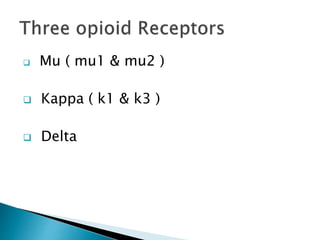
 Mu ( mu1 & mu2 )
 Kappa ( k1 & k3 )
 Delta
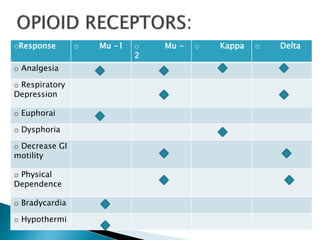
oResponse o Mu -1 o Mu -
2
o Kappa o Delta
o Analgesia
o Respiratory
Depression
o Euphorai
o Dysphoria
o Decrease GI
motility
o Physical
Dependence
o Bradycardia
o Hypothermi
 PURE AGONIST: has affinity for binding plus
efficacy
 PURE ANTAGONIST: has affinity for binding
but no efficacy; blocks action of endogenous
and exogenous ligands.
 MIXED AGONIST-ANTAGONIST: produce an
agonist effect at one receptor and an
antagonist effect at another.
 PARTIAL AGONIST: has affinity for binding but
low efficacy
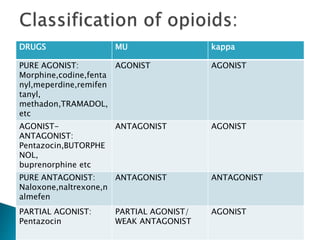
DRUGS MU kappa
PURE AGONIST:
Morphine,codine,fenta
nyl,meperdine,remifen
tanyl,
methadon,TRAMADOL,
etc
AGONIST AGONIST
AGONIST-
ANTAGONIST:
Pentazocin,BUTORPHE
NOL,
buprenorphine etc
ANTAGONIST AGONIST
PURE ANTAGONIST:
Naloxone,naltrexone,n
almefen
ANTAGONIST ANTAGONIST
PARTIAL AGONIST:
Pentazocin
PARTIAL AGONIST/
WEAK ANTAGONIST
AGONIST
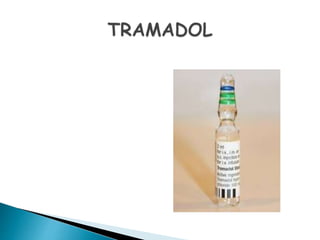
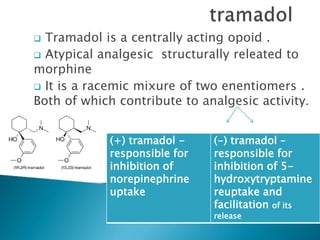
 Tramadol is a centrally acting opoid .
 Atypical analgesic structurally releated to
morphine
 It is a racemic mixure of two enentiomers .
Both of which contribute to analgesic activity.
(+) tramadol -
responsible for
inhibition of
norepinephrine
uptake
(-) tramadol –
responsible for
inhibition of 5-
hydroxytryptamine
reuptake and
facilitation of its
release
Tramadol acts as a:-
 Mu-opiod receptor agonist:-
 Moderate affinity for Mu-opoid receptor
 Weak kappa and delta opoid receptor affinity.
 But is 5-10 times less potent than morphine as
an analgesic
 Serotonin reuptake inhibitor and
releasing agent
 Nor epinephrine reuptake inhibitor
 5-HTc receptor antagonist
 Nicotonic acetylcholyn receptor
antagonist
 M1 and M3 mucuranic
acetylcholyn receptor antagonist
 mild-moderate severe pain
 Mainly use for treatment of chronic
pain
 Less likely to generate addiction
 Not associated with major organ toxicity
 Less sedative effect
 Slow gastric emptying
 Around 40-60 % of the patient under regional
anaesthesia develop shivering
 Shivering increases metabolic rate and
oxygen consumption up to 100-600%
 May induce:-
 lactic acidosis
 increase IOP and ICT
 arterial hypoxemia
 interfers with ECGmonitoring ,pulse
rate,BP etc
 Tramadol is metabolise by hepatic P450
enzyme systems to form major metabolite
O-Desmythyltramadol.
 It also exerts modest stereoselective
analgesic effect.
 The elimination half life of racemic
tramadol is approximately 6 hrs ,
irrespective of the mode of administration ,
and about 8 hrs for O-
desmethyltramadol
 Half life may be prolong in people with
decreased liver or kidney function.
 Route of administration : tramadol can be
given by oral , intramascular (IM) or
intravenous (IV) route.
 Adult dose: 3mg/kg is effective for
treatment of moderate to severe pain
 Children : 1-2 mg/kg 4-6 hrly
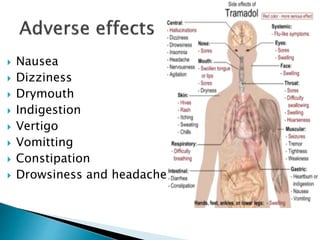
 Nausea
 Dizziness
 Drymouth
 Indigestion
 Vertigo
 Vomitting
 Constipation
 Drowsiness and headache
 Hypotention
 Bradycardia
 Seizures
 Coma
 rhabdomyolysis
 Butorphanol is a synthetic opioid analgesic.
 It is structurally related to levorphenol.
 It is an agonist-antagonist opioid that
resembles pentazocin.
 But its agonist effects are 20 times greater
and antagonist actions are 10 to 30 times
greater than pentazocin
 It is speculated that butorphenol has:
 Low affinity for mu receptors to produce
antagonism
 Moderate affinity for kappa receptors to
produce analgesia and antishivering effect
 Minimal affinity on delta receptor ,so the
incidence of dysphoria is low
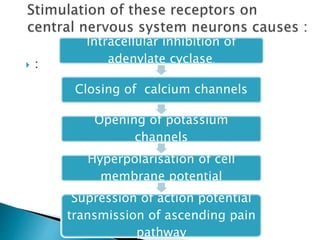
 :
Intracellular inhibition of
adenylate cyclase.
Closing of calcium channels
Opening of potassium
channels
Hyperpolarisation of cell
membrane potential
Supression of action potential
transmission of ascending pain
pathway
 Butorphanol is principally metabolise to
inactive hydroxybutorphenol , which is
eliminated largely in bile and to a lesser
extent in urine.
 The elimination half time of butorphanol is
2.5 to 3.5 hrs
 It has been used in a dose of 1-4 mg IM or IV
for postoperative and other short lasting
painful conditions
 It is rapidly and almost completely absorbed
after IM injection.
Parental injection is use for
 Moderate to severe pain associated with acute
pain such as orthopedic issues, burns ,renal colic
and surgical
 Labour analgesia: indicated for labor pain in full
term women without fetal distress in early labour
 Balanced anaesthesia.
 Postoperative use in patient controlled analgesia
 The nasal spray formulation is an effective
analgesic for the relief of moderate to severe
pain such as:
 Migrain attacks
 Dental
 Maxillofacial
 Other surgical pain
 Sedation
 Nausea ,vommiting
 Diaphoresis’
 Dysphoria
 Depression of ventilation
 Increase in systemic blood pressure
 Increase in pulmonary arterial blood pressure
 Increase in cardiac output
 Dizziness
 Nasal congestion
 Insomnia‘
 Effect of butorphenol on biliary and
gastrointestinal tract are mild .
 Withdrawl symptoms do occur after acute
discontinuation of chronic therapy
 References :-
Stoelting’s Pharmacology & Physiology.
Barash Clinical Anesthesiology.
KD Tripathi Essentials of Medical Pharmacology
Tramadol

Tramadol

  • 1.
     Presented by:DR VISHAL KUMAR KANDHWAY
  • 3.
     “ opioid“ is a natural or synthetic drug that binds to opioid receptors producing agonist effects.  “ opioid analgesic “ : analgesia (pain absence) without resulting in loss of consiousness/sleep. “ opioid have been mainstay of pain treatment for thousands of years , and they remain…so today…..
  • 4.
     Natural Opioids: Alkaloids like morphine , codine and thebaine  Semi-synthetic opioids : Diacetylmorphine (heroin), pholcodeine, Ethylmorphine  Synthetic opioids : Fentanyl ,meperidine ,pentazocin methadone ,TRAMADOL, etc
  • 5.
     Mu (mu1 & mu2 )  Kappa ( k1 & k3 )  Delta
  • 6.
    oResponse o Mu-1 o Mu - 2 o Kappa o Delta o Analgesia o Respiratory Depression o Euphorai o Dysphoria o Decrease GI motility o Physical Dependence o Bradycardia o Hypothermi
  • 7.
     PURE AGONIST:has affinity for binding plus efficacy  PURE ANTAGONIST: has affinity for binding but no efficacy; blocks action of endogenous and exogenous ligands.  MIXED AGONIST-ANTAGONIST: produce an agonist effect at one receptor and an antagonist effect at another.  PARTIAL AGONIST: has affinity for binding but low efficacy
  • 8.
    DRUGS MU kappa PUREAGONIST: Morphine,codine,fenta nyl,meperdine,remifen tanyl, methadon,TRAMADOL, etc AGONIST AGONIST AGONIST- ANTAGONIST: Pentazocin,BUTORPHE NOL, buprenorphine etc ANTAGONIST AGONIST PURE ANTAGONIST: Naloxone,naltrexone,n almefen ANTAGONIST ANTAGONIST PARTIAL AGONIST: Pentazocin PARTIAL AGONIST/ WEAK ANTAGONIST AGONIST
  • 10.
     Tramadol isa centrally acting opoid .  Atypical analgesic structurally releated to morphine  It is a racemic mixure of two enentiomers . Both of which contribute to analgesic activity. (+) tramadol - responsible for inhibition of norepinephrine uptake (-) tramadol – responsible for inhibition of 5- hydroxytryptamine reuptake and facilitation of its release
  • 11.
    Tramadol acts asa:-  Mu-opiod receptor agonist:-  Moderate affinity for Mu-opoid receptor  Weak kappa and delta opoid receptor affinity.  But is 5-10 times less potent than morphine as an analgesic  Serotonin reuptake inhibitor and releasing agent  Nor epinephrine reuptake inhibitor
  • 12.
     5-HTc receptorantagonist  Nicotonic acetylcholyn receptor antagonist  M1 and M3 mucuranic acetylcholyn receptor antagonist
  • 13.
     mild-moderate severepain  Mainly use for treatment of chronic pain  Less likely to generate addiction  Not associated with major organ toxicity  Less sedative effect  Slow gastric emptying
  • 14.
     Around 40-60% of the patient under regional anaesthesia develop shivering  Shivering increases metabolic rate and oxygen consumption up to 100-600%  May induce:-  lactic acidosis  increase IOP and ICT  arterial hypoxemia  interfers with ECGmonitoring ,pulse rate,BP etc
  • 15.
     Tramadol ismetabolise by hepatic P450 enzyme systems to form major metabolite O-Desmythyltramadol.  It also exerts modest stereoselective analgesic effect.  The elimination half life of racemic tramadol is approximately 6 hrs , irrespective of the mode of administration , and about 8 hrs for O- desmethyltramadol  Half life may be prolong in people with decreased liver or kidney function.
  • 16.
     Route ofadministration : tramadol can be given by oral , intramascular (IM) or intravenous (IV) route.  Adult dose: 3mg/kg is effective for treatment of moderate to severe pain  Children : 1-2 mg/kg 4-6 hrly
  • 17.
     Nausea  Dizziness Drymouth  Indigestion  Vertigo  Vomitting  Constipation  Drowsiness and headache
  • 18.
     Hypotention  Bradycardia Seizures  Coma  rhabdomyolysis
  • 19.
     Butorphanol isa synthetic opioid analgesic.  It is structurally related to levorphenol.  It is an agonist-antagonist opioid that resembles pentazocin.  But its agonist effects are 20 times greater and antagonist actions are 10 to 30 times greater than pentazocin
  • 20.
     It isspeculated that butorphenol has:  Low affinity for mu receptors to produce antagonism  Moderate affinity for kappa receptors to produce analgesia and antishivering effect  Minimal affinity on delta receptor ,so the incidence of dysphoria is low
  • 21.
     : Intracellular inhibitionof adenylate cyclase. Closing of calcium channels Opening of potassium channels Hyperpolarisation of cell membrane potential Supression of action potential transmission of ascending pain pathway
  • 22.
     Butorphanol isprincipally metabolise to inactive hydroxybutorphenol , which is eliminated largely in bile and to a lesser extent in urine.  The elimination half time of butorphanol is 2.5 to 3.5 hrs
  • 23.
     It hasbeen used in a dose of 1-4 mg IM or IV for postoperative and other short lasting painful conditions  It is rapidly and almost completely absorbed after IM injection.
  • 24.
    Parental injection isuse for  Moderate to severe pain associated with acute pain such as orthopedic issues, burns ,renal colic and surgical  Labour analgesia: indicated for labor pain in full term women without fetal distress in early labour  Balanced anaesthesia.  Postoperative use in patient controlled analgesia
  • 25.
     The nasalspray formulation is an effective analgesic for the relief of moderate to severe pain such as:  Migrain attacks  Dental  Maxillofacial  Other surgical pain
  • 26.
     Sedation  Nausea,vommiting  Diaphoresis’  Dysphoria  Depression of ventilation  Increase in systemic blood pressure  Increase in pulmonary arterial blood pressure  Increase in cardiac output
  • 27.
     Dizziness  Nasalcongestion  Insomnia‘  Effect of butorphenol on biliary and gastrointestinal tract are mild .  Withdrawl symptoms do occur after acute discontinuation of chronic therapy
  • 28.
     References :- Stoelting’sPharmacology & Physiology. Barash Clinical Anesthesiology. KD Tripathi Essentials of Medical Pharmacology