



Anaphylaxis
Dr. BISHAL SAPKOTA
Consultant
General Practice and Emergency Medicine
Province Hospital Jomsom,Mustang
Historical Background
• Discovered by Portier and Richet in 1902
• While attempting to immunize dogs to venom of a sea anemone, they
unknowingly sensitized the dogs
• Dogs unexpectedly reacted to a previously nonlethal dose
• Coined the term “anaphylaxie”, meaning without, or against, protection
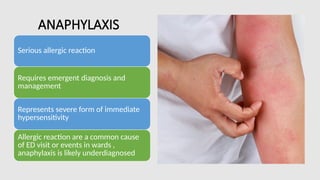
ANAPHYLAXIS
Serious allergic reaction
Requires emergent diagnosis and
management
Represents severe form of immediate
hypersensitivity
Allergic reaction are a common cause
of ED visit or events in wards ,
anaphylaxis is likely underdiagnosed
ANAPHYLAXIS
Acute
Potentially life-threatening
Multisystem syndrome
Caused by the sudden release of mast cell mediators into
the systemic circulation
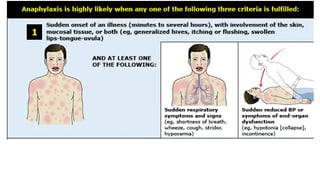
Clinical criteria 1(unknown allergen)
• Urticaria, generalized itching or flushing, or oedema of lips, tongue,
uvula, or skin developing over minutes to hours
And associated with at least 1 of the following:
• Respiratory distress(dyspnoea, wheeze, stridor, hypoxemia, persistent cough
and or throat clearing)
or
• Hypotension(systolic BP <90 or decrease of greater than 30% from base line)
or cardiovascular collapse
or
• Associated symptoms of organ dysfunction (e.g., hypotonia, syncope,
incontinence)
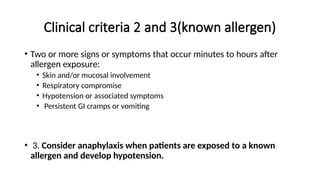
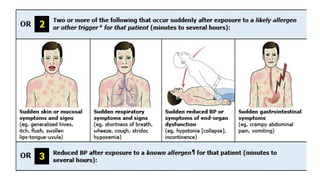
Clinical criteria 2 and 3(known allergen)
• Two or more signs or symptoms that occur minutes to hours after
allergen exposure:
• Skin and/or mucosal involvement
• Respiratory compromise
• Hypotension or associated symptoms
• Persistent GI cramps or vomiting
• 3. Consider anaphylaxis when patients are exposed to a known
allergen and develop hypotension.
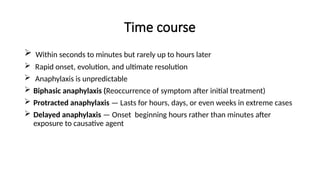
Time course
 Within seconds to minutes but rarely up to hours later
 Rapid onset, evolution, and ultimate resolution
 Anaphylaxis is unpredictable
 Biphasic anaphylaxis (Reoccurrence of symptom after initial treatment)
 Protracted anaphylaxis — Lasts for hours, days, or even weeks in extreme cases
 Delayed anaphylaxis — Onset beginning hours rather than minutes after
exposure to causative agent
Biphasic anaphylaxis
 Recurrence of symptoms following resolution of the initial anaphylactic
episode
 Without exposure to causative agents
 Can occur in 20 % of cases
 Clinically significant in 4-5 %
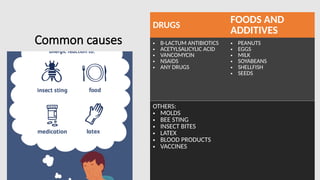
Common causes
DRUGS
FOODS AND
ADDITIVES
• B-LACTUM ANTIBIOTICS
• ACETYLSALICYLIC ACID
• VANCOMYCIN
• NSAIDS
• ANY DRUGS
• PEANUTS
• EGGS
• MILK
• SOYABEANS
• SHELLFISH
• SEEDS
OTHERS:
• MOLDS
• BEE STING
• INSECT BITES
• LATEX
• BLOOD PRODUCTS
• VACCINES
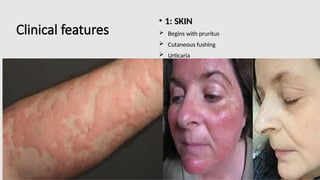
Clinical features
• 1: SKIN
 Begins with pruritus
 Cutaneous fushing
 Urticaria
Clinical features
• Respiratory System:
• Dyspnoea
• Tachypnoea
• throat swelling
• Wheeze/crackles
• Stridor and/or hoarseness,
• Cardiovascular system:
• Hypotension
• Hypoxia
• Tachycardia
• Arrhythmias
• Gastro-Intestinal system:
• Nausea
• Diarrhoea
• Stomach cramp
• Bloating and/or abdominal distension
• Vomiting
• Central Nervous System
• Confusion
• Dizziness
• Headache
• Agitation and/or anxiety
Cascade
Respirator
y distress
Decreased
level of
conciousn
ess
Circulatory
collapse
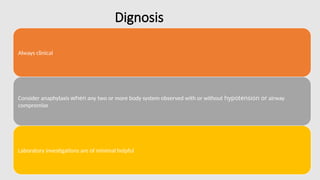
Dignosis
Always clinical
Consider anaphylaxis when any two or more body system observed with or without hypotension or airway
compromise
Laboratory investigations are of minimal helpful
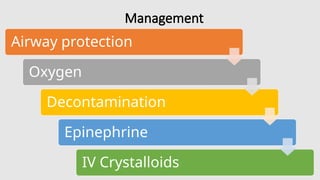
Management
Airway protection
Oxygen
Decontamination
Epinephrine
IV Crystalloids
Airway and
oxygenation Securing airway is the first priority
Examine the mouth, pharynx, and neck for signs and symptoms of
angioedema: uvula edema , audible stridor, respiratory distress, hypoxia
Intubate early if angioedema causing respiratory distress
Oxygen to maintain arterial oxygen saturation >90%
Decontamination
Termination of exposure
Gastric lavage is not recommended for foodborne allergens
Remove any remaining stinging remnants
Epinephrine
• α1- and β-receptor agent
 α1-receptor activation reduces mucosal oedema and treats hypotension
 β1-receptor stimulation increases heart rate and myocardial contractility
 β2-receptor stimulation provides bronchodilation and limits further mediator
release
 Epinephrine is treatment of choice for anaphylaxis
 Observational studies indicate that it is underused, often dosed sub optimally, and under
prescribed upon discharge for potential future self-administration
Epinephrine
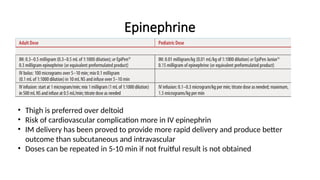
• Thigh is preferred over deltoid
• Risk of cardiovascular complication more in IV epinephrin
• IM delivery has been proved to provide more rapid delivery and produce better
outcome than subcutaneous and intravascular
• Doses can be repeated in 5-10 min if not fruitful result is not obtained
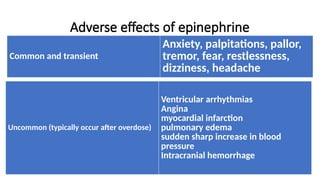
Adverse effects of epinephrine
Common and transient
Anxiety, palpitations, pallor,
tremor, fear, restlessness,
dizziness, headache
Uncommon (typically occur after overdose)
Ventricular arrhythmias
Angina
myocardial infarction
pulmonary edema
sudden sharp increase in blood
pressure
Intracranial hemorrhage
IV Crystalloids
A bolus of 1 to 2 L (10 to 20 mL/kg in children)
of isotonic crystalloid solution should be
administered concurrently with epinephrine
Second line Treatment
Corticosteroids
Anti histamines
Inhaled bronchodilators
Vasopressor
Glucagon
Corticosteroids
• Corticosteroids prevent protracted and biphasic reactions, although evidence for
clinical benefit is scant
• Methylprednisolone 80 to 125 milligrams IV (2 milligrams/kg in children; up to
125 milligrams)
• Hydrocortisone 250 to 500 milligrams IV (5 to 10 milligrams/kg in children; up
to 500 milligrams)
Glucocorticoid and recent advances
• Little evidence of benefit
• Onset of action of glucocorticoids takes several hours
• Do not relieve initial symptoms and signs of anaphylaxis
• One rationale is to revent the biphasic or protracted reactions that
occur in some cases of anaphylaxis
• 2020 systematic review failed to find evidence for this effect
(2020 practice parameter update, systematic review, and Grading of Recommendations,
Assessment, Development and Evaluation (GRADE) analysis.)
Glucocorticoid and recent advances
• In absence of conclusive data or consensus, our approach is not to
administer glucocorticoids routinely to patients who respond well
to epinephrine
• Glucocorticoids may well be beneficial for patients with severe
symptoms requiring hospitalization or for those with known asthma
and significant bronchospasm
(2020 practice parameter update, systematic review, and Grading of Recommendations, Assessment,
Development and Evaluation (GRADE) analysis.)
Antihistamines
• Consensus guidelines recommend that most patients with anaphylaxis should
receive an H1 antihistamine
• Diphenhydramine 25 to 50 milligrams IV by slow infusion
• Clinical benefit is unproven
• In severe cases guidelines recommend H2 antihistamines, such as ranitidine or
cimetidine (evidence suggesting histamine has crossover selectivity of receptors)
Vasopressors
 Substituted when patient require more dose of epinephrin
 Dopamine, dobutamine, norepinephrine, phenylephrine,vasopressin
 Can use in dangerous dysrhythmias or tachycardia result from epinephrine
AGENTS FOR ALLERGIC BRONCHOSPASM
 β2 bronchodilator nebulization(1st
line)
 Albuterol/salbutamol
 Asthmatics are often more refractory to treatment of allergic bronchospasm
 IV magnesium sulphate for refractory bronchospasm ( 2gm iv over 20 mins )
GLUCAGON
• For patients taking β-blockers with hypotension refractory to fluids
and epinephrine
• 1 milligram IV every5 min until hypotension resolves, followed by 5–
15 micrograms/min infusion
• Side effects
• Nausea
• Vomiting
• Hypokalaemia
• Dizziness
• Hyperglycaemia
REFRACTORY ANAPHYLAXIS
• Other vasopressors:
• Addition of another vasopressor should be considered if the patient continues
to be hypotensive despite maximal epinephrine and fluid therapy
• Norepinephrine, vasopressin
• Methylene blue:
• Inhibitor of nitric oxide synthase and guanylate cyclase, in severe anaphylaxis
• Single bolus of 1 to 2 mg/kg given over 20 to 60 minutes
REFRACTORY
ANAPHYLAXIS
Extracorporeal membrane oxygenation —
Extracorporeal membrane oxygenation (ECMO)
or operative cardiopulmonary bypass are used
for resusitation for refractory anaphylaxis
Considered in patients unresponsive to
complete resuscitative efforts in institutions with
experience in this technology
Started early in patients unresponsive to
traditional resuscitative measures, before
irreversible ischemic acidosis develops
Admission and observation
 Admission is rare ( 1% to 4% )
 Unstable patients with anaphylaxis refractory to treatment or with
airway interventions admit in ICU
 Who receive Epinephrine IM should be observed
 Precise duration of observation is unclear
 Healthy patients who remain symptom free for one or 6 hours after
appropriate treatment can be discharged
Discharge prescription
• Education
• Identification of inciting allergen
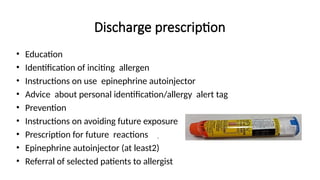
• Instructions on use epinephrine autoinjector
• Advice about personal identification/allergy alert tag
• Prevention
• Instructions on avoiding future exposure
• Prescription for future reactions
• Epinephrine autoinjector (at least2)
• Referral of selected patients to allergist
.
Reference
• Tintinalli’s Emergency Medicine 9th edition
• Uptodate 2025
Anaphylaxis Comprehensive Clinical Overview

Anaphylaxis Comprehensive Clinical Overview

  • 1.
    Anaphylaxis Dr. BISHAL SAPKOTA Consultant GeneralPractice and Emergency Medicine Province Hospital Jomsom,Mustang
  • 2.
    Historical Background • Discoveredby Portier and Richet in 1902 • While attempting to immunize dogs to venom of a sea anemone, they unknowingly sensitized the dogs • Dogs unexpectedly reacted to a previously nonlethal dose • Coined the term “anaphylaxie”, meaning without, or against, protection
  • 3.
    ANAPHYLAXIS Serious allergic reaction Requiresemergent diagnosis and management Represents severe form of immediate hypersensitivity Allergic reaction are a common cause of ED visit or events in wards , anaphylaxis is likely underdiagnosed
  • 4.
    ANAPHYLAXIS Acute Potentially life-threatening Multisystem syndrome Causedby the sudden release of mast cell mediators into the systemic circulation
  • 5.
    Clinical criteria 1(unknownallergen) • Urticaria, generalized itching or flushing, or oedema of lips, tongue, uvula, or skin developing over minutes to hours And associated with at least 1 of the following: • Respiratory distress(dyspnoea, wheeze, stridor, hypoxemia, persistent cough and or throat clearing) or • Hypotension(systolic BP <90 or decrease of greater than 30% from base line) or cardiovascular collapse or • Associated symptoms of organ dysfunction (e.g., hypotonia, syncope, incontinence)
  • 7.
    Clinical criteria 2and 3(known allergen) • Two or more signs or symptoms that occur minutes to hours after allergen exposure: • Skin and/or mucosal involvement • Respiratory compromise • Hypotension or associated symptoms • Persistent GI cramps or vomiting • 3. Consider anaphylaxis when patients are exposed to a known allergen and develop hypotension.
  • 9.
    Time course  Withinseconds to minutes but rarely up to hours later  Rapid onset, evolution, and ultimate resolution  Anaphylaxis is unpredictable  Biphasic anaphylaxis (Reoccurrence of symptom after initial treatment)  Protracted anaphylaxis — Lasts for hours, days, or even weeks in extreme cases  Delayed anaphylaxis — Onset beginning hours rather than minutes after exposure to causative agent
  • 10.
    Biphasic anaphylaxis  Recurrenceof symptoms following resolution of the initial anaphylactic episode  Without exposure to causative agents  Can occur in 20 % of cases  Clinically significant in 4-5 %
  • 11.
    Common causes DRUGS FOODS AND ADDITIVES •B-LACTUM ANTIBIOTICS • ACETYLSALICYLIC ACID • VANCOMYCIN • NSAIDS • ANY DRUGS • PEANUTS • EGGS • MILK • SOYABEANS • SHELLFISH • SEEDS OTHERS: • MOLDS • BEE STING • INSECT BITES • LATEX • BLOOD PRODUCTS • VACCINES
  • 12.
    Clinical features • 1:SKIN  Begins with pruritus  Cutaneous fushing  Urticaria
  • 13.
    Clinical features • RespiratorySystem: • Dyspnoea • Tachypnoea • throat swelling • Wheeze/crackles • Stridor and/or hoarseness, • Cardiovascular system: • Hypotension • Hypoxia • Tachycardia • Arrhythmias • Gastro-Intestinal system: • Nausea • Diarrhoea • Stomach cramp • Bloating and/or abdominal distension • Vomiting • Central Nervous System • Confusion • Dizziness • Headache • Agitation and/or anxiety
  • 14.
  • 15.
    Dignosis Always clinical Consider anaphylaxiswhen any two or more body system observed with or without hypotension or airway compromise Laboratory investigations are of minimal helpful
  • 16.
  • 17.
    Airway and oxygenation Securingairway is the first priority Examine the mouth, pharynx, and neck for signs and symptoms of angioedema: uvula edema , audible stridor, respiratory distress, hypoxia Intubate early if angioedema causing respiratory distress Oxygen to maintain arterial oxygen saturation >90%
  • 18.
    Decontamination Termination of exposure Gastriclavage is not recommended for foodborne allergens Remove any remaining stinging remnants
  • 19.
    Epinephrine • α1- andβ-receptor agent  α1-receptor activation reduces mucosal oedema and treats hypotension  β1-receptor stimulation increases heart rate and myocardial contractility  β2-receptor stimulation provides bronchodilation and limits further mediator release  Epinephrine is treatment of choice for anaphylaxis  Observational studies indicate that it is underused, often dosed sub optimally, and under prescribed upon discharge for potential future self-administration
  • 20.
    Epinephrine • Thigh ispreferred over deltoid • Risk of cardiovascular complication more in IV epinephrin • IM delivery has been proved to provide more rapid delivery and produce better outcome than subcutaneous and intravascular • Doses can be repeated in 5-10 min if not fruitful result is not obtained
  • 21.
    Adverse effects ofepinephrine Common and transient Anxiety, palpitations, pallor, tremor, fear, restlessness, dizziness, headache Uncommon (typically occur after overdose) Ventricular arrhythmias Angina myocardial infarction pulmonary edema sudden sharp increase in blood pressure Intracranial hemorrhage
  • 22.
    IV Crystalloids A bolusof 1 to 2 L (10 to 20 mL/kg in children) of isotonic crystalloid solution should be administered concurrently with epinephrine
  • 23.
    Second line Treatment Corticosteroids Antihistamines Inhaled bronchodilators Vasopressor Glucagon
  • 24.
    Corticosteroids • Corticosteroids preventprotracted and biphasic reactions, although evidence for clinical benefit is scant • Methylprednisolone 80 to 125 milligrams IV (2 milligrams/kg in children; up to 125 milligrams) • Hydrocortisone 250 to 500 milligrams IV (5 to 10 milligrams/kg in children; up to 500 milligrams)
  • 25.
    Glucocorticoid and recentadvances • Little evidence of benefit • Onset of action of glucocorticoids takes several hours • Do not relieve initial symptoms and signs of anaphylaxis • One rationale is to revent the biphasic or protracted reactions that occur in some cases of anaphylaxis • 2020 systematic review failed to find evidence for this effect (2020 practice parameter update, systematic review, and Grading of Recommendations, Assessment, Development and Evaluation (GRADE) analysis.)
  • 26.
    Glucocorticoid and recentadvances • In absence of conclusive data or consensus, our approach is not to administer glucocorticoids routinely to patients who respond well to epinephrine • Glucocorticoids may well be beneficial for patients with severe symptoms requiring hospitalization or for those with known asthma and significant bronchospasm (2020 practice parameter update, systematic review, and Grading of Recommendations, Assessment, Development and Evaluation (GRADE) analysis.)
  • 27.
    Antihistamines • Consensus guidelinesrecommend that most patients with anaphylaxis should receive an H1 antihistamine • Diphenhydramine 25 to 50 milligrams IV by slow infusion • Clinical benefit is unproven • In severe cases guidelines recommend H2 antihistamines, such as ranitidine or cimetidine (evidence suggesting histamine has crossover selectivity of receptors)
  • 28.
    Vasopressors  Substituted whenpatient require more dose of epinephrin  Dopamine, dobutamine, norepinephrine, phenylephrine,vasopressin  Can use in dangerous dysrhythmias or tachycardia result from epinephrine
  • 29.
    AGENTS FOR ALLERGICBRONCHOSPASM  β2 bronchodilator nebulization(1st line)  Albuterol/salbutamol  Asthmatics are often more refractory to treatment of allergic bronchospasm  IV magnesium sulphate for refractory bronchospasm ( 2gm iv over 20 mins )
  • 30.
    GLUCAGON • For patientstaking β-blockers with hypotension refractory to fluids and epinephrine • 1 milligram IV every5 min until hypotension resolves, followed by 5– 15 micrograms/min infusion • Side effects • Nausea • Vomiting • Hypokalaemia • Dizziness • Hyperglycaemia
  • 31.
    REFRACTORY ANAPHYLAXIS • Othervasopressors: • Addition of another vasopressor should be considered if the patient continues to be hypotensive despite maximal epinephrine and fluid therapy • Norepinephrine, vasopressin • Methylene blue: • Inhibitor of nitric oxide synthase and guanylate cyclase, in severe anaphylaxis • Single bolus of 1 to 2 mg/kg given over 20 to 60 minutes
  • 32.
    REFRACTORY ANAPHYLAXIS Extracorporeal membrane oxygenation— Extracorporeal membrane oxygenation (ECMO) or operative cardiopulmonary bypass are used for resusitation for refractory anaphylaxis Considered in patients unresponsive to complete resuscitative efforts in institutions with experience in this technology Started early in patients unresponsive to traditional resuscitative measures, before irreversible ischemic acidosis develops
  • 33.
    Admission and observation Admission is rare ( 1% to 4% )  Unstable patients with anaphylaxis refractory to treatment or with airway interventions admit in ICU  Who receive Epinephrine IM should be observed  Precise duration of observation is unclear  Healthy patients who remain symptom free for one or 6 hours after appropriate treatment can be discharged
  • 34.
    Discharge prescription • Education •Identification of inciting allergen • Instructions on use epinephrine autoinjector • Advice about personal identification/allergy alert tag • Prevention • Instructions on avoiding future exposure • Prescription for future reactions • Epinephrine autoinjector (at least2) • Referral of selected patients to allergist .
  • 35.
    Reference • Tintinalli’s EmergencyMedicine 9th edition • Uptodate 2025