


SHOCK by: CRISBERT I. CUALTEROS, MD
Shock A clinical state characterized by inadequate tissue perfusion resulting in oxygen and substrate delivery that is insufficient to meet tissue metabolic demands.
Types of Shock  According to Etiology: Hypovolemic shock Cardiogenic shock Distributive shock
Hypovolemic Shock Inadequate intravascular volume  relative to vascular space. Causes:  diarrhea  vomiting  trauma
Cardiogenic Shock Adequate intravascular volume but cardiac dysfunction limits cardiac output. Ex: myocarditis
Distributive Shock Inappropriate distribution of blood volume. Causes:  Sepsis  Anaphylaxis Neurogenic shock
Types of Shock According to Its Effect on Blood Pressure: Compensated shock Decompensated shock
Signs of Shock: Tachycardia Mottled or pale color Cool skin Diminished peripheral pulses Change in mental status Oliguria Delayed CRT
Types of Shock According to Its Effect on Blood Pressure: Compensated shock Decompensated shock
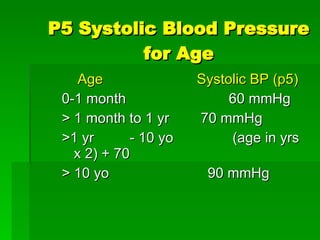
P5 Systolic Blood Pressure for Age Age   Systolic BP (p5) 0-1 month   60 mmHg > 1 month to 1 yr  70 mmHg >1 yr  - 10 yo  (age in yrs x 2) + 70 > 10 yo  90 mmHg
Septic Shock Inflammatory triad Fever Tachycardia Vasodilation Change in mental status Inconsolable irritability Lack of interaction with parents Inability to be aroused
Clinical Diagnosis of Septic Shock Suspected infection Decreased perfusion Decreased mental status Decreased urine output Prolonged CRT or flash CR Diminished or bounding peripheral pulses Mottled cool extremities
Objectives of Fluid Resuscitation: Rapidly restore effective circulating volume in hypovolemic & distributive shock. Restore oxygen-carrying capacity in hemorrhagic shock states. Correct metabolic imbalances secondary to volume depletion.
Types of Fluids: Crystalloids Colloids Blood Products
Crystalloids Ex.: Lactated Ringer’s, normal saline Advantages: Readily available  Inexpensive No allergic reactions Disadvantage: Remain in intravascular compartment for few minutes.
Crystalloids Dextrose-Containing Solution: Osmotic diuresis Hypokalemia Ischemic brain injury
Colloids Ex.: Dextran, Haesteril, Gelafundin Advantage: Remain in intravascular compartment longer Disadvantage: Cause sensitivity reactions
Blood Products Indications: Replacement of blood loss Correction of coagulopathies Complications: Blood-borne infections Hypothermia
Blood Products Recommended for fluid replacement of volume loss in pediatric trauma victims with inadequate perfusion despite 2 to 3 boluses of crystalloid solution. Administer: 10 to 15 ml/kg PRBC 20 ml/kg WB
Fluid Bolus Administration  General guideline: Administer 20 ml/kg of isotonic  crystalloid solution very rapidly  (over 5 to 20 minutes).
Fluid Bolus Administration If a child has severe signs of hypovolemic shock (severe hemorrhage after trauma,  severe dehydration), a 20 ml/Kg bolus is delivered rapidly  (< 5 to 10 minutes).
Fluid Bolus Administration If the child demonstrates less severe signs of shock or there is some impairment in cardiac function, a bolus of 10 ml/Kg is delivered over 10 to 20 minutes.
Fluid Bolus Administration  If the child has severe myocardial dysfunction (calcium channel blocker or  ß-adrenergic blocker poisoning) , smaller fluid boluses (5 to 10 ml/Kg) is delivered more slowly (over 10 to 20 minutes).
Drugs That Support  Cardiac Output Inotropes Vasopressors Vasodilators Inodilators
Inotropes : increase cardiac contractility and heart rate. Vasopressors : increase vascular resistance and blood pressure Drugs That Support  Cardiac Output
Vasodilators : decrease vascular resistance and cardiac afterload and promote peripheral perfusion Inodilators : increase cardiac contractility and reduce afterload Drugs That Support  Cardiac Output
Dopamine Dobutamine Epinephrine Norepinephrine Sodium nitroprusside Milrinone Drugs That Support  Cardiac Output
Dopamine Indications: Inadequate cardiac output Hypotension Need for enhanced splanchnic blood flow and urine output
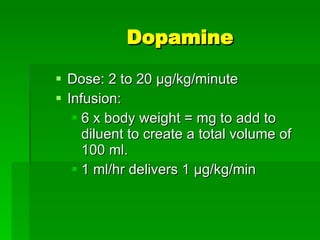
Dose: 2 to 20  μg/kg/minute Infusion: 6 x body weight = mg to add to diluent to create a total volume of 100 ml. 1 ml/hr delivers 1  μg/kg/min Dopamine
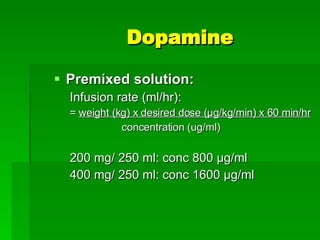
Premixed solution: Infusion rate (ml/hr):  =  weight (kg) x desired dose ( μg/kg/min) x 60 min/hr concentration (ug/ml) 200 mg/ 250 ml: conc 800 μg/ml 400 mg/ 250 ml: conc 1600 μg/ml Dopamine
Dobutamine Indications: Myocardial dysfunction Inadequate cardiac output (elevated systemic or pulmonary vascular resistance)
Dobutamine Dose: 2 to 20  μg/kg/minute Infusion: 6 x body weight = mg to add to diluent to create a total volume of 100 ml. 1 ml/hr delivers 1  μg/kg/min
Premixed solution: Infusion rate (ml/hr):  =  weight (kg) x desired dose ( μg/kg/min) x 60 min/hr concentration (ug/ml) 250 mg/ 250 ml: conc 1000 μg/ml 500 mg/ 250 ml: conc 2000 μg/ml Dobutamine
Epinephrine Indications:  Inadequate cardiac output Hypotension Symptomatic bradycardia Pulseless cardiac arrest Septic shock
Dose: 0.1 to 1  μg/kg/minute Infusion:  0.6 x body weight = mg to be added to sufficient diluent to create a total volume of 100 ml. 1 ml/hr delivers 0.1 μg/kg/min Epinephrine
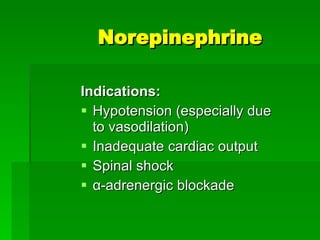
Norepinephrine Indications: Hypotension (especially due to vasodilation) Inadequate cardiac output Spinal shock α-adrenergic blockade
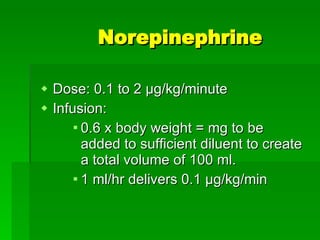
Norepinephrine Dose: 0.1 to 2  μg/kg/minute Infusion:  0.6 x body weight = mg to be added to sufficient diluent to create a total volume of 100 ml. 1 ml/hr delivers 0.1 μg/kg/min
Sodium Nitroprusside Indications: Hypertensive emergencies Inadequate cardiac output with high systemic or pulmonary vascular resistance Cardiogenic shock
Dose: 1 to 8  μg/kg/minute Infusion: 6 x body weight = mg to add to diluent to create a total volume of 100 ml. 1 ml/hr delivers 1  μg/kg/min Sodium Nitroprusside
Milrinone Indications:  Inadequate cardiac output with high systemic or pulmonary vascular resistance Cardiogenic shock Septic shock
Loading dose: 50 to 75  μg/kg Infusion: 0.5 to 0.75 μg/kg/min 0.6 x body weight = mg to be added to sufficient diluent to create a total volume of 100 ml. 1 ml/hr delivers 0.1 μg/kg/min Milrinone
Postarrest shock Fluid bolus (10-20 ml/kg NS or RL,  monitor response) Reassess –  signs of shock continue What is blood pressure ? Hypotensive (decompensated) shock? Normotensive (compensated) shock? Consider further fluid boluses Epinephrine   (0.1 to 1  μg/kg/min) or Dopamine  at higher doses  (up to 20  μg/kg/min) Norepinephrine  (0.1 to 2  μg/kg/min) Consider further fluid boluses Dobutamine  (2 to 20  μg/kg/min) or Dopamine  (2 to 20  μg/kg/min) or Low-dose  epinephrine  (0.05 to 0.3  μg/kg/min) Inamrinone:  load with 0.75 to 1 mg/kg  over 5 mins, may repeat up to 3 mg/kg.  Infusion: 5 to 10  μg/kg/min Milrinone:  load with 50 to 75  μg/kg.  Infusion: 0.5 to 0.75  μg/kg/min.   Approach to Selection of Vasoactive Medications for Postresuscitation Hemodynamic Stabilization
First  5 minutes Recognize altered mental status and perfusion Maintain airway and establish access according to PALS guidelines 5 to 15 minutes Push 20 cc/kg of  isotonic crystalloid  or colloid boluses up to and over 60 cc/kg Correct hypoglycemia and hypocalcemia Fluid responsive ? Observe in PICU Fluid refractory shock Establish central venous access, begin  dopamine  or  dobutamine  therapy and establish arterial monitoring Proposed Algorithm for Treatment of Septic Shock  Yes No  Fluid refractory-dopamine/dobutamine resistant shock Titrate  epinephrine  for cold shock.  Norepinephrine  for warm shock. Catecholamine-resistant shock Is patient at risk for adrenal insufficiency? 0-5 min 15 min Carcillo JA, Fields AI: Clinical practice parameters for hemodynamic support of pediatric and neonatal patients in septic shock.  Crit Care Med  2002; 30: 1365-1378
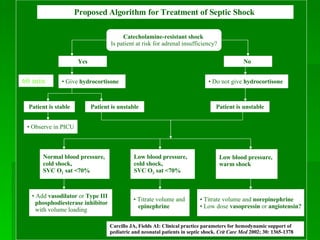
Give  hydrocortisone Normal blood pressure,  cold shock,  SVC O 2  sat <70% Proposed Algorithm for Treatment of Septic Shock  Yes No  Add  vasodilator  or  Type III  phosphodiesterase inhibitor  with volume loading  Catecholamine-resistant shock Is patient at risk for adrenal insufficiency? Do not give  hydrocortisone Observe in PICU Patient is stable Patient is unstable Patient is unstable Low blood pressure,  cold shock,  SVC O 2  sat <70% Low blood pressure,  warm shock Titrate volume and  epinephrine Titrate volume and  norepinephrine   Low dose  vasopressin  or  angiotensin? 60 min Carcillo JA, Fields AI: Clinical practice parameters for hemodynamic support of pediatric and neonatal patients in septic shock.  Crit Care Med  2002; 30: 1365-1378
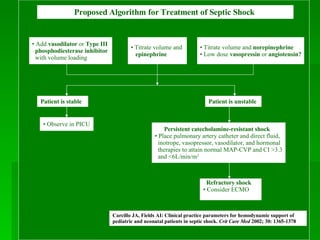
Persistent catecholamine-resistant shock Place pulmonary artery catheter and direct fluid,  inotrope, vasopressor, vasodilator, and hormonal therapies to attain normal MAP-CVP and CI >3.3 and <6L/min/m 2  Proposed Algorithm for Treatment of Septic Shock  Add  vasodilator  or  Type III  phosphodiesterase inhibitor  with volume loading  Observe in PICU Refractory shock Consider ECMO Titrate volume and  epinephrine Titrate volume and  norepinephrine   Low dose  vasopressin  or  angiotensin? Patient is stable Patient is unstable Carcillo JA, Fields AI: Clinical practice parameters for hemodynamic support of pediatric and neonatal patients in septic shock.  Crit Care Med  2002; 30: 1365-1378
Thank You !!!

SHOCK

  • 1.
    SHOCK by: CRISBERTI. CUALTEROS, MD
  • 2.
    Shock A clinicalstate characterized by inadequate tissue perfusion resulting in oxygen and substrate delivery that is insufficient to meet tissue metabolic demands.
  • 3.
    Types of Shock According to Etiology: Hypovolemic shock Cardiogenic shock Distributive shock
  • 4.
    Hypovolemic Shock Inadequateintravascular volume relative to vascular space. Causes: diarrhea vomiting trauma
  • 5.
    Cardiogenic Shock Adequateintravascular volume but cardiac dysfunction limits cardiac output. Ex: myocarditis
  • 6.
    Distributive Shock Inappropriatedistribution of blood volume. Causes: Sepsis Anaphylaxis Neurogenic shock
  • 7.
    Types of ShockAccording to Its Effect on Blood Pressure: Compensated shock Decompensated shock
  • 8.
    Signs of Shock:Tachycardia Mottled or pale color Cool skin Diminished peripheral pulses Change in mental status Oliguria Delayed CRT
  • 9.
    Types of ShockAccording to Its Effect on Blood Pressure: Compensated shock Decompensated shock
  • 10.
    P5 Systolic BloodPressure for Age Age Systolic BP (p5) 0-1 month 60 mmHg > 1 month to 1 yr 70 mmHg >1 yr - 10 yo (age in yrs x 2) + 70 > 10 yo 90 mmHg
  • 11.
    Septic Shock Inflammatorytriad Fever Tachycardia Vasodilation Change in mental status Inconsolable irritability Lack of interaction with parents Inability to be aroused
  • 12.
    Clinical Diagnosis ofSeptic Shock Suspected infection Decreased perfusion Decreased mental status Decreased urine output Prolonged CRT or flash CR Diminished or bounding peripheral pulses Mottled cool extremities
  • 13.
    Objectives of FluidResuscitation: Rapidly restore effective circulating volume in hypovolemic & distributive shock. Restore oxygen-carrying capacity in hemorrhagic shock states. Correct metabolic imbalances secondary to volume depletion.
  • 14.
    Types of Fluids:Crystalloids Colloids Blood Products
  • 15.
    Crystalloids Ex.: LactatedRinger’s, normal saline Advantages: Readily available Inexpensive No allergic reactions Disadvantage: Remain in intravascular compartment for few minutes.
  • 16.
    Crystalloids Dextrose-Containing Solution:Osmotic diuresis Hypokalemia Ischemic brain injury
  • 17.
    Colloids Ex.: Dextran,Haesteril, Gelafundin Advantage: Remain in intravascular compartment longer Disadvantage: Cause sensitivity reactions
  • 18.
    Blood Products Indications:Replacement of blood loss Correction of coagulopathies Complications: Blood-borne infections Hypothermia
  • 19.
    Blood Products Recommendedfor fluid replacement of volume loss in pediatric trauma victims with inadequate perfusion despite 2 to 3 boluses of crystalloid solution. Administer: 10 to 15 ml/kg PRBC 20 ml/kg WB
  • 20.
    Fluid Bolus Administration General guideline: Administer 20 ml/kg of isotonic crystalloid solution very rapidly (over 5 to 20 minutes).
  • 21.
    Fluid Bolus AdministrationIf a child has severe signs of hypovolemic shock (severe hemorrhage after trauma, severe dehydration), a 20 ml/Kg bolus is delivered rapidly (< 5 to 10 minutes).
  • 22.
    Fluid Bolus AdministrationIf the child demonstrates less severe signs of shock or there is some impairment in cardiac function, a bolus of 10 ml/Kg is delivered over 10 to 20 minutes.
  • 23.
    Fluid Bolus Administration If the child has severe myocardial dysfunction (calcium channel blocker or ß-adrenergic blocker poisoning) , smaller fluid boluses (5 to 10 ml/Kg) is delivered more slowly (over 10 to 20 minutes).
  • 24.
    Drugs That Support Cardiac Output Inotropes Vasopressors Vasodilators Inodilators
  • 25.
    Inotropes : increasecardiac contractility and heart rate. Vasopressors : increase vascular resistance and blood pressure Drugs That Support Cardiac Output
  • 26.
    Vasodilators : decreasevascular resistance and cardiac afterload and promote peripheral perfusion Inodilators : increase cardiac contractility and reduce afterload Drugs That Support Cardiac Output
  • 27.
    Dopamine Dobutamine EpinephrineNorepinephrine Sodium nitroprusside Milrinone Drugs That Support Cardiac Output
  • 28.
    Dopamine Indications: Inadequatecardiac output Hypotension Need for enhanced splanchnic blood flow and urine output
  • 29.
    Dose: 2 to20 μg/kg/minute Infusion: 6 x body weight = mg to add to diluent to create a total volume of 100 ml. 1 ml/hr delivers 1 μg/kg/min Dopamine
  • 30.
    Premixed solution: Infusionrate (ml/hr): = weight (kg) x desired dose ( μg/kg/min) x 60 min/hr concentration (ug/ml) 200 mg/ 250 ml: conc 800 μg/ml 400 mg/ 250 ml: conc 1600 μg/ml Dopamine
  • 31.
    Dobutamine Indications: Myocardialdysfunction Inadequate cardiac output (elevated systemic or pulmonary vascular resistance)
  • 32.
    Dobutamine Dose: 2to 20 μg/kg/minute Infusion: 6 x body weight = mg to add to diluent to create a total volume of 100 ml. 1 ml/hr delivers 1 μg/kg/min
  • 33.
    Premixed solution: Infusionrate (ml/hr): = weight (kg) x desired dose ( μg/kg/min) x 60 min/hr concentration (ug/ml) 250 mg/ 250 ml: conc 1000 μg/ml 500 mg/ 250 ml: conc 2000 μg/ml Dobutamine
  • 34.
    Epinephrine Indications: Inadequate cardiac output Hypotension Symptomatic bradycardia Pulseless cardiac arrest Septic shock
  • 35.
    Dose: 0.1 to1 μg/kg/minute Infusion: 0.6 x body weight = mg to be added to sufficient diluent to create a total volume of 100 ml. 1 ml/hr delivers 0.1 μg/kg/min Epinephrine
  • 36.
    Norepinephrine Indications: Hypotension(especially due to vasodilation) Inadequate cardiac output Spinal shock α-adrenergic blockade
  • 37.
    Norepinephrine Dose: 0.1to 2 μg/kg/minute Infusion: 0.6 x body weight = mg to be added to sufficient diluent to create a total volume of 100 ml. 1 ml/hr delivers 0.1 μg/kg/min
  • 38.
    Sodium Nitroprusside Indications:Hypertensive emergencies Inadequate cardiac output with high systemic or pulmonary vascular resistance Cardiogenic shock
  • 39.
    Dose: 1 to8 μg/kg/minute Infusion: 6 x body weight = mg to add to diluent to create a total volume of 100 ml. 1 ml/hr delivers 1 μg/kg/min Sodium Nitroprusside
  • 40.
    Milrinone Indications: Inadequate cardiac output with high systemic or pulmonary vascular resistance Cardiogenic shock Septic shock
  • 41.
    Loading dose: 50to 75 μg/kg Infusion: 0.5 to 0.75 μg/kg/min 0.6 x body weight = mg to be added to sufficient diluent to create a total volume of 100 ml. 1 ml/hr delivers 0.1 μg/kg/min Milrinone
  • 42.
    Postarrest shock Fluidbolus (10-20 ml/kg NS or RL, monitor response) Reassess – signs of shock continue What is blood pressure ? Hypotensive (decompensated) shock? Normotensive (compensated) shock? Consider further fluid boluses Epinephrine (0.1 to 1 μg/kg/min) or Dopamine at higher doses (up to 20 μg/kg/min) Norepinephrine (0.1 to 2 μg/kg/min) Consider further fluid boluses Dobutamine (2 to 20 μg/kg/min) or Dopamine (2 to 20 μg/kg/min) or Low-dose epinephrine (0.05 to 0.3 μg/kg/min) Inamrinone: load with 0.75 to 1 mg/kg over 5 mins, may repeat up to 3 mg/kg. Infusion: 5 to 10 μg/kg/min Milrinone: load with 50 to 75 μg/kg. Infusion: 0.5 to 0.75 μg/kg/min. Approach to Selection of Vasoactive Medications for Postresuscitation Hemodynamic Stabilization
  • 43.
    First 5minutes Recognize altered mental status and perfusion Maintain airway and establish access according to PALS guidelines 5 to 15 minutes Push 20 cc/kg of isotonic crystalloid or colloid boluses up to and over 60 cc/kg Correct hypoglycemia and hypocalcemia Fluid responsive ? Observe in PICU Fluid refractory shock Establish central venous access, begin dopamine or dobutamine therapy and establish arterial monitoring Proposed Algorithm for Treatment of Septic Shock Yes No Fluid refractory-dopamine/dobutamine resistant shock Titrate epinephrine for cold shock. Norepinephrine for warm shock. Catecholamine-resistant shock Is patient at risk for adrenal insufficiency? 0-5 min 15 min Carcillo JA, Fields AI: Clinical practice parameters for hemodynamic support of pediatric and neonatal patients in septic shock. Crit Care Med 2002; 30: 1365-1378
  • 44.
    Give hydrocortisoneNormal blood pressure, cold shock, SVC O 2 sat <70% Proposed Algorithm for Treatment of Septic Shock Yes No Add vasodilator or Type III phosphodiesterase inhibitor with volume loading Catecholamine-resistant shock Is patient at risk for adrenal insufficiency? Do not give hydrocortisone Observe in PICU Patient is stable Patient is unstable Patient is unstable Low blood pressure, cold shock, SVC O 2 sat <70% Low blood pressure, warm shock Titrate volume and epinephrine Titrate volume and norepinephrine Low dose vasopressin or angiotensin? 60 min Carcillo JA, Fields AI: Clinical practice parameters for hemodynamic support of pediatric and neonatal patients in septic shock. Crit Care Med 2002; 30: 1365-1378
  • 45.
    Persistent catecholamine-resistant shockPlace pulmonary artery catheter and direct fluid, inotrope, vasopressor, vasodilator, and hormonal therapies to attain normal MAP-CVP and CI >3.3 and <6L/min/m 2 Proposed Algorithm for Treatment of Septic Shock Add vasodilator or Type III phosphodiesterase inhibitor with volume loading Observe in PICU Refractory shock Consider ECMO Titrate volume and epinephrine Titrate volume and norepinephrine Low dose vasopressin or angiotensin? Patient is stable Patient is unstable Carcillo JA, Fields AI: Clinical practice parameters for hemodynamic support of pediatric and neonatal patients in septic shock. Crit Care Med 2002; 30: 1365-1378
  • 46.