Jonathan B. Hjelm, PharmD, BCPS, BCNSP, CGP
Clinical Pharmacist
Pharmastar PBM
Objectives
1. Define IV compatibility and incompatibility.
2. Where can incompatibilities occur?
3. What can be done to prevent them?
4. How do you know if a combination of drugs are
compatible?
I. What questions to ask
II. Where to look for compatibility data
III. How to interpret compatibility data
Background
 Drug stability and compatibility are critically
important in the provision of safe and effective drug
therapy
 Multiple drugs may be administered simultaneously to
a critically ill patient and determining the
compatibility of those agents is of great importance.
 It is estimated that over 30% of the commonly utilized
drugs are incompatible or unstable when added or
combined with usual fluids or agents.
Definition
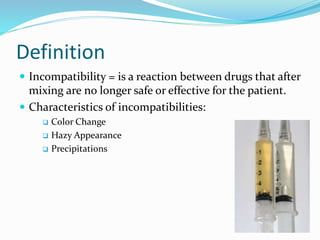
 Incompatibility = is a reaction between drugs that after
mixing are no longer safe or effective for the patient.
 Characteristics of incompatibilities:
 Color Change
 Hazy Appearance
 Precipitations
NOT all incompatibilities are dangerous, some are
just normal.
 Color Change
 Imipenem-cilastatin or dobutamine may show some
color change but NOT a sign of incompatibility.
 Hazy Appearance
 When ceftazidime is reconstituted, carbon dioxide gas is
released and can cause a hazy appearance.
 Precipitation
 The precipitate that forms when paclitaxel is
refrigerated dissolves again at room temperature.
Contributing Factors
 Light
 Amphotericin B, cisplatin, and metronidazole must be
protected from light.
 Temperature
 Cefazolin is stable at room temperature for 24 hours but
under refrigeration for 14 days
 Dilution
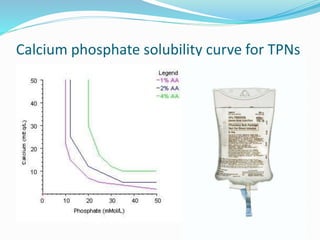
 Up to 10 mEq of Calcium can be added to each liter of TPN
containing 20 mEq of PO4.
 Concentration dependant
 Bactrim 5 ml/75 ml D5W stable for 2 hours, whereas 5 ml/125
ml D5W is stable for 6 hours
 Buffer capacity, pH, and Time
 Amino acid composition and concentration in TPN
Types of Incompatibilities
1. Therapeutic Incompatibility
2. Physical Incompatibility
3. Chemical Incompatibility
4. Drug IV Container Incompatibilities
Therapeutic Incompatibility
 The result of pharmacological effects of several drugs
in one patient (a.k.a. drug interactions).
 Mechanisms
1. Pharmacokinetic: absorption, distribution, metabolism,
excretion (e.g. Ciprofloxacin and Maalox).
2. Pharmacodynamic: antagonism/ synergism (e.g. Coumadin
and Vitamin K)
Example Intervention
Heparin and antibiotics Best to avoid mixing heparin with IV
antibiotics since heparin can affect
the stability of certain antibiotics
(e.g. aminoglycosides)
Physical Incompatibility
 The incompatibility that is more on solubility changes
and container interactions
Type Ways to Prevent
Insolubility -Do not administer a
precipitate forming drug
-Avoid mixing drugs prepared
in special diluents with other
drugs
- In administration of multiple
IV medications, prepare each
drug in a separate syringe
Sorption Phenomena
Gas Formation
Solution pH
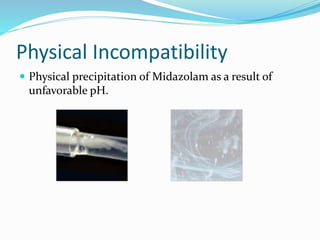
Physical Incompatibility
 Physical precipitation of Midazolam as a result of
unfavorable pH.
Chemical Incompatibility
 Results from the molecular changes or rearrangement
and leads to chemical decomposition
Type Ways to Prevent
Hydrolysis Store drugs in moisture
proof containers or use
desiccants
Oxidation Reaction Store drugs in amber bottles
Reduction Reaction Keep away from reducing
agents
Photolysis Use light proof containers
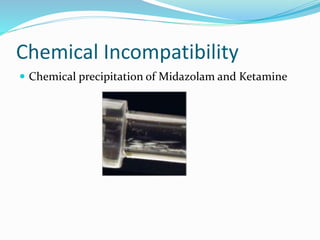
Chemical Incompatibility
 Chemical precipitation of Midazolam and Ketamine
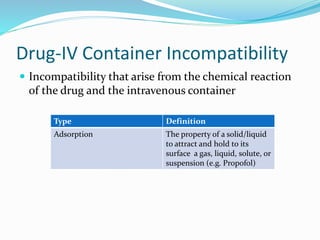
Drug-IV Container Incompatibility
 Incompatibility that arise from the chemical reaction
of the drug and the intravenous container
Type Definition
Adsorption The property of a solid/liquid
to attract and hold to its
surface a gas, liquid, solute, or
suspension (e.g. Propofol)
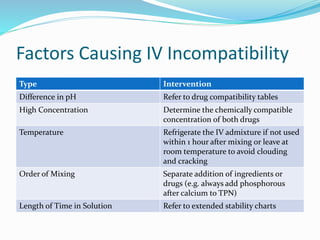
Factors Causing IV Incompatibility
Type Intervention
Difference in pH Refer to drug compatibility tables
High Concentration Determine the chemically compatible
concentration of both drugs
Temperature Refrigerate the IV admixture if not used
within 1 hour after mixing or leave at
room temperature to avoid clouding
and cracking
Order of Mixing Separate addition of ingredients or
drugs (e.g. always add phosphorous
after calcium to TPN)
Length of Time in Solution Refer to extended stability charts
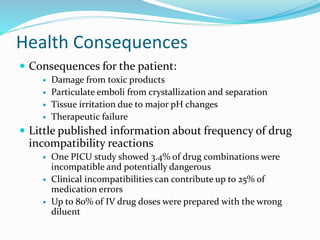
Health Consequences
 Consequences for the patient:
 Damage from toxic products
 Particulate emboli from crystallization and separation
 Tissue irritation due to major pH changes
 Therapeutic failure
 Little published information about frequency of drug
incompatibility reactions
 One PICU study showed 3.4% of drug combinations were
incompatible and potentially dangerous
 Clinical incompatibilities can contribute up to 25% of
medication errors
 Up to 80% of IV drug doses were prepared with the wrong
diluent
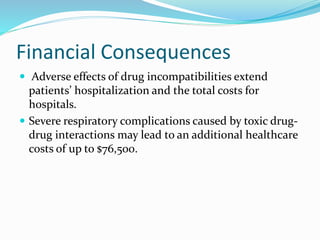
Financial Consequences
 Adverse effects of drug incompatibilities extend
patients’ hospitalization and the total costs for
hospitals.
 Severe respiratory complications caused by toxic drug-
drug interactions may lead to an additional healthcare
costs of up to $76,500.
Preventive Strategies
 Always check for compatibility
 Standardize protocol for drug preparation
 Check for alternative modes of administration
 Separation of drug doses by time and place
 Usage of multi-lumen catheters
 Use in-line filters
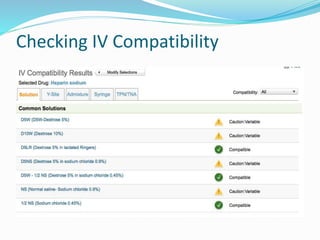
Checking IV Compatibility
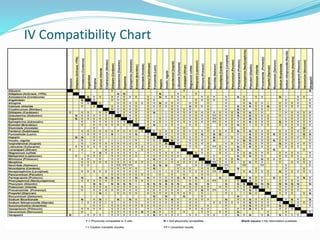
IV Compatibility Chart
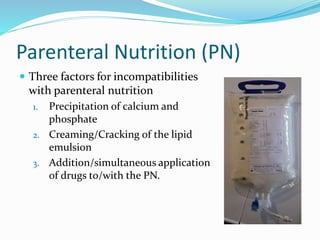
Parenteral Nutrition (PN)
 Three factors for incompatibilities
with parenteral nutrition
1. Precipitation of calcium and
phosphate
2. Creaming/Cracking of the lipid
emulsion
3. Addition/simultaneous application
of drugs to/with the PN.
Incompatibility Between Drugs and PN
 Four criteria for drugs commonly added to PN
admixtures (e.g. insulin, heparin, and Pepcid)
1. Stable dosage regimen over 24 hours
2. Pharmacokinetic profile supporting 24-hour infusion
3. Stable PN solution infusion rate
4. Documented chemical and physical stability over 24
hours
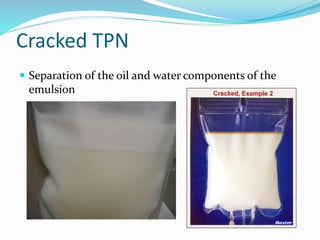
Cracked TPN
 Separation of the oil and water components of the
emulsion
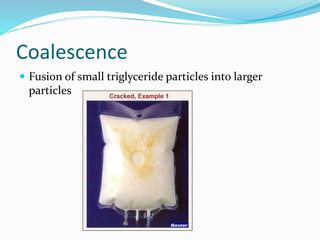
Coalescence
 Fusion of small triglyceride particles into larger
particles
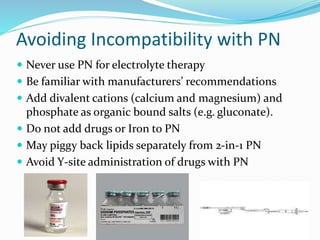
Avoiding Incompatibility with PN
 Never use PN for electrolyte therapy
 Be familiar with manufacturers’ recommendations
 Add divalent cations (calcium and magnesium) and
phosphate as organic bound salts (e.g. gluconate).
 Do not add drugs or Iron to PN
 May piggy back lipids separately from 2-in-1 PN
 Avoid Y-site administration of drugs with PN
Calcium phosphate solubility curve for TPNs
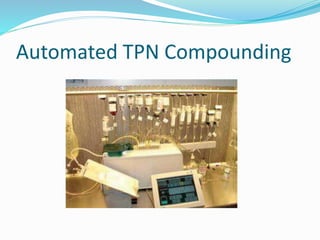
Automated TPN Compounding
Where To Look For Compatibility Data
 Must use professional judgment when evaluating
different reference sources.
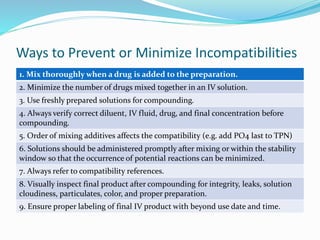
Ways to Prevent or Minimize Incompatibilities
1. Mix thoroughly when a drug is added to the preparation.
2. Minimize the number of drugs mixed together in an IV solution.
3. Use freshly prepared solutions for compounding.
4. Always verify correct diluent, IV fluid, drug, and final concentration before
compounding.
5. Order of mixing additives affects the compatibility (e.g. add PO4 last to TPN)
6. Solutions should be administered promptly after mixing or within the stability
window so that the occurrence of potential reactions can be minimized.
7. Always refer to compatibility references.
8. Visually inspect final product after compounding for integrity, leaks, solution
cloudiness, particulates, color, and proper preparation.
9. Ensure proper labeling of final IV product with beyond use date and time.
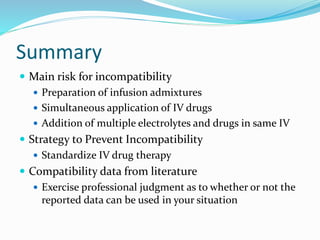
Summary
 Main risk for incompatibility
 Preparation of infusion admixtures
 Simultaneous application of IV drugs
 Addition of multiple electrolytes and drugs in same IV
 Strategy to Prevent Incompatibility
 Standardize IV drug therapy
 Compatibility data from literature
 Exercise professional judgment as to whether or not the
reported data can be used in your situation

IV Drug Incompatibilities

  • 1.
    Jonathan B. Hjelm,PharmD, BCPS, BCNSP, CGP Clinical Pharmacist Pharmastar PBM
  • 2.
    Objectives 1. Define IVcompatibility and incompatibility. 2. Where can incompatibilities occur? 3. What can be done to prevent them? 4. How do you know if a combination of drugs are compatible? I. What questions to ask II. Where to look for compatibility data III. How to interpret compatibility data
  • 3.
    Background  Drug stabilityand compatibility are critically important in the provision of safe and effective drug therapy  Multiple drugs may be administered simultaneously to a critically ill patient and determining the compatibility of those agents is of great importance.  It is estimated that over 30% of the commonly utilized drugs are incompatible or unstable when added or combined with usual fluids or agents.
  • 4.
    Definition  Incompatibility =is a reaction between drugs that after mixing are no longer safe or effective for the patient.  Characteristics of incompatibilities:  Color Change  Hazy Appearance  Precipitations
  • 5.
    NOT all incompatibilitiesare dangerous, some are just normal.  Color Change  Imipenem-cilastatin or dobutamine may show some color change but NOT a sign of incompatibility.  Hazy Appearance  When ceftazidime is reconstituted, carbon dioxide gas is released and can cause a hazy appearance.  Precipitation  The precipitate that forms when paclitaxel is refrigerated dissolves again at room temperature.
  • 6.
    Contributing Factors  Light Amphotericin B, cisplatin, and metronidazole must be protected from light.  Temperature  Cefazolin is stable at room temperature for 24 hours but under refrigeration for 14 days  Dilution  Up to 10 mEq of Calcium can be added to each liter of TPN containing 20 mEq of PO4.  Concentration dependant  Bactrim 5 ml/75 ml D5W stable for 2 hours, whereas 5 ml/125 ml D5W is stable for 6 hours  Buffer capacity, pH, and Time  Amino acid composition and concentration in TPN
  • 7.
    Types of Incompatibilities 1.Therapeutic Incompatibility 2. Physical Incompatibility 3. Chemical Incompatibility 4. Drug IV Container Incompatibilities
  • 8.
    Therapeutic Incompatibility  Theresult of pharmacological effects of several drugs in one patient (a.k.a. drug interactions).  Mechanisms 1. Pharmacokinetic: absorption, distribution, metabolism, excretion (e.g. Ciprofloxacin and Maalox). 2. Pharmacodynamic: antagonism/ synergism (e.g. Coumadin and Vitamin K) Example Intervention Heparin and antibiotics Best to avoid mixing heparin with IV antibiotics since heparin can affect the stability of certain antibiotics (e.g. aminoglycosides)
  • 9.
    Physical Incompatibility  Theincompatibility that is more on solubility changes and container interactions Type Ways to Prevent Insolubility -Do not administer a precipitate forming drug -Avoid mixing drugs prepared in special diluents with other drugs - In administration of multiple IV medications, prepare each drug in a separate syringe Sorption Phenomena Gas Formation Solution pH
  • 10.
    Physical Incompatibility  Physicalprecipitation of Midazolam as a result of unfavorable pH.
  • 11.
    Chemical Incompatibility  Resultsfrom the molecular changes or rearrangement and leads to chemical decomposition Type Ways to Prevent Hydrolysis Store drugs in moisture proof containers or use desiccants Oxidation Reaction Store drugs in amber bottles Reduction Reaction Keep away from reducing agents Photolysis Use light proof containers
  • 12.
    Chemical Incompatibility  Chemicalprecipitation of Midazolam and Ketamine
  • 13.
    Drug-IV Container Incompatibility Incompatibility that arise from the chemical reaction of the drug and the intravenous container Type Definition Adsorption The property of a solid/liquid to attract and hold to its surface a gas, liquid, solute, or suspension (e.g. Propofol)
  • 14.
    Factors Causing IVIncompatibility Type Intervention Difference in pH Refer to drug compatibility tables High Concentration Determine the chemically compatible concentration of both drugs Temperature Refrigerate the IV admixture if not used within 1 hour after mixing or leave at room temperature to avoid clouding and cracking Order of Mixing Separate addition of ingredients or drugs (e.g. always add phosphorous after calcium to TPN) Length of Time in Solution Refer to extended stability charts
  • 15.
    Health Consequences  Consequencesfor the patient:  Damage from toxic products  Particulate emboli from crystallization and separation  Tissue irritation due to major pH changes  Therapeutic failure  Little published information about frequency of drug incompatibility reactions  One PICU study showed 3.4% of drug combinations were incompatible and potentially dangerous  Clinical incompatibilities can contribute up to 25% of medication errors  Up to 80% of IV drug doses were prepared with the wrong diluent
  • 16.
    Financial Consequences  Adverseeffects of drug incompatibilities extend patients’ hospitalization and the total costs for hospitals.  Severe respiratory complications caused by toxic drug- drug interactions may lead to an additional healthcare costs of up to $76,500.
  • 17.
    Preventive Strategies  Alwayscheck for compatibility  Standardize protocol for drug preparation  Check for alternative modes of administration  Separation of drug doses by time and place  Usage of multi-lumen catheters  Use in-line filters
  • 18.
  • 19.
  • 20.
    Parenteral Nutrition (PN) Three factors for incompatibilities with parenteral nutrition 1. Precipitation of calcium and phosphate 2. Creaming/Cracking of the lipid emulsion 3. Addition/simultaneous application of drugs to/with the PN.
  • 21.
    Incompatibility Between Drugsand PN  Four criteria for drugs commonly added to PN admixtures (e.g. insulin, heparin, and Pepcid) 1. Stable dosage regimen over 24 hours 2. Pharmacokinetic profile supporting 24-hour infusion 3. Stable PN solution infusion rate 4. Documented chemical and physical stability over 24 hours
  • 22.
    Cracked TPN  Separationof the oil and water components of the emulsion
  • 23.
    Coalescence  Fusion ofsmall triglyceride particles into larger particles
  • 24.
    Avoiding Incompatibility withPN  Never use PN for electrolyte therapy  Be familiar with manufacturers’ recommendations  Add divalent cations (calcium and magnesium) and phosphate as organic bound salts (e.g. gluconate).  Do not add drugs or Iron to PN  May piggy back lipids separately from 2-in-1 PN  Avoid Y-site administration of drugs with PN
  • 25.
  • 26.
  • 27.
    Where To LookFor Compatibility Data  Must use professional judgment when evaluating different reference sources.
  • 28.
    Ways to Preventor Minimize Incompatibilities 1. Mix thoroughly when a drug is added to the preparation. 2. Minimize the number of drugs mixed together in an IV solution. 3. Use freshly prepared solutions for compounding. 4. Always verify correct diluent, IV fluid, drug, and final concentration before compounding. 5. Order of mixing additives affects the compatibility (e.g. add PO4 last to TPN) 6. Solutions should be administered promptly after mixing or within the stability window so that the occurrence of potential reactions can be minimized. 7. Always refer to compatibility references. 8. Visually inspect final product after compounding for integrity, leaks, solution cloudiness, particulates, color, and proper preparation. 9. Ensure proper labeling of final IV product with beyond use date and time.
  • 29.
    Summary  Main riskfor incompatibility  Preparation of infusion admixtures  Simultaneous application of IV drugs  Addition of multiple electrolytes and drugs in same IV  Strategy to Prevent Incompatibility  Standardize IV drug therapy  Compatibility data from literature  Exercise professional judgment as to whether or not the reported data can be used in your situation