S
Anaphylaxis
Case Examination – Diagnosis, and management
of anaphylaxis in the pre-hospital setting
Adam Khan
MCoP Paramedic Clinical Tutor
Aim:
The student should be able to demonstrate a clear
understanding of the safe approach, diagnosis and timely
management of a patient presenting with anaphylaxis in the
pre-hospital setting.
Objectives:
S Understand the causes, prevalence & clinical
manifestation of anaphylaxis.
S Demonstrate a safe approach to a patient presenting with
anaphylaxis.
S Understand the diagnosis and management of a patient
presenting with acute life-threatening anaphylaxis.
S Understand the definitive management and referral
options to a patient suffering with anaphylaxis
Case Presentation:
you are dispatched to a 30-year-old female ‘Louise’ who is
complaining of acute onset of dyspnea.
S Acute onset of dyspnea, choking.
S Occurrence following what is described as a ‘Bee sting’
S Previous medical history: Childhood Asthma
Case Presentation: continued
Location:
S Louise is located in a busy public
park with her boyfriend.
S Warm, sunny and dry afternoon.
Case Presentation: continued
Patient Assessment Triangle (PAT):
S Marginally obstructed airway.
S resp. rate 32 resp/min. Shallow & laboured.
S Flushed in appearance, clear agitation, swelling around the
eyes and mouth.
S Palpable Radial pulses, bi-laterally rate of 133 b/min.
S Responding verbally in broken sentences – clear hoarse voice
Anaphylaxis: What is it?
S Anaphylaxis is a severe, life-threatening, generalised
or systemic hypersensitivity reaction
S Multisystem involvement, including the airway, vascular
system, gastro intestinal (GI) tract and skin and central
nervous system.
S Acute onset.
Anaphylaxis: What is it?
Patients who have anaphylactic reaction have life-
threatening airway and/or breathing and/or circulation
problems usually associated with skin and mucosal
changes
Resuscitation council UK (2012)
Causes: of anaphylaxis
Stings 47
Nuts 32
Food 13
Food Possible Cause 17
Antibiotics 27
Anaesthetic Drugs 39
Other Drugs 24
Contrast Media 11
Other 3 Figures taken from Resuscitaiton Council (UK) 2008.
Table 1. Suspected triggers for fatal
anaphylactic reactions in the UK between
1992-2001
Lifetime Prevalence:
S According to the Resuscitation Council (2008) approx. in
1 in 1,333 of the English population have experienced
anaphylaxis at some point in their lives.
S The current incidence rate suggests that between 30 and
950 cases per 100,000 persons per year present in the
ED with anaphylaxis
Anaphylaxis: Mortality
S Post Mortem Findings:
S Airway (laryngeal) and tissue (visceral) edema
S Gastrointestinal Hemorrhage
S Myocardial injury
Anaphylaxis: Risk Factors
S Fatal cases – 4%
S Risk factors
S Asthmatics
S Mast Cell Disease – (rare)
S Personal/Familial history of anaphylaxis
S Age
S Sex
Anaphylaxis – Clinical Presentation
S The Skin (Integumentary
System)
S Pruritus (Itching), Urticaria
(Hives), Angioedema,
Flushing
Example of urticaria (hives) presenting in a child
Anaphylaxis – Clinical Presentation
S Angioedema affecting
the eyes and mouth.
S If left untreated this can
develop into a life-
threatening airway
obstruction
Anaphylaxis – Clinical Presentation
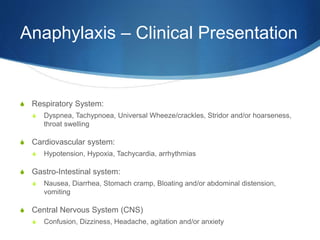
S Respiratory System:
S Dyspnea, Tachypnoea, Universal Wheeze/crackles, Stridor and/or hoarseness,
throat swelling
S Cardiovascular system:
S Hypotension, Hypoxia, Tachycardia, arrhythmias
S Gastro-Intestinal system:
S Nausea, Diarrhea, Stomach cramp, Bloating and/or abdominal distension,
vomiting
S Central Nervous System (CNS)
S Confusion, Dizziness, Headache, agitation and/or anxiety
Case Presentation:
S Vital Signs:
S Angioedema, Dyspnoea & tachypnoea 32 r/min
S SpO2: 89% (air)
S Tachycardia: 133 b/min
S Blood pressure: 88/52 mm/hg
S Temperature: 37.1 degrees Celsius
S 12 lead ECG: Sinus Tachycardia
S Blood sugar: 6.6
Anaphylaxis: Initial management
S Should consist of:
S Removal of offending agent (if possible)
S Rapid primary assessment ABCDE
S Focused Secondary assessment which includes
S Head to toe physical assessment
S NIBP
S 12 Lead ECG monitoring
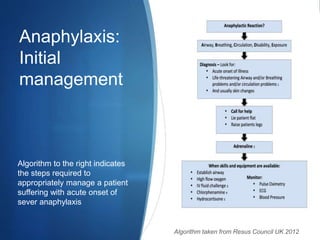
Anaphylaxis:
Initial
management
Algorithm to the right indicates
the steps required to
appropriately manage a patient
suffering with acute onset of
sever anaphylaxis
Algorithm taken from Resus Council UK 2012
Anaphylaxis: Treatment
S Joint Royal Colleges Ambulance Liaison Committee (JRCALC)
S ABC Assessment – Anaphylaxis
S OXYGEN – 15L if SpO2 <95%
S ADRENALINE (ADX) 1:1,000 Intra-muscular (IM) 500 mcgs
S HYDROCORTISONE (HYC) Intra-venous/muscular 200mgs
S SALBUTAMOL (SLB) Nebulised 5.0mg
Anaphylaxis: Treatment (cont.)
S CHLORPHENAMINE (CPH) Intra-venous 10mg
S SODIUM CHLORIDE (SCP) Intra-venous. 250 mL (titrated)
S NOTE:
S Establishing IV access should not delay transport to ED
S Adrenaline can be re-administered after 5 minutes if no effect
S Hydrocortisone is considered if transport time to ED is >30 mins
Transport Considerations
S Rapid Transport to Accident & Emergency
S ATMIST pre-alert en-route
S Consider HEMS if in a rural location or >45mins from hospital
Anaphylaxis: Temporal Pattern
S Uni-phasic:
S Singular allergic reaction, can be self limiting
S Bi-phasic:
S Initial allergic reaction
S Recurrence of same manifestations up to 8hrs later
S Protracted
S Up to 32 hours
S May not be prevented by glucocorticoids
Further treatment:
S ED will consider admittance if patient:
S Presents with biphasic or protracted reactions.
S If this is the patients first reaction.
S Age of patient – Risk management
S Children
S Elderly
S Referral onto an immunologist or allergy specialist will be
required
Differential Diagnosis
S Life Threatening:
S Severe Asthma
S Sepsis (SIRS)
S Pulmonary Embolism (PE)
S Choking
S Non life-threatening
S Syncope (vasovagal
episode)
S Panic Attack
S Idiopathic Urticaria
S Isolated Angioedema
Summary:
S Anaphylaxis is a life-threatening condition.
S Prompt identification, assessment and management is
vital for positive outcomes.
S Rapid transport is key to definitive treatment. Do not
delay on scene time
S Be aware of future treatment options

Anaphylaxis

  • 1.
    S Anaphylaxis Case Examination –Diagnosis, and management of anaphylaxis in the pre-hospital setting Adam Khan MCoP Paramedic Clinical Tutor
  • 2.
    Aim: The student shouldbe able to demonstrate a clear understanding of the safe approach, diagnosis and timely management of a patient presenting with anaphylaxis in the pre-hospital setting.
  • 3.
    Objectives: S Understand thecauses, prevalence & clinical manifestation of anaphylaxis. S Demonstrate a safe approach to a patient presenting with anaphylaxis. S Understand the diagnosis and management of a patient presenting with acute life-threatening anaphylaxis. S Understand the definitive management and referral options to a patient suffering with anaphylaxis
  • 4.
    Case Presentation: you aredispatched to a 30-year-old female ‘Louise’ who is complaining of acute onset of dyspnea. S Acute onset of dyspnea, choking. S Occurrence following what is described as a ‘Bee sting’ S Previous medical history: Childhood Asthma
  • 5.
    Case Presentation: continued Location: SLouise is located in a busy public park with her boyfriend. S Warm, sunny and dry afternoon.
  • 6.
    Case Presentation: continued PatientAssessment Triangle (PAT): S Marginally obstructed airway. S resp. rate 32 resp/min. Shallow & laboured. S Flushed in appearance, clear agitation, swelling around the eyes and mouth. S Palpable Radial pulses, bi-laterally rate of 133 b/min. S Responding verbally in broken sentences – clear hoarse voice
  • 7.
    Anaphylaxis: What isit? S Anaphylaxis is a severe, life-threatening, generalised or systemic hypersensitivity reaction S Multisystem involvement, including the airway, vascular system, gastro intestinal (GI) tract and skin and central nervous system. S Acute onset.
  • 8.
    Anaphylaxis: What isit? Patients who have anaphylactic reaction have life- threatening airway and/or breathing and/or circulation problems usually associated with skin and mucosal changes Resuscitation council UK (2012)
  • 9.
    Causes: of anaphylaxis Stings47 Nuts 32 Food 13 Food Possible Cause 17 Antibiotics 27 Anaesthetic Drugs 39 Other Drugs 24 Contrast Media 11 Other 3 Figures taken from Resuscitaiton Council (UK) 2008. Table 1. Suspected triggers for fatal anaphylactic reactions in the UK between 1992-2001
  • 10.
    Lifetime Prevalence: S Accordingto the Resuscitation Council (2008) approx. in 1 in 1,333 of the English population have experienced anaphylaxis at some point in their lives. S The current incidence rate suggests that between 30 and 950 cases per 100,000 persons per year present in the ED with anaphylaxis
  • 11.
    Anaphylaxis: Mortality S PostMortem Findings: S Airway (laryngeal) and tissue (visceral) edema S Gastrointestinal Hemorrhage S Myocardial injury
  • 12.
    Anaphylaxis: Risk Factors SFatal cases – 4% S Risk factors S Asthmatics S Mast Cell Disease – (rare) S Personal/Familial history of anaphylaxis S Age S Sex
  • 13.
    Anaphylaxis – ClinicalPresentation S The Skin (Integumentary System) S Pruritus (Itching), Urticaria (Hives), Angioedema, Flushing Example of urticaria (hives) presenting in a child
  • 14.
    Anaphylaxis – ClinicalPresentation S Angioedema affecting the eyes and mouth. S If left untreated this can develop into a life- threatening airway obstruction
  • 15.
    Anaphylaxis – ClinicalPresentation S Respiratory System: S Dyspnea, Tachypnoea, Universal Wheeze/crackles, Stridor and/or hoarseness, throat swelling S Cardiovascular system: S Hypotension, Hypoxia, Tachycardia, arrhythmias S Gastro-Intestinal system: S Nausea, Diarrhea, Stomach cramp, Bloating and/or abdominal distension, vomiting S Central Nervous System (CNS) S Confusion, Dizziness, Headache, agitation and/or anxiety
  • 16.
    Case Presentation: S VitalSigns: S Angioedema, Dyspnoea & tachypnoea 32 r/min S SpO2: 89% (air) S Tachycardia: 133 b/min S Blood pressure: 88/52 mm/hg S Temperature: 37.1 degrees Celsius S 12 lead ECG: Sinus Tachycardia S Blood sugar: 6.6
  • 17.
    Anaphylaxis: Initial management SShould consist of: S Removal of offending agent (if possible) S Rapid primary assessment ABCDE S Focused Secondary assessment which includes S Head to toe physical assessment S NIBP S 12 Lead ECG monitoring
  • 18.
    Anaphylaxis: Initial management Algorithm to theright indicates the steps required to appropriately manage a patient suffering with acute onset of sever anaphylaxis Algorithm taken from Resus Council UK 2012
  • 19.
    Anaphylaxis: Treatment S JointRoyal Colleges Ambulance Liaison Committee (JRCALC) S ABC Assessment – Anaphylaxis S OXYGEN – 15L if SpO2 <95% S ADRENALINE (ADX) 1:1,000 Intra-muscular (IM) 500 mcgs S HYDROCORTISONE (HYC) Intra-venous/muscular 200mgs S SALBUTAMOL (SLB) Nebulised 5.0mg
  • 20.
    Anaphylaxis: Treatment (cont.) SCHLORPHENAMINE (CPH) Intra-venous 10mg S SODIUM CHLORIDE (SCP) Intra-venous. 250 mL (titrated) S NOTE: S Establishing IV access should not delay transport to ED S Adrenaline can be re-administered after 5 minutes if no effect S Hydrocortisone is considered if transport time to ED is >30 mins
  • 21.
    Transport Considerations S RapidTransport to Accident & Emergency S ATMIST pre-alert en-route S Consider HEMS if in a rural location or >45mins from hospital
  • 22.
    Anaphylaxis: Temporal Pattern SUni-phasic: S Singular allergic reaction, can be self limiting S Bi-phasic: S Initial allergic reaction S Recurrence of same manifestations up to 8hrs later S Protracted S Up to 32 hours S May not be prevented by glucocorticoids
  • 23.
    Further treatment: S EDwill consider admittance if patient: S Presents with biphasic or protracted reactions. S If this is the patients first reaction. S Age of patient – Risk management S Children S Elderly S Referral onto an immunologist or allergy specialist will be required
  • 24.
    Differential Diagnosis S LifeThreatening: S Severe Asthma S Sepsis (SIRS) S Pulmonary Embolism (PE) S Choking S Non life-threatening S Syncope (vasovagal episode) S Panic Attack S Idiopathic Urticaria S Isolated Angioedema
  • 25.
    Summary: S Anaphylaxis isa life-threatening condition. S Prompt identification, assessment and management is vital for positive outcomes. S Rapid transport is key to definitive treatment. Do not delay on scene time S Be aware of future treatment options

Editor's Notes

  • #4 Understand the clinical differences between an allergy and anaphylaxis What are your main considerations when approaching a patient, not just suffering with anaphylaxis? What are the key clinical features of anaphylaxis? Once diagnosed, what will be your main considerations? Treatment plans? How are we going to transport the patient and what will the definitive treatment likely to be?
  • #6 Considerations at this point? SSS Safety, Scene, Situation Access & Egress Safe access and egress
  • #7 Considerations at this point. Does Louise appear to be a time-critical patient What course of action would you take at this point? E.g. back-up, crowd control, focused primary assessment ABCDE We will come back to Louise late in this session
  • #10 The prevalence of anaphylaxis has been hard to estimate due to: Individuals never actually informing their doctor about the reactions they have experienced Difficulties with definition e.g. (hives without any other manifestations) Epidemiological surveys suggest reaction to insect stings in 1% of children and 3% of adults Food allergy is more common in children than adults Food induced anaphylaxis is estimated to occur in 1%-3% of children Drug reactions are also common with anaphylaxis occurring in approx. 1% of adults. Radiocontrast media causes anaphylaxis in 0.1% of procedures performed Allergen immunotherapy injections cause systemic symptoms in 10%-15% of treated patients, but anaphylaxis is estimated to occur in 3% of cases Various estimates suggest that 5% of adults may have a history of anaphylaxis
  • #11 The UK incidence of anaphylactic reactions is rising.
  • #12 Autopsy findings in anaphylaxis vary from widespread severe pathological findings of pulmonary edema, gastrointestinal hemorrhage, myocardial infarction and severe head and neck angioedema to no pathologic signs.
  • #13 The risk groups associated with anaphylaxis are: Asthmatics: Given the complexities of asthma as primarily a condition affecting breathing it stands to reason that if a patient with a history of poorly managed asthma develops an acute overreaction to a particular allergen, breathing is likely to be affected more severely. Mast Cell Disease: Although rare Mast Cell disease should be considered. AKA Mastocytosis, increased number of mast cells in the bodies tissue. When mast cells detect an allergen, they release histamine and other chemicals into the bloodstream. Histamine makes the blood vessels expand and the surrounding skin itchy and swollen. There are 2 types of mast cell disease: 1 Cutaneous 2. Systemic – generally associated with a heightened reaction to an allergen and subsequent anaphylaxis Family History: If you have a family member who’ve experienced exercise-induced anaphylaxis, your risk of developing this type of anaphylaxis is higher than it is for someone with no family history. Age: Anaphylaxis can occur at any age. Figures however suggest that the highest treatment rate for anaphylactic shock is administered to boys aged 12-17 months. Severe food allergy is more common in children than adults. However, the frequency in adults may be increasing, since severe food allergy often persists into adulthood. Sex: Studies suggest that there may well be a female predominance to the presentation of anaphylaxis outlining that anaphylaxis to IV muscle relaxants, aspirin and latex are more common in women, whereas insect sting anaphylaxis is more common in men. Again these sex discrepancies are a likely function of exposure to frequency.
  • #17 Referring back to Louise’s case and during your primary assessment your findings are as follows. Louise has significant angioedema that is causing significant dyspnoea. Her respiration rate is 33 and shallow and she has widespread wheezes across all aspects of her lungs, she is hypoxic at 89% SpO2 on air. She was very weak palpable radial pulses that are fading rapidly and her blood pressure is 88/52. Louise is profoundly hypotensive. Louise is also presenting with sinus tachycardia on the 12 lead ECG With the vital signs listed what are your immediate concerns? Is louise suffering from life-threatening anaphylaxis? So what next?
  • #18 Primary Assessment will need to be completed in a timely fashion: this process should take no more than 90 seconds Airway Patency Breathing assessment including FLAPS TWELVE Circulation: CRT, radial pulse check, 1 on the floor 4 more Disability: GCS, Pupil Check, Blood Pressure Evaluation Secondary assessment may take place en route to hospital or once the patient has received initial treatment for life threatening ABCD issues. This will consist of a full head to toe physical assessment of the patient taking into account: Abdominal assessment Skin assessment Assessing long bones and extremities Head, eyes and neck
  • #20 Adrenaline should be considered as soon as you suspect that anaphylaxis. The timely administration of adrenaline (epinephrine) can make the difference between life and death in some cases. NOTE: A patient may carry their own adrenaline injector (Epipen) this may well have already been administered by your patient prior to your arrival. If no improvement can be seen then the patient must either re-administer a further dose of their own Epipen if available. Or the clinician must administer the required dose.
  • #23 Some patients may present with recurrent reactions (bipahsic syndrome) several hours after apparent resolution of the initial sings and symptoms, Biphasic anaphylaxis has been reported between 4% and 20% of cases. Signs and symptoms experienced during the recurrent phase may be equivalent to, or worse than, those associated with the initial reaction. Protracted anaphylaxis or (persistent anaphylaxis) may also occur and may not respond to treatment with glucocorticosteroids. Since life-threatening manifestations may recyr, it may be necessary to observe patients for up to 12 hours after apparent recovery from anaphylactic episodes.
  • #25 Life threatening: Asthma can present with very similar symptoms to anaphylaxis Wheeze/crackles Dyspnoea Shortness of Breath Reduced oxygen saturations Talking in broken sentences Acute onset Sepsis or Systemic Inflammatory Response Syndrome (SIRS) also presents with similar markers Tachycardia Shortness of Breath (depending on the manifestation) Tachypnoea Confusion Flushing Hypotension Pulmonary Embolism (PE) Breathlessness Chest tightness Tachycardia Collapse Choking: Inability to talk Noisy or difficult breathing Collapse
  • #26 Early administration of IM adrenaline Aggressive fluid management