• Penicillin is one of the most commonly
prescribed antibiotics. It is part of a
family of antibiotics known as beta
lactams, and there are many individual
medications
1- Natural Penicillins e.g. Penicillin G
These have greatest activity against G+
organisms, g – cocci.
2- Penicillinase-resistant Penicillins
( antistaphylococal P ) e.g. Cloxacillin,
Dicloxacillin, Methicillin, Nafcillin, Oxacillin.
They are active against staphylococci and
streptococci.
3- Extended-spectrum P
e.g. Amoxicillin, ampicillin,
Have further activity against G- organism
• is a hypersensitive state acquired
through exposure to a particular
allergen.
• An immunologically mediated disease
• Covers broad range of clinical
manifestations from mild ,delayed
reaction to immediate life threatening
reactions
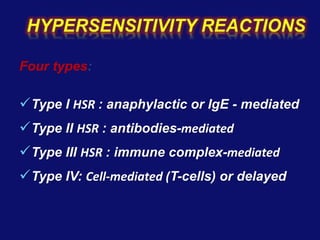
Four types:
Type I HSR : anaphylactic or IgE - mediated
Type II HSR : antibodies-mediated
Type III HSR : immune complex-mediated
Type IV: Cell-mediated (T-cells) or delayed
1-Immunoglobulin(Ig)E antibody-mediated
2-Immediate response
3-allergens(antigens)
A. Dust
B. Mites
C. Pollens
D. Animal danders
E. Food
F. Drugs
4-Symptomes
A. Anaphylaxis
B. Hay fever
C. Asthma
D. Urticaria , angioedema
E. Symptoms on occasion
5-Frequency:affect about 10% of population
6-Iherited tendency
• Penicillin allergy is an abnormal reaction of
your immune system to the antibiotic drug
penicillin
• A penicillin allergy is an allergic reaction that
occurs when your body's immune system
overreacts to penicillin antibiotic
Skin rashes
Hives itching
Shortness of
breath
wheezing
swelling
anaphylaxis
Itchy ,watery
eyes
Runny nose
fever
• Anaphylaxis is a rare, life-threatening allergic
reaction that causes the widespread
dysfunction of body systems. Signs and
symptoms of anaphylaxis include:
1. Itching of soft palate
2. Nausea , vomiting
3. Sub sternal pressure
4. Shortness of breath
5. Hypotension
6. Urticaria
7. Laryngeal edema
8. Bronchospasm
9. Cardiac arrhythmias
• Serum sickness
• Drug induced anemia
• Drug reaction with eosinophilia and systemic
symptoms (DRESS)
• Inflammation in the kidneys (nephritis)
1. A history of other allergies, such as food allergy
or hay fever
2. Allergic reaction to another drug
3. A family history of drug allergy
4. Increased exposure to penicillin, because of
high doses, repetitive use or prolonged use
5. Certain illnesses commonly associated with
allergic drug reactions, such as infection with
HIV or the Epstein-Barr virus
• Skin tests
• With a skin test, the allergist or nurse
administers a small amount of the suspect
penicillin to your skin either with a tiny needle
that scratches the skin or an injection. A positive
reaction to a test will cause a red, itchy, raised
bump.
• A positive result indicates a high likelihood of
penicillin allergy. A negative test result usually
means you're not allergic to penicillin, but a
negative result is more difficult to interpret
because some kinds of drug reactions cannot be
detected by skin tests
I. Treatment for the present allergy
symptoms
II. Desensitization to penicillin
1-Treating current symptoms
• Withdrawal of the drug.
• Antihistamines.
• Corticosteroids.
• Treatment of anaphylaxis
2-Drug desensitization
1. Inform health care workers
2. Wear a bracelet
3. Have an emergency kit
• Urticarial swelling or angioedema
• Reaction is rapid lesion developing within
short time
• Painless soft tissue swelling may cause
itching and burning
• Lesion can be present for 1-3 days if untreated
but will resolve spontaneously
• Oral antihistamine(oral diphenhydramine) 50
mg/4hrs for (1-3days)
1. Urticaria or angioedema
A. Reaction occur soon after contact with
antigen
B. Reaction consist of painless swelling
C. Itching and burning may occur
D. Lesion may remain for 1-3 days
1. Reaction not involving tongue , pharynx or
larynx and with no respiratory distress
noted requires 50 mg of diphenyhydramine
4 times a day until swelling diminshes
2. Reaction involving tongue , pharynx or
larynx with respiratory distress noted
requires the following:
A. 0.5ml of 1:1000 epinephrine , IM or SC
B. Oxygen
C. Once immediate danger is over,50 mg of
diphenhydramine should be given 4 times a
day until swelling diminishes
1. Call for medical help
2. Place patient in supine position
3. Check for open airway
4. Administer oxygen
5-Check pulse , blood pressure and respiration.
• If any of vital signs is depressed or absent
inject o.5ml 1:1000 epinephrine into tongue
• Provide cardiopulmonary resuscitation if
needed
• Repeat IM injection of 0.5 ml 1:1000
epinephrine if no response
I. Tetracycline (e.g. doxycycline)
II. quinolones (e.g. ciprofloxacin)
III. macrolides (e.g. clarithromycin)
IV. aminoglycosides (e.g. gentamicin)
V. glycopeptides (e.g. vancomycin)
1. Erythromycin or clindamycin for treatment
of oral infection
2. Or clindamycin for prophylaxis against
infective endocarditis
• Don’t use aspirin
• Patient with history of penicillin reaction :1st
skin test for penicillin sensitivity
A. Negative –use penicillin or cephalosporin
B. Positive:
1. Avoid penicillin
2. Skin test for cephalosporin ;use it if result is
negative
• ELECTIVE DENTAL CARE:
• Elective dental case requiring local
anasthesia may need to be postponded
until a thorough evaluation of the
patient is completed by a competent
individual
• Option 1: consultation
• Immediate consultation to test the patient
for allergy to LA.
• If pain is present it may be managed orally
with various analgesics and infections can be
controlled with antibiotics
• Option2:General anasthesia
• Use of GA in place of LA to manage the
dental emergency.
• Highly useful and relatively safe technique
but has complications and unavailability in
dental office
Option 3:Histamine Blocker
1. Use of histamine blocker like diphenhydramine as
LA.
2. 1%solution with 1 in 100,000 epinephrine,pulpal
anasthesia upto 30 mins is produced
3. Burning or stinging sensation is produced which
can be minimized by using nitrous oxide and O2
4. Post operative tissue swelling and soreness
maybe present
Appropriate drug therapy with
immediate medical
consultation(option 1)is the most
reasonable mode of action
1. Dentist should obtain from each patient a
history of any reaction
2. Avoid contact with or use of antigens
3. Most of allergic patient can receive any
dental treatment as long as the antigen is
avoided and precautions are taken for
patient receiving steroids or have
angioedema
penicillin allergy
penicillin allergy

penicillin allergy

  • 2.
    • Penicillin isone of the most commonly prescribed antibiotics. It is part of a family of antibiotics known as beta lactams, and there are many individual medications
  • 3.
    1- Natural Penicillinse.g. Penicillin G These have greatest activity against G+ organisms, g – cocci.
  • 4.
    2- Penicillinase-resistant Penicillins (antistaphylococal P ) e.g. Cloxacillin, Dicloxacillin, Methicillin, Nafcillin, Oxacillin. They are active against staphylococci and streptococci.
  • 5.
    3- Extended-spectrum P e.g.Amoxicillin, ampicillin, Have further activity against G- organism
  • 6.
    • is ahypersensitive state acquired through exposure to a particular allergen. • An immunologically mediated disease • Covers broad range of clinical manifestations from mild ,delayed reaction to immediate life threatening reactions
  • 7.
    Four types: Type IHSR : anaphylactic or IgE - mediated Type II HSR : antibodies-mediated Type III HSR : immune complex-mediated Type IV: Cell-mediated (T-cells) or delayed
  • 8.
    1-Immunoglobulin(Ig)E antibody-mediated 2-Immediate response 3-allergens(antigens) A.Dust B. Mites C. Pollens D. Animal danders E. Food F. Drugs
  • 9.
    4-Symptomes A. Anaphylaxis B. Hayfever C. Asthma D. Urticaria , angioedema E. Symptoms on occasion 5-Frequency:affect about 10% of population 6-Iherited tendency
  • 10.
    • Penicillin allergyis an abnormal reaction of your immune system to the antibiotic drug penicillin • A penicillin allergy is an allergic reaction that occurs when your body's immune system overreacts to penicillin antibiotic
  • 11.
    Skin rashes Hives itching Shortnessof breath wheezing swelling anaphylaxis Itchy ,watery eyes Runny nose fever
  • 13.
    • Anaphylaxis isa rare, life-threatening allergic reaction that causes the widespread dysfunction of body systems. Signs and symptoms of anaphylaxis include:
  • 14.
    1. Itching ofsoft palate 2. Nausea , vomiting 3. Sub sternal pressure 4. Shortness of breath 5. Hypotension 6. Urticaria 7. Laryngeal edema 8. Bronchospasm 9. Cardiac arrhythmias
  • 15.
    • Serum sickness •Drug induced anemia • Drug reaction with eosinophilia and systemic symptoms (DRESS) • Inflammation in the kidneys (nephritis)
  • 16.
    1. A historyof other allergies, such as food allergy or hay fever 2. Allergic reaction to another drug 3. A family history of drug allergy 4. Increased exposure to penicillin, because of high doses, repetitive use or prolonged use 5. Certain illnesses commonly associated with allergic drug reactions, such as infection with HIV or the Epstein-Barr virus
  • 17.
    • Skin tests •With a skin test, the allergist or nurse administers a small amount of the suspect penicillin to your skin either with a tiny needle that scratches the skin or an injection. A positive reaction to a test will cause a red, itchy, raised bump. • A positive result indicates a high likelihood of penicillin allergy. A negative test result usually means you're not allergic to penicillin, but a negative result is more difficult to interpret because some kinds of drug reactions cannot be detected by skin tests
  • 19.
    I. Treatment forthe present allergy symptoms II. Desensitization to penicillin
  • 20.
    1-Treating current symptoms •Withdrawal of the drug. • Antihistamines. • Corticosteroids. • Treatment of anaphylaxis 2-Drug desensitization
  • 22.
    1. Inform healthcare workers 2. Wear a bracelet 3. Have an emergency kit
  • 24.
    • Urticarial swellingor angioedema • Reaction is rapid lesion developing within short time • Painless soft tissue swelling may cause itching and burning • Lesion can be present for 1-3 days if untreated but will resolve spontaneously • Oral antihistamine(oral diphenhydramine) 50 mg/4hrs for (1-3days)
  • 25.
    1. Urticaria orangioedema A. Reaction occur soon after contact with antigen B. Reaction consist of painless swelling C. Itching and burning may occur D. Lesion may remain for 1-3 days
  • 26.
    1. Reaction notinvolving tongue , pharynx or larynx and with no respiratory distress noted requires 50 mg of diphenyhydramine 4 times a day until swelling diminshes 2. Reaction involving tongue , pharynx or larynx with respiratory distress noted requires the following:
  • 27.
    A. 0.5ml of1:1000 epinephrine , IM or SC B. Oxygen C. Once immediate danger is over,50 mg of diphenhydramine should be given 4 times a day until swelling diminishes
  • 28.
    1. Call formedical help 2. Place patient in supine position 3. Check for open airway 4. Administer oxygen
  • 29.
    5-Check pulse ,blood pressure and respiration. • If any of vital signs is depressed or absent inject o.5ml 1:1000 epinephrine into tongue • Provide cardiopulmonary resuscitation if needed • Repeat IM injection of 0.5 ml 1:1000 epinephrine if no response
  • 31.
    I. Tetracycline (e.g.doxycycline) II. quinolones (e.g. ciprofloxacin) III. macrolides (e.g. clarithromycin) IV. aminoglycosides (e.g. gentamicin) V. glycopeptides (e.g. vancomycin)
  • 32.
    1. Erythromycin orclindamycin for treatment of oral infection 2. Or clindamycin for prophylaxis against infective endocarditis • Don’t use aspirin
  • 33.
    • Patient withhistory of penicillin reaction :1st skin test for penicillin sensitivity A. Negative –use penicillin or cephalosporin B. Positive: 1. Avoid penicillin 2. Skin test for cephalosporin ;use it if result is negative
  • 34.
    • ELECTIVE DENTALCARE: • Elective dental case requiring local anasthesia may need to be postponded until a thorough evaluation of the patient is completed by a competent individual
  • 35.
    • Option 1:consultation • Immediate consultation to test the patient for allergy to LA. • If pain is present it may be managed orally with various analgesics and infections can be controlled with antibiotics
  • 36.
    • Option2:General anasthesia •Use of GA in place of LA to manage the dental emergency. • Highly useful and relatively safe technique but has complications and unavailability in dental office
  • 37.
    Option 3:Histamine Blocker 1.Use of histamine blocker like diphenhydramine as LA. 2. 1%solution with 1 in 100,000 epinephrine,pulpal anasthesia upto 30 mins is produced 3. Burning or stinging sensation is produced which can be minimized by using nitrous oxide and O2 4. Post operative tissue swelling and soreness maybe present
  • 38.
    Appropriate drug therapywith immediate medical consultation(option 1)is the most reasonable mode of action
  • 39.
    1. Dentist shouldobtain from each patient a history of any reaction 2. Avoid contact with or use of antigens 3. Most of allergic patient can receive any dental treatment as long as the antigen is avoided and precautions are taken for patient receiving steroids or have angioedema