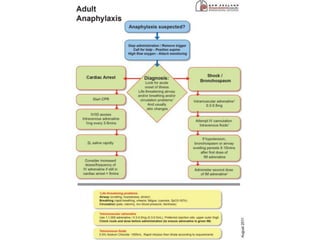
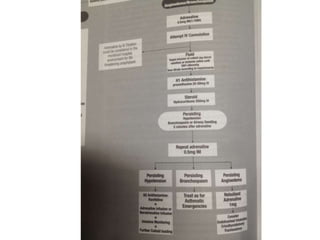
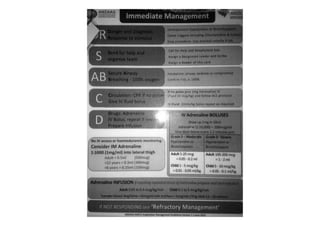
Anaphylaxis
SHO presentation
Tom Francis ICU Registrar
Anaphylaxis
• What is it
• Pathophysiology
• Common causes / precipitants
• Features / signs
• Treatment
• After-care / discharge
Anaphylactic shock
• Type 1 IgE mediated (usually) hypersensitivity
reaction
• Chain Reaction
• Release of histamine and other cytokines from
mast cells and basophills
• Causes contraction of bronchial smooth
muscles, vasodilation of peripheral
vasculature, capillary leak and cardiac muscle
depression
ADRENALINE
• Mainstay of treatment is Adrenaline
0.5mg IM ADRENALINE
Precipitants / causes
• Drugs
– Abx, cross reactivity B-lactams
– Muscle relaxants
– IV contrast
• Food
• Bee stings / wasp / horse fly
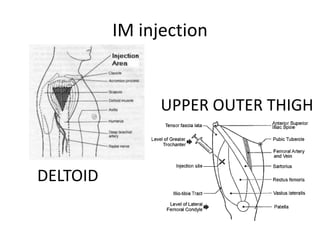
IM injection
DELTOID
UPPER OUTER THIGH
Recognition
• Airway
– Airway oedema – larynx, lips, tongue, eyelids
– Stridor is a sign of airway obstruction
• Breathing
– Bronchial smooth muscle constriction – wheeze,
respiratory distress, increased work of breathing
• Circulation
– Relaxation of vascular smooth muscle – Vasodilation,
hypotension and erythema
– Increased capillary permeability leading to loss of fluid
from circulation : hypotension, tissue swelling, urticaria
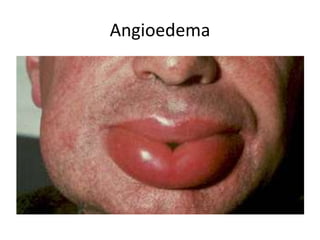
and Angioedema
Urticaria
Angioedema
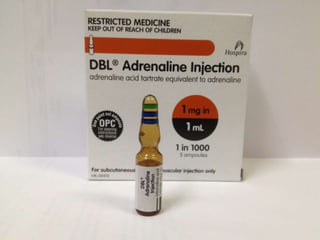
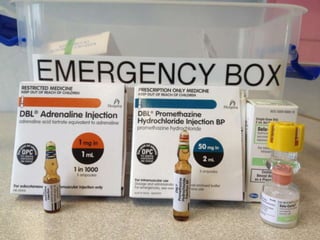
ADRENALINE
• 0.5mg IM
• Half of 1/1000 vial (the small one)
• Found in emergency box on all wards
• Can repeat every 5 mins
0.5mg ADRENALINE IM
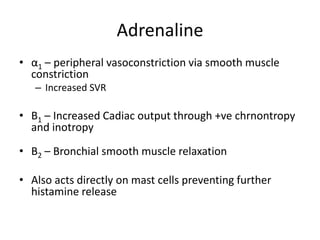
Adrenaline
• α1 – peripheral vasoconstriction via smooth muscle
constriction
– Increased SVR
• Β1 – Increased Cadiac output through +ve chrnontropy
and inotropy
• Β2 – Bronchial smooth muscle relaxation
• Also acts directly on mast cells preventing further
histamine release
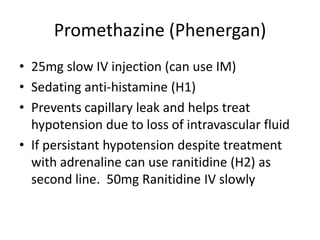
Promethazine (Phenergan)
• 25mg slow IV injection (can use IM)
• Sedating anti-histamine (H1)
• Prevents capillary leak and helps treat
hypotension due to loss of intravascular fluid
• If persistant hypotension despite treatment
with adrenaline can use ranitidine (H2) as
second line. 50mg Ranitidine IV slowly
Hydrocortisone
• 200mg IV hydrocortisone
• Requires reconstituion with sterile water
• OF NO VALUE IN IMMEDIATE RESUSCITATION
• Is of value to prevent rebound anaphylaxis
though onset of several hours, should be given
to prevent further deterioration in severely
affected patients
IV Fluids
• Vasodilation and increased vascular
permeability
• 3rd spacing of fluid into interstitial space
• DISTRIBUTIVE SHOCK
• 1 litre Crystalloid or colloid STAT once
Adrenaline given IM
• 1 – 3 litres commonly required
• 50mg Ranitidine can help persitant low BP
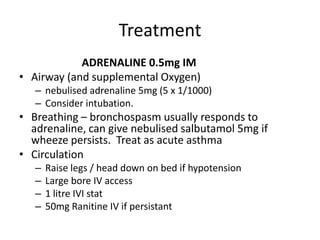
Treatment
ADRENALINE 0.5mg IM
• Airway (and supplemental Oxygen)
– nebulised adrenaline 5mg (5 x 1/1000)
– Consider intubation.
• Breathing – bronchospasm usually responds to
adrenaline, can give nebulised salbutamol 5mg if
wheeze persists. Treat as acute asthma
• Circulation
– Raise legs / head down on bed if hypotension
– Large bore IV access
– 1 litre IVI stat
– 50mg Ranitine IV if persistant
Treatment
• Mainstay of treatment is Adrenaline
0.5mg IM ADRENALINE
Where now?
• Pts who require treatment for anaphylaxis
need to be discussed with ICU
• Rebound Anaphylaxis is a concern
• Tryptase levels to confirm diagnosis
– <1 Hour, 8 hours, 24 hours
Discharge post anaphylaxis
• Oral antihistamine e.g loratadine 3/7
• Oral Steroid 3/7
– Reduces risk of further reaction
• Refer for specific allergy diagnosis
• Epi-pen prescription
– 300mcg Adrenaline
Further Mx…
• ACC form
• Refer to GP for Medic Alert bracelet
• Fill out an Alert/Adverse Reactions/Allergies form
• Complete CARM report if a medication allergy
– (Centre for adverse reactions monitoring)
– https://nzphvc-01.otago.ac.nz/carm/
– Or easily found on google!
Don’t forget!!!
0.5mg IM ADRENALINE
Paediatrics
• Adrenaline 0.01ml/kg of 1:1000 IM
– Minimum 0.1 ml (10kg)
– Maximum 0.5 ml (50kg)
• Dose will be between 100 – 500mcg IM
Airway obstruction
• Sit child upright
• Neb adrenaline 1:1000 0.5ml/kg, max 6ml.
Dilute to at least 4ml
Cardiovascular compromise
• Poor perfusion, tachycardia, hypotension
• IV access – Consider IO
• 20ml/kg NaCl
• Rpt as required – 4% albumin after 2nd bolus
• Adrenaline infusion
Bronchospasm
• Salbutamol neb 5mg PRN/continuous
• Consider IV salbutamol
• Intubation / ventilation
Further Mx
• Hydrocortisone 4mg/kg IV Q6H
• H1 antihistamine (loratadine / cetirizine)
– Itch
– Angioedema
• PO Ranitidine 1-2mg/kg (max 150mg) in sever
reactions
• If require more than 1x dose Adrenaline require 24
hour admission
References:
• ALS handbook (UK)
• ACLS level 7 handbook (NZ)
• NZ resuscitation website
• Starship PICU guidelines

Anaphylaxis. Dr Tom Francis

  • 1.
  • 2.
    Anaphylaxis • What isit • Pathophysiology • Common causes / precipitants • Features / signs • Treatment • After-care / discharge
  • 3.
    Anaphylactic shock • Type1 IgE mediated (usually) hypersensitivity reaction • Chain Reaction • Release of histamine and other cytokines from mast cells and basophills • Causes contraction of bronchial smooth muscles, vasodilation of peripheral vasculature, capillary leak and cardiac muscle depression
  • 4.
    ADRENALINE • Mainstay oftreatment is Adrenaline 0.5mg IM ADRENALINE
  • 5.
    Precipitants / causes •Drugs – Abx, cross reactivity B-lactams – Muscle relaxants – IV contrast • Food • Bee stings / wasp / horse fly
  • 6.
  • 7.
    Recognition • Airway – Airwayoedema – larynx, lips, tongue, eyelids – Stridor is a sign of airway obstruction • Breathing – Bronchial smooth muscle constriction – wheeze, respiratory distress, increased work of breathing • Circulation – Relaxation of vascular smooth muscle – Vasodilation, hypotension and erythema – Increased capillary permeability leading to loss of fluid from circulation : hypotension, tissue swelling, urticaria and Angioedema
  • 8.
  • 9.
  • 10.
    ADRENALINE • 0.5mg IM •Half of 1/1000 vial (the small one) • Found in emergency box on all wards • Can repeat every 5 mins 0.5mg ADRENALINE IM
  • 12.
    Adrenaline • α1 –peripheral vasoconstriction via smooth muscle constriction – Increased SVR • Β1 – Increased Cadiac output through +ve chrnontropy and inotropy • Β2 – Bronchial smooth muscle relaxation • Also acts directly on mast cells preventing further histamine release
  • 14.
    Promethazine (Phenergan) • 25mgslow IV injection (can use IM) • Sedating anti-histamine (H1) • Prevents capillary leak and helps treat hypotension due to loss of intravascular fluid • If persistant hypotension despite treatment with adrenaline can use ranitidine (H2) as second line. 50mg Ranitidine IV slowly
  • 15.
    Hydrocortisone • 200mg IVhydrocortisone • Requires reconstituion with sterile water • OF NO VALUE IN IMMEDIATE RESUSCITATION • Is of value to prevent rebound anaphylaxis though onset of several hours, should be given to prevent further deterioration in severely affected patients
  • 16.
    IV Fluids • Vasodilationand increased vascular permeability • 3rd spacing of fluid into interstitial space • DISTRIBUTIVE SHOCK • 1 litre Crystalloid or colloid STAT once Adrenaline given IM • 1 – 3 litres commonly required • 50mg Ranitidine can help persitant low BP
  • 17.
    Treatment ADRENALINE 0.5mg IM •Airway (and supplemental Oxygen) – nebulised adrenaline 5mg (5 x 1/1000) – Consider intubation. • Breathing – bronchospasm usually responds to adrenaline, can give nebulised salbutamol 5mg if wheeze persists. Treat as acute asthma • Circulation – Raise legs / head down on bed if hypotension – Large bore IV access – 1 litre IVI stat – 50mg Ranitine IV if persistant
  • 19.
    Treatment • Mainstay oftreatment is Adrenaline 0.5mg IM ADRENALINE
  • 22.
    Where now? • Ptswho require treatment for anaphylaxis need to be discussed with ICU • Rebound Anaphylaxis is a concern • Tryptase levels to confirm diagnosis – <1 Hour, 8 hours, 24 hours
  • 23.
    Discharge post anaphylaxis •Oral antihistamine e.g loratadine 3/7 • Oral Steroid 3/7 – Reduces risk of further reaction • Refer for specific allergy diagnosis • Epi-pen prescription – 300mcg Adrenaline
  • 24.
    Further Mx… • ACCform • Refer to GP for Medic Alert bracelet • Fill out an Alert/Adverse Reactions/Allergies form • Complete CARM report if a medication allergy – (Centre for adverse reactions monitoring) – https://nzphvc-01.otago.ac.nz/carm/ – Or easily found on google!
  • 25.
  • 26.
    Paediatrics • Adrenaline 0.01ml/kgof 1:1000 IM – Minimum 0.1 ml (10kg) – Maximum 0.5 ml (50kg) • Dose will be between 100 – 500mcg IM
  • 27.
    Airway obstruction • Sitchild upright • Neb adrenaline 1:1000 0.5ml/kg, max 6ml. Dilute to at least 4ml
  • 28.
    Cardiovascular compromise • Poorperfusion, tachycardia, hypotension • IV access – Consider IO • 20ml/kg NaCl • Rpt as required – 4% albumin after 2nd bolus • Adrenaline infusion
  • 29.
    Bronchospasm • Salbutamol neb5mg PRN/continuous • Consider IV salbutamol • Intubation / ventilation
  • 30.
    Further Mx • Hydrocortisone4mg/kg IV Q6H • H1 antihistamine (loratadine / cetirizine) – Itch – Angioedema • PO Ranitidine 1-2mg/kg (max 150mg) in sever reactions • If require more than 1x dose Adrenaline require 24 hour admission
  • 31.
    References: • ALS handbook(UK) • ACLS level 7 handbook (NZ) • NZ resuscitation website • Starship PICU guidelines