Treatment of contrast
reaction
Dr Mohit Goel
JR III, 9 july, 2014
Bibliography-
• ACR Manual on Contrast Media
Version 8
2012
ACR (American College of Radiology)
Committee on Drugs and Contrast Media
• RADCONT08 - Contrast Media Reactions :
Management and Preventions.
• Contrast Media,Wilbur L. Reddinger Jr.,
B.S.,R.T.(R)(CT),November 1996.
Treatment
It is most important to target premedication to those who, in the past, have
had moderately severe or severe reactions requiring treatment.
Two frequently used regimens are:
1. Prednisone – 50 mg by mouth at 13 hours, 7 hours, and 1 hour before
contrast media injection, plus Diphenhydramine (Benadryl®) – 50 mg
intravenously, intramuscularly, or by mouth 1 hour before contrast medium.
or
2. Methylprednisolone (Medrol®) – 32 mg by mouth 12 hours and 2 hours
before contrast media injection.An anti-histamine (as in option 1) can also
be added to this regimen injection.
If the patient is unable to take oral medication, 200 mg of hydrocortisone
intravenously may be substituted for oral prednisone.(Greenberger protocol)
• Premedication strategies
(ACR Manual on Contrast Media ,Version 8 , 2012)
In evaluating a patient for a potential contrast reaction, five important
immediate assessments should be made:
• How does the patient look?
• Can the patient speak? How does the patient’s voice sound?
• How is the patient’s breathing?
• What is the patient’s pulse strength and rate?
• What is the patient’s blood pressure?
The level of consciousness, the appearance of the skin, quality of phonation,
lung auscultation, blood pressure and heart rate assessment will allow the
responding physician to quickly determine the severity of a reaction.
These findings also allow for the proper diagnosis of the reaction including
urticaria, facial or laryngeal edema, bronchospasm, hemodynamic
instability, vagal reaction, seizures, and pulmonary edema.
Management of acute reactions in adults
Urticaria
1. Discontinue injection if not completed
2. No treatment needed in most cases
3. Give H1-receptor blocker: diphenhydramine (Benadryl®) PO/IM/IV 25–50
mg.
If severe or widely disseminated: give alpha-agonist (arteriolar and venous
constriction): epinephrine SC (1:1,000) 0.1–0.3 ml (= 0.1–0.3 mg) (if no cardiac
contraindications).
Facial or Laryngeal Edema
1. Give O2 6–10 liters/min (via mask).
2. Give alpha agonist (arteriolar and venous constriction): epinephrine SC
or IM (1:1,000) 0.1–0.3 ml (= 0.1–0.3 mg) or, especially if hypotension
evident, epinephrine (1:10,000) slowly IV –3 ml (= 0.1–0.3 mg).
Repeat as needed up to a maximum of 1 mg.
If not responsive to therapy or if there is obvious acute laryngeal edema,
seek appropriate assistance (e.g., cardiopulmonary arrest response team).
Hypotension withTachycardia
1. Legs elevated 60 degree or more (preferred).
2. Monitor: electrocardiogram, pulse oximeter, blood pressure.
3. Give O2 6–10 liters/min (via mask).
4. Rapid intravenous administration of large volumes of Ringer’s lactate or
normal saline.
If poorly responsive: epinephrine (1:10,000) slowly IV 1 ml (= 0.1 mg)
Repeat as needed up to a maximum of 1 mg.If still poorly responsive seek
appropriate assistance (e.g., cardiopulmonary arrest response team)
Hypotension with Bradycardia (Vagal Reaction)
1 Secure airway: giveO2 6–10 liters/min (via mask)
2. Monitor vital signs.
3. Elevate legs.
4. Secure IV access: rapid administration of Ringer’s lactate or normal saline.
5. Give atropine 0.6–1 mg IV slowly if patient does not respond quickly to
steps 2–4.
Repeat atropine up to a total dose of 0.04 mg/kg (2–3 mg) in adult.
6. Ensure complete resolution of hypotension and bradycardia prior to
discharge.
Hypertension, Severe
1. Give O2 6–10 liters/min (via mask).
2. Monitor electrocardiogram, pulse oximeter, blood pressure.
3. Give nitroglycerine 0.4-mg tablet, sublingual (may repeat × 3); or, topical
2% ointment, apply 1-inch strip.
4. If no response, consider labetalol 20 mg IV, then 20 to 80 mg IV every 10
minutes up to 300 mg. Transfer to intensive care unit or emergency
department.
Seizures or Convulsions
1. Give O2 6–10 liters/min (via mask).
2. Consider diazepam (Valium®) 5 mg IV (or more, as appropriate) or
midazolam (Versed®) 0.5 to 1 mg IV.
3. If longer effect needed, obtain consultation; consider phenytoin
(Dilantin®) infusion — 15–18 mg/kg at 50 mg/min.
4. Careful monitoring of vital signs required, particularly of pO2because of
risk to respiratory depression with benzodiazepine administration.
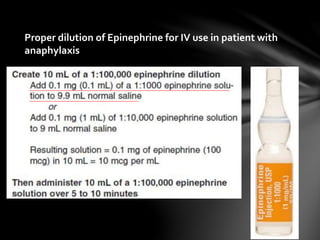
Proper dilution of Epinephrine for IV use in patient with
anaphylaxis
First-line emergency drugs and instruments that
should be in the room where contrast medium is
injected
• Oxygen
• Adrenaline 1:1000
• Antihistamine H1 – suitable for injection
• Atropine
• B2 agonist metered dose inhaler
• Intravenous fluids-normal saline or ringer’s solution
• Anti convulsive drugs (diazepam)
• Sphygmomanometer
• One-way mouth “breathing” apparatus
Thank you

Treat. contrast reaction

  • 1.
    Treatment of contrast reaction DrMohit Goel JR III, 9 july, 2014 Bibliography- • ACR Manual on Contrast Media Version 8 2012 ACR (American College of Radiology) Committee on Drugs and Contrast Media • RADCONT08 - Contrast Media Reactions : Management and Preventions. • Contrast Media,Wilbur L. Reddinger Jr., B.S.,R.T.(R)(CT),November 1996.
  • 2.
    Treatment It is mostimportant to target premedication to those who, in the past, have had moderately severe or severe reactions requiring treatment. Two frequently used regimens are: 1. Prednisone – 50 mg by mouth at 13 hours, 7 hours, and 1 hour before contrast media injection, plus Diphenhydramine (Benadryl®) – 50 mg intravenously, intramuscularly, or by mouth 1 hour before contrast medium. or 2. Methylprednisolone (Medrol®) – 32 mg by mouth 12 hours and 2 hours before contrast media injection.An anti-histamine (as in option 1) can also be added to this regimen injection. If the patient is unable to take oral medication, 200 mg of hydrocortisone intravenously may be substituted for oral prednisone.(Greenberger protocol) • Premedication strategies (ACR Manual on Contrast Media ,Version 8 , 2012)
  • 3.
    In evaluating apatient for a potential contrast reaction, five important immediate assessments should be made: • How does the patient look? • Can the patient speak? How does the patient’s voice sound? • How is the patient’s breathing? • What is the patient’s pulse strength and rate? • What is the patient’s blood pressure? The level of consciousness, the appearance of the skin, quality of phonation, lung auscultation, blood pressure and heart rate assessment will allow the responding physician to quickly determine the severity of a reaction. These findings also allow for the proper diagnosis of the reaction including urticaria, facial or laryngeal edema, bronchospasm, hemodynamic instability, vagal reaction, seizures, and pulmonary edema.
  • 4.
    Management of acutereactions in adults Urticaria 1. Discontinue injection if not completed 2. No treatment needed in most cases 3. Give H1-receptor blocker: diphenhydramine (Benadryl®) PO/IM/IV 25–50 mg. If severe or widely disseminated: give alpha-agonist (arteriolar and venous constriction): epinephrine SC (1:1,000) 0.1–0.3 ml (= 0.1–0.3 mg) (if no cardiac contraindications).
  • 5.
    Facial or LaryngealEdema 1. Give O2 6–10 liters/min (via mask). 2. Give alpha agonist (arteriolar and venous constriction): epinephrine SC or IM (1:1,000) 0.1–0.3 ml (= 0.1–0.3 mg) or, especially if hypotension evident, epinephrine (1:10,000) slowly IV –3 ml (= 0.1–0.3 mg). Repeat as needed up to a maximum of 1 mg. If not responsive to therapy or if there is obvious acute laryngeal edema, seek appropriate assistance (e.g., cardiopulmonary arrest response team).
  • 6.
    Hypotension withTachycardia 1. Legselevated 60 degree or more (preferred). 2. Monitor: electrocardiogram, pulse oximeter, blood pressure. 3. Give O2 6–10 liters/min (via mask). 4. Rapid intravenous administration of large volumes of Ringer’s lactate or normal saline. If poorly responsive: epinephrine (1:10,000) slowly IV 1 ml (= 0.1 mg) Repeat as needed up to a maximum of 1 mg.If still poorly responsive seek appropriate assistance (e.g., cardiopulmonary arrest response team)
  • 7.
    Hypotension with Bradycardia(Vagal Reaction) 1 Secure airway: giveO2 6–10 liters/min (via mask) 2. Monitor vital signs. 3. Elevate legs. 4. Secure IV access: rapid administration of Ringer’s lactate or normal saline. 5. Give atropine 0.6–1 mg IV slowly if patient does not respond quickly to steps 2–4. Repeat atropine up to a total dose of 0.04 mg/kg (2–3 mg) in adult. 6. Ensure complete resolution of hypotension and bradycardia prior to discharge.
  • 8.
    Hypertension, Severe 1. GiveO2 6–10 liters/min (via mask). 2. Monitor electrocardiogram, pulse oximeter, blood pressure. 3. Give nitroglycerine 0.4-mg tablet, sublingual (may repeat × 3); or, topical 2% ointment, apply 1-inch strip. 4. If no response, consider labetalol 20 mg IV, then 20 to 80 mg IV every 10 minutes up to 300 mg. Transfer to intensive care unit or emergency department.
  • 9.
    Seizures or Convulsions 1.Give O2 6–10 liters/min (via mask). 2. Consider diazepam (Valium®) 5 mg IV (or more, as appropriate) or midazolam (Versed®) 0.5 to 1 mg IV. 3. If longer effect needed, obtain consultation; consider phenytoin (Dilantin®) infusion — 15–18 mg/kg at 50 mg/min. 4. Careful monitoring of vital signs required, particularly of pO2because of risk to respiratory depression with benzodiazepine administration.
  • 10.
    Proper dilution ofEpinephrine for IV use in patient with anaphylaxis
  • 13.
    First-line emergency drugsand instruments that should be in the room where contrast medium is injected • Oxygen • Adrenaline 1:1000 • Antihistamine H1 – suitable for injection • Atropine • B2 agonist metered dose inhaler • Intravenous fluids-normal saline or ringer’s solution • Anti convulsive drugs (diazepam) • Sphygmomanometer • One-way mouth “breathing” apparatus
  • 14.