Thrombocytopenic Purpura
By: Hussein Falih
Group: 52
prof. Lodmila
•
•
•
•
•
•
•
•
•

Contents.

What is Thrombocytopenic purpura
types
Epidemiology.
Pathogenesis.
Clinical picture.
The Diagnoses.
Case study.
Treatment.
References.
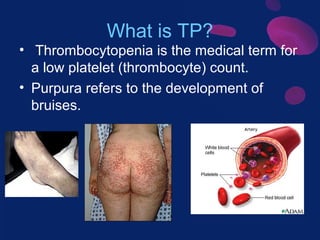
What is TP?
• Thrombocytopenia is the medical term for
a low platelet (thrombocyte) count.
• Purpura refers to the development of
bruises.
TYPES OF TP:

It can be:
•Autoimmune (Idiopathic)
thrombocytopenic purpura
•thrombotic thrombocytopenic
purpura.
•Drug induced
thrombocytopenic purpura.
Epidemiology.
• Acute TP lasts < 6 months. It mainly
occurs in children. Idiopathic TP is the
most common type of TP. It often occurs
after an infection from a virus.
• Chronic TP lasts > 6 months. It occurs
mainly in adults. Women are 2-3 times
more likely to be affected by Chronic TP.
• Reference range of a normal platelet
count is (150–400 x 109/L)
Pathogenesis of TP.
In ~ 60% of patients with TP, cause is
autoimmune.
-Abs of the IgG type binds to 1 of the platelet
membrane glycoproteins IIb – IIIa or Ib-IX.
Immune destruction
Intravascular coagulation (DIC or localized)
Microangiopathy
Damage by bacterial enzymes, etc
CLINICAL PICTURE
Bleeding
most important clinical manifestation of
ITP
Petechiae
Ecchymoses
Epistaxis
Gingival bleeding
Menorrhagia

Disabling fatigue
Proteinuria/hematuria
Abd. Pain,nausea,vomiting
Fever.
Diagnoses
Medical history.
• Physical examination.
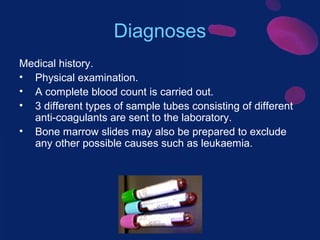
• A complete blood count is carried out.
• 3 different types of sample tubes consisting of different
anti-coagulants are sent to the laboratory.
• Bone marrow slides may also be prepared to exclude
any other possible causes such as leukaemia.
Case Study
• 12 year old male.
• Presented in emergency room with recent onset
of easy bruising and bleeding gums.
• Previously in excellent health. Father stated he
was "never sick before in his entire life."
• No history of recent viral infection, and no family
history of bleeding disorders.
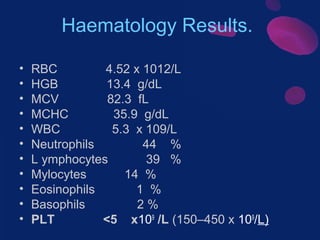
Haematology Results.
•
•
•
•
•
•
•
•
•
•
•

RBC
4.52 x 10¹²/L
HGB
13.4 g/dL
MCV
82.3 fL
MCHC
35.9 g/dL
WBC
5.3 x 10⁹/L
Neutrophils
44 %
L ymphocytes
39 %
Mylocytes
14 %
Eosinophils
1 %
Basophils
2%
PLT
<5 x10⁹ /L (150–450 x 109/L)
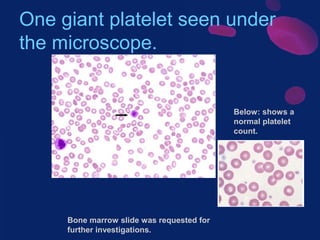
One giant platelet seen under
the microscope.

Below: shows a
normal platelet
count.

Bone marrow slide was requested for
further investigations.
• What is the most likely
diagnoses?
• Diagnosis
Immune thrombocytopenic purpura (ITP)
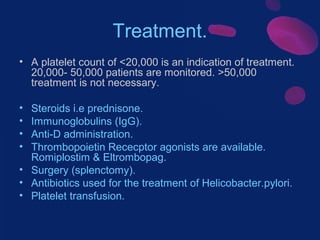
Treatment.
• A platelet count of <20,000 is an indication of treatment.
20,000- 50,000 patients are monitored. >50,000
treatment is not necessary.
•
•
•
•

Steroids i.e prednisone.
Immunoglobulins (IgG).
Anti-D administration.
Thrombopoietin Rececptor agonists are available.
Romiplostim & Eltrombopag.
• Surgery (splenctomy).
• Antibiotics used for the treatment of Helicobacter.pylori.
• Platelet transfusion.
Differential Diagnosis
• Disseminated intravascular coagulation.
• Sepsis: cytomegalovirus, rocky
mountain spotted fever,
meningococcemia.
• Preeclampsia/eclampsia, HELLP.
• Disseminated malignancy.
• Hemolytic-uremic syndrome
• Evans syndrome
• Malignant hypertension.
References.
• Wikipedia.
• Essensials of Kumar and Clarks clinical
medicine fifth edition 2012.
• Internal medicine department lectures.
Thank you.

Thrombocytopenic purpura

  • 1.
    Thrombocytopenic Purpura By: HusseinFalih Group: 52 prof. Lodmila
  • 2.
    • • • • • • • • • Contents. What is Thrombocytopenicpurpura types Epidemiology. Pathogenesis. Clinical picture. The Diagnoses. Case study. Treatment. References.
  • 3.
    What is TP? •Thrombocytopenia is the medical term for a low platelet (thrombocyte) count. • Purpura refers to the development of bruises.
  • 4.
    TYPES OF TP: Itcan be: •Autoimmune (Idiopathic) thrombocytopenic purpura •thrombotic thrombocytopenic purpura. •Drug induced thrombocytopenic purpura.
  • 5.
    Epidemiology. • Acute TPlasts < 6 months. It mainly occurs in children. Idiopathic TP is the most common type of TP. It often occurs after an infection from a virus. • Chronic TP lasts > 6 months. It occurs mainly in adults. Women are 2-3 times more likely to be affected by Chronic TP. • Reference range of a normal platelet count is (150–400 x 109/L)
  • 6.
    Pathogenesis of TP. In~ 60% of patients with TP, cause is autoimmune. -Abs of the IgG type binds to 1 of the platelet membrane glycoproteins IIb – IIIa or Ib-IX. Immune destruction Intravascular coagulation (DIC or localized) Microangiopathy Damage by bacterial enzymes, etc
  • 7.
    CLINICAL PICTURE Bleeding most importantclinical manifestation of ITP Petechiae Ecchymoses Epistaxis Gingival bleeding Menorrhagia Disabling fatigue Proteinuria/hematuria Abd. Pain,nausea,vomiting Fever.
  • 8.
    Diagnoses Medical history. • Physicalexamination. • A complete blood count is carried out. • 3 different types of sample tubes consisting of different anti-coagulants are sent to the laboratory. • Bone marrow slides may also be prepared to exclude any other possible causes such as leukaemia.
  • 9.
    Case Study • 12year old male. • Presented in emergency room with recent onset of easy bruising and bleeding gums. • Previously in excellent health. Father stated he was "never sick before in his entire life." • No history of recent viral infection, and no family history of bleeding disorders.
  • 10.
    Haematology Results. • • • • • • • • • • • RBC 4.52 x10¹²/L HGB 13.4 g/dL MCV 82.3 fL MCHC 35.9 g/dL WBC 5.3 x 10⁹/L Neutrophils 44 % L ymphocytes 39 % Mylocytes 14 % Eosinophils 1 % Basophils 2% PLT <5 x10⁹ /L (150–450 x 109/L)
  • 11.
    One giant plateletseen under the microscope. Below: shows a normal platelet count. Bone marrow slide was requested for further investigations.
  • 12.
    • What isthe most likely diagnoses?
  • 13.
  • 14.
    Treatment. • A plateletcount of <20,000 is an indication of treatment. 20,000- 50,000 patients are monitored. >50,000 treatment is not necessary. • • • • Steroids i.e prednisone. Immunoglobulins (IgG). Anti-D administration. Thrombopoietin Rececptor agonists are available. Romiplostim & Eltrombopag. • Surgery (splenctomy). • Antibiotics used for the treatment of Helicobacter.pylori. • Platelet transfusion.
  • 15.
    Differential Diagnosis • Disseminatedintravascular coagulation. • Sepsis: cytomegalovirus, rocky mountain spotted fever, meningococcemia. • Preeclampsia/eclampsia, HELLP. • Disseminated malignancy. • Hemolytic-uremic syndrome • Evans syndrome • Malignant hypertension.
  • 16.
    References. • Wikipedia. • Essensialsof Kumar and Clarks clinical medicine fifth edition 2012. • Internal medicine department lectures.
  • 17.

Editor's Notes

  • #12 One lymphocyte.
  • #14 Patient was given the first line of
  • #16 DD is mainly for microangiopathic hemolytic anemia DIC: prominent coagulopathy. HELLP: abnormal LFTS along with HTN Most common in gastric adenocarcinoma, followed by breast., renal failure is always present along with pulmonary edema HUS : is overlapping with TTP, platelet microthrombi is deposited predominantly in glomeruli. Shiga toxin has the direct in realizing ULVWF from the endothelium.