Anaphylaxis is:
–A severe, life-threatening, generalized or systemic
hypersensitivity reaction
Anaphylaxis is characterized by:
–Rapidly developing, life threatening, Airway and/or
Breathing and or Circulation problems
–Usually with skin and/or mucosal changes
•Mainly children and young adults
•Commoner in females
•Incidence seems to be increasing
Stings 47 29 wasp, 4 bee, ? 14
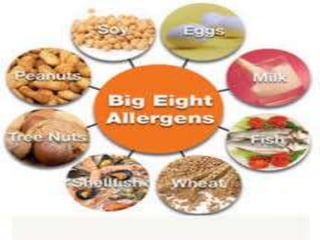
Nuts 32 10 peanut, 6 walnut, 2 almond, 2 brazil, 1 hazel, 11 mixed
or ?
Food 13 5 milk, 2 fish, 2 chickpea, 2 crustacean, 1 banana, 1 snail
? Food 18 5 during meal, 3 milk, 3 nut, 1 each - fish, yeast, sherbet,
nectarine, grape, strawberry
Antibiotics 27 11 penicillin, 12 cephalosporin, 2 amphotericin, 1
ciprofloxacin, 1 vancomycin
Anaesthetic drugs 35 19 suxamethonium, 7 vecuronium, 6 atracurium, 7 at
induction
Other drugs 15 6 NSAID, 3 ACEI, 5 gelatins, 2 protamine, 2 vitamin K, 1
each - etoposide, diamox, pethidine, local anaesthetic,
diamorphine, streptokinase
Contrast media 11 9 iodinated, 1 technetium, 1 fluorescine
Other 4 1 latex, 1 hair dye, 1 hydatid,1 idiopathic
Suspected triggers for fatal anaphylactic reactions in the UK between 1992‐2001
Adapted from Pumphrey RS. Lessons for management of anaphylaxis from a
study of fatal reactions. Clin Exp Allergy 2000;30(8):1144-50.
Pathophysiology
 Initial contact sensitizes the immune system
(does not produce clinical response)
 A secondary reaction, mediated by IgE, causes
the clinical symptoms of anaphylaxis.
 Antigens that stimulate the immune system to
produce IgE are called “Allergens”
Antigen Specific IgE
Fab
Fc
Mast Cell &
Basophils
Y Y YY Y Y
Mast Cell Mediators of Anaphylaxis:
Pre-Formed: Newly Formed:
Histamine Leukotrienes
Typtase, etc. Platelet-activating Factor
NCF-A Prostaglandin D2
•Immediate Hypersensitivity.
•Mediated By Ige
•Causes The Release of Histamine,
Leukotrienes
Prostaglandins
From Mastcells and Basophils.
•Usually Atopic (Familial Predisposition.
1. Ige Binds To Mast Cells
2. Antigen Cross Bridging
3. Histamine Release (Mast Cell Degranulation)
Urticaria
Angioedema
•Diagnosis not always obvious
•Sudden onset and rapid progression of symptoms
•Life-threatening Airway and/or Breathing and/or
Circulation problems
•Skin and/or mucosal changes
(flushing, urticaria,angioedema)
•Exposure to a known allergen/trigger
for the patient helps support the
diagnosis
•Skin or mucosal changes alone are not a sign of an
anaphylactic reaction
•Skin or mucosal changes can be subtle or absent in up to
20% of reactions (some patients can have only a decrease
in blood pressure i.e., a Circulation problem)
•There can also be gastrointestinal symptoms
(e.g. vomiting, abdominal pain, incontinence)
•Airway swelling e.g. throat and tongue swelling
•Difficulty in breathing and swallowing
•Sensation that throat is ‘closing up’
•Hoarse voice
•Stridor
•Shortness of breath
•Increased respiratory rate
•Wheeze
•Patient becoming tired
•Confusion caused by hypoxia
•Cyanosis (appears blue) –a late sign
•Respiratory arrest
•Signs of shock –pale, clammy
•Increased pulse rate (tachycardia)
•Low blood pressure (hypotension)
•Decreased conscious level
•Myocardialischaemia/ angina
•Cardiac arrest
DO NOT STAND PATIENT UP
•Sense of “impending doom”
•Anxiety, panic
•Decreased conscious level caused by airway,
breathing or circulation problem
•Skin changes often the first feature
•Present in over 80% of anaphylactic reactions
•Skin, mucosal, or both skin and mucosal changes
•Erythema–a patchy, or generalised, red rash
•Urticaria(also called hives, nettle rash,wealsor welts) anywhere on the body
•Angioedema-similar tourticaria but involves swelling of deeper tissues
e.g. eyelids and lips, sometimes in the mouth and throat
Life-threatening conditions:
•Asthma -can present with similar symptoms and
signs to anaphylaxis, particularly in children
•Septic shock –hypotension with
petechial/purpuricrash
Non-life-threatening conditions:
•Vasovagal episode
•Panic attack
•Breath-holding episode in a child
•Idiopathic (non-allergic) urticaria or angioedema
Seek help early if there are any doubts about the
diagnosis
Anaphylactic Reaction?
Assess : Airway, Breathing, Circulation, Disability, Exposure
Diagnosis-look for:
•Acute onset of illness •Life threatening features 1
•And usually skin changes
+/-Exposure to known allergen
+/-Gastrointestinal symptoms
Call for help
Lie patient flat and raise legs (if breathing not impaired)
Adrenaline
When skills and equipment available:
A. Establish airway
B. High flow oxygen Monitor:
C.IVfluidchallenge3 •Pulse oximetry
Chlorphenamine4 •ECG
Hydrocortisone5 •Blood pressure Anaphylactic
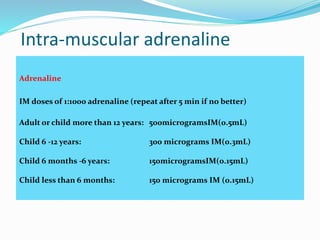
Intra-muscular adrenaline
Adrenaline
IM doses of 1:1000 adrenaline (repeat after 5 min if no better)
Adult or child more than 12 years: 500microgramsIM(0.5mL)
Child 6 ‐12 years: 300 micrograms IM(0.3mL)
Child 6 months ‐6 years: 150microgramsIM(0.15mL)
Child less than 6 months: 150 micrograms IM (0.15mL)
Caution with intravenous adrenaline
For use by experts only
Monitored patient
Anaphylactic Reaction?
Assess : Airway, Breathing, Circulation, Disability, Exposure
Diagnosis-look for:
•Acute onset of illness •Life threatening features 1
•And usually skin changes
+/-Exposure to known allergen
+/-Gastrointestinal symptoms
Call for help
Lie patient flat and raise legs (if breathing not impaired)
Adrenaline
When skills and equipment available:
A. Establish airway
B. High flow oxygen Monitor:
C.IVfluidchallenge3 •Pulse oximetry
Chlorphenamine4 •ECG
Hydrocortisone5 •Blood pressure Anaphylactic
•Once IV access established
•500 –1000mLIV bolus in adult
•20mL/Kg IV bolus in child
•Monitor response -give further bolus as necessary
•Colloid or crystalloid
(0.9% sodium chloride or Hartmann’s)
•Avoid colloid, if colloid thought to have caused reaction
•Second line drugs
•Use after initial resuscitation started
•Do not delay initial ABC treatments
•Can wait until transfer to hospital
Hydrocortisone (IM or slow IV)
 Adult or child more than 12 years 200 mg
 Child 6 - 12 years 100 mg
 Child 6 months to 6 years 50 mg
 Child less than 6 months 25 mg
Chlorphenamine(IM or slow IV)
 Adult or child more than 12 years 10 mg
 Child 6 - 12 years 5 mg
 Child 6 months to 6 years 2.5 mg
 Child less than 6 months 250 micrograms/kg
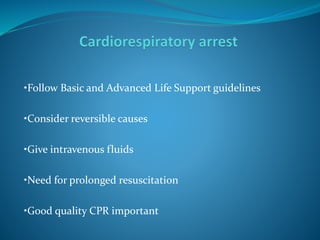
•Follow Basic and Advanced Life Support guidelines
•Consider reversible causes
•Give intravenous fluids
•Need for prolonged resuscitation
•Good quality CPR important
Ideal sample timing:
1.After initial resuscitation started and feasible
to do so
2. 1-2 hours after onset of symptoms
3. 24 hours or in convalescence or at follow up
•For self-use by patients or carers
•Should be prescribed by allergy specialist
•For those with severe reactions and difficult to
avoid trigger
•Train the patient and carers in using the device
•Practice regularly with a trainer device
•Rescuers should use these if only adrenaline available*
*see www.anaphylaxis.org.uk for videos on how to use auto-injectors
•Recognition and early treatment
•ABCDE approach
•Adrenaline
•Investigate
•Specialist follow up
•Education –avoid trigger
•Consider auto-injector
Further information on
anaphylaxis
is available at:
www.resus.org.uk
Resuscitation Council (UK)
46
Shake and Shout
47
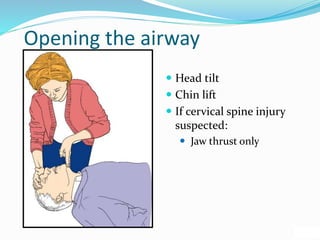
Opening the airway
 Head tilt
 Chin lift
 If cervical spine injury
suspected:
 Jaw thrust only
Jaw Thrust
49
Assess Breathing
 Look for chest movement
 Listen for breath sounds
 Feel for expired air
 Assess for 10 seconds before
deciding breathing is absent
Chest compressions
51
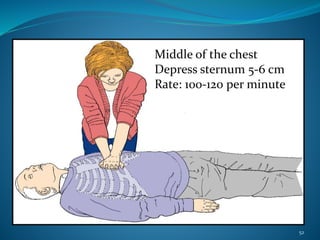
Middle of the chest
Depress sternum 5-6 cm
Rate: 100-120 per minute
52
Combine Chest compression with
rescue breaths
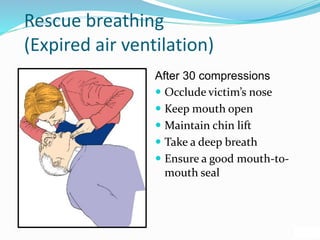
Rescue breathing
(Expired air ventilation)
After 30 compressions
 Occlude victim’s nose
 Keep mouth open
 Maintain chin lift
 Take a deep breath
 Ensure a good mouth-to-
mouth seal
Rescue breathing
(Expired air ventilation)
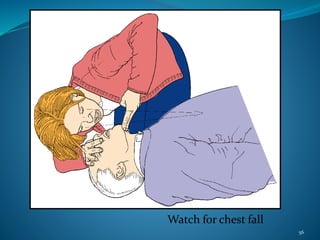
 Blow steadily (01 sec) into
victim’s mouth
 Watch for chest rise
 Maintain head tilt & chin lift,
remove mouth
 Watch chest fall
 Another rescue breath – total
2 rescue breaths
Watch for chest fall
56
 Mouth to
Tracheostomy
Ventilation
 Bag Mask
Ventilation
Needs considerable
skill & experience
57
Thank you

Workshop Aug 2015: Anaphylaxis

  • 4.
    Anaphylaxis is: –A severe,life-threatening, generalized or systemic hypersensitivity reaction Anaphylaxis is characterized by: –Rapidly developing, life threatening, Airway and/or Breathing and or Circulation problems –Usually with skin and/or mucosal changes
  • 6.
    •Mainly children andyoung adults •Commoner in females •Incidence seems to be increasing
  • 8.
    Stings 47 29wasp, 4 bee, ? 14 Nuts 32 10 peanut, 6 walnut, 2 almond, 2 brazil, 1 hazel, 11 mixed or ? Food 13 5 milk, 2 fish, 2 chickpea, 2 crustacean, 1 banana, 1 snail ? Food 18 5 during meal, 3 milk, 3 nut, 1 each - fish, yeast, sherbet, nectarine, grape, strawberry Antibiotics 27 11 penicillin, 12 cephalosporin, 2 amphotericin, 1 ciprofloxacin, 1 vancomycin Anaesthetic drugs 35 19 suxamethonium, 7 vecuronium, 6 atracurium, 7 at induction Other drugs 15 6 NSAID, 3 ACEI, 5 gelatins, 2 protamine, 2 vitamin K, 1 each - etoposide, diamox, pethidine, local anaesthetic, diamorphine, streptokinase Contrast media 11 9 iodinated, 1 technetium, 1 fluorescine Other 4 1 latex, 1 hair dye, 1 hydatid,1 idiopathic Suspected triggers for fatal anaphylactic reactions in the UK between 1992‐2001
  • 10.
    Adapted from PumphreyRS. Lessons for management of anaphylaxis from a study of fatal reactions. Clin Exp Allergy 2000;30(8):1144-50.
  • 11.
    Pathophysiology  Initial contactsensitizes the immune system (does not produce clinical response)  A secondary reaction, mediated by IgE, causes the clinical symptoms of anaphylaxis.  Antigens that stimulate the immune system to produce IgE are called “Allergens”
  • 12.
    Antigen Specific IgE Fab Fc MastCell & Basophils Y Y YY Y Y Mast Cell Mediators of Anaphylaxis: Pre-Formed: Newly Formed: Histamine Leukotrienes Typtase, etc. Platelet-activating Factor NCF-A Prostaglandin D2
  • 13.
    •Immediate Hypersensitivity. •Mediated ByIge •Causes The Release of Histamine, Leukotrienes Prostaglandins From Mastcells and Basophils. •Usually Atopic (Familial Predisposition. 1. Ige Binds To Mast Cells 2. Antigen Cross Bridging 3. Histamine Release (Mast Cell Degranulation)
  • 14.
  • 15.
  • 16.
  • 17.
    •Sudden onset andrapid progression of symptoms •Life-threatening Airway and/or Breathing and/or Circulation problems •Skin and/or mucosal changes (flushing, urticaria,angioedema)
  • 18.
    •Exposure to aknown allergen/trigger for the patient helps support the diagnosis
  • 19.
    •Skin or mucosalchanges alone are not a sign of an anaphylactic reaction •Skin or mucosal changes can be subtle or absent in up to 20% of reactions (some patients can have only a decrease in blood pressure i.e., a Circulation problem) •There can also be gastrointestinal symptoms (e.g. vomiting, abdominal pain, incontinence)
  • 20.
    •Airway swelling e.g.throat and tongue swelling •Difficulty in breathing and swallowing •Sensation that throat is ‘closing up’ •Hoarse voice •Stridor
  • 21.
    •Shortness of breath •Increasedrespiratory rate •Wheeze •Patient becoming tired •Confusion caused by hypoxia •Cyanosis (appears blue) –a late sign •Respiratory arrest
  • 22.
    •Signs of shock–pale, clammy •Increased pulse rate (tachycardia) •Low blood pressure (hypotension) •Decreased conscious level •Myocardialischaemia/ angina •Cardiac arrest DO NOT STAND PATIENT UP
  • 23.
    •Sense of “impendingdoom” •Anxiety, panic •Decreased conscious level caused by airway, breathing or circulation problem
  • 24.
    •Skin changes oftenthe first feature •Present in over 80% of anaphylactic reactions •Skin, mucosal, or both skin and mucosal changes
  • 25.
    •Erythema–a patchy, orgeneralised, red rash •Urticaria(also called hives, nettle rash,wealsor welts) anywhere on the body •Angioedema-similar tourticaria but involves swelling of deeper tissues e.g. eyelids and lips, sometimes in the mouth and throat
  • 26.
    Life-threatening conditions: •Asthma -canpresent with similar symptoms and signs to anaphylaxis, particularly in children •Septic shock –hypotension with petechial/purpuricrash
  • 27.
    Non-life-threatening conditions: •Vasovagal episode •Panicattack •Breath-holding episode in a child •Idiopathic (non-allergic) urticaria or angioedema Seek help early if there are any doubts about the diagnosis
  • 32.
    Anaphylactic Reaction? Assess :Airway, Breathing, Circulation, Disability, Exposure Diagnosis-look for: •Acute onset of illness •Life threatening features 1 •And usually skin changes +/-Exposure to known allergen +/-Gastrointestinal symptoms Call for help Lie patient flat and raise legs (if breathing not impaired) Adrenaline When skills and equipment available: A. Establish airway B. High flow oxygen Monitor: C.IVfluidchallenge3 •Pulse oximetry Chlorphenamine4 •ECG Hydrocortisone5 •Blood pressure Anaphylactic
  • 33.
    Intra-muscular adrenaline Adrenaline IM dosesof 1:1000 adrenaline (repeat after 5 min if no better) Adult or child more than 12 years: 500microgramsIM(0.5mL) Child 6 ‐12 years: 300 micrograms IM(0.3mL) Child 6 months ‐6 years: 150microgramsIM(0.15mL) Child less than 6 months: 150 micrograms IM (0.15mL)
  • 34.
    Caution with intravenousadrenaline For use by experts only Monitored patient
  • 35.
    Anaphylactic Reaction? Assess :Airway, Breathing, Circulation, Disability, Exposure Diagnosis-look for: •Acute onset of illness •Life threatening features 1 •And usually skin changes +/-Exposure to known allergen +/-Gastrointestinal symptoms Call for help Lie patient flat and raise legs (if breathing not impaired) Adrenaline When skills and equipment available: A. Establish airway B. High flow oxygen Monitor: C.IVfluidchallenge3 •Pulse oximetry Chlorphenamine4 •ECG Hydrocortisone5 •Blood pressure Anaphylactic
  • 36.
    •Once IV accessestablished •500 –1000mLIV bolus in adult •20mL/Kg IV bolus in child •Monitor response -give further bolus as necessary •Colloid or crystalloid (0.9% sodium chloride or Hartmann’s) •Avoid colloid, if colloid thought to have caused reaction
  • 37.
    •Second line drugs •Useafter initial resuscitation started •Do not delay initial ABC treatments •Can wait until transfer to hospital
  • 38.
    Hydrocortisone (IM orslow IV)  Adult or child more than 12 years 200 mg  Child 6 - 12 years 100 mg  Child 6 months to 6 years 50 mg  Child less than 6 months 25 mg
  • 39.
    Chlorphenamine(IM or slowIV)  Adult or child more than 12 years 10 mg  Child 6 - 12 years 5 mg  Child 6 months to 6 years 2.5 mg  Child less than 6 months 250 micrograms/kg
  • 40.
    •Follow Basic andAdvanced Life Support guidelines •Consider reversible causes •Give intravenous fluids •Need for prolonged resuscitation •Good quality CPR important
  • 41.
    Ideal sample timing: 1.Afterinitial resuscitation started and feasible to do so 2. 1-2 hours after onset of symptoms 3. 24 hours or in convalescence or at follow up
  • 42.
    •For self-use bypatients or carers •Should be prescribed by allergy specialist •For those with severe reactions and difficult to avoid trigger
  • 43.
    •Train the patientand carers in using the device •Practice regularly with a trainer device •Rescuers should use these if only adrenaline available* *see www.anaphylaxis.org.uk for videos on how to use auto-injectors
  • 44.
    •Recognition and earlytreatment •ABCDE approach •Adrenaline •Investigate •Specialist follow up •Education –avoid trigger •Consider auto-injector
  • 45.
    Further information on anaphylaxis isavailable at: www.resus.org.uk Resuscitation Council (UK)
  • 46.
  • 47.
  • 48.
    Opening the airway Head tilt  Chin lift  If cervical spine injury suspected:  Jaw thrust only
  • 49.
  • 50.
    Assess Breathing  Lookfor chest movement  Listen for breath sounds  Feel for expired air  Assess for 10 seconds before deciding breathing is absent
  • 51.
  • 52.
    Middle of thechest Depress sternum 5-6 cm Rate: 100-120 per minute 52
  • 53.
    Combine Chest compressionwith rescue breaths
  • 54.
    Rescue breathing (Expired airventilation) After 30 compressions  Occlude victim’s nose  Keep mouth open  Maintain chin lift  Take a deep breath  Ensure a good mouth-to- mouth seal
  • 55.
    Rescue breathing (Expired airventilation)  Blow steadily (01 sec) into victim’s mouth  Watch for chest rise  Maintain head tilt & chin lift, remove mouth  Watch chest fall  Another rescue breath – total 2 rescue breaths
  • 56.
  • 57.
     Mouth to Tracheostomy Ventilation Bag Mask Ventilation Needs considerable skill & experience 57
  • 59.