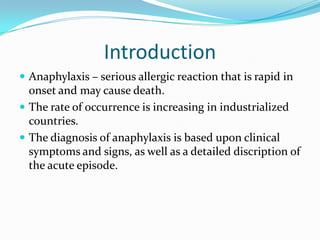
Introduction
 Anaphylaxis – serious allergic reaction that is rapid in
onset and may cause death.
 The rate of occurrence is increasing in industrialized
countries.
 The diagnosis of anaphylaxis is based upon clinical
symptoms and signs, as well as a detailed discription of
the acute episode.
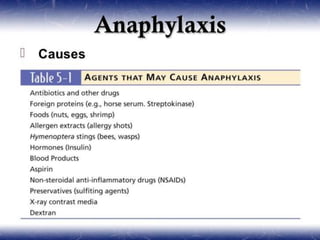
AGENTS
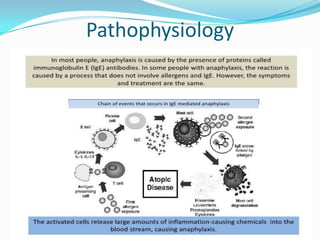
Pathophysiology
CRITERIA
 There are three diagnostic criteria, each reflecting a
different clinical presentation of anaphylaxis.
 Anaphylaxis is highly likely when any of the following
criteria is fullfilled.
Criterion 1.
 Acute onset of an illness (minutes to several hours)
with involvement of the skin, mucosal tissue, or both
(eg, generalized hives, pruritus or flushing, swollen
lips-tongue-uvula)
AND AT LEAST ONE OF THE FOLLOWING:
 Respiratory compromise (eg, dyspnea, wheeze-
bronchospasm, stridor, reduced peak expiratory
function [PEF], hypoxemia)
 Reduced blood pressure (BP) or associated symptoms
of end-organ dysfunction (eg, hypotonia [collapse],
syncope, incontinence)
 Because the majority of anaphylactic reactions (>80%)
include skin symptoms, it was judged that at least 80%
of anaphylactic reactions should be identified by
criterion 1 — even when the allergic status of the
patient and potential cause of the reaction is
unknown. However, cutaneous symptoms might be
absent in up to 20% of anaphylactic reactions in
children with food or insect sting allergy.
Criterion 2.
 Two or more of the following that occur rapidly after
exposure to a likely allergen for that patient (minutes
to several hours):
1. Involvement of the skin-mucosal tissue (eg,
generalized hives, itch-flush, swollen lips-tongue-
uvula)
2. Respiratory compromise (eg, dyspnea, wheeze-
bronchospasm, stridor, reduced PEF, hypoxemia)
3. Reduced BP or associated symptoms (eg, hypotonia
[collapse], syncope, incontinence)
4. Persistent GI symptoms (eg, cramping abdominal
pain, vomiting).
 In patients with a known allergic history and possible
exposure, criterion 2 should provide ample evidence
that an anaphylactic reaction is occurring.
Criterion 3.
 Reduced BP after exposure to known allergen for that
patient (minutes to several hours):
1. Infants and children: low systolic BP* (age specific) or
greater than 30% decrease in systolic BP
2. Adults: systolic BP of less than 90 mm Hg or greater
than 30% decrease from that person’s baseline
 Criterion 3 should identify the rare patients who
experience an acute hypotensive episode after
exposure to a known allergen.
TIME COURSE
 Biphasic anaphylaxis is defined as a recurrence of
symptoms that develops following the apparent
resolution of the initial anaphylactic episode with no
additional exposure of the trigger.
 in up to 23% of episodes.
 Within 8-10 hours. Up to 72 hours.
 Protracted anaphylaxis is defined as an anaphylactic
reaction that lasts for hours, days or even weeks in
extreme cases.
SIGNS
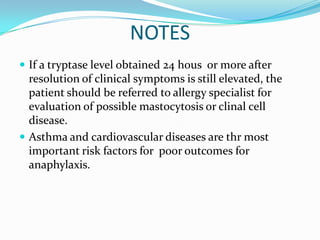
NOTES
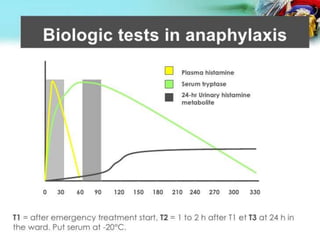
 If a tryptase level obtained 24 hous or more after
resolution of clinical symptoms is still elevated, the
patient should be referred to allergy specialist for
evaluation of possible mastocytosis or clinal cell
disease.
 Asthma and cardiovascular diseases are thr most
important risk factors for poor outcomes for
anaphylaxis.
 There are NO absolute contraindications for
epinephrine use in anaphylaxis.
CAUTION:
1. Patients with cardiovascular diseases
2. Patients receiving MAO and tricyclic antidepressants
3. Recent intracranial surgery, aortic aneurism,
uncontrolled hyperthyroidism
4. Patients receiving stimulants
5. Cocaine abused
Anaphylaxis
Anaphylaxis
Anaphylaxis

Anaphylaxis

  • 2.
    Introduction  Anaphylaxis –serious allergic reaction that is rapid in onset and may cause death.  The rate of occurrence is increasing in industrialized countries.  The diagnosis of anaphylaxis is based upon clinical symptoms and signs, as well as a detailed discription of the acute episode.
  • 4.
  • 6.
  • 7.
    CRITERIA  There arethree diagnostic criteria, each reflecting a different clinical presentation of anaphylaxis.  Anaphylaxis is highly likely when any of the following criteria is fullfilled.
  • 8.
    Criterion 1.  Acuteonset of an illness (minutes to several hours) with involvement of the skin, mucosal tissue, or both (eg, generalized hives, pruritus or flushing, swollen lips-tongue-uvula) AND AT LEAST ONE OF THE FOLLOWING:  Respiratory compromise (eg, dyspnea, wheeze- bronchospasm, stridor, reduced peak expiratory function [PEF], hypoxemia)  Reduced blood pressure (BP) or associated symptoms of end-organ dysfunction (eg, hypotonia [collapse], syncope, incontinence)
  • 9.
     Because themajority of anaphylactic reactions (>80%) include skin symptoms, it was judged that at least 80% of anaphylactic reactions should be identified by criterion 1 — even when the allergic status of the patient and potential cause of the reaction is unknown. However, cutaneous symptoms might be absent in up to 20% of anaphylactic reactions in children with food or insect sting allergy.
  • 10.
    Criterion 2.  Twoor more of the following that occur rapidly after exposure to a likely allergen for that patient (minutes to several hours): 1. Involvement of the skin-mucosal tissue (eg, generalized hives, itch-flush, swollen lips-tongue- uvula) 2. Respiratory compromise (eg, dyspnea, wheeze- bronchospasm, stridor, reduced PEF, hypoxemia) 3. Reduced BP or associated symptoms (eg, hypotonia [collapse], syncope, incontinence) 4. Persistent GI symptoms (eg, cramping abdominal pain, vomiting).
  • 11.
     In patientswith a known allergic history and possible exposure, criterion 2 should provide ample evidence that an anaphylactic reaction is occurring.
  • 12.
    Criterion 3.  ReducedBP after exposure to known allergen for that patient (minutes to several hours): 1. Infants and children: low systolic BP* (age specific) or greater than 30% decrease in systolic BP 2. Adults: systolic BP of less than 90 mm Hg or greater than 30% decrease from that person’s baseline
  • 13.
     Criterion 3should identify the rare patients who experience an acute hypotensive episode after exposure to a known allergen.
  • 14.
    TIME COURSE  Biphasicanaphylaxis is defined as a recurrence of symptoms that develops following the apparent resolution of the initial anaphylactic episode with no additional exposure of the trigger.  in up to 23% of episodes.  Within 8-10 hours. Up to 72 hours.  Protracted anaphylaxis is defined as an anaphylactic reaction that lasts for hours, days or even weeks in extreme cases.
  • 15.
  • 24.
    NOTES  If atryptase level obtained 24 hous or more after resolution of clinical symptoms is still elevated, the patient should be referred to allergy specialist for evaluation of possible mastocytosis or clinal cell disease.  Asthma and cardiovascular diseases are thr most important risk factors for poor outcomes for anaphylaxis.
  • 25.
     There areNO absolute contraindications for epinephrine use in anaphylaxis. CAUTION: 1. Patients with cardiovascular diseases 2. Patients receiving MAO and tricyclic antidepressants 3. Recent intracranial surgery, aortic aneurism, uncontrolled hyperthyroidism 4. Patients receiving stimulants 5. Cocaine abused