ECG 101
ECG 101
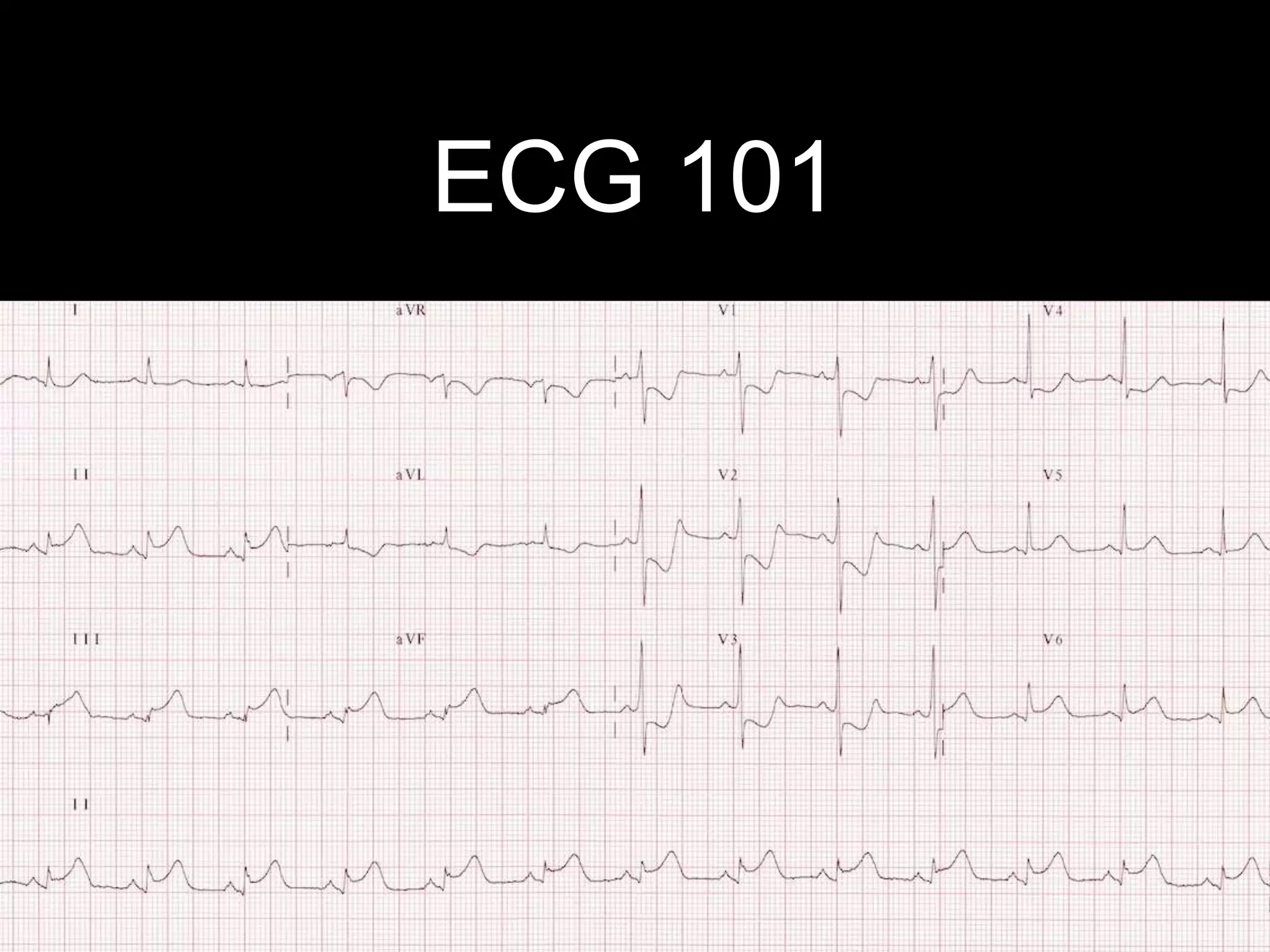
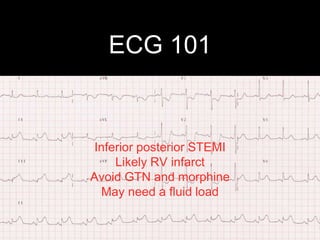
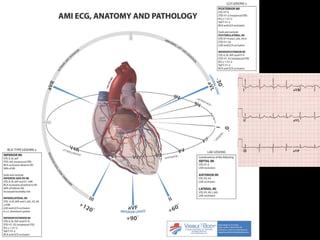
Inferior posterior STEMI
Likely RV infarct
Avoid GTN and morphine
May need a fluid load
The eyes may be the window to the
soul
But the ECG is the window to the heart,
lungs, toxicology, electrolytes, body
temperature and sometimes even the
brain
Pattern recognition
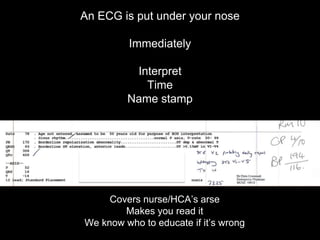
An ECG is put under your nose
Immediately
Interpret
Time
Name stamp
Covers nurse/HCA’s arse
Makes you read it
We know who to educate if it’s wrong
Be systematic
One system
Patient’s name
Presenting complaint
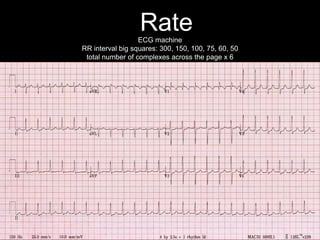
ECG machine
RR interval big squares: 300, 150, 100, 75, 60, 50
total number of complexes across the page x 6
Rate
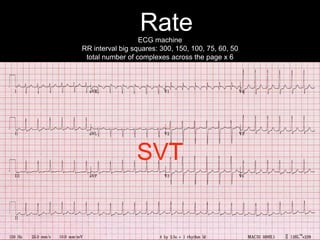
ECG machine
RR interval big squares: 300, 150, 100, 75, 60, 50
total number of complexes across the page x 6
Rate
SVT
Rhythm
Rhythm
Atrial flutter with 2:1 block
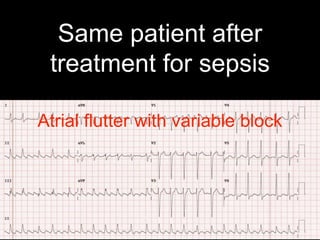
Same patient after
treatment for sepsis
A
Atrial flutter with variable block
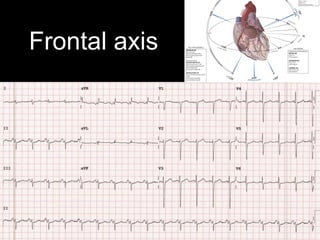
Frontal axis
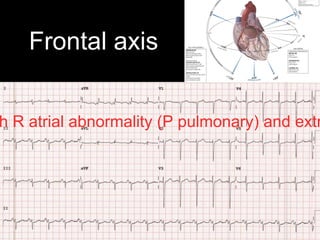
Frontal axis
h R atrial abnormality (P pulmonary) and extr
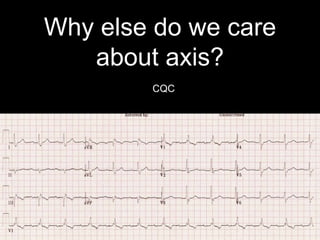
Why else do we care
about axis?
CQC
Why else do we care
about axis?
CQC
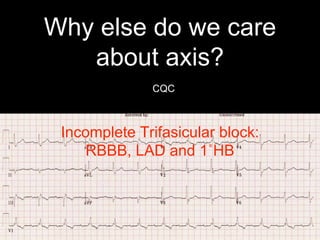
Incomplete Trifasicular block:
RBBB, LAD and 1˚HB
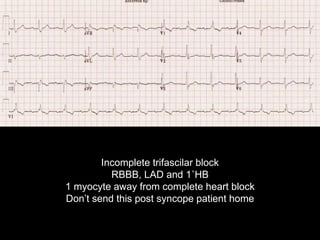
Incomplete trifascilar block
RBBB, LAD and 1˚HB
1 myocyte away from complete heart block
Don’t send this post syncope patient home
Then proceed through
the complexes
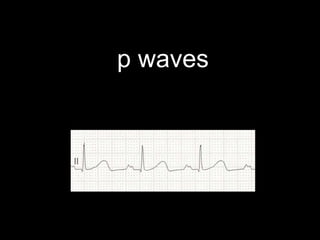
p waves
p waves
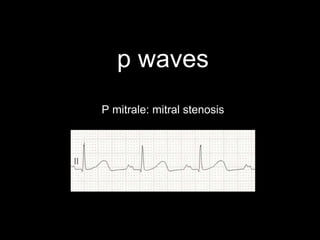
P mitrale: mitral stenosis
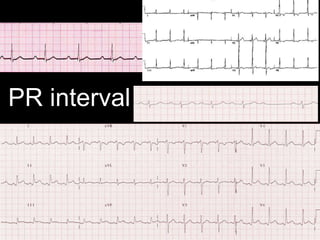
PR interval
PR interval
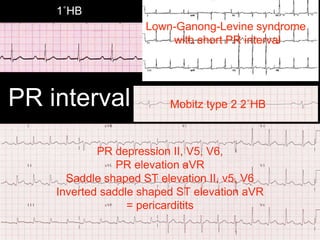
1˚HB
Lown-Ganong-Levine syndrome
with short PR interval
Mobitz type 2 2˚HB
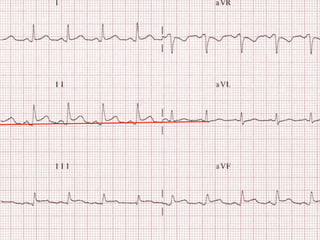
PR depression II, V5, V6,
PR elevation aVR
Saddle shaped ST elevation II, v5, V6
Inverted saddle shaped ST elevation aVR
= pericarditits
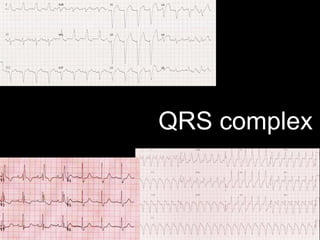
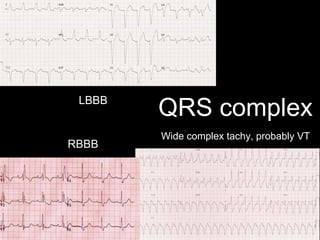
QRS complex
QRS complex
Wide complex tachy, probably VT
LBBB
RBBB
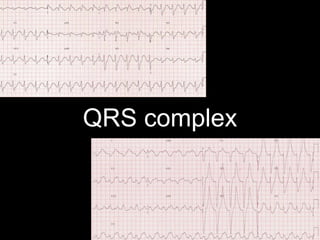
QRS complex
QRS complex
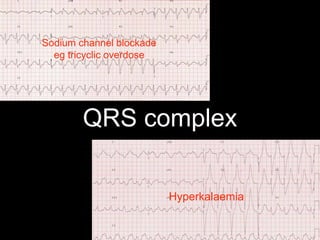
Hyperkalaemia
Sodium channel blockade
eg tricyclic overdose
QRS complex
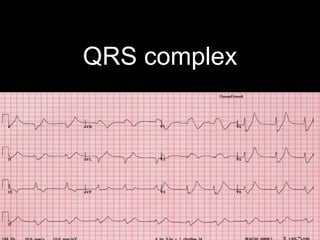
QRS complex
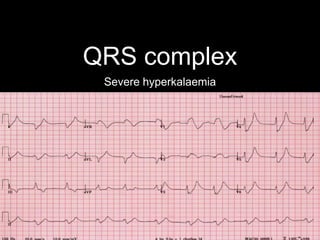
Severe hyperkalaemia
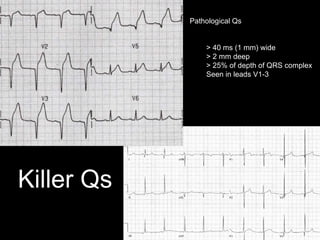
Killer Qs
Pathological Qs
> 40 ms (1 mm) wide
> 2 mm deep
> 25% of depth of QRS complex
Seen in leads V1-3
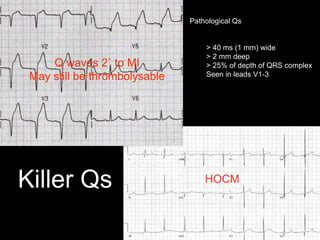
Killer Qs
Pathological Qs
> 40 ms (1 mm) wide
> 2 mm deep
> 25% of depth of QRS complex
Seen in leads V1-3
Q waves 2˚ to MI
May still be thrombolysable
HOCM
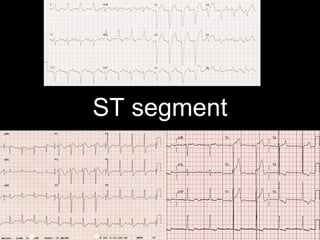
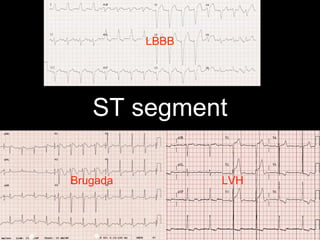
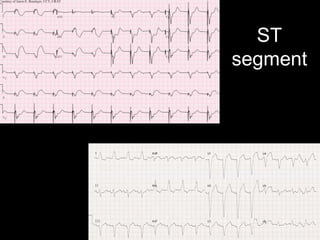
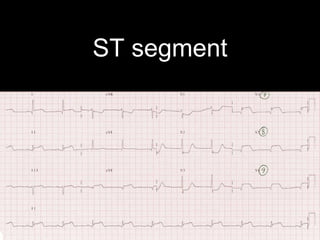
ST segment
ST segment
LBBB
LVHBrugada
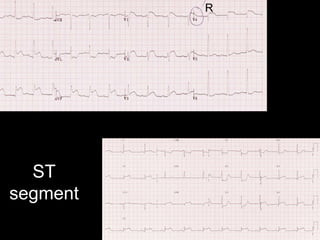
ST
segment
R
ST
segment
R
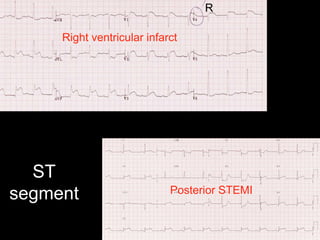
Right ventricular infarct
Posterior STEMI
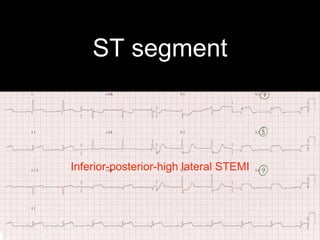
ST segment
ST segment
Inferior-posterior-high lateral STEMI
ST
segment
ST
segment
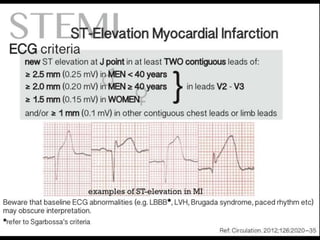
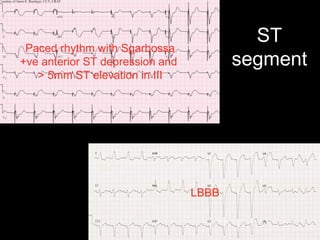
Paced rhythm with Sgarbossa
+ve anterior ST depression and
> 5mm ST elevation in III
LBBB
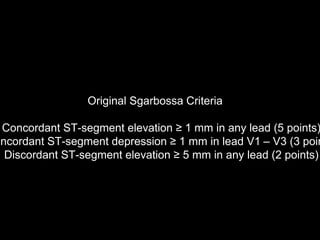
Original Sgarbossa Criteria
Concordant ST-segment elevation ≥ 1 mm in any lead (5 points)
oncordant ST-segment depression ≥ 1 mm in lead V1 – V3 (3 poin
Discordant ST-segment elevation ≥ 5 mm in any lead (2 points)
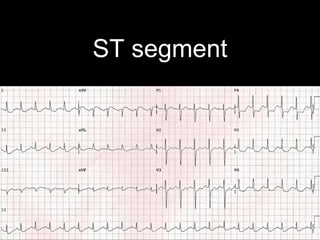
ST segment
ST segment
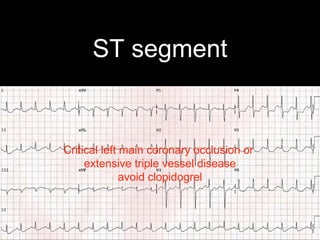
Critical left main coronary occlusion or
extensive triple vessel disease
avoid clopidogrel
T waves
T waves
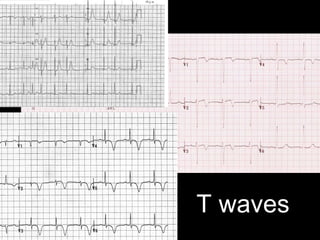
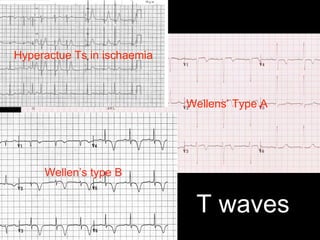
Hyperactue Ts in ischaemia
Wellens’ Type A
Wellen’s type B
Repeat
ECGs
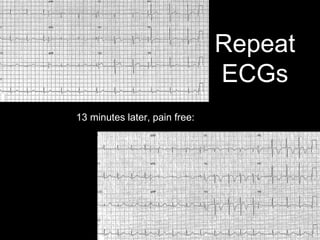
13 minutes later, pain free:
Repeat
ECGs
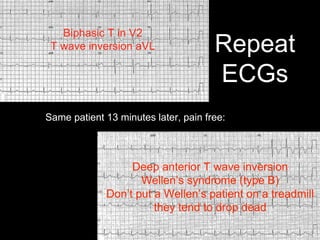
Same patient 13 minutes later, pain free:
Biphasic T in V2
T wave inversion aVL
Deep anterior T wave inversion
Wellen’s syndrome (type B)
Don’t put a Wellen’s patient on a treadmill
they tend to drop dead
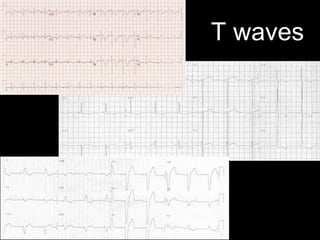
T waves
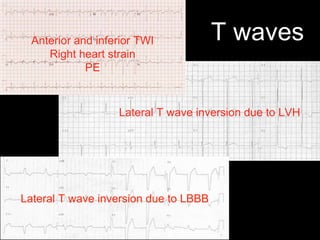
T wavesAnterior and inferior TWI
Right heart strain
PE
Lateral T wave inversion due to LVH
Lateral T wave inversion due to LBBB
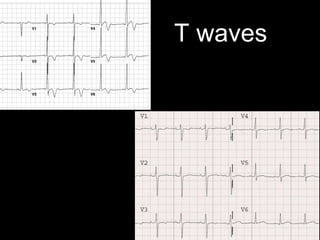
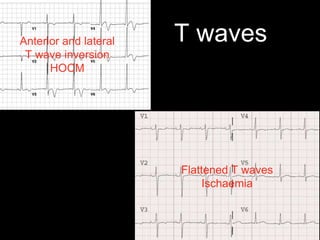
T waves
T wavesAnterior and lateral
T wave inversion
HOCM
Flattened T waves
Ischaemia
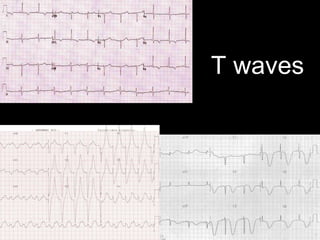
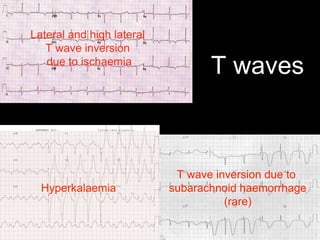
T waves
T waves
Lateral and high lateral
T wave inversion
due to ischaemia
T wave inversion due to
subarachnoid haemorrhage
(rare)
Hyperkalaemia
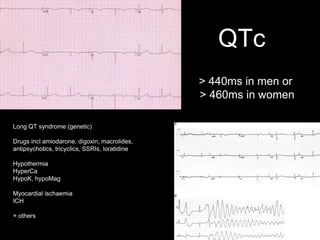
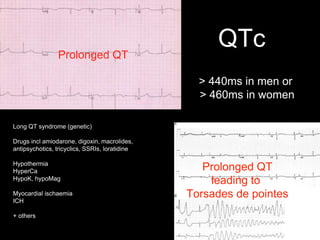
QTc
Long QT syndrome (genetic)
Drugs incl amiodarone, digoxin, macrolides,
antipsychotics, tricyclics, SSRIs, loratidine
Hypothermia
HyperCa
HypoK, hypoMag
Myocardial ischaemia
ICH
+ others
> 440ms in men or
> 460ms in women
QTc
Long QT syndrome (genetic)
Drugs incl amiodarone, digoxin, macrolides,
antipsychotics, tricyclics, SSRIs, loratidine
Hypothermia
HyperCa
HypoK, hypoMag
Myocardial ischaemia
ICH
+ others
> 440ms in men or
> 460ms in women
Prolonged QT
Prolonged QT
leading to
Torsades de pointes
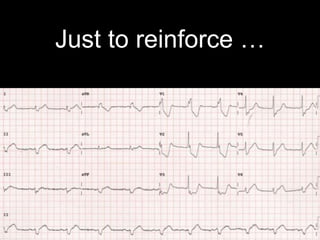
Just to reinforce …
Just to reinforce …
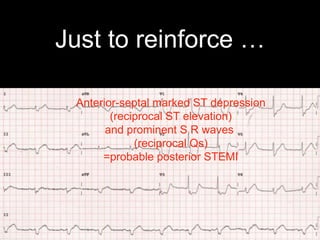
Anterior-septal marked ST depression
(reciprocal ST elevation)
and prominent S R waves
(reciprocal Qs)
=probable posterior STEMI
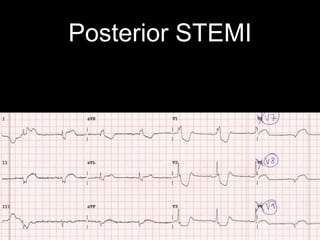
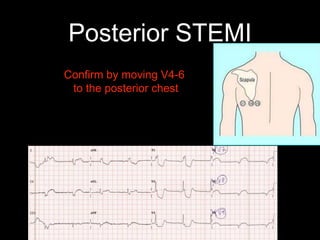
Posterior STEMI
Posterior STEMI
Confirm by moving V4-6
to the posterior chest
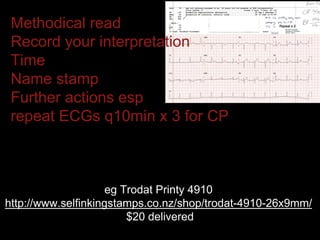
Methodical read
Record your interpretation
Time
Name stamp
Further actions esp
repeat ECGs q10min x 3 for CP
eg Trodat Printy 4910
http://www.selfinkingstamps.co.nz/shop/trodat-4910-26x9mm/
$20 delivered
References and images
Most facts checked with and images obtained from
Life in The Fast Lane
http://lifeinthefastlane.com/

Ecg 101 with answers

Editor's Notes

  • #7 10-20 times a day a ECG will be put under your nose Nurses and HCAs trained: ECG not complete till it has been read by a doctor.
  • #15 Use I and aVF or I and II Ayo: ECG: Sinus tachycardia rate 114. Axis: -90- 120˚ With p pulmonale probably extreme R axis deviation. COPCXR consistent with pulmonary hypertension. JVP + 3cm, no oedema. ?Shd of had respiratory follow-up.
  • #16 Use I and aVF or I and II Ayo: ECG: Sinus tachycardia rate 114. Axis: -90- 120˚ With p pulmonale probably extreme R axis deviation. COPCXR consistent with pulmonary hypertension. JVP + 3cm, no oedema. ?Shd of had respiratory follow-up.
  • #17 Incomplete trifascilar block RBBB, LAD and 1˚HB
  • #18 Incomplete trifascilar block RBBB, LAD and 1˚HB
  • #21 P mitrale eg mitral stenosis
  • #22 P mitrale eg mitral stenosis
  • #23 1˚ HB eg rheumatic fever, short PR in Lown-Ganong-Levine syndrome, PR depression (and elevation in aVR) in pericarditis. Mobitz 1 = Wenckeback. TP segment is the baseline.
  • #24 1˚ HB eg rheumatic fever, short PR in Lown-Ganong-Levine syndrome, PR depression (and elevation in aVR) in pericarditis. Mobitz 1 = Wenckeback. TP segment is the baseline.
  • #26 LBBB RBBB VT
  • #27 LBBB RBBB VT
  • #28 Na channel blockade / TCA overdose with prominent R wave in aVR Hyperkalaemia
  • #29 Na channel blockade / TCA overdose with prominent R wave in aVR Hyperkalaemia
  • #30 HyperK
  • #31 HyperK
  • #32 Q wave MI ≠ too late for thrombolysis HOCM
  • #33 Q wave MI ≠ too late for thrombolysis HOCM
  • #34 LBBB Brugada LVH
  • #35 LBBB Brugada LVH
  • #37 RV infarct Posterior STEMI
  • #38 RV infarct Posterior STEMI
  • #39 Posterior-inferior-lateral MI
  • #40 Posterior-inferior-lateral MI
  • #41  Sgarbossa paced
  • #42  Sgarbossa paced
  • #44 LMCA occlusion
  • #45 LMCA occlusion
  • #46 Clockwise: Chest pain, hyperacute Ts. Read 7 hours later. Wellen’s type A, hyper K, Wellen’s type B
  • #47 Clockwise: Chest pain, hyperacute Ts. Read 7 hours later. Wellen’s type A, Wellen’s type B
  • #48 Wellens’
  • #49 Wellens’
  • #50 Clock wise RV strain: PE, lateral TWI due to LVH, Lateral TWI due to LBBB
  • #51 Clock wise RV strain: PE, lateral TWI due to LVH, Lateral TWI due to LBBB
  • #52 HOCM, flattened Ts due to ischaemia
  • #53 HOCM, flattened Ts due to ischaemia
  • #54 Widespread ischaemia, SAH, hyperkalaemia
  • #55 Widespread ischaemia, SAH, hyperkalaemia