Random ECGs 1
Dr Chris Cresswell
Emergency Physician
2015
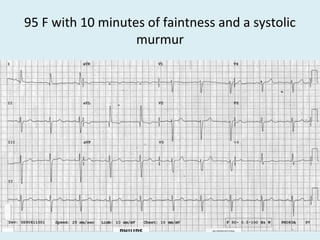
95 F with 10 minutes of faintness and a systolic
murmur
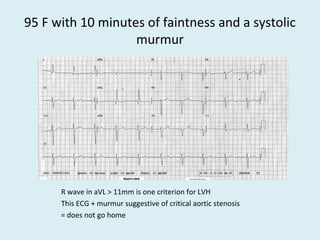
95 F with 10 minutes of faintness and a systolic
murmur
R wave in aVL > 11mm is one criterion for LVH
This ECG + murmur suggestive of critical aortic stenosis
= does not go home
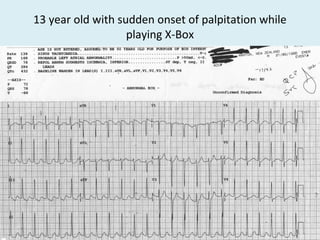
13 year old with sudden onset of palpitation while
playing X-Box
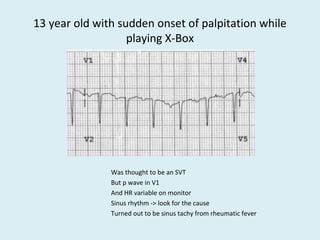
13 year old with sudden onset of palpitation while
playing X-Box
Was thought to be an SVT
But p wave in V1
And HR variable on monitor
Sinus rhythm -> look for the cause
Turned out to be sinus tachy from rheumatic fever
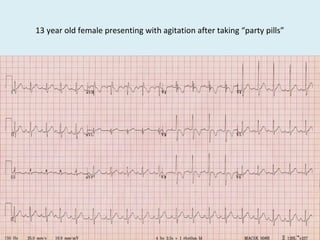
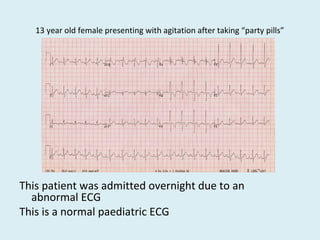
13 year old female presenting with agitation after taking “party pills”
This patient was admitted overnight due to an
abnormal ECG
This is a normal paediatric ECG
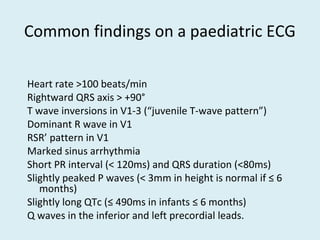
Common findings on a paediatric ECG
Heart rate >100 beats/min
Rightward QRS axis > +90°
T wave inversions in V1-3 (“juvenile T-wave pattern”)
Dominant R wave in V1
RSR’ pattern in V1
Marked sinus arrhythmia
Short PR interval (< 120ms) and QRS duration (<80ms)
Slightly peaked P waves (< 3mm in height is normal if ≤ 6
months)
Slightly long QTc (≤ 490ms in infants ≤ 6 months)
Q waves in the inferior and left precordial leads.
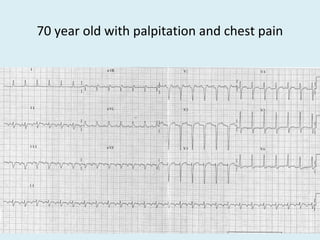
70 year old with palpitation and chest pain
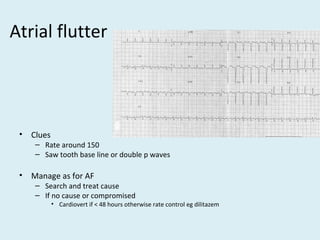
Atrial flutter
• Clues
– Rate around 150
– Saw tooth base line or double p waves
• Manage as for AF
– Search and treat cause
– If no cause or compromised
• Cardiovert if < 48 hours otherwise rate control eg dilitazem
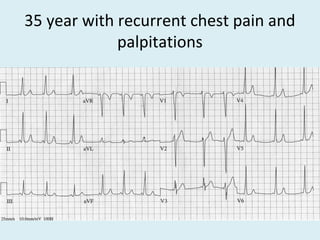
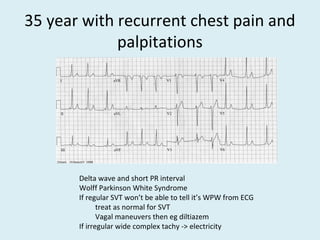
35 year with recurrent chest pain and
palpitations
35 year with recurrent chest pain and
palpitations
Delta wave and short PR interval
Wolff Parkinson White Syndrome
If regular SVT won’t be able to tell it’s WPW from ECG
treat as normal for SVT
Vagal maneuvers then eg diltiazem
If irregular wide complex tachy -> electricity
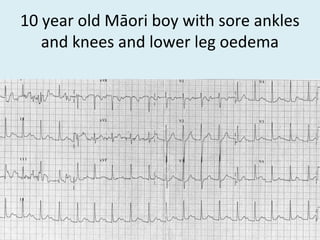
10 year old Māori boy with sore ankles
and knees and lower leg oedema
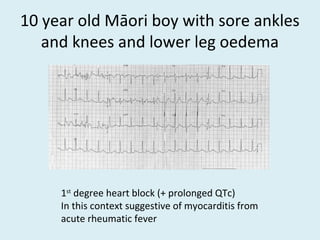
10 year old Māori boy with sore ankles
and knees and lower leg oedema
1st
degree heart block (+ prolonged QTc)
In this context suggestive of myocarditis from
acute rheumatic fever
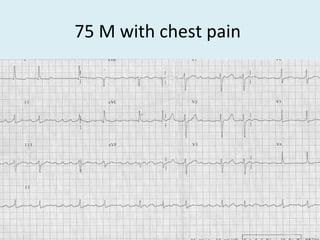
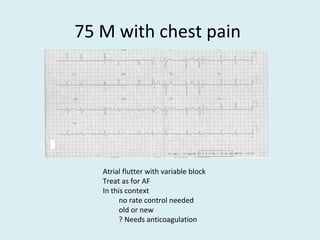
75 M with chest pain
Atrial flutter with variable block
Treat as for AF
In this context
no rate control needed
old or new
? Needs anticoagulation
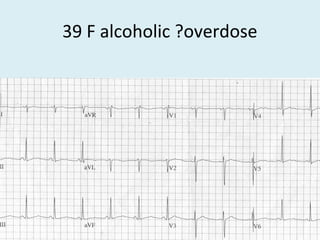
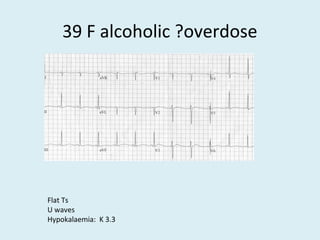
39 F alcoholic ?overdose
Flat Ts
U waves
Hypokalaemia: K 3.3
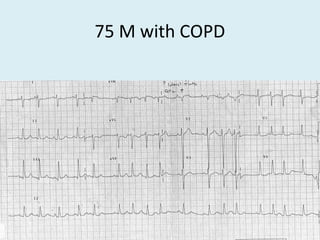
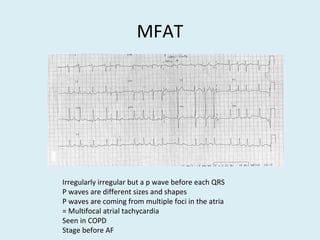
75 M with COPD
MFAT
Irregularly irregular but a p wave before each QRS
P waves are different sizes and shapes
P waves are coming from multiple foci in the atria
= Multifocal atrial tachycardia
Seen in COPD
Stage before AF
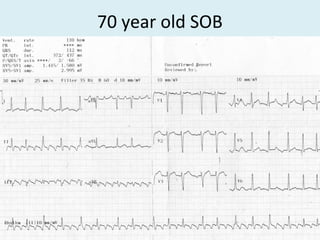
70 year old SOB
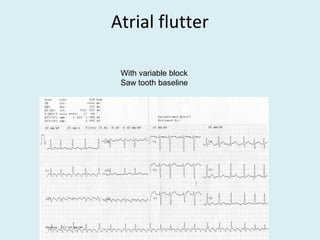
Atrial flutter
With variable block
Saw tooth baseline
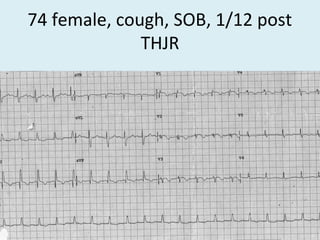
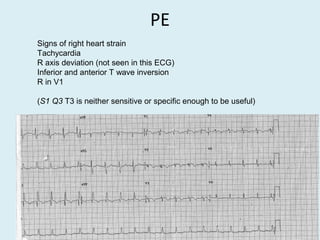
74 female, cough, SOB, 1/12 post
THJR
PE
Signs of right heart strain
Tachycardia
R axis deviation (not seen in this ECG)
Inferior and anterior T wave inversion
R in V1
(S1 Q3 T3 is neither sensitive or specific enough to be useful)
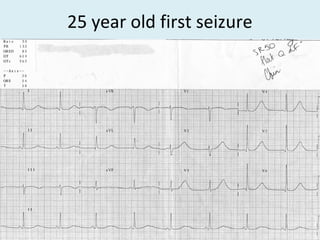
25 year old first seizure
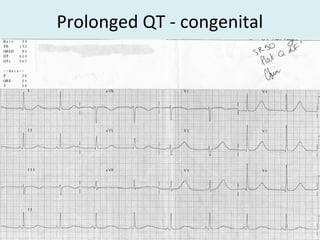
Prolonged QT - congenital
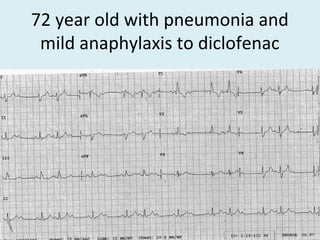
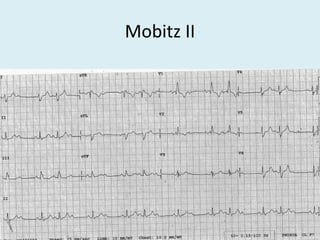
72 year old with pneumonia and
mild anaphylaxis to diclofenac
Mobitz II
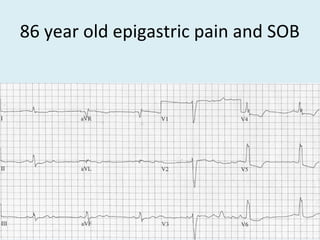
86 year old epigastric pain and SOB
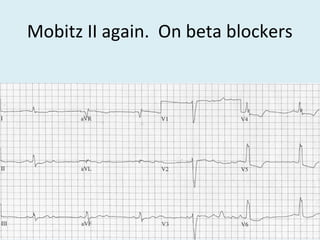
Mobitz II again. On beta blockers
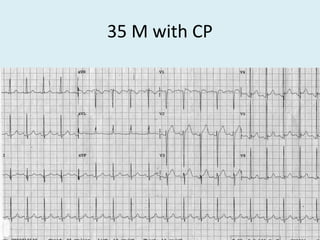
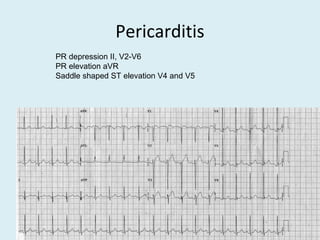
35 M with CP
Pericarditis
PR depression II, V2-V6
PR elevation aVR
Saddle shaped ST elevation V4 and V5

Random ECGs 1

  • 1.
    Random ECGs 1 DrChris Cresswell Emergency Physician 2015
  • 2.
    95 F with10 minutes of faintness and a systolic murmur
  • 3.
    95 F with10 minutes of faintness and a systolic murmur R wave in aVL > 11mm is one criterion for LVH This ECG + murmur suggestive of critical aortic stenosis = does not go home
  • 4.
    13 year oldwith sudden onset of palpitation while playing X-Box
  • 5.
    13 year oldwith sudden onset of palpitation while playing X-Box Was thought to be an SVT But p wave in V1 And HR variable on monitor Sinus rhythm -> look for the cause Turned out to be sinus tachy from rheumatic fever
  • 6.
    13 year oldfemale presenting with agitation after taking “party pills”
  • 7.
    13 year oldfemale presenting with agitation after taking “party pills” This patient was admitted overnight due to an abnormal ECG This is a normal paediatric ECG
  • 8.
    Common findings ona paediatric ECG Heart rate >100 beats/min Rightward QRS axis > +90° T wave inversions in V1-3 (“juvenile T-wave pattern”) Dominant R wave in V1 RSR’ pattern in V1 Marked sinus arrhythmia Short PR interval (< 120ms) and QRS duration (<80ms) Slightly peaked P waves (< 3mm in height is normal if ≤ 6 months) Slightly long QTc (≤ 490ms in infants ≤ 6 months) Q waves in the inferior and left precordial leads.
  • 9.
    70 year oldwith palpitation and chest pain
  • 10.
    Atrial flutter • Clues –Rate around 150 – Saw tooth base line or double p waves • Manage as for AF – Search and treat cause – If no cause or compromised • Cardiovert if < 48 hours otherwise rate control eg dilitazem
  • 11.
    35 year withrecurrent chest pain and palpitations
  • 12.
    35 year withrecurrent chest pain and palpitations Delta wave and short PR interval Wolff Parkinson White Syndrome If regular SVT won’t be able to tell it’s WPW from ECG treat as normal for SVT Vagal maneuvers then eg diltiazem If irregular wide complex tachy -> electricity
  • 13.
    10 year oldMāori boy with sore ankles and knees and lower leg oedema
  • 14.
    10 year oldMāori boy with sore ankles and knees and lower leg oedema 1st degree heart block (+ prolonged QTc) In this context suggestive of myocarditis from acute rheumatic fever
  • 15.
    75 M withchest pain
  • 16.
    75 M withchest pain Atrial flutter with variable block Treat as for AF In this context no rate control needed old or new ? Needs anticoagulation
  • 17.
    39 F alcoholic?overdose
  • 18.
    39 F alcoholic?overdose Flat Ts U waves Hypokalaemia: K 3.3
  • 19.
  • 20.
    MFAT Irregularly irregular buta p wave before each QRS P waves are different sizes and shapes P waves are coming from multiple foci in the atria = Multifocal atrial tachycardia Seen in COPD Stage before AF
  • 21.
  • 22.
    Atrial flutter With variableblock Saw tooth baseline
  • 23.
    74 female, cough,SOB, 1/12 post THJR
  • 24.
    PE Signs of rightheart strain Tachycardia R axis deviation (not seen in this ECG) Inferior and anterior T wave inversion R in V1 (S1 Q3 T3 is neither sensitive or specific enough to be useful)
  • 25.
    25 year oldfirst seizure
  • 26.
    Prolonged QT -congenital
  • 27.
    72 year oldwith pneumonia and mild anaphylaxis to diclofenac
  • 28.
  • 29.
    86 year oldepigastric pain and SOB
  • 30.
    Mobitz II again.On beta blockers
  • 31.
  • 32.
    Pericarditis PR depression II,V2-V6 PR elevation aVR Saddle shaped ST elevation V4 and V5