ACUTE RHEUMATIC
FEVER
JERIN.T.S, 3RD YEAR BSC NURSING,
KRSMCON MANGALORE.
PH:+919496743672
WHAT IS ACUTE RHEUMATIC FEVER ?
Acute rheumatic fever (ARF) is an acute
autoimmune disease that occurs as a
sequelae of group A beta-hemolytic
streptococcal infection. It is characterized by
inflammatory lesions of connective tissue
and endothelial tissue, primarily affecting the
joints and heart.
JERIN.T.S, 3RD YEAR BSC NURSING,
KRSMCON MANGALORE.
PH:+919496743672
ETIOLOGY
 Most first attacks of ARF occur 1 to 5 weeks
(average 3 weeks) after a streptococcal
infection of the throat or of the upper respiratory
tract.
 Peak incidence occurs in children ages 6 to 15.
Incidence after a mild streptococcal pharyngeal
infection is 0.3% and after a severe
streptococcal infection is 1% to 3%.
 Family history of rheumatic fever is usually
positive.
JERIN.T.S, 3RD YEAR BSC NURSING,
KRSMCON MANGALORE.
PH:+919496743672
PATHOPHYSIOLOGY
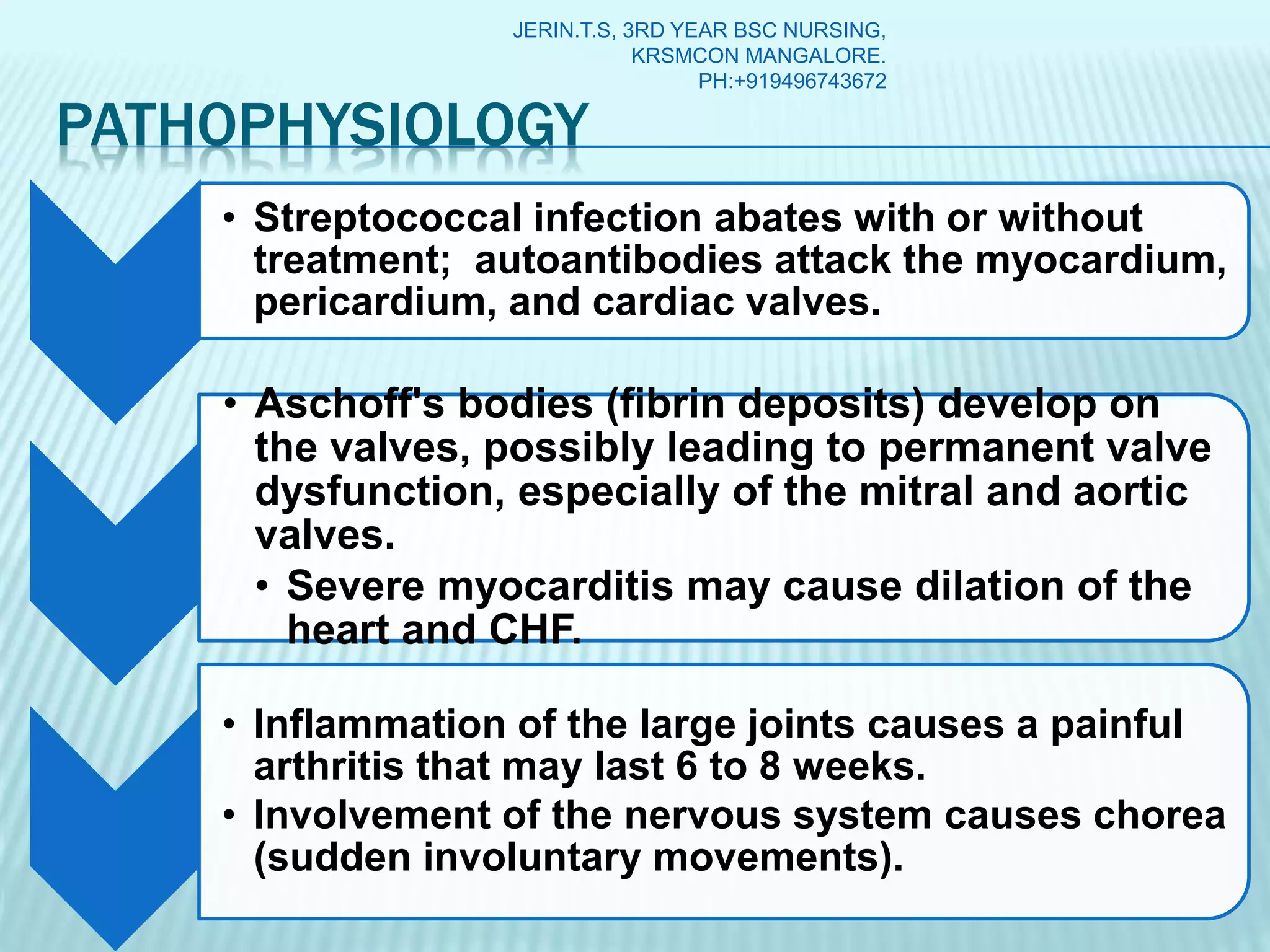
• Streptococcal infection abates with or without
treatment; autoantibodies attack the myocardium,
pericardium, and cardiac valves.
• Aschoff's bodies (fibrin deposits) develop on
the valves, possibly leading to permanent valve
dysfunction, especially of the mitral and aortic
valves.
• Severe myocarditis may cause dilation of the
heart and CHF.
• Inflammation of the large joints causes a painful
arthritis that may last 6 to 8 weeks.
• Involvement of the nervous system causes chorea
(sudden involuntary movements).
JERIN.T.S, 3RD YEAR BSC NURSING,
KRSMCON MANGALORE.
PH:+919496743672
CLINICAL MANIFESTATIONS
 Major
Manifestations
 Carditis signs of CHF
.
 Polyarthritis
 Chorea.
 Erythema
marginatum.
 Subcutaneous
nodules
 Minor Manifestations
 Previous rheumatic fever or
rheumatic heart disease
 Polyarthralgia
 Fever
 Acute phase reaction:
elevated erythrocyte
sedimentation rate, C-
reactive protein,
leukocytosis
 Prolonged PR interval
JERIN.T.S, 3RD YEAR BSC NURSING,
KRSMCON MANGALORE.
PH:+919496743672
DIAGNOSTIC EVALUATION
 the Jones criteria from the American Heart
Association.
 ECG done to evaluate PR interval and other
changes
 Laboratory tests: group A streptococcal
culture and/or antistreptolysin-O titer to detect
streptococcal antibodies from recent infection.
 Chest X-ray for cardiomegaly, pulmonary
congestion, or edema.
JERIN.T.S, 3RD YEAR BSC NURSING,
KRSMCON MANGALORE.
PH:+919496743672
MANAGEMENT
 Course of antibiotic therapy to completely
eradicate streptococcal infection
 benzathine penicillin is given I.M. in a single dose.
 Oral erythromycin may be used for children who
are allergic to penicillin.
 Oral salicylates (aspirin) or nonsteroidal anti-
inflammatory drugs (naproxen sodium) usually
used to control pain and inflammation of arthritis.
Aspirin is continued for 4 to 6 weeks for carditis.
 Corticosteroids used in severe cases to try to
control cardiac inflammation..
JERIN.T.S, 3RD YEAR BSC NURSING,
KRSMCON MANGALORE.
PH:+919496743672
 Phenobarbital, diazepam, or other neurologic
agent to control chorea.
 Bed rest during the acute phase (until ESR
decreases, C-reactive protein becomes
negative, and pulse rate returns to normal) to
rest the heart. Bed rest may need to be
maintained for 2 to 4 months in cases of
severe carditis.
 Mitral valve replacement may be necessary
in some cases.
JERIN.T.S, 3RD YEAR BSC NURSING,
KRSMCON MANGALORE.
PH:+919496743672
 Secondary prevention of recurrent ARF:
 Risk of recurrence greatest within first 5 years,
with multiple episodes of ARF, and with
rheumatic heart disease. Prophylactic antibiotic
treatment may be lifelong.
 For those at low risk for recurrence, antibiotic
prophylaxis may be continued for 5 years or
longer.
 Antibiotic regimens may include the following:
 Benzathine penicillin I.M. every 28 days.
 Penicillin V or erythromycin 250 mg twice per day.
 Sulfisoxazole (Pediazole) 0.5 to 1 g (dosage
calculated according to patient's weight) once per
day. JERIN.T.S, 3RD YEAR BSC NURSING,
KRSMCON MANGALORE.
PH:+919496743672
COMPLICATIONS
 CHF.
 Pericarditis, pericardial effusion.
 Permanent damage to the aortic or mitral
valve, possibly requiring valve replacement
JERIN.T.S, 3RD YEAR BSC NURSING,
KRSMCON MANGALORE.
PH:+919496743672
NURSING ASSESSMENT
 Assess for signs of cardiac involvement by auscultation of
the heart for murmur and cardiac monitoring for prolonged
PR interval.
 Monitor pulse for 1 full minute to determine heart rate.
 Assess temperature for elevation.
 Observe for involuntary movements: stick out tongue or
smile; garbled or hesitant speech when asked to recite
numbers or the ABCs; hyperextension of the wrists and
fingers when trying to extend arms.
 Assess child's ability to feed self, dress, and do other
activities if chorea or arthritis present.
 Assess pain level using scale appropriate for child's age.
 Assess parents' ability to cope with illness and care for
child.
 Assess need for home schooling while patient is on bed
rest.
JERIN.T.S, 3RD YEAR BSC NURSING,
KRSMCON MANGALORE.
PH:+919496743672
NURSING DIAGNOSES
 Decreased Cardiac Output related to carditis
 Acute and Chronic Pain related to arthritis
 Risk for Injury related to chorea
JERIN.T.S, 3RD YEAR BSC NURSING,
KRSMCON MANGALORE.
PH:+919496743672
FAMILY EDUCATION AND HEALTH MAINTENANCE
 Teach the appropriate administration of all
medications, including prophylactic antibiotic.
 Encourage all family and household members
to be screened for streptococcus and receive
the appropriate treatment.
 Instruct on additional prophylaxis for
endocarditis with dental procedures and
surgery as indicated.
 Encourage following activity restrictions,
resuming activity gradually, and resting
whenever tired.JERIN.T.S, 3RD YEAR BSC NURSING,
KRSMCON MANGALORE.
PH:+919496743672
 Encourage keeping appointments for follow-
up evaluation by cardiologist and other health
care providers.
 Advise the parents that child cannot return to
school until health care provider assesses
that all disease activity is gone. Parents may
need to discuss with teachers how the child
can catch up with schoolwork.
JERIN.T.S, 3RD YEAR BSC NURSING, KRSMCON MANGALORE. PH:+919496743672
 Instruct on follow-up with usual health care
provider for immunizations, well-child
evaluations, hearing and vision screening, and
other health maintenance needs.
 Provide general health education about early
identification and treatment seeking for any
possible streptococcal infection (fever, sore
throat). Compliance with 10 to 14 days of
antibiotics can greatly reduce the risk of ARF
and other post streptococcal sequelae.
JERIN.T.S, 3RD YEAR BSC NURSING, KRSMCON MANGALORE.
PH:+919496743672
JERIN.T.S, 3RD YEAR BSC NURSING,
KRSMCON MANGALORE.
PH:+919496743672

acute rheumatic fever

  • 1.
    ACUTE RHEUMATIC FEVER JERIN.T.S, 3RDYEAR BSC NURSING, KRSMCON MANGALORE. PH:+919496743672
  • 2.
    WHAT IS ACUTERHEUMATIC FEVER ? Acute rheumatic fever (ARF) is an acute autoimmune disease that occurs as a sequelae of group A beta-hemolytic streptococcal infection. It is characterized by inflammatory lesions of connective tissue and endothelial tissue, primarily affecting the joints and heart. JERIN.T.S, 3RD YEAR BSC NURSING, KRSMCON MANGALORE. PH:+919496743672
  • 3.
    ETIOLOGY  Most firstattacks of ARF occur 1 to 5 weeks (average 3 weeks) after a streptococcal infection of the throat or of the upper respiratory tract.  Peak incidence occurs in children ages 6 to 15. Incidence after a mild streptococcal pharyngeal infection is 0.3% and after a severe streptococcal infection is 1% to 3%.  Family history of rheumatic fever is usually positive. JERIN.T.S, 3RD YEAR BSC NURSING, KRSMCON MANGALORE. PH:+919496743672
  • 4.
    PATHOPHYSIOLOGY • Streptococcal infectionabates with or without treatment; autoantibodies attack the myocardium, pericardium, and cardiac valves. • Aschoff's bodies (fibrin deposits) develop on the valves, possibly leading to permanent valve dysfunction, especially of the mitral and aortic valves. • Severe myocarditis may cause dilation of the heart and CHF. • Inflammation of the large joints causes a painful arthritis that may last 6 to 8 weeks. • Involvement of the nervous system causes chorea (sudden involuntary movements). JERIN.T.S, 3RD YEAR BSC NURSING, KRSMCON MANGALORE. PH:+919496743672
  • 5.
    CLINICAL MANIFESTATIONS  Major Manifestations Carditis signs of CHF .  Polyarthritis  Chorea.  Erythema marginatum.  Subcutaneous nodules  Minor Manifestations  Previous rheumatic fever or rheumatic heart disease  Polyarthralgia  Fever  Acute phase reaction: elevated erythrocyte sedimentation rate, C- reactive protein, leukocytosis  Prolonged PR interval JERIN.T.S, 3RD YEAR BSC NURSING, KRSMCON MANGALORE. PH:+919496743672
  • 6.
    DIAGNOSTIC EVALUATION  theJones criteria from the American Heart Association.  ECG done to evaluate PR interval and other changes  Laboratory tests: group A streptococcal culture and/or antistreptolysin-O titer to detect streptococcal antibodies from recent infection.  Chest X-ray for cardiomegaly, pulmonary congestion, or edema. JERIN.T.S, 3RD YEAR BSC NURSING, KRSMCON MANGALORE. PH:+919496743672
  • 7.
    MANAGEMENT  Course ofantibiotic therapy to completely eradicate streptococcal infection  benzathine penicillin is given I.M. in a single dose.  Oral erythromycin may be used for children who are allergic to penicillin.  Oral salicylates (aspirin) or nonsteroidal anti- inflammatory drugs (naproxen sodium) usually used to control pain and inflammation of arthritis. Aspirin is continued for 4 to 6 weeks for carditis.  Corticosteroids used in severe cases to try to control cardiac inflammation.. JERIN.T.S, 3RD YEAR BSC NURSING, KRSMCON MANGALORE. PH:+919496743672
  • 8.
     Phenobarbital, diazepam,or other neurologic agent to control chorea.  Bed rest during the acute phase (until ESR decreases, C-reactive protein becomes negative, and pulse rate returns to normal) to rest the heart. Bed rest may need to be maintained for 2 to 4 months in cases of severe carditis.  Mitral valve replacement may be necessary in some cases. JERIN.T.S, 3RD YEAR BSC NURSING, KRSMCON MANGALORE. PH:+919496743672
  • 9.
     Secondary preventionof recurrent ARF:  Risk of recurrence greatest within first 5 years, with multiple episodes of ARF, and with rheumatic heart disease. Prophylactic antibiotic treatment may be lifelong.  For those at low risk for recurrence, antibiotic prophylaxis may be continued for 5 years or longer.  Antibiotic regimens may include the following:  Benzathine penicillin I.M. every 28 days.  Penicillin V or erythromycin 250 mg twice per day.  Sulfisoxazole (Pediazole) 0.5 to 1 g (dosage calculated according to patient's weight) once per day. JERIN.T.S, 3RD YEAR BSC NURSING, KRSMCON MANGALORE. PH:+919496743672
  • 10.
    COMPLICATIONS  CHF.  Pericarditis,pericardial effusion.  Permanent damage to the aortic or mitral valve, possibly requiring valve replacement JERIN.T.S, 3RD YEAR BSC NURSING, KRSMCON MANGALORE. PH:+919496743672
  • 11.
    NURSING ASSESSMENT  Assessfor signs of cardiac involvement by auscultation of the heart for murmur and cardiac monitoring for prolonged PR interval.  Monitor pulse for 1 full minute to determine heart rate.  Assess temperature for elevation.  Observe for involuntary movements: stick out tongue or smile; garbled or hesitant speech when asked to recite numbers or the ABCs; hyperextension of the wrists and fingers when trying to extend arms.  Assess child's ability to feed self, dress, and do other activities if chorea or arthritis present.  Assess pain level using scale appropriate for child's age.  Assess parents' ability to cope with illness and care for child.  Assess need for home schooling while patient is on bed rest. JERIN.T.S, 3RD YEAR BSC NURSING, KRSMCON MANGALORE. PH:+919496743672
  • 12.
    NURSING DIAGNOSES  DecreasedCardiac Output related to carditis  Acute and Chronic Pain related to arthritis  Risk for Injury related to chorea JERIN.T.S, 3RD YEAR BSC NURSING, KRSMCON MANGALORE. PH:+919496743672
  • 13.
    FAMILY EDUCATION ANDHEALTH MAINTENANCE  Teach the appropriate administration of all medications, including prophylactic antibiotic.  Encourage all family and household members to be screened for streptococcus and receive the appropriate treatment.  Instruct on additional prophylaxis for endocarditis with dental procedures and surgery as indicated.  Encourage following activity restrictions, resuming activity gradually, and resting whenever tired.JERIN.T.S, 3RD YEAR BSC NURSING, KRSMCON MANGALORE. PH:+919496743672
  • 14.
     Encourage keepingappointments for follow- up evaluation by cardiologist and other health care providers.  Advise the parents that child cannot return to school until health care provider assesses that all disease activity is gone. Parents may need to discuss with teachers how the child can catch up with schoolwork. JERIN.T.S, 3RD YEAR BSC NURSING, KRSMCON MANGALORE. PH:+919496743672
  • 15.
     Instruct onfollow-up with usual health care provider for immunizations, well-child evaluations, hearing and vision screening, and other health maintenance needs.  Provide general health education about early identification and treatment seeking for any possible streptococcal infection (fever, sore throat). Compliance with 10 to 14 days of antibiotics can greatly reduce the risk of ARF and other post streptococcal sequelae. JERIN.T.S, 3RD YEAR BSC NURSING, KRSMCON MANGALORE. PH:+919496743672
  • 16.
    JERIN.T.S, 3RD YEARBSC NURSING, KRSMCON MANGALORE. PH:+919496743672