Amines 
BY: KAMRAN MANJINDER AND JENNIFER
Introduction of Amines 
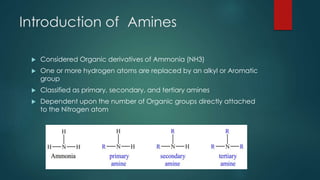
 Considered Organic derivatives of Ammonia (NH3) 
 One or more hydrogen atoms are replaced by an alkyl or Aromatic 
group 
 Classified as primary, secondary, and tertiary amines 
 Dependent upon the number of Organic groups directly attached 
to the Nitrogen atom
Rules/Laws to predict predominant 
product(s) And Reactions 
Primary amines 
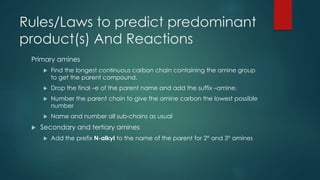
 Find the longest continuous carbon chain containing the amine group 
to get the parent compound. 
 Drop the final –e of the parent name and add the suffix –amine. 
 Number the parent chain to give the amine carbon the lowest possible 
number 
 Name and number all sub-chains as usual 
 Secondary and tertiary amines 
 Add the prefix N-alkyl to the name of the parent for 2° and 3° amines
Cont’d - Examples 
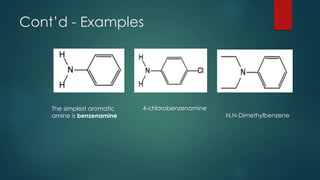
The simplest aromatic 
amine is benzenamine 
4-chlorobenzenamine 
N,N-Dimethylbenzene
Structural Drawings of reactions 
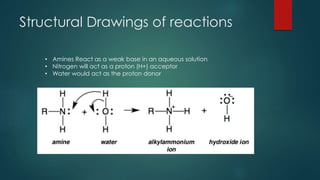
• Amines React as a weak base in an aqueous solution 
• Nitrogen will act as a proton (H+) acceptor 
• Water would act as the proton donor
Cont’d Reactions 
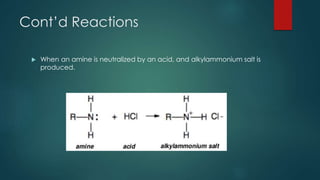
 When an amine is neutralized by an acid, and alkylammonium salt is 
produced.
Cont’d Reactions 
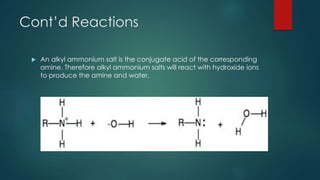
 An alkyl ammonium salt is the conjugate acid of the corresponding 
amine. Therefore alkyl ammonium salts will react with hydroxide ions 
to produce the amine and water.
Cont’d Reaction Catalysts 
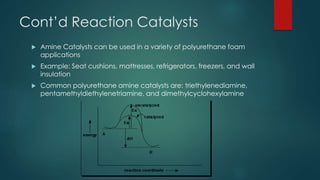
 Amine Catalysts can be used in a variety of polyurethane foam 
applications 
 Example: Seat cushions, mattresses, refrigerators, freezers, and wall 
insulation 
 Common polyurethane amine catalysts are: triethylenediamine, 
pentamethyldiethylenetriamine, and dimethylcyclohexylamine
APPLICATIONS OF AMINES
Using amines as dyes 
Primary aromatic amines are used as a starting material for the 
manufacture of azo dyes, some examples are as follows 
1. methyl orange 
2. direct brown 138 
3. sunset yellow FCF 
4. poncean
Using amines for drugs 
 Many drugs are designed to mimic or to interfere with the action of 
natural amine neurotransmitters , exemplified by the amine drugs: 
 ·chlorpheniramine is an antihistamine that helps to relieve allergic 
disorders due to cold, hay fever, itchy skin, insect bites and stings. 
 · chlorpromazine is a tranquillizer that sedates without inducing 
sleep. It is used to relieve anxiety, excitement, restlessness or even 
mental disorder. 
 · ephedrine and phenyleprine, as amine hydrochlorides, are used as 
decongestant
Using amines for gas treatment 
 Aqueous monoethanolamine (MEA) and some other widely amines 
are used industrially for removing carbon dioxide (CO2) and 
hydrogen sulfide (H2S) from natural gas and refinery process 
streams. 
 They may also be used to remove CO2 from combustion gases /flue 
gases and may have potential for abatement of greenhouse gases. 
Related processes are known as sweetening.
Health and environmental impacts 
of amines 
1. The process of post combustion ( CO2-capture by chemical 
absorption) relies on large scale of amines in aqueous solution. 
In such operations, emissions of amines may occur through the 
cleaned exhaust gas, as degraded solvent and as accidental 
spills. It is thus important that the chemicals used have low or 
no environmental effects. 
2. To check this, standard ecotoxicity and biodegradability tests 
for a marine environment were performed on more than 40 
amines, including both solvents already in use for CO2- 
removal and new promising chemicals.
 Some of the solvents used for carbon capture, have 
been shown to have low biodegradability. The tertiary 
amines which have been tested do not degrade easily, 
while the amino acids tested both have low toxicity and 
degrade easily.

ALL ABOUT AMINES ! (chemistry)

  • 1.
    Amines BY: KAMRANMANJINDER AND JENNIFER
  • 2.
    Introduction of Amines  Considered Organic derivatives of Ammonia (NH3)  One or more hydrogen atoms are replaced by an alkyl or Aromatic group  Classified as primary, secondary, and tertiary amines  Dependent upon the number of Organic groups directly attached to the Nitrogen atom
  • 3.
    Rules/Laws to predictpredominant product(s) And Reactions Primary amines  Find the longest continuous carbon chain containing the amine group to get the parent compound.  Drop the final –e of the parent name and add the suffix –amine.  Number the parent chain to give the amine carbon the lowest possible number  Name and number all sub-chains as usual  Secondary and tertiary amines  Add the prefix N-alkyl to the name of the parent for 2° and 3° amines
  • 4.
    Cont’d - Examples The simplest aromatic amine is benzenamine 4-chlorobenzenamine N,N-Dimethylbenzene
  • 5.
    Structural Drawings ofreactions • Amines React as a weak base in an aqueous solution • Nitrogen will act as a proton (H+) acceptor • Water would act as the proton donor
  • 6.
    Cont’d Reactions When an amine is neutralized by an acid, and alkylammonium salt is produced.
  • 7.
    Cont’d Reactions An alkyl ammonium salt is the conjugate acid of the corresponding amine. Therefore alkyl ammonium salts will react with hydroxide ions to produce the amine and water.
  • 8.
    Cont’d Reaction Catalysts  Amine Catalysts can be used in a variety of polyurethane foam applications  Example: Seat cushions, mattresses, refrigerators, freezers, and wall insulation  Common polyurethane amine catalysts are: triethylenediamine, pentamethyldiethylenetriamine, and dimethylcyclohexylamine
  • 9.
  • 10.
    Using amines asdyes Primary aromatic amines are used as a starting material for the manufacture of azo dyes, some examples are as follows 1. methyl orange 2. direct brown 138 3. sunset yellow FCF 4. poncean
  • 11.
    Using amines fordrugs  Many drugs are designed to mimic or to interfere with the action of natural amine neurotransmitters , exemplified by the amine drugs:  ·chlorpheniramine is an antihistamine that helps to relieve allergic disorders due to cold, hay fever, itchy skin, insect bites and stings.  · chlorpromazine is a tranquillizer that sedates without inducing sleep. It is used to relieve anxiety, excitement, restlessness or even mental disorder.  · ephedrine and phenyleprine, as amine hydrochlorides, are used as decongestant
  • 12.
    Using amines forgas treatment  Aqueous monoethanolamine (MEA) and some other widely amines are used industrially for removing carbon dioxide (CO2) and hydrogen sulfide (H2S) from natural gas and refinery process streams.  They may also be used to remove CO2 from combustion gases /flue gases and may have potential for abatement of greenhouse gases. Related processes are known as sweetening.
  • 13.
    Health and environmentalimpacts of amines 1. The process of post combustion ( CO2-capture by chemical absorption) relies on large scale of amines in aqueous solution. In such operations, emissions of amines may occur through the cleaned exhaust gas, as degraded solvent and as accidental spills. It is thus important that the chemicals used have low or no environmental effects. 2. To check this, standard ecotoxicity and biodegradability tests for a marine environment were performed on more than 40 amines, including both solvents already in use for CO2- removal and new promising chemicals.
  • 14.
     Some ofthe solvents used for carbon capture, have been shown to have low biodegradability. The tertiary amines which have been tested do not degrade easily, while the amino acids tested both have low toxicity and degrade easily.