PRESENTED BY:
Beverly Bayo
Mark Erick Zoleta
IV-BSCT
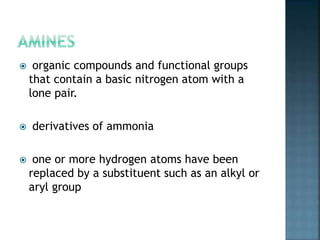
 organic compounds and functional groups
that contain a basic nitrogen atom with a
lone pair.
 derivatives of ammonia
 one or more hydrogen atoms have been
replaced by a substituent such as an alkyl or
aryl group
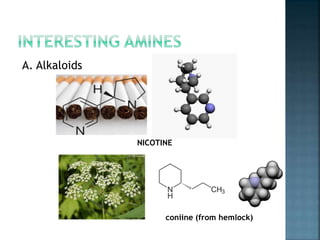
A. Alkaloids
NICOTINE
coniine (from hemlock)
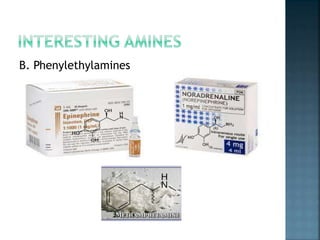
B. Phenylethylamines
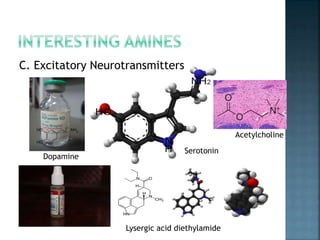
C. Excitatory Neurotransmitters
Lysergic acid diethylamide
Dopamine
Serotonin
Acetylcholine
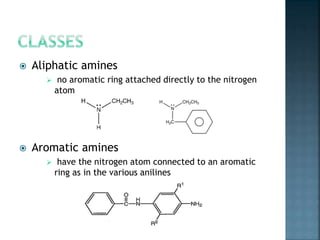
 Aliphatic amines
 no aromatic ring attached directly to the nitrogen
atom
 Aromatic amines
 have the nitrogen atom connected to an aromatic
ring as in the various anilines
 Primary amines
 Secondary amines
 Tertiary amines
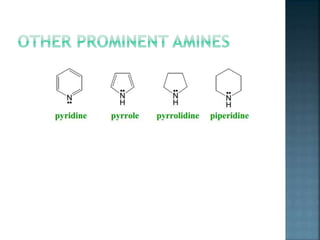
 Cyclic amines
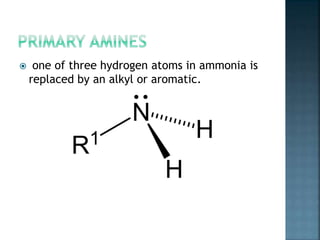
 one of three hydrogen atoms in ammonia is
replaced by an alkyl or aromatic.
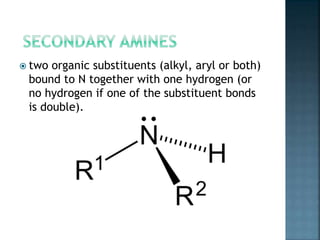
 two organic substituents (alkyl, aryl or both)
bound to N together with one hydrogen (or
no hydrogen if one of the substituent bonds
is double).
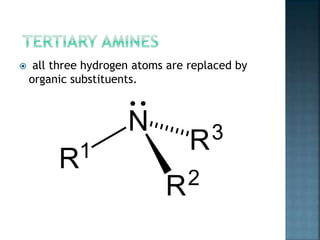
 all three hydrogen atoms are replaced by
organic substituents.
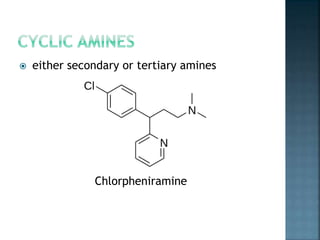
 either secondary or tertiary amines
Chlorpheniramine
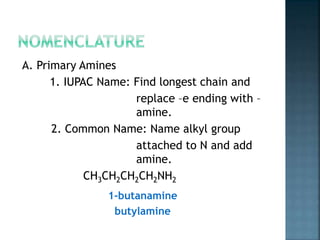
A. Primary Amines
1. IUPAC Name: Find longest chain and
replace –e ending with –
amine.
2. Common Name: Name alkyl group
attached to N and add
amine.
CH3CH2CH2CH2NH2
1-butanamine
butylamine
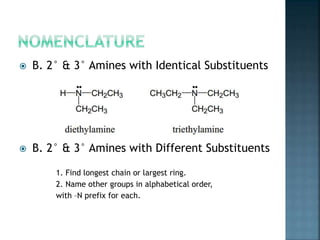
 B. 2° & 3° Amines with Identical Substituents
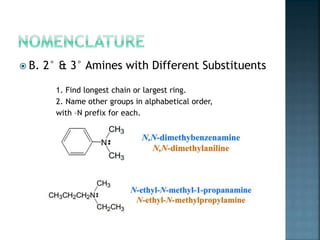
 B. 2° & 3° Amines with Different Substituents
1. Find longest chain or largest ring.
2. Name other groups in alphabetical order,
with –N prefix for each.
 B. 2° & 3° Amines with Different Substituents
1. Find longest chain or largest ring.
2. Name other groups in alphabetical order,
with –N prefix for each.
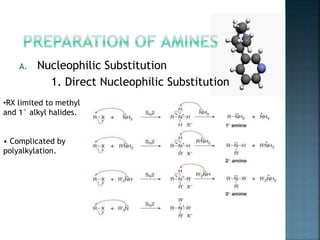
A. Nucleophilic Substitution
1. Direct Nucleophilic Substitution
•RX limited to methyl
and 1° alkyl halides.
• Complicated by
polyalkylation.
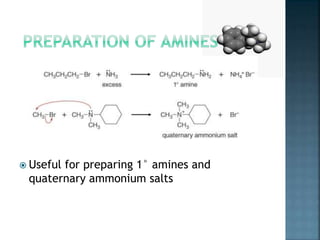
 Useful for preparing 1° amines and
quaternary ammonium salts
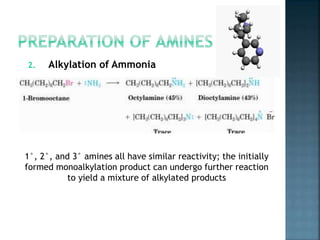
2. Alkylation of Ammonia
1°, 2°, and 3° amines all have similar reactivity; the initially
formed monoalkylation product can undergo further reaction
to yield a mixture of alkylated products
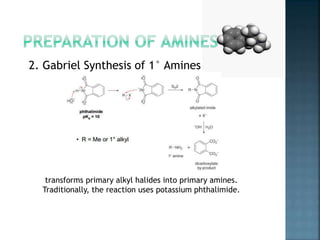
2. Gabriel Synthesis of 1° Amines
transforms primary alkyl halides into primary amines.
Traditionally, the reaction uses potassium phthalimide.
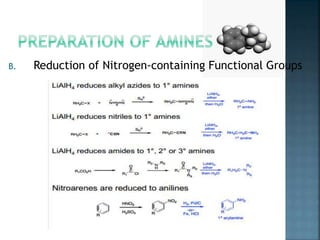
B. Reduction of Nitrogen-containing Functional Groups
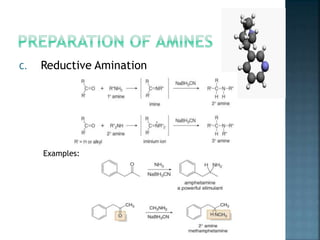
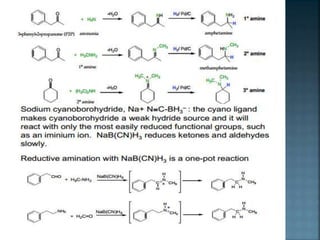
C. Reductive Amination
Examples:
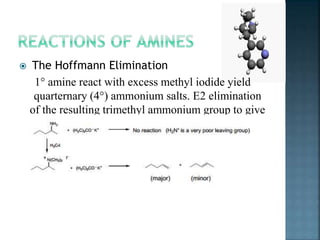
 The Hoffmann Elimination
1° amine react with excess methyl iodide yield
quarternary (4°) ammonium salts. E2 elimination
of the resulting trimethyl ammonium group to give
an alkene.
PRESENTED BY:
Beverly Bayo
Mark Erick Zoleta
IV-BSCT

Amines

  • 1.
    PRESENTED BY: Beverly Bayo MarkErick Zoleta IV-BSCT
  • 3.
     organic compoundsand functional groups that contain a basic nitrogen atom with a lone pair.  derivatives of ammonia  one or more hydrogen atoms have been replaced by a substituent such as an alkyl or aryl group
  • 4.
  • 5.
  • 6.
    C. Excitatory Neurotransmitters Lysergicacid diethylamide Dopamine Serotonin Acetylcholine
  • 7.
     Aliphatic amines no aromatic ring attached directly to the nitrogen atom  Aromatic amines  have the nitrogen atom connected to an aromatic ring as in the various anilines
  • 8.
     Primary amines Secondary amines  Tertiary amines  Cyclic amines
  • 9.
     one ofthree hydrogen atoms in ammonia is replaced by an alkyl or aromatic.
  • 10.
     two organicsubstituents (alkyl, aryl or both) bound to N together with one hydrogen (or no hydrogen if one of the substituent bonds is double).
  • 11.
     all threehydrogen atoms are replaced by organic substituents.
  • 12.
     either secondaryor tertiary amines Chlorpheniramine
  • 13.
    A. Primary Amines 1.IUPAC Name: Find longest chain and replace –e ending with – amine. 2. Common Name: Name alkyl group attached to N and add amine. CH3CH2CH2CH2NH2 1-butanamine butylamine
  • 14.
     B. 2°& 3° Amines with Identical Substituents  B. 2° & 3° Amines with Different Substituents 1. Find longest chain or largest ring. 2. Name other groups in alphabetical order, with –N prefix for each.
  • 15.
     B. 2°& 3° Amines with Different Substituents 1. Find longest chain or largest ring. 2. Name other groups in alphabetical order, with –N prefix for each.
  • 17.
    A. Nucleophilic Substitution 1.Direct Nucleophilic Substitution •RX limited to methyl and 1° alkyl halides. • Complicated by polyalkylation.
  • 18.
     Useful forpreparing 1° amines and quaternary ammonium salts
  • 19.
    2. Alkylation ofAmmonia 1°, 2°, and 3° amines all have similar reactivity; the initially formed monoalkylation product can undergo further reaction to yield a mixture of alkylated products
  • 20.
    2. Gabriel Synthesisof 1° Amines transforms primary alkyl halides into primary amines. Traditionally, the reaction uses potassium phthalimide.
  • 21.
    B. Reduction ofNitrogen-containing Functional Groups
  • 22.
  • 25.
     The HoffmannElimination 1° amine react with excess methyl iodide yield quarternary (4°) ammonium salts. E2 elimination of the resulting trimethyl ammonium group to give an alkene.
  • 26.
    PRESENTED BY: Beverly Bayo MarkErick Zoleta IV-BSCT

Editor's Notes

  • #21 The Gabriel synthesis is a chemical reaction that transforms primary alkyl halides into primary amines. Traditionally, the reaction uses potassium phthalimide. he reaction is named after the German chemist Siegmund Gabriel. The Gabriel reaction has been generalized to include the alkylation of sulfonamides and imides, followed by deprotection, to obtain amines  Traditional Gabriel Synthesis- he sodium or potassium salt of phthalimide is N-alkylated with a primary alkyl halide to give the corresponding N-alkylphthalimide. The reaction fails with most secondary alkyl halides: Alternative Gabriel reagents - Many alternative reagents have been developed to complement the use of phthalimides. Most such reagents, e.g. the sodium salt of saccharin, are electronically similar to the phthalimide salts. In terms of their advantages, some such alternative reagents hydrolyze more readily, extend the reactivity to secondary alkyl halides, and allow the production of secondary amines.
  • #23 Reductive amination (also known as reductive alkylation) is a form of amination that involves the conversion of a carbonyl group to an amine via an intermediate imine. The carbonyl group is most commonly a ketone or an aldehyde. It is considered the most important way to make amines, and a majority of amines made in the pharmaceutical industry are made this way
  • #26 Hofmann elimination gives the less substituted alkene, where E2 elimination of an alkyl halide or tosylate will follow Zaitsev rule to give the more substituted alkene