SUZUKI & SHAPIRO
REACTION
SUBMITTED BY : SHALINEE CHANDRA
1st YEAR, M.PHARM, 21032
SUBMITTED TO : Mr. ASHOK KUMAR YADAV
SIR
PHARMACEUTICAL CHEMISTRY
UIPS,PANJAB UNIVERSITY
SUZUKI REACTION
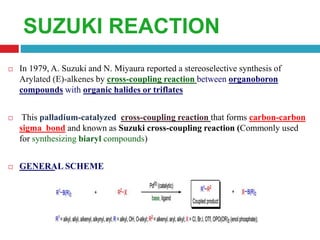
 In 1979, A. Suzuki and N. Miyaura reported a stereoselective synthesis of
Arylated (E)-alkenes by cross-coupling reaction between organoboron
compounds with organic halides or triflates
 This palladium-catalyzed cross-coupling reaction that forms carbon-carbon
sigma bond and known as Suzuki cross-coupling reaction (Commonly used
for synthesizing biaryl compounds)
 GENERAL SCHEME
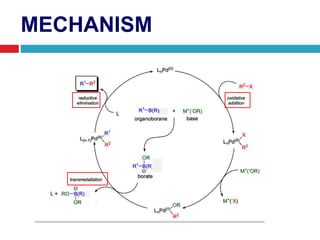
MECHANISM
MECHANISM
 STEP1 – OXIDATIVE ADDITION - The rate determining step of the catalytic
cycle in which an organic halide couples to the Palladium catalyt to form
organopalladium complex[Pd(0)-species to form Pd(II); as two groups add to the
metal]
 STEP2 – Exchange of the anion attached to the palladium for the anion of the
base; Hydroxide attacks Pd, kicking off X
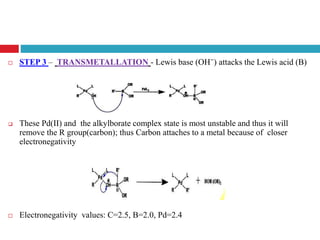
 STEP 3 – TRANSMETALLATION - Lewis base (OH⁻) attacks the Lewis acid (B)
 These Pd(II) and the alkylborate complex state is most unstable and thus it will
remove the R group(carbon); thus Carbon attaches to a metal because of closer
electronegativity
 Electronegativity values: C=2.5, B=2.0, Pd=2.4
 STEP 4 – Reductive elimination- The final step that forms the C-C sigma
bond and also regenerates the Palladium catalyst[ Pd(0) ] so that it can
participate again in catalytic cycle
 The order of reductive elimination is as follows : Ar-Ar > Ar-R > R-R
DISADVANTAGES
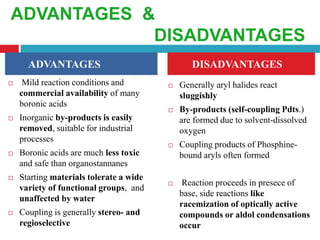
 Mild reaction conditions and
commercial availability of many
boronic acids
 Inorganic by-products is easily
removed, suitable for industrial
processes
 Boronic acids are much less toxic
and safe than organostannanes
 Starting materials tolerate a wide
variety of functional groups, and
unaffected by water
 Coupling is generally stereo- and
regioselective
ADVANTAGES
 Generally aryl halides react
sluggishly
 By-products (self-coupling Pdts.)
are formed due to solvent-dissolved
oxygen
 Coupling products of Phosphine-
bound aryls often formed
 Reaction proceeds in presece of
base, side reactions like
racemization of optically active
compounds or aldol condensations
occur
ADVANTAGES &
DISADVANTAGES
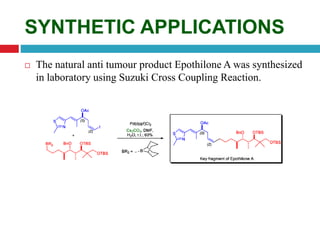
 The natural anti tumour product Epothilone A was synthesized
in laboratory using Suzuki Cross Coupling Reaction.
SYNTHETIC APPLICATIONS
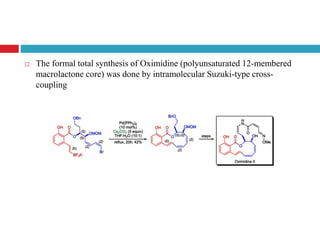
 The formal total synthesis of Oximidine (polyunsaturated 12-membered
macrolactone core) was done by intramolecular Suzuki-type cross-
coupling
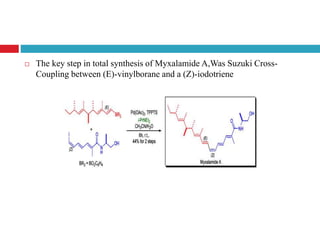
 The key step in total synthesis of Myxalamide A,Was Suzuki Cross-
Coupling between (E)-vinylborane and a (Z)-iodotriene
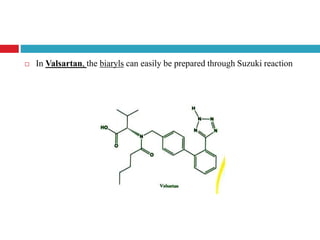
 In Valsartan, the biaryls can easily be prepared through Suzuki reaction
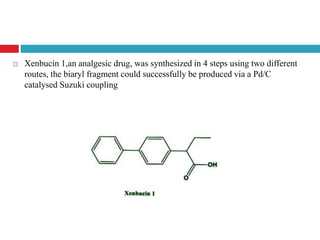
 Xenbucin 1,an analgesic drug, was synthesized in 4 steps using two different
routes, the biaryl fragment could successfully be produced via a Pd/C
catalysed Suzuki coupling
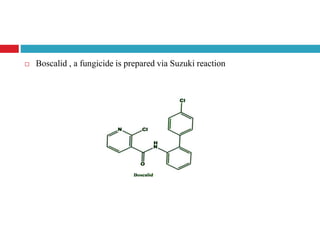
 Boscalid , a fungicide is prepared via Suzuki reaction
SHAPIRO REACTION
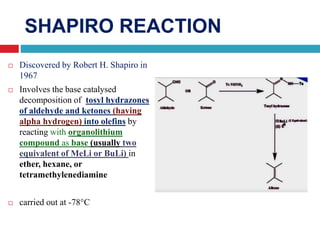
 Discovered by Robert H. Shapiro in
1967
 Involves the base catalysed
decomposition of tosyl hydrazones
of aldehyde and ketones (having
alpha hydrogen) into olefins by
reacting with organolithium
compound as base (usually two
equivalent of MeLi or BuLi) in
ether, hexane, or
tetramethylenediamine
 carried out at -78°C
GENERAL SCHEME
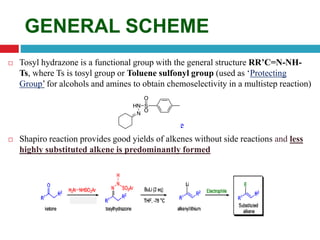
 Tosyl hydrazone is a functional group with the general structure RR’C=N-NH-
Ts, where Ts is tosyl group or Toluene sulfonyl group (used as ‘Protecting
Group’ for alcohols and amines to obtain chemoselectivity in a multistep reaction)
Tosyl hydrazone
 Shapiro reaction provides good yields of alkenes without side reactions and less
highly substituted alkene is predominantly formed
 This reaction is similar to Bamford Steven reaction where bases
such as NaOMe, LiH, NaH, NaNH₂ etc are used
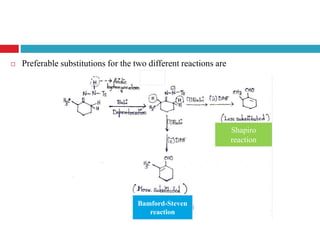
 Major difference is that Shapiro reaction yield less substituted
olefins as kinetic product (predominates reaction at low
temperature) while Bamford Stevens reaction yields more
substituted olefins as thermodynamic product (predominates
reaction at higher temperature)
MECHANISM
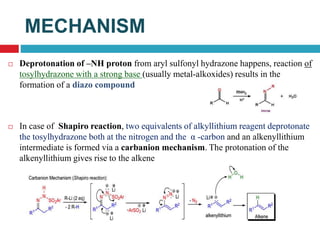
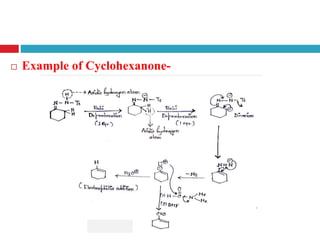
 Deprotonation of –NH proton from aryl sulfonyl hydrazone happens, reaction of
tosylhydrazone with a strong base (usually metal-alkoxides) results in the
formation of a diazo compound
 In case of Shapiro reaction, two equivalents of alkyllithium reagent deprotonate
the tosylhydrazone both at the nitrogen and the α -carbon and an alkenyllithium
intermediate is formed via a carbanion mechanism. The protonation of the
alkenyllithium gives rise to the alkene
 Example of Cyclohexanone-
 Bamford Steven Reaction mechanism
 In aprotic condition, initially formed diazo compound loses a molecule of
nitrogen and forms a carbene intermediate, that undergoes a [1,2]-H shift and
gives rise to alkene
 Preferable substitutions for the two different reactions are
Shapiro
reaction
Bamford-Steven
reaction
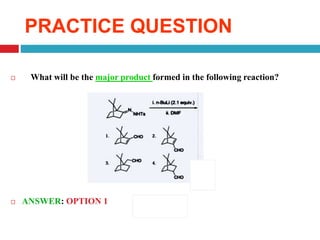
 What will be the major product formed in the following reaction?
 ANSWER: OPTION 1
PRACTICE QUESTION
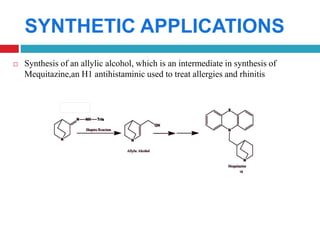
SYNTHETIC APPLICATIONS
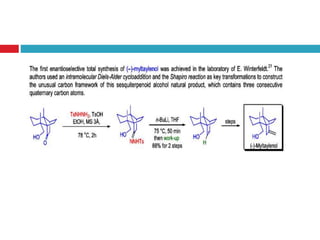
 Synthesis of an allylic alcohol, which is an intermediate in synthesis of
Mequitazine,an H1 antihistaminic used to treat allergies and rhinitis
//
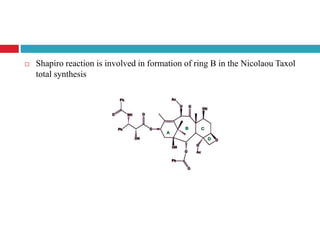
 Shapiro reaction is involved in formation of ring B in the Nicolaou Taxol
total synthesis

Suzuki and Shapiro reaction

  • 1.
    SUZUKI & SHAPIRO REACTION SUBMITTEDBY : SHALINEE CHANDRA 1st YEAR, M.PHARM, 21032 SUBMITTED TO : Mr. ASHOK KUMAR YADAV SIR PHARMACEUTICAL CHEMISTRY UIPS,PANJAB UNIVERSITY
  • 2.
    SUZUKI REACTION  In1979, A. Suzuki and N. Miyaura reported a stereoselective synthesis of Arylated (E)-alkenes by cross-coupling reaction between organoboron compounds with organic halides or triflates  This palladium-catalyzed cross-coupling reaction that forms carbon-carbon sigma bond and known as Suzuki cross-coupling reaction (Commonly used for synthesizing biaryl compounds)  GENERAL SCHEME
  • 4.
  • 5.
    MECHANISM  STEP1 –OXIDATIVE ADDITION - The rate determining step of the catalytic cycle in which an organic halide couples to the Palladium catalyt to form organopalladium complex[Pd(0)-species to form Pd(II); as two groups add to the metal]  STEP2 – Exchange of the anion attached to the palladium for the anion of the base; Hydroxide attacks Pd, kicking off X
  • 6.
     STEP 3– TRANSMETALLATION - Lewis base (OH⁻) attacks the Lewis acid (B)  These Pd(II) and the alkylborate complex state is most unstable and thus it will remove the R group(carbon); thus Carbon attaches to a metal because of closer electronegativity  Electronegativity values: C=2.5, B=2.0, Pd=2.4
  • 7.
     STEP 4– Reductive elimination- The final step that forms the C-C sigma bond and also regenerates the Palladium catalyst[ Pd(0) ] so that it can participate again in catalytic cycle  The order of reductive elimination is as follows : Ar-Ar > Ar-R > R-R
  • 8.
    DISADVANTAGES  Mild reactionconditions and commercial availability of many boronic acids  Inorganic by-products is easily removed, suitable for industrial processes  Boronic acids are much less toxic and safe than organostannanes  Starting materials tolerate a wide variety of functional groups, and unaffected by water  Coupling is generally stereo- and regioselective ADVANTAGES  Generally aryl halides react sluggishly  By-products (self-coupling Pdts.) are formed due to solvent-dissolved oxygen  Coupling products of Phosphine- bound aryls often formed  Reaction proceeds in presece of base, side reactions like racemization of optically active compounds or aldol condensations occur ADVANTAGES & DISADVANTAGES
  • 9.
     The naturalanti tumour product Epothilone A was synthesized in laboratory using Suzuki Cross Coupling Reaction. SYNTHETIC APPLICATIONS
  • 10.
     The formaltotal synthesis of Oximidine (polyunsaturated 12-membered macrolactone core) was done by intramolecular Suzuki-type cross- coupling
  • 11.
     The keystep in total synthesis of Myxalamide A,Was Suzuki Cross- Coupling between (E)-vinylborane and a (Z)-iodotriene
  • 12.
     In Valsartan,the biaryls can easily be prepared through Suzuki reaction
  • 13.
     Xenbucin 1,ananalgesic drug, was synthesized in 4 steps using two different routes, the biaryl fragment could successfully be produced via a Pd/C catalysed Suzuki coupling
  • 14.
     Boscalid ,a fungicide is prepared via Suzuki reaction
  • 15.
    SHAPIRO REACTION  Discoveredby Robert H. Shapiro in 1967  Involves the base catalysed decomposition of tosyl hydrazones of aldehyde and ketones (having alpha hydrogen) into olefins by reacting with organolithium compound as base (usually two equivalent of MeLi or BuLi) in ether, hexane, or tetramethylenediamine  carried out at -78°C
  • 16.
    GENERAL SCHEME  Tosylhydrazone is a functional group with the general structure RR’C=N-NH- Ts, where Ts is tosyl group or Toluene sulfonyl group (used as ‘Protecting Group’ for alcohols and amines to obtain chemoselectivity in a multistep reaction) Tosyl hydrazone  Shapiro reaction provides good yields of alkenes without side reactions and less highly substituted alkene is predominantly formed
  • 17.
     This reactionis similar to Bamford Steven reaction where bases such as NaOMe, LiH, NaH, NaNH₂ etc are used  Major difference is that Shapiro reaction yield less substituted olefins as kinetic product (predominates reaction at low temperature) while Bamford Stevens reaction yields more substituted olefins as thermodynamic product (predominates reaction at higher temperature)
  • 18.
    MECHANISM  Deprotonation of–NH proton from aryl sulfonyl hydrazone happens, reaction of tosylhydrazone with a strong base (usually metal-alkoxides) results in the formation of a diazo compound  In case of Shapiro reaction, two equivalents of alkyllithium reagent deprotonate the tosylhydrazone both at the nitrogen and the α -carbon and an alkenyllithium intermediate is formed via a carbanion mechanism. The protonation of the alkenyllithium gives rise to the alkene
  • 19.
     Example ofCyclohexanone-
  • 20.
     Bamford StevenReaction mechanism  In aprotic condition, initially formed diazo compound loses a molecule of nitrogen and forms a carbene intermediate, that undergoes a [1,2]-H shift and gives rise to alkene
  • 21.
     Preferable substitutionsfor the two different reactions are Shapiro reaction Bamford-Steven reaction
  • 22.
     What willbe the major product formed in the following reaction?  ANSWER: OPTION 1 PRACTICE QUESTION
  • 23.
    SYNTHETIC APPLICATIONS  Synthesisof an allylic alcohol, which is an intermediate in synthesis of Mequitazine,an H1 antihistaminic used to treat allergies and rhinitis
  • 24.
  • 25.
     Shapiro reactionis involved in formation of ring B in the Nicolaou Taxol total synthesis