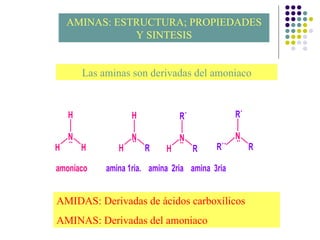
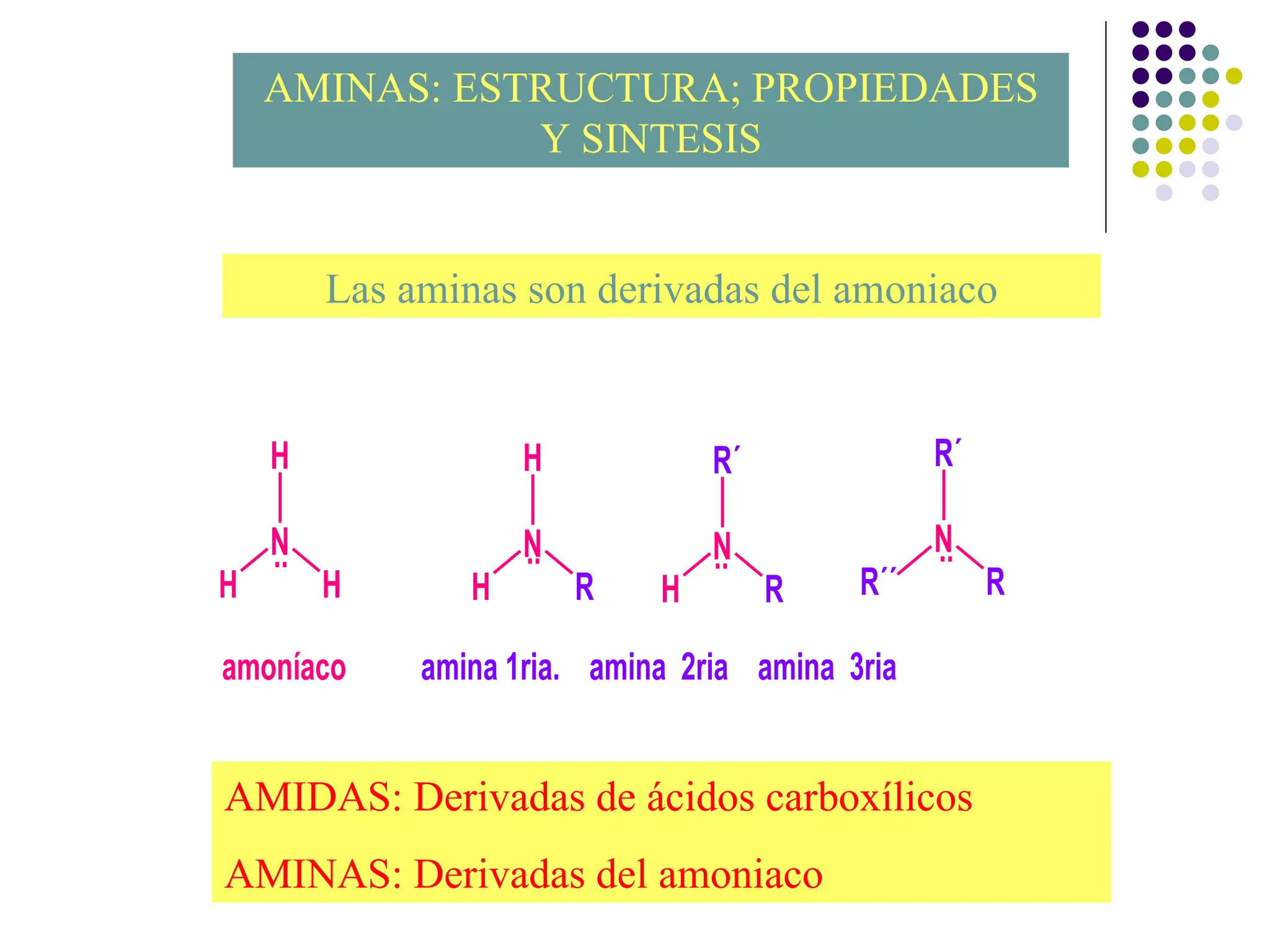
AMINAS: ESTRUCTURA; PROPIEDADES Y SINTESIS Las aminas son derivadas del amoniaco AMIDAS: Derivadas de ácidos carboxílicos AMINAS: Derivadas del amoniaco
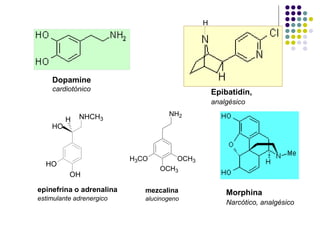
Morphina Narcótico, analgésico   Epibatidin, analgésico   Dopamine  cardiotónico
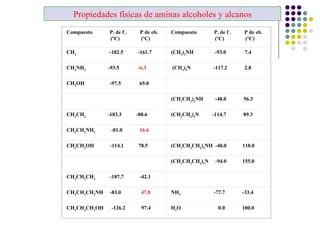
  Propiedades físicas de aminas alcoholes y alcanos Compuesto  P. de f .  P de eb. (ºC)  (ºC) Compuesto  P. de f .  P de eb. (ºC)  (ºC) CH 4   -182.5  -161.7 (CH 3 ) 2 NH  -93.0  7.4 CH 3 NH 2  -93.5  -6.3   (CH 3 ) 3 N  -117.2  2.8 CH 3 OH  -97.5  65.0    (CH 3 CH 2 ) 2 NH  -48.0  56.3  CH 3 CH 3  -183.3  -88.6  (CH 3 CH 2 ) 3 N  -114.7  89.3  CH 3 CH 2 NH 2   -81.0  16.6     CH 3 CH 2 OH  -114.1  78.5  (CH 3 CH 2 CH 2 ) 2 NH  -40.0  110.0    (CH 3 CH 2 CH 2 ) 3 N  -94.0  155.0  CH 3 CH 2 CH 3   -187.7  -42.1    CH 3 CH 2 CH 2 NH   -83.0  47.8   NH 3   -77.7  -33.4 CH 3 CH 2 CH 2 OH  -126.2  97.4  H 2 O  0.0  100.0
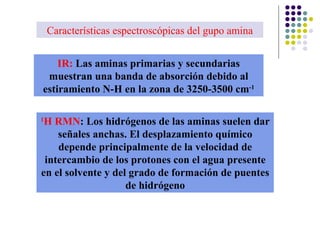
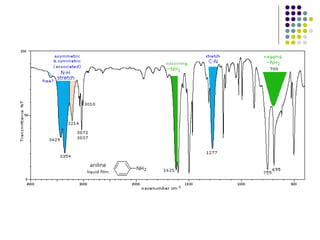
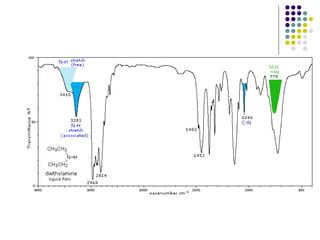
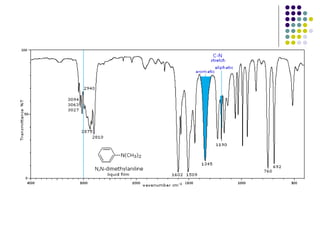
Características espectroscópicas del gupo amina IR:  Las aminas primarias y secundarias muestran una banda de absorción debido al estiramiento N-H en la zona de 3250-3500 cm -1 1 H RMN :   Los hidrógenos de las aminas suelen dar señales anchas. El desplazamiento químico depende principalmente de la velocidad de intercambio de los protones con el agua presente en el solvente y del grado de formación de puentes de hidrógeno


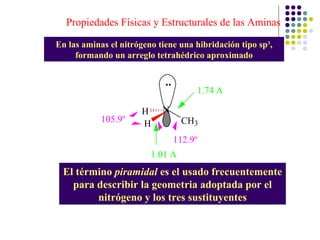
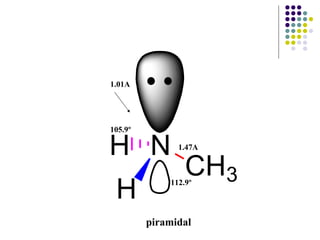
Propiedades Físicas y Estructurales de las Aminas En las aminas el nitrógeno tiene una hibridación tipo sp 3 , formando un arreglo tetrahédrico aproximado El término  piramidal  es el usado frecuentemente para describir la geometria adoptada por el nitrógeno y los tres sustituyentes
1.01A 1.47A 112.9º 105.9º piramidal
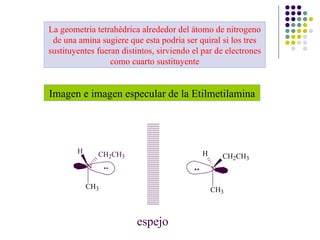
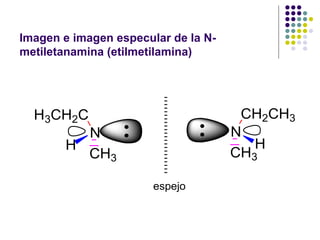
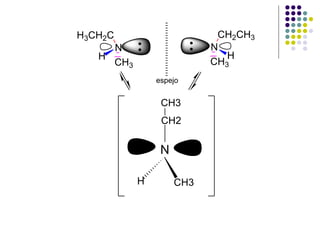
La geometria tetrahédrica alrededor del átomo de nitrogeno de una amina sugiere que esta podria ser quiral si los tres sustituyentes fueran distintos, sirviendo el par de electrones como cuarto sustituyente Imagen e imagen especular de la Etilmetilamina
Imagen e imagen especular de la N-metiletanamina (etilmetilamina)
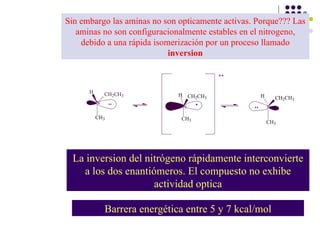
Sin embargo las aminas no son opticamente activas. Porque??? Las aminas no son configuracionalmente estables en el nitrogeno, debido a una rápida isomerización por un proceso llamado  inversion Barrera energética entre 5 y 7 kcal/mol La inversion del nitrógeno rápidamente interconvierte a los dos enantiómeros. El compuesto no exhibe actividad optica
 
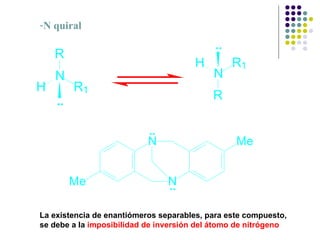
N quiral La existencia de enantiómeros separables, para este compuesto, se debe a la  imposibilidad de inversión del átomo de nitrógeno
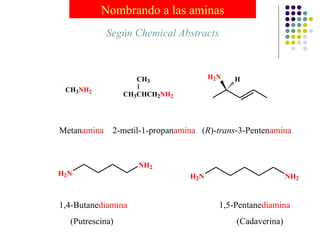
Nombrando a las aminas Metan amina  2-metil-1-propan amina  ( R )- trans -3-Penten amina Según Chemical Abstracts 1,4-Butane diamina  1,5-Pentane diamina  (Putrescina)  (Cadaverina)
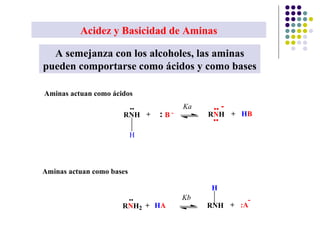
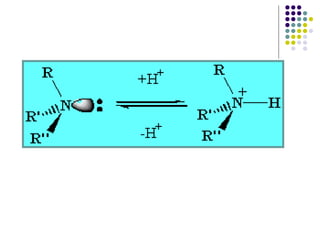
Acidez y Basicidad de Aminas A semejanza con los alcoholes, las aminas pueden comportarse como ácidos y como bases
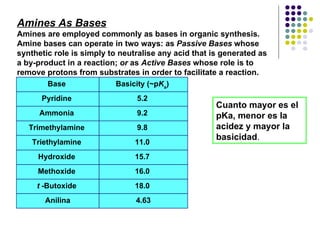
Amines As Bases Amines are employed commonly as bases in organic synthesis. Amine bases can operate in two ways: as  Passive Bases  whose synthetic role is simply to neutralise any acid that is generated as a by-product in a reaction;  or  as  Active Bases  whose role is to remove protons from substrates in order to facilitate a reaction.  Cuanto mayor es el pKa, menor es la acidez y mayor la basicidad .  4.63 Anilina 18.0  t  -Butoxide  16.0  Methoxide  15.7  Hydroxide  11.0  Triethylamine  9.8  Trimethylamine  9.2  Ammonia  5.2  Pyridine  Basicity (~p K a )  Base
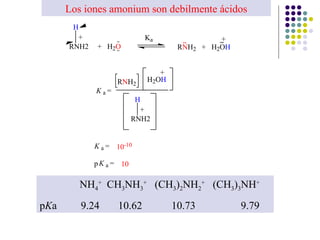
Los iones amonium son debilmente ácidos NH 4 +   CH 3 NH 3 +   (CH 3 ) 2 NH 2 +   (CH 3 ) 3 NH + p K a  9.24  10.62  10.73  9.79
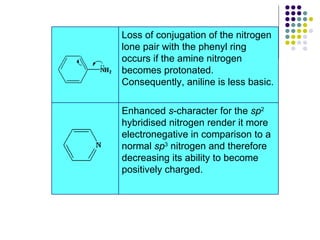
Enhanced  s -character for the  sp 2  hybridised nitrogen render it more electronegative in comparison to a normal  sp 3  nitrogen and therefore decreasing its ability to become positively charged.  Loss of conjugation of the nitrogen lone pair with the phenyl ring occurs if the amine nitrogen becomes protonated.  Consequently, aniline is less basic.
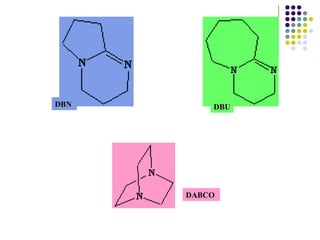
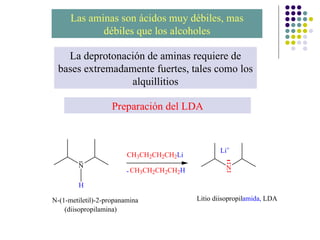
The passive bases (in general the weaker bases) are employed in reactions that require a base in order to attain completion. An example of this is the acylation of primary or secondary amines. In these reactions, bulky, non–nucleophilic bases such as Hünig’s base (diisopropylethylamine) are frequently used. More powerful amine bases are required when the reaction involves removal of a proton from a substrate in order to generate an anionic intermediate. The most commonly employed strong organonitrogen base is lithium diisopropylamide (LDA) (a metal amide) – this is produced by treating diisopropylamine with butyl lithium. Reactions using LDA are typically carried out at –78 ºC in order to avoid detrimental side reactions. In the case of substrates where two acidic protons can be abstracted by base, treatment with LDA leads to the kinetic (i.e.  sterically least hindered ) product. LDA is not as strong a base as BuLi, however, it is too hindered to act as a nucleophile. In the uncommon case where it does participate as a nucleophile, LDA can be replaced by the even bulkier base, lithium hexamethyldisilazide. Strong bases such as LDA are not always required to abstract protons from substrates. In the case of elimination reactions, milder organonitrogen bases such as 1,5-diazabicyclo[4.3.0]non-5-ene (DBN), 1,8-diazabicyclo[5.4.0]undec-7-ene (DBU), 1,4- diazabicyclo[2.2.2]octane (DABCO) or even pyridine are employed.
DBN   DBU DABCO      
 
It is clear that electron-donating groups stabilise the positive charge of the ammonium nitrogen and therefore enable the above equilibrium to lie further to the right hand side. Consequently, the association constant is reduced and the p K a is subsequently raised. This is clearly evident by consideration of ethylamine and diethylamine ( note  that steric effects actually serve to decrease the basicity of the nitrogen in triethylamine). The basicity of the nitrogen atoms in amines such as aniline and pyridine are dramatically affected by aromaticity and the ability to form numerous canonical forms  via  resonance of the amines’ lone pair of electrons with the benzene p-system.
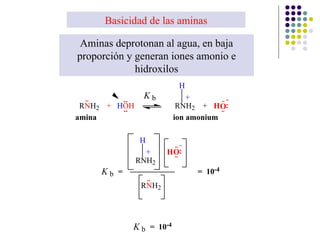
Basicidad de las aminas Aminas deprotonan al agua, en baja proporción y generan iones amonio e hidroxilos
Las aminas son ácidos muy débiles, mas débiles que los alcoholes La deprotonación de aminas requiere de bases extremadamente fuertes, tales como los alquillitios Preparación del LDA
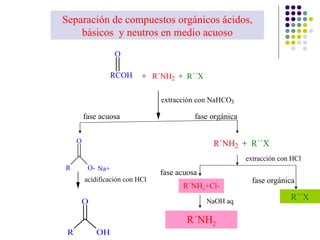
Separación de compuestos orgánicos ácidos, básicos  y neutros en medio acuoso fase orgánica fase acuosa R´´X R´NH 3 +Cl- R´NH 2 extracción con HCl fase orgánica fase acuosa NaOH aq
Amines are unusually versatile species – very few other systems possess the ability to act as both a base and a nucleophile so readily. The nucleophilic character of an amine can usually be easily quenched by addition of acid to the amine – protonation of the nitrogen by dative attack by the lone pair of the nitrogen render it unable to attack electrophilic carbon sites .
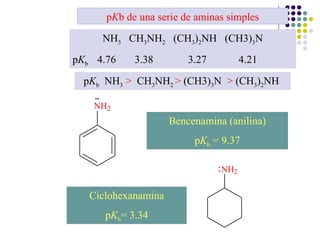
p K b de una serie de aminas simples NH 3   CH 3 NH 2   (CH 3 ) 2 NH  (CH3) 3 N p K b  4.76  3.38  3.27  4.21 p K b   NH 3   >   CH 3 NH 2  >  (CH3) 3 N  >  (CH 3 ) 2 NH  Bencenamina (anilina) p K b  = 9.37 Ciclohexanamina p K b = 3.34
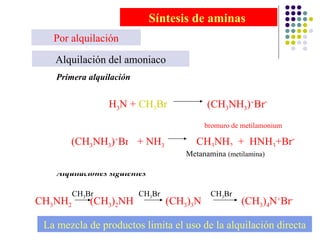
Síntesis de aminas   Por alquilación Alquilación del amoniaco Primera alquilación H 3 N +  CH 3 Br  (CH 3 NH 3 ) + Br - bromuro de metilamonium Alquilaciones siguientes (CH 3 NH 3 ) + Br - + NH 3   CH 3 NH 2   +  HNH 3 +Br - Metanamina  (metilamina) CH 3 NH 2  (CH 3 ) 2 NH  (CH 3 ) 3 N  (CH 3 ) 4 N + Br - CH 3 Br CH 3 Br CH 3 Br La mezcla de productos limita el uso de la alquilación directa
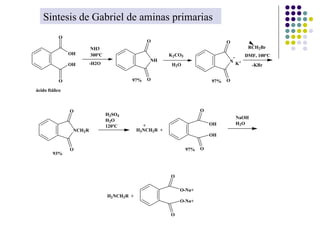
Sintesis de Gabriel de aminas primarias
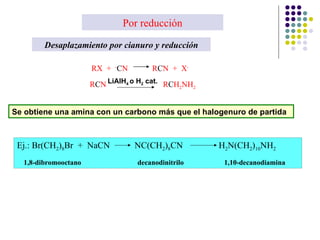
Por reducción Desaplazamiento por cianuro y reducción RX  +  - C N  R C N  +  X - R C N  R C H 2 NH 2 Ej.: Br(CH 2 ) 8 Br  +  NaCN  NC(CH 2 ) 8 CN  H 2 N(CH 2 ) 10 NH 2 1,8-dibromooctano  decanodinitrilo  1,10-decanodiamina Se obtiene una amina con un carbono más que el halogenuro de partida LiAlH 4  o H 2  cat.
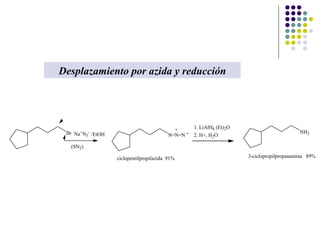
Desplazamiento por azida y reducción
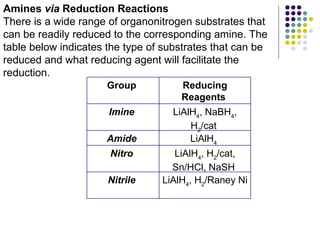
Amines  via  Reduction Reactions There is a wide range of organonitrogen substrates that can be readily reduced to the corresponding amine. The table below indicates the type of substrates that can be reduced and what reducing agent will facilitate the reduction.  LiAlH 4 , H 2 /Raney Ni  Nitrile  LiAlH 4 , H 2 /cat, Sn/HCl, NaSH  Nitro  LiAlH 4   Amide  LiAlH 4 , NaBH 4 , H 2 /cat  Imine  Reducing Reagents   Group
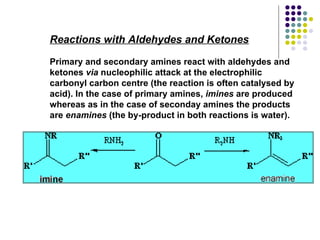
Reactions with Aldehydes and Ketones Primary and secondary amines react with aldehydes and ketones  via  nucleophilic attack at the electrophilic carbonyl carbon centre (the reaction is often catalysed by acid). In the case of primary amines,  imines  are produced whereas as in the case of seconday amines the products are  enamines  (the by-product in both reactions is water).
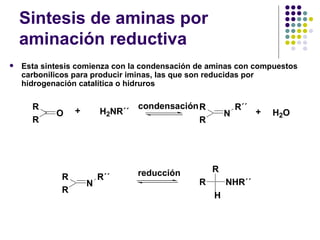
Sintesis de aminas por aminación reductiva Esta sintesis comienza con la condensación de aminas con compuestos carbonilicos para producir iminas, las que son reducidas por hidrogenación catalítica o hidruros reducción
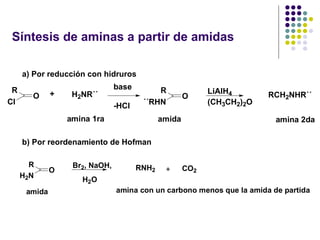
Síntesis de aminas a partir de amidas a) Por reducción con hidruros b) Por reordenamiento de Hofman
 

Aminas

  • 1.
    AMINAS: ESTRUCTURA; PROPIEDADESY SINTESIS Las aminas son derivadas del amoniaco AMIDAS: Derivadas de ácidos carboxílicos AMINAS: Derivadas del amoniaco
  • 2.
    Morphina Narcótico, analgésico Epibatidin, analgésico Dopamine cardiotónico
  • 3.
      Propiedades físicasde aminas alcoholes y alcanos Compuesto P. de f . P de eb. (ºC) (ºC) Compuesto P. de f . P de eb. (ºC) (ºC) CH 4 -182.5 -161.7 (CH 3 ) 2 NH -93.0 7.4 CH 3 NH 2 -93.5 -6.3 (CH 3 ) 3 N -117.2 2.8 CH 3 OH -97.5 65.0   (CH 3 CH 2 ) 2 NH -48.0 56.3 CH 3 CH 3 -183.3 -88.6 (CH 3 CH 2 ) 3 N -114.7 89.3 CH 3 CH 2 NH 2 -81.0 16.6   CH 3 CH 2 OH -114.1 78.5 (CH 3 CH 2 CH 2 ) 2 NH -40.0 110.0   (CH 3 CH 2 CH 2 ) 3 N -94.0 155.0 CH 3 CH 2 CH 3 -187.7 -42.1   CH 3 CH 2 CH 2 NH -83.0 47.8 NH 3 -77.7 -33.4 CH 3 CH 2 CH 2 OH -126.2 97.4 H 2 O 0.0 100.0
  • 4.
    Características espectroscópicas delgupo amina IR: Las aminas primarias y secundarias muestran una banda de absorción debido al estiramiento N-H en la zona de 3250-3500 cm -1 1 H RMN : Los hidrógenos de las aminas suelen dar señales anchas. El desplazamiento químico depende principalmente de la velocidad de intercambio de los protones con el agua presente en el solvente y del grado de formación de puentes de hidrógeno
  • 5.
  • 6.
  • 7.
  • 8.
    Propiedades Físicas yEstructurales de las Aminas En las aminas el nitrógeno tiene una hibridación tipo sp 3 , formando un arreglo tetrahédrico aproximado El término piramidal es el usado frecuentemente para describir la geometria adoptada por el nitrógeno y los tres sustituyentes
  • 9.
    1.01A 1.47A 112.9º105.9º piramidal
  • 10.
    La geometria tetrahédricaalrededor del átomo de nitrogeno de una amina sugiere que esta podria ser quiral si los tres sustituyentes fueran distintos, sirviendo el par de electrones como cuarto sustituyente Imagen e imagen especular de la Etilmetilamina
  • 11.
    Imagen e imagenespecular de la N-metiletanamina (etilmetilamina)
  • 12.
    Sin embargo lasaminas no son opticamente activas. Porque??? Las aminas no son configuracionalmente estables en el nitrogeno, debido a una rápida isomerización por un proceso llamado inversion Barrera energética entre 5 y 7 kcal/mol La inversion del nitrógeno rápidamente interconvierte a los dos enantiómeros. El compuesto no exhibe actividad optica
  • 13.
  • 14.
    N quiral Laexistencia de enantiómeros separables, para este compuesto, se debe a la imposibilidad de inversión del átomo de nitrógeno
  • 15.
    Nombrando a lasaminas Metan amina 2-metil-1-propan amina ( R )- trans -3-Penten amina Según Chemical Abstracts 1,4-Butane diamina 1,5-Pentane diamina (Putrescina) (Cadaverina)
  • 16.
    Acidez y Basicidadde Aminas A semejanza con los alcoholes, las aminas pueden comportarse como ácidos y como bases
  • 17.
    Amines As BasesAmines are employed commonly as bases in organic synthesis. Amine bases can operate in two ways: as Passive Bases whose synthetic role is simply to neutralise any acid that is generated as a by-product in a reaction; or as Active Bases whose role is to remove protons from substrates in order to facilitate a reaction. Cuanto mayor es el pKa, menor es la acidez y mayor la basicidad . 4.63 Anilina 18.0 t -Butoxide 16.0 Methoxide 15.7 Hydroxide 11.0 Triethylamine 9.8 Trimethylamine 9.2 Ammonia 5.2 Pyridine Basicity (~p K a ) Base
  • 18.
    Los iones amoniumson debilmente ácidos NH 4 + CH 3 NH 3 + (CH 3 ) 2 NH 2 + (CH 3 ) 3 NH + p K a 9.24 10.62 10.73 9.79
  • 19.
    Enhanced s-character for the sp 2 hybridised nitrogen render it more electronegative in comparison to a normal sp 3 nitrogen and therefore decreasing its ability to become positively charged. Loss of conjugation of the nitrogen lone pair with the phenyl ring occurs if the amine nitrogen becomes protonated. Consequently, aniline is less basic.
  • 20.
    The passive bases(in general the weaker bases) are employed in reactions that require a base in order to attain completion. An example of this is the acylation of primary or secondary amines. In these reactions, bulky, non–nucleophilic bases such as Hünig’s base (diisopropylethylamine) are frequently used. More powerful amine bases are required when the reaction involves removal of a proton from a substrate in order to generate an anionic intermediate. The most commonly employed strong organonitrogen base is lithium diisopropylamide (LDA) (a metal amide) – this is produced by treating diisopropylamine with butyl lithium. Reactions using LDA are typically carried out at –78 ºC in order to avoid detrimental side reactions. In the case of substrates where two acidic protons can be abstracted by base, treatment with LDA leads to the kinetic (i.e. sterically least hindered ) product. LDA is not as strong a base as BuLi, however, it is too hindered to act as a nucleophile. In the uncommon case where it does participate as a nucleophile, LDA can be replaced by the even bulkier base, lithium hexamethyldisilazide. Strong bases such as LDA are not always required to abstract protons from substrates. In the case of elimination reactions, milder organonitrogen bases such as 1,5-diazabicyclo[4.3.0]non-5-ene (DBN), 1,8-diazabicyclo[5.4.0]undec-7-ene (DBU), 1,4- diazabicyclo[2.2.2]octane (DABCO) or even pyridine are employed.
  • 21.
    DBN DBU DABCO    
  • 22.
  • 23.
    It is clearthat electron-donating groups stabilise the positive charge of the ammonium nitrogen and therefore enable the above equilibrium to lie further to the right hand side. Consequently, the association constant is reduced and the p K a is subsequently raised. This is clearly evident by consideration of ethylamine and diethylamine ( note that steric effects actually serve to decrease the basicity of the nitrogen in triethylamine). The basicity of the nitrogen atoms in amines such as aniline and pyridine are dramatically affected by aromaticity and the ability to form numerous canonical forms via resonance of the amines’ lone pair of electrons with the benzene p-system.
  • 24.
    Basicidad de lasaminas Aminas deprotonan al agua, en baja proporción y generan iones amonio e hidroxilos
  • 25.
    Las aminas sonácidos muy débiles, mas débiles que los alcoholes La deprotonación de aminas requiere de bases extremadamente fuertes, tales como los alquillitios Preparación del LDA
  • 26.
    Separación de compuestosorgánicos ácidos, básicos y neutros en medio acuoso fase orgánica fase acuosa R´´X R´NH 3 +Cl- R´NH 2 extracción con HCl fase orgánica fase acuosa NaOH aq
  • 27.
    Amines are unusuallyversatile species – very few other systems possess the ability to act as both a base and a nucleophile so readily. The nucleophilic character of an amine can usually be easily quenched by addition of acid to the amine – protonation of the nitrogen by dative attack by the lone pair of the nitrogen render it unable to attack electrophilic carbon sites .
  • 28.
    p K bde una serie de aminas simples NH 3 CH 3 NH 2 (CH 3 ) 2 NH (CH3) 3 N p K b 4.76 3.38 3.27 4.21 p K b NH 3 > CH 3 NH 2 > (CH3) 3 N > (CH 3 ) 2 NH Bencenamina (anilina) p K b = 9.37 Ciclohexanamina p K b = 3.34
  • 29.
    Síntesis de aminas Por alquilación Alquilación del amoniaco Primera alquilación H 3 N + CH 3 Br (CH 3 NH 3 ) + Br - bromuro de metilamonium Alquilaciones siguientes (CH 3 NH 3 ) + Br - + NH 3 CH 3 NH 2 + HNH 3 +Br - Metanamina (metilamina) CH 3 NH 2 (CH 3 ) 2 NH (CH 3 ) 3 N (CH 3 ) 4 N + Br - CH 3 Br CH 3 Br CH 3 Br La mezcla de productos limita el uso de la alquilación directa
  • 30.
    Sintesis de Gabrielde aminas primarias
  • 31.
    Por reducción Desaplazamientopor cianuro y reducción RX + - C N R C N + X - R C N R C H 2 NH 2 Ej.: Br(CH 2 ) 8 Br + NaCN NC(CH 2 ) 8 CN H 2 N(CH 2 ) 10 NH 2 1,8-dibromooctano decanodinitrilo 1,10-decanodiamina Se obtiene una amina con un carbono más que el halogenuro de partida LiAlH 4 o H 2 cat.
  • 32.
  • 33.
    Amines via Reduction Reactions There is a wide range of organonitrogen substrates that can be readily reduced to the corresponding amine. The table below indicates the type of substrates that can be reduced and what reducing agent will facilitate the reduction. LiAlH 4 , H 2 /Raney Ni Nitrile LiAlH 4 , H 2 /cat, Sn/HCl, NaSH Nitro LiAlH 4 Amide LiAlH 4 , NaBH 4 , H 2 /cat Imine Reducing Reagents Group
  • 34.
    Reactions with Aldehydesand Ketones Primary and secondary amines react with aldehydes and ketones via nucleophilic attack at the electrophilic carbonyl carbon centre (the reaction is often catalysed by acid). In the case of primary amines, imines are produced whereas as in the case of seconday amines the products are enamines (the by-product in both reactions is water).
  • 35.
    Sintesis de aminaspor aminación reductiva Esta sintesis comienza con la condensación de aminas con compuestos carbonilicos para producir iminas, las que son reducidas por hidrogenación catalítica o hidruros reducción
  • 36.
    Síntesis de aminasa partir de amidas a) Por reducción con hidruros b) Por reordenamiento de Hofman
  • 37.