A M I N E
At the end of session students should able to-
1
2. Explain basic nature of amines
3. Compare basicity of substituted amines
4. Explain functional group test for amine
5. Draw structure and list out
various uses of amines
Definition2
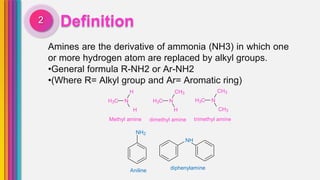
Amines are the derivative of ammonia (NH3) in which one
or more hydrogen atom are replaced by alkyl groups.
•General formula R-NH2 or Ar-NH2
•(Where R= Alkyl group and Ar= Aromatic ring)
NH2
NH
diphenylamineAniline
H CH3
H3C NH3C N H3C N
CH3
trimethyl amine
H
Methyl amine
H
dimethyl amine
CH3
Classification3
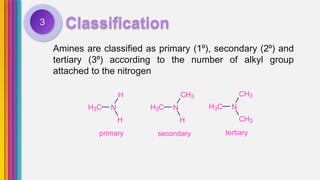
Amines are classified as primary (1⁰), secondary (2⁰) and
tertiary (3⁰) according to the number of alkyl group
attached to the nitrogen
CH3H CH3
H3C NH3C N H3C N
CH3
tertiary
H
primary
H
secondary
Basicity of amines
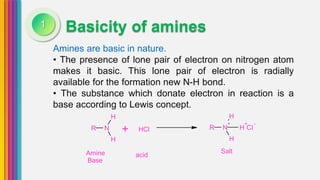
Amines are basic in nature.
• The presence of lone pair of electron on nitrogen atom
makes it basic. This lone pair of electron is radially
available for the formation new N-H bond.
• The substance which donate electron in reaction is a
base according to Lewis concept.
1
HH
+ + -
+ R N H ClR N HCl
H
Salt
H
Amine
Base
acid
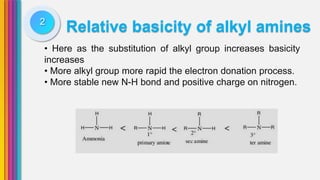
Relative basicity of alkyl amines2
• Here as the substitution of alkyl group increases basicity
increases
• More alkyl group more rapid the electron donation process.
• More stable new N-H bond and positive charge on nitrogen.
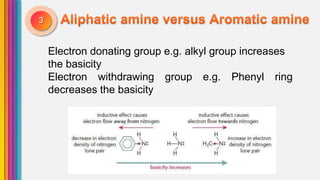
Electron donating group e.g. alkyl group increases
the basicity
Electron withdrawing group e.g. Phenyl ring
decreases the basicity
3
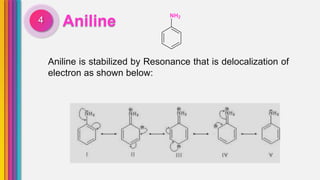
Aniline4
Aniline is stabilized by Resonance that is delocalization of
electron as shown below:
NH2
Basicity of aniline with substituents5
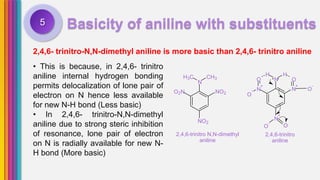
• This is because, in 2,4,6- trinitro
aniline internal hydrogen bonding
permits delocalization of lone pair of
electron on N hence less available
for new N-H bond (Less basic)
• In 2,4,6- trinitro-N,N-dimethyl
aniline due to strong steric inhibition
of resonance, lone pair of electron
on N is radially available for new N-
H bond (More basic)
H HH3C CH3 O N ON
-++
ONN-
O
NO2O2N
+
NNO2 -
OO
2,4,6-trinitro
aniline
2,4,6-trinitro N,N-dimethyl
aniline
2,4,6- trinitro-N,N-dimethyl aniline is more basic than 2,4,6- trinitro aniline
Qualitative test: Amine
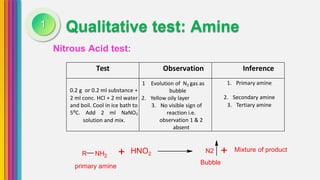
Nitrous Acid test:
1
Test Observation Inference
0.2 g or 0.2 ml substance +
2 ml conc. HCl + 2 ml water
and boil. Cool in ice bath to
5⁰C. Add 2 ml NaNO2
solution and mix.
1 Evolution of N2 gas as
bubble
2. Yellow oily layer
3. No visible sign of
reaction i.e.
observation 1 & 2
absent
1. Primary amine
2. Secondary amine
3. Tertiary amine
++ Mixture of productHNO2 N2R NH2
Bubble
primary amine
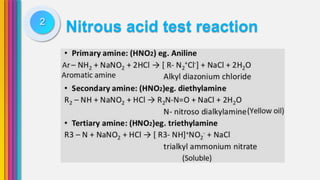
Nitrous acid test reaction2
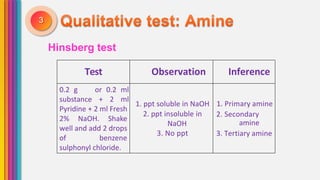
Hinsberg test
3
2. Secondary
3. Tertiary amine
Test Observation Inference
0.2 g or 0.2 ml
substance + 2 ml
Pyridine + 2 ml Fresh
2% NaOH. Shake
well and add 2 drops
of benzene
sulphonyl chloride.
1. ppt soluble in NaOH
2. ppt insoluble in
NaOH
3. No ppt
1. Primary amine
amine
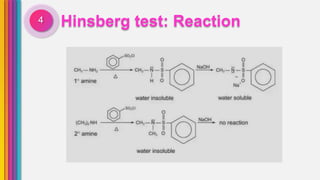
Hinsberg test: Reaction4
Qualitative test: Amine5
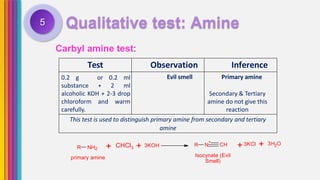
Carbyl amine test:
Test Observation Inference
0.2 g or 0.2 ml
substance + 2 ml
alcoholic KOH + 2-3 drop
chloroform and warm
carefully.
Evil smell Primary amine
Secondary & Tertiary
amine do not give this
reaction
This test is used to distinguish primary amine from secondary and tertiary
amine
++
++ 3H O
+ 3KClCHCHCl3
R N3KOH 2
R NH2
Isocynate (Evil
Smell)
primary amine
Qualitative test: Amine
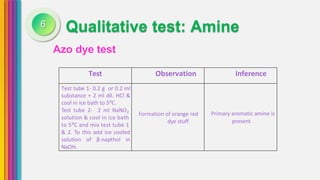
Azo dye test
6
present
Test Observation Inference
Test tube 1- 0.2 g or 0.2 ml
substance + 2 ml dil. HCl &
cool in ice bath to 5⁰C.
Test tube 2- 2 ml NaNO2
solution & cool in ice bath
to 5⁰C and mix test tube 1
& 2. To this add ice cooled
solution of β-napthol in
NaOH.
Formation of orange red
dye stuff
Primary aromatic amine is
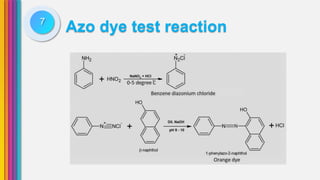
Azo dye test reaction7
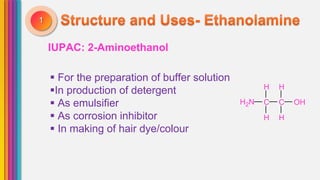
IUPAC: 2-Aminoethanol
1
 For the preparation of buffer solution
In production of detergent
 As emulsifier
 As corrosion inhibitor
 In making of hair dye/colour
H H
H2N C C OH
H H
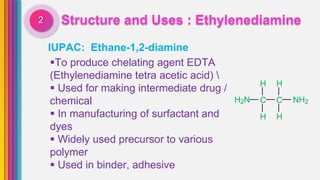
Structure and Uses : Ethylenediamine2
IUPAC: Ethane-1,2-diamine
To produce chelating agent EDTA
(Ethylenediamine tetra acetic acid) 
 Used for making intermediate drug /
chemical
 In manufacturing of surfactant and
dyes
 Widely used precursor to various
polymer
 Used in binder, adhesive
H H
H2N C C NH2
H H
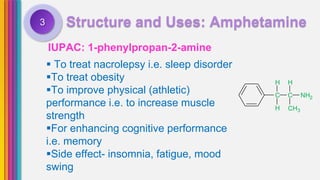
Structure and Uses: Amphetamine3
IUPAC: 1-phenylpropan-2-amine
 To treat nacrolepsy i.e. sleep disorder
To treat obesity
To improve physical (athletic)
performance i.e. to increase muscle
strength
For enhancing cognitive performance
i.e. memory
Side effect- insomnia, fatigue, mood
swing
H H
C C NH2
H CH3
follow
Chemistry blog
www.atulbendale
.wordpress.com
Chemistry
classes
atulbendale.class
room.google.co
m
Chemistry ICT
atulchemistry.gn
omio.com
© Dr. Atul R. Bendale

Amines fy b. pharmacy pci

  • 1.
    A M IN E
  • 2.
    At the endof session students should able to- 1 2. Explain basic nature of amines 3. Compare basicity of substituted amines 4. Explain functional group test for amine 5. Draw structure and list out various uses of amines
  • 3.
    Definition2 Amines are thederivative of ammonia (NH3) in which one or more hydrogen atom are replaced by alkyl groups. •General formula R-NH2 or Ar-NH2 •(Where R= Alkyl group and Ar= Aromatic ring) NH2 NH diphenylamineAniline H CH3 H3C NH3C N H3C N CH3 trimethyl amine H Methyl amine H dimethyl amine CH3
  • 4.
    Classification3 Amines are classifiedas primary (1⁰), secondary (2⁰) and tertiary (3⁰) according to the number of alkyl group attached to the nitrogen CH3H CH3 H3C NH3C N H3C N CH3 tertiary H primary H secondary
  • 5.
    Basicity of amines Aminesare basic in nature. • The presence of lone pair of electron on nitrogen atom makes it basic. This lone pair of electron is radially available for the formation new N-H bond. • The substance which donate electron in reaction is a base according to Lewis concept. 1 HH + + - + R N H ClR N HCl H Salt H Amine Base acid
  • 6.
    Relative basicity ofalkyl amines2 • Here as the substitution of alkyl group increases basicity increases • More alkyl group more rapid the electron donation process. • More stable new N-H bond and positive charge on nitrogen.
  • 7.
    Electron donating groupe.g. alkyl group increases the basicity Electron withdrawing group e.g. Phenyl ring decreases the basicity 3
  • 8.
    Aniline4 Aniline is stabilizedby Resonance that is delocalization of electron as shown below: NH2
  • 9.
    Basicity of anilinewith substituents5 • This is because, in 2,4,6- trinitro aniline internal hydrogen bonding permits delocalization of lone pair of electron on N hence less available for new N-H bond (Less basic) • In 2,4,6- trinitro-N,N-dimethyl aniline due to strong steric inhibition of resonance, lone pair of electron on N is radially available for new N- H bond (More basic) H HH3C CH3 O N ON -++ ONN- O NO2O2N + NNO2 - OO 2,4,6-trinitro aniline 2,4,6-trinitro N,N-dimethyl aniline 2,4,6- trinitro-N,N-dimethyl aniline is more basic than 2,4,6- trinitro aniline
  • 10.
    Qualitative test: Amine NitrousAcid test: 1 Test Observation Inference 0.2 g or 0.2 ml substance + 2 ml conc. HCl + 2 ml water and boil. Cool in ice bath to 5⁰C. Add 2 ml NaNO2 solution and mix. 1 Evolution of N2 gas as bubble 2. Yellow oily layer 3. No visible sign of reaction i.e. observation 1 & 2 absent 1. Primary amine 2. Secondary amine 3. Tertiary amine ++ Mixture of productHNO2 N2R NH2 Bubble primary amine
  • 11.
  • 12.
    Hinsberg test 3 2. Secondary 3.Tertiary amine Test Observation Inference 0.2 g or 0.2 ml substance + 2 ml Pyridine + 2 ml Fresh 2% NaOH. Shake well and add 2 drops of benzene sulphonyl chloride. 1. ppt soluble in NaOH 2. ppt insoluble in NaOH 3. No ppt 1. Primary amine amine
  • 13.
  • 14.
    Qualitative test: Amine5 Carbylamine test: Test Observation Inference 0.2 g or 0.2 ml substance + 2 ml alcoholic KOH + 2-3 drop chloroform and warm carefully. Evil smell Primary amine Secondary & Tertiary amine do not give this reaction This test is used to distinguish primary amine from secondary and tertiary amine ++ ++ 3H O + 3KClCHCHCl3 R N3KOH 2 R NH2 Isocynate (Evil Smell) primary amine
  • 15.
    Qualitative test: Amine Azodye test 6 present Test Observation Inference Test tube 1- 0.2 g or 0.2 ml substance + 2 ml dil. HCl & cool in ice bath to 5⁰C. Test tube 2- 2 ml NaNO2 solution & cool in ice bath to 5⁰C and mix test tube 1 & 2. To this add ice cooled solution of β-napthol in NaOH. Formation of orange red dye stuff Primary aromatic amine is
  • 16.
    Azo dye testreaction7
  • 17.
    IUPAC: 2-Aminoethanol 1  Forthe preparation of buffer solution In production of detergent  As emulsifier  As corrosion inhibitor  In making of hair dye/colour H H H2N C C OH H H
  • 18.
    Structure and Uses: Ethylenediamine2 IUPAC: Ethane-1,2-diamine To produce chelating agent EDTA (Ethylenediamine tetra acetic acid)  Used for making intermediate drug / chemical  In manufacturing of surfactant and dyes  Widely used precursor to various polymer  Used in binder, adhesive H H H2N C C NH2 H H
  • 19.
    Structure and Uses:Amphetamine3 IUPAC: 1-phenylpropan-2-amine  To treat nacrolepsy i.e. sleep disorder To treat obesity To improve physical (athletic) performance i.e. to increase muscle strength For enhancing cognitive performance i.e. memory Side effect- insomnia, fatigue, mood swing H H C C NH2 H CH3
  • 20.