
1
BY
VANA JAGAN MOHAN RAO M.S.Pharm, MED.CHEM
NIPER-KOLKATA
Asst.Professor, MIPER-KURNOOL
Email: jaganvana6@gmail.com
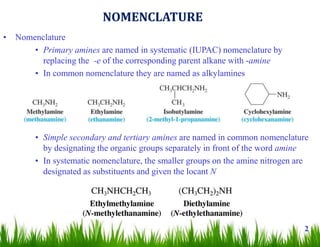
• Nomenclature
• Primary amines are named in systematic (IUPAC) nomenclature by
replacing the -e of the corresponding parent alkane with -amine
• In common nomenclature they are named as alkylamines
• Simple secondary and tertiary amines are named in common nomenclature
by designating the organic groups separately in front of the word amine
• In systematic nomenclature, the smaller groups on the amine nitrogen are
designated as substituents and given the locant N
2
NOMENCLATURE
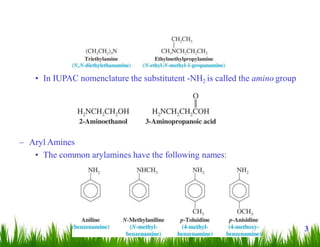
• In IUPAC nomenclature the substitutent -NH2 is called the amino group
– Aryl Amines
• The common arylamines have the following names:
3
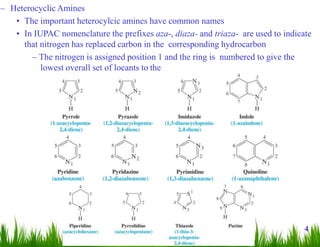
– Heterocyclic Amines
• The important heterocylcic amines have common names
• In IUPAC nomenclature the prefixes aza-, diaza- and triaza- are used to indicate
that nitrogen has replaced carbon in the corresponding hydrocarbon
– The nitrogen is assigned position 1 and the ring is numbered to give the
lowest overall set of locants to the
heteroatoms
4
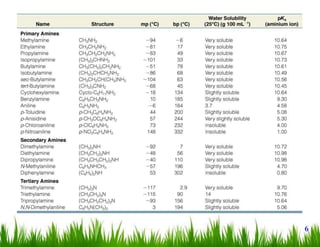
Physical Properties and Structure of Amines
• Primary and secondary amines can form hydrogen bonds to
each other and water
• Tertiary amines cannot form hydrogen bonds to each other but
can form hydrogen bonds to hydrogen bond donors such as
water
• Tertiary amines have lower boiling points than primary or
secondary amines of comparable molecular weights
• Low molecular weight amines tend to be water soluble whether
they are primary, secondary or tertiary
5
PHYSICAL PROPERTIES
6
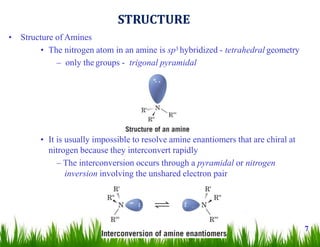
• Structure of Amines
• The nitrogen atom in an amine is sp3 hybridized - tetrahedral geometry
– only thegroups - trigonal pyramidal
• It is usually impossible to resolve amine enantiomers that are chiral at
nitrogen because they interconvert rapidly
– The interconversion occurs through a pyramidal or nitrogen
inversion involving the unshared electron pair
7
STRUCTURE
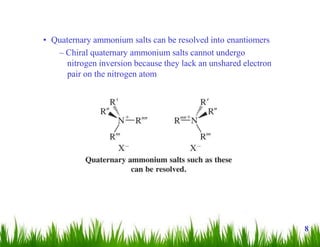
• Quaternary ammonium salts can be resolved into enantiomers
– Chiral quaternary ammonium salts cannot undergo
nitrogen inversion because they lack an unshared electron
pair on the nitrogen atom
8
9
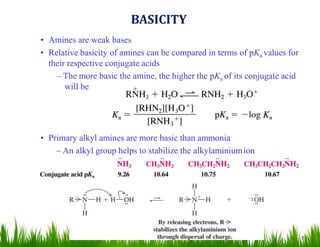
• Amines are weak bases
• Relative basicity of amines can be compared in terms of pKa values for
their respective conjugate acids
– The more basic the amine, the higher the pKa of its conjugate acid
will be
• Primary alkyl amines are more basic than ammonia
– An alkyl group helps to stabilize the alkylaminiumion
BASICITY
10
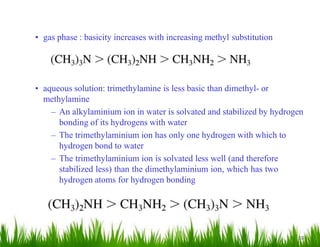
• gas phase : basicity increases with increasing methyl substitution
• aqueous solution: trimethylamine is less basic than dimethyl- or
methylamine
– An alkylaminium ion in water is solvated and stabilized by hydrogen
bonding of its hydrogens with water
– The trimethylaminium ion has only one hydrogen with which to
hydrogen bond to water
– The trimethylaminium ion is solvated less well (and therefore
stabilized less) than the dimethylaminium ion, which has two
hydrogen atoms for hydrogen bonding
11
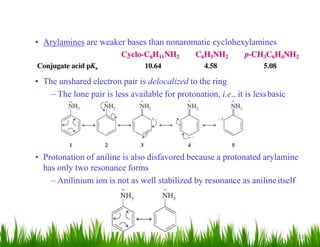
• Arylamines are weaker bases than nonaromatic cyclohexylamines
• The unshared electron pair is delocalized to the ring
– The lone pair is less available for protonation, i.e., it is lessbasic
• Protonation of aniline is also disfavored because a protonated arylamine
has only two resonance forms
– Anilinium ion is not as well stabilized by resonance as anilineitself
12
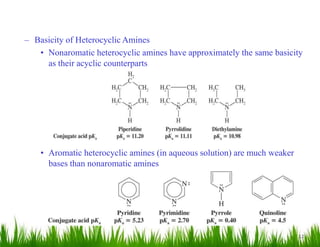
– Basicity of Heterocyclic Amines
• Nonaromatic heterocyclic amines have approximately the same basicity
as their acyclic counterparts
• Aromatic heterocyclic amines (in aqueous solution) are much weaker
bases than nonaromatic amines
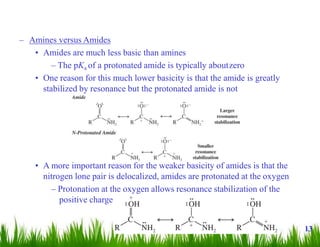
– Amines versus Amides
• Amides are much less basic than amines
– The pKa of a protonated amide is typically aboutzero
• One reason for this much lower basicity is that the amide is greatly
stabilized by resonance but the protonated amide is not
• A more important reason for the weaker basicity of amides is that the
nitrogen lone pair is delocalized, amides are protonated at the oxygen
– Protonation at the oxygen allows resonance stabilization of the
positive charge
13
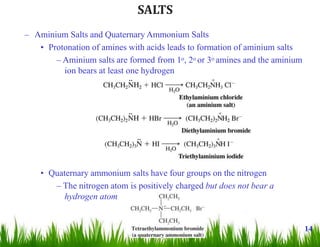
– Aminium Salts and Quaternary Ammonium Salts
• Protonation of amines with acids leads to formation of aminium salts
– Aminium salts are formed from 1o, 2o or 3o amines and the aminium
ion bears at least one hydrogen
• Quaternary ammonium salts have four groups on the nitrogen
– The nitrogen atom is positively charged but does not bear a
hydrogen atom
14
SALTS
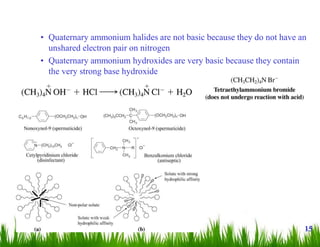
• Quaternary ammonium halides are not basic because they do not have an
unshared electron pair on nitrogen
• Quaternary ammonium hydroxides are very basic because they contain
the very strong base hydroxide
15
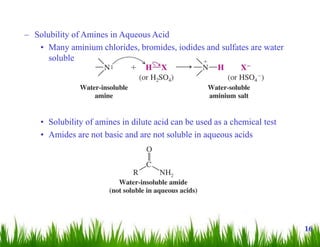
– Solubility of Amines in Aqueous Acid
• Many aminium chlorides, bromides, iodides and sulfates are water
soluble
• Solubility of amines in dilute acid can be used as a chemical test
• Amides are not basic and are not soluble in aqueous acids
16
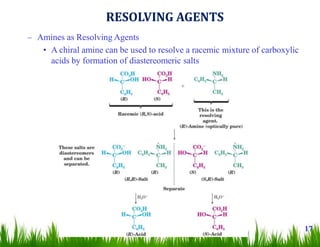
– Amines as Resolving Agents
• A chiral amine can be used to resolve a racemic mixture of carboxylic
acids by formation of diastereomeric salts
17
RESOLVING AGENTS
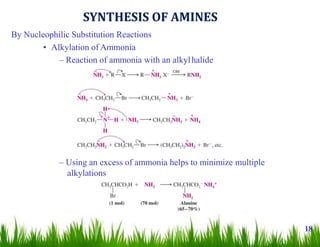
By Nucleophilic Substitution Reactions
• Alkylation of Ammonia
– Reaction of ammonia with an alkylhalide
– Using an excess of ammonia helps to minimize multiple
alkylations
18
SYNTHESIS OF AMINES
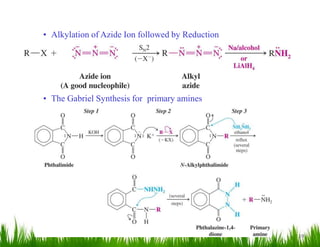
19
• Alkylation of Azide Ion followed by Reduction
• The Gabriel Synthesis for primary amines
20
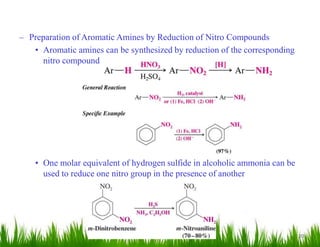
– Preparation of Aromatic Amines by Reduction of Nitro Compounds
• Aromatic amines can be synthesized by reduction of the corresponding
nitro compound
• One molar equivalent of hydrogen sulfide in alcoholic ammonia can be
used to reduce one nitro group in the presence of another
21
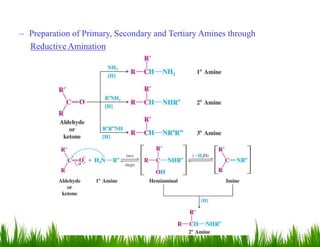
– Preparation of Primary, Secondary and Tertiary Amines through
Reductive Amination
22
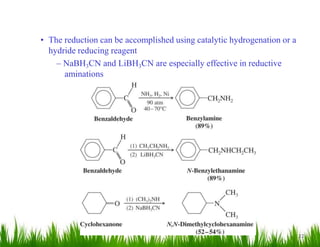
• The reduction can be accomplished using catalytic hydrogenation or a
hydride reducing reagent
– NaBH3CN and LiBH3CN are especially effective in reductive
aminations
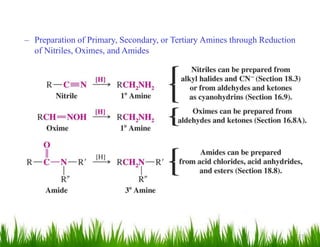
– Preparation of Primary, Secondary, or Tertiary Amines through Reduction
of Nitriles, Oximes, and Amides
23
24
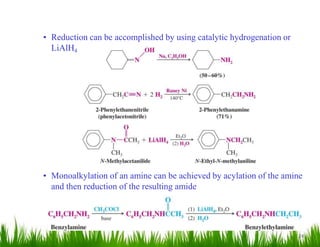
• Reduction can be accomplished by using catalytic hydrogenation or
LiAlH4
• Monoalkylation of an amine can be achieved by acylation of the amine
and then reduction of the resulting amide
25
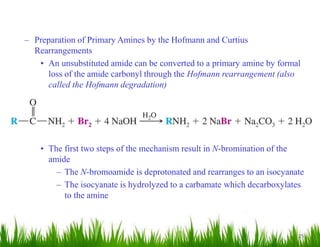
– Preparation of Primary Amines by the Hofmann and Curtius
Rearrangements
• An unsubstituted amide can be converted to a primary amine by formal
loss of the amide carbonyl through the Hofmann rearrangement (also
called the Hofmann degradation)
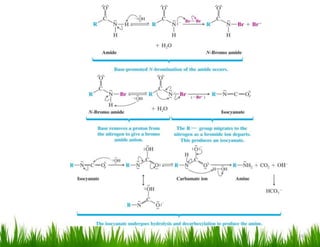
• The first two steps of the mechanism result in N-bromination of the
amide
– The N-bromoamide is deprotonated and rearranges to an isocyanate
– The isocyanate is hydrolyzed to a carbamate which decarboxylates
to the amine
26
27
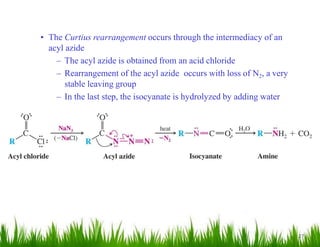
• The Curtius rearrangement occurs through the intermediacy of an
acyl azide
– The acyl azide is obtained from an acid chloride
– Rearrangement of the acyl azide occurs with loss of N2, a very
stable leaving group
– In the last step, the isocyanate is hydrolyzed by adding water
28
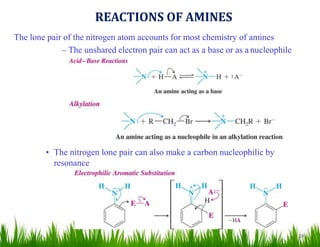
The lone pair of the nitrogen atom accounts for most chemistry of amines
– The unshared electron pair can act as a base or as a nucleophile
• The nitrogen lone pair can also make a carbon nucleophilic by
resonance
REACTIONS OF AMINES
29
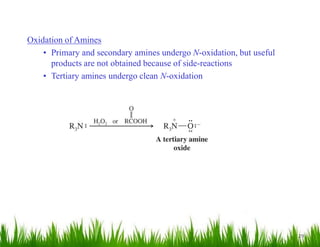
Oxidation of Amines
• Primary and secondary amines undergo N-oxidation, but useful
products are not obtained because of side-reactions
• Tertiary amines undergo clean N-oxidation
30
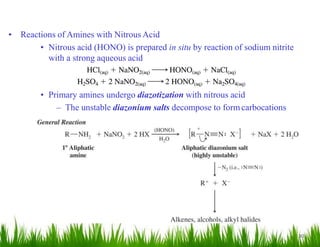
• Reactions of Amines with Nitrous Acid
• Nitrous acid (HONO) is prepared in situ by reaction of sodium nitrite
with a strong aqueous acid
• Primary amines undergo diazotization with nitrous acid
– The unstable diazonium salts decompose to formcarbocations
31
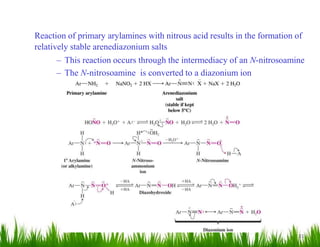
Reaction of primary arylamines with nitrous acid results in the formation of
relatively stable arenediazonium salts
– This reaction occurs through the intermediacy of an N-nitrosoamine
– The N-nitrosoamine is converted to a diazonium ion
32
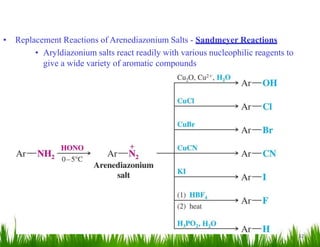
• Replacement Reactions of Arenediazonium Salts - Sandmeyer Reactions
• Aryldiazonium salts react readily with various nucleophilic reagents to
give a wide variety of aromatic compounds
33
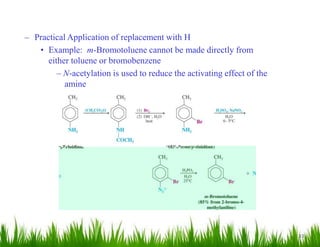
– Practical Application of replacement with H
• Example: m-Bromotoluene cannot be made directly from
either toluene or bromobenzene
– N-acetylation is used to reduce the activating effect of the
amine
34
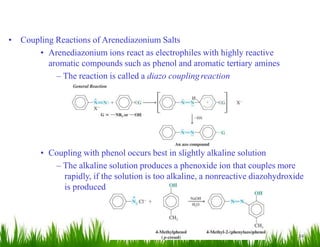
• Coupling Reactions of Arenediazonium Salts
• Arenediazonium ions react as electrophiles with highly reactive
aromatic compounds such as phenol and aromatic tertiary amines
– The reaction is called a diazo couplingreaction
• Coupling with phenol occurs best in slightly alkaline solution
– The alkaline solution produces a phenoxide ion that couples more
rapidly, if the solution is too alkaline, a nonreactive diazohydroxide
is produced
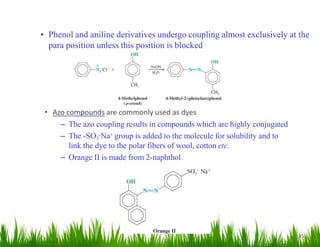
• Azo compounds are commonly used as dyes
– The azo coupling results in compounds which are highly conjugated
– The -SO3
-Na+ group is added to the molecule for solubility and to
link the dye to the polar fibers of wool, cotton etc.
– Orange II is made from 2-naphthol
35
• Phenol and aniline derivatives undergo coupling almost exclusively at the
para position unless this position is blocked
36
Safranin
Crystal violet
1935
37
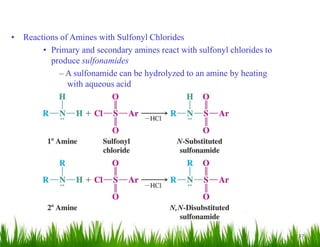
• Reactions of Amines with Sulfonyl Chlorides
• Primary and secondary amines react with sulfonyl chlorides to
produce sulfonamides
– A sulfonamide can be hydrolyzed to an amine by heating
with aqueous acid
38
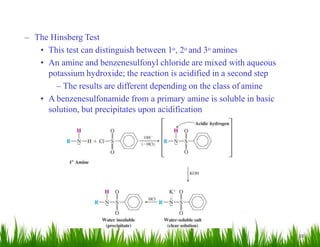
– The Hinsberg Test
• This test can distinguish between 1o, 2o and 3o amines
• An amine and benzenesulfonyl chloride are mixed with aqueous
potassium hydroxide; the reaction is acidified in a second step
– The results are different depending on the class of amine
• A benzenesulfonamide from a primary amine is soluble in basic
solution, but precipitates upon acidification
39
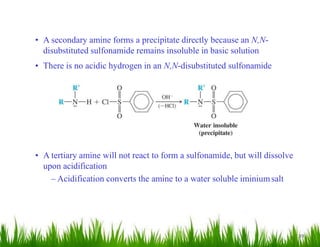
• A secondary amine forms a precipitate directly because an N,N-
disubstituted sulfonamide remains insoluble in basic solution
• There is no acidic hydrogen in an N,N-disubstituted sulfonamide
• A tertiary amine will not react to form a sulfonamide, but will dissolve
upon acidification
– Acidification converts the amine to a water soluble iminiumsalt
40
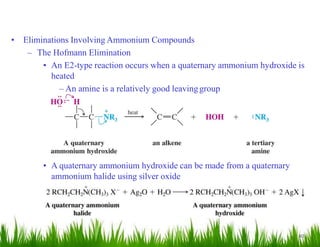
• Eliminations Involving Ammonium Compounds
– The Hofmann Elimination
• An E2-type reaction occurs when a quaternary ammonium hydroxide is
heated
– An amine is a relatively good leavinggroup
• A quaternary ammonium hydroxide can be made from a quaternary
ammonium halide using silver oxide
41
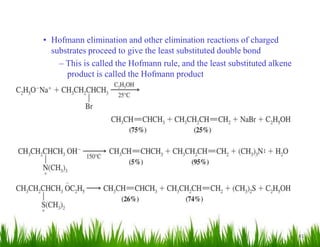
• Hofmann elimination and other elimination reactions of charged
substrates proceed to give the least substituted double bond
– This is called the Hofmann rule, and the least substituted alkene
product is called the Hofmann product
42
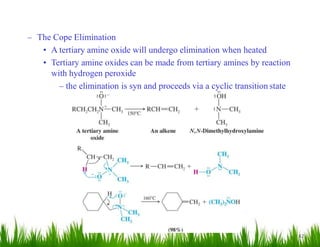
– The Cope Elimination
• A tertiary amine oxide will undergo elimination when heated
• Tertiary amine oxides can be made from tertiary amines by reaction
with hydrogen peroxide
– the elimination is syn and proceeds via a cyclic transition state
Amines 2

Amines 2

  • 1.
    1 BY VANA JAGAN MOHANRAO M.S.Pharm, MED.CHEM NIPER-KOLKATA Asst.Professor, MIPER-KURNOOL Email: jaganvana6@gmail.com
  • 2.
    • Nomenclature • Primaryamines are named in systematic (IUPAC) nomenclature by replacing the -e of the corresponding parent alkane with -amine • In common nomenclature they are named as alkylamines • Simple secondary and tertiary amines are named in common nomenclature by designating the organic groups separately in front of the word amine • In systematic nomenclature, the smaller groups on the amine nitrogen are designated as substituents and given the locant N 2 NOMENCLATURE
  • 3.
    • In IUPACnomenclature the substitutent -NH2 is called the amino group – Aryl Amines • The common arylamines have the following names: 3
  • 4.
    – Heterocyclic Amines •The important heterocylcic amines have common names • In IUPAC nomenclature the prefixes aza-, diaza- and triaza- are used to indicate that nitrogen has replaced carbon in the corresponding hydrocarbon – The nitrogen is assigned position 1 and the ring is numbered to give the lowest overall set of locants to the heteroatoms 4
  • 5.
    Physical Properties andStructure of Amines • Primary and secondary amines can form hydrogen bonds to each other and water • Tertiary amines cannot form hydrogen bonds to each other but can form hydrogen bonds to hydrogen bond donors such as water • Tertiary amines have lower boiling points than primary or secondary amines of comparable molecular weights • Low molecular weight amines tend to be water soluble whether they are primary, secondary or tertiary 5 PHYSICAL PROPERTIES
  • 6.
  • 7.
    • Structure ofAmines • The nitrogen atom in an amine is sp3 hybridized - tetrahedral geometry – only thegroups - trigonal pyramidal • It is usually impossible to resolve amine enantiomers that are chiral at nitrogen because they interconvert rapidly – The interconversion occurs through a pyramidal or nitrogen inversion involving the unshared electron pair 7 STRUCTURE
  • 8.
    • Quaternary ammoniumsalts can be resolved into enantiomers – Chiral quaternary ammonium salts cannot undergo nitrogen inversion because they lack an unshared electron pair on the nitrogen atom 8
  • 9.
    9 • Amines areweak bases • Relative basicity of amines can be compared in terms of pKa values for their respective conjugate acids – The more basic the amine, the higher the pKa of its conjugate acid will be • Primary alkyl amines are more basic than ammonia – An alkyl group helps to stabilize the alkylaminiumion BASICITY
  • 10.
    10 • gas phase: basicity increases with increasing methyl substitution • aqueous solution: trimethylamine is less basic than dimethyl- or methylamine – An alkylaminium ion in water is solvated and stabilized by hydrogen bonding of its hydrogens with water – The trimethylaminium ion has only one hydrogen with which to hydrogen bond to water – The trimethylaminium ion is solvated less well (and therefore stabilized less) than the dimethylaminium ion, which has two hydrogen atoms for hydrogen bonding
  • 11.
    11 • Arylamines areweaker bases than nonaromatic cyclohexylamines • The unshared electron pair is delocalized to the ring – The lone pair is less available for protonation, i.e., it is lessbasic • Protonation of aniline is also disfavored because a protonated arylamine has only two resonance forms – Anilinium ion is not as well stabilized by resonance as anilineitself
  • 12.
    12 – Basicity ofHeterocyclic Amines • Nonaromatic heterocyclic amines have approximately the same basicity as their acyclic counterparts • Aromatic heterocyclic amines (in aqueous solution) are much weaker bases than nonaromatic amines
  • 13.
    – Amines versusAmides • Amides are much less basic than amines – The pKa of a protonated amide is typically aboutzero • One reason for this much lower basicity is that the amide is greatly stabilized by resonance but the protonated amide is not • A more important reason for the weaker basicity of amides is that the nitrogen lone pair is delocalized, amides are protonated at the oxygen – Protonation at the oxygen allows resonance stabilization of the positive charge 13
  • 14.
    – Aminium Saltsand Quaternary Ammonium Salts • Protonation of amines with acids leads to formation of aminium salts – Aminium salts are formed from 1o, 2o or 3o amines and the aminium ion bears at least one hydrogen • Quaternary ammonium salts have four groups on the nitrogen – The nitrogen atom is positively charged but does not bear a hydrogen atom 14 SALTS
  • 15.
    • Quaternary ammoniumhalides are not basic because they do not have an unshared electron pair on nitrogen • Quaternary ammonium hydroxides are very basic because they contain the very strong base hydroxide 15
  • 16.
    – Solubility ofAmines in Aqueous Acid • Many aminium chlorides, bromides, iodides and sulfates are water soluble • Solubility of amines in dilute acid can be used as a chemical test • Amides are not basic and are not soluble in aqueous acids 16
  • 17.
    – Amines asResolving Agents • A chiral amine can be used to resolve a racemic mixture of carboxylic acids by formation of diastereomeric salts 17 RESOLVING AGENTS
  • 18.
    By Nucleophilic SubstitutionReactions • Alkylation of Ammonia – Reaction of ammonia with an alkylhalide – Using an excess of ammonia helps to minimize multiple alkylations 18 SYNTHESIS OF AMINES
  • 19.
    19 • Alkylation ofAzide Ion followed by Reduction • The Gabriel Synthesis for primary amines
  • 20.
    20 – Preparation ofAromatic Amines by Reduction of Nitro Compounds • Aromatic amines can be synthesized by reduction of the corresponding nitro compound • One molar equivalent of hydrogen sulfide in alcoholic ammonia can be used to reduce one nitro group in the presence of another
  • 21.
    21 – Preparation ofPrimary, Secondary and Tertiary Amines through Reductive Amination
  • 22.
    22 • The reductioncan be accomplished using catalytic hydrogenation or a hydride reducing reagent – NaBH3CN and LiBH3CN are especially effective in reductive aminations
  • 23.
    – Preparation ofPrimary, Secondary, or Tertiary Amines through Reduction of Nitriles, Oximes, and Amides 23
  • 24.
    24 • Reduction canbe accomplished by using catalytic hydrogenation or LiAlH4 • Monoalkylation of an amine can be achieved by acylation of the amine and then reduction of the resulting amide
  • 25.
    25 – Preparation ofPrimary Amines by the Hofmann and Curtius Rearrangements • An unsubstituted amide can be converted to a primary amine by formal loss of the amide carbonyl through the Hofmann rearrangement (also called the Hofmann degradation) • The first two steps of the mechanism result in N-bromination of the amide – The N-bromoamide is deprotonated and rearranges to an isocyanate – The isocyanate is hydrolyzed to a carbamate which decarboxylates to the amine
  • 26.
  • 27.
    27 • The Curtiusrearrangement occurs through the intermediacy of an acyl azide – The acyl azide is obtained from an acid chloride – Rearrangement of the acyl azide occurs with loss of N2, a very stable leaving group – In the last step, the isocyanate is hydrolyzed by adding water
  • 28.
    28 The lone pairof the nitrogen atom accounts for most chemistry of amines – The unshared electron pair can act as a base or as a nucleophile • The nitrogen lone pair can also make a carbon nucleophilic by resonance REACTIONS OF AMINES
  • 29.
    29 Oxidation of Amines •Primary and secondary amines undergo N-oxidation, but useful products are not obtained because of side-reactions • Tertiary amines undergo clean N-oxidation
  • 30.
    30 • Reactions ofAmines with Nitrous Acid • Nitrous acid (HONO) is prepared in situ by reaction of sodium nitrite with a strong aqueous acid • Primary amines undergo diazotization with nitrous acid – The unstable diazonium salts decompose to formcarbocations
  • 31.
    31 Reaction of primaryarylamines with nitrous acid results in the formation of relatively stable arenediazonium salts – This reaction occurs through the intermediacy of an N-nitrosoamine – The N-nitrosoamine is converted to a diazonium ion
  • 32.
    32 • Replacement Reactionsof Arenediazonium Salts - Sandmeyer Reactions • Aryldiazonium salts react readily with various nucleophilic reagents to give a wide variety of aromatic compounds
  • 33.
    33 – Practical Applicationof replacement with H • Example: m-Bromotoluene cannot be made directly from either toluene or bromobenzene – N-acetylation is used to reduce the activating effect of the amine
  • 34.
    34 • Coupling Reactionsof Arenediazonium Salts • Arenediazonium ions react as electrophiles with highly reactive aromatic compounds such as phenol and aromatic tertiary amines – The reaction is called a diazo couplingreaction • Coupling with phenol occurs best in slightly alkaline solution – The alkaline solution produces a phenoxide ion that couples more rapidly, if the solution is too alkaline, a nonreactive diazohydroxide is produced
  • 35.
    • Azo compoundsare commonly used as dyes – The azo coupling results in compounds which are highly conjugated – The -SO3 -Na+ group is added to the molecule for solubility and to link the dye to the polar fibers of wool, cotton etc. – Orange II is made from 2-naphthol 35 • Phenol and aniline derivatives undergo coupling almost exclusively at the para position unless this position is blocked
  • 36.
  • 37.
    37 • Reactions ofAmines with Sulfonyl Chlorides • Primary and secondary amines react with sulfonyl chlorides to produce sulfonamides – A sulfonamide can be hydrolyzed to an amine by heating with aqueous acid
  • 38.
    38 – The HinsbergTest • This test can distinguish between 1o, 2o and 3o amines • An amine and benzenesulfonyl chloride are mixed with aqueous potassium hydroxide; the reaction is acidified in a second step – The results are different depending on the class of amine • A benzenesulfonamide from a primary amine is soluble in basic solution, but precipitates upon acidification
  • 39.
    39 • A secondaryamine forms a precipitate directly because an N,N- disubstituted sulfonamide remains insoluble in basic solution • There is no acidic hydrogen in an N,N-disubstituted sulfonamide • A tertiary amine will not react to form a sulfonamide, but will dissolve upon acidification – Acidification converts the amine to a water soluble iminiumsalt
  • 40.
    40 • Eliminations InvolvingAmmonium Compounds – The Hofmann Elimination • An E2-type reaction occurs when a quaternary ammonium hydroxide is heated – An amine is a relatively good leavinggroup • A quaternary ammonium hydroxide can be made from a quaternary ammonium halide using silver oxide
  • 41.
    41 • Hofmann eliminationand other elimination reactions of charged substrates proceed to give the least substituted double bond – This is called the Hofmann rule, and the least substituted alkene product is called the Hofmann product
  • 42.
    42 – The CopeElimination • A tertiary amine oxide will undergo elimination when heated • Tertiary amine oxides can be made from tertiary amines by reaction with hydrogen peroxide – the elimination is syn and proceeds via a cyclic transition state