Hmmm...
How about those classifying activities we
did?
– Was it easy to make up the classification
scheme?
– Was it easy to follow other people's
instructions?
– Should it be easy for anyone to follow?
– What types of questions make it easier to
classify?
Biodiversity
• Scientists have identified 1.75 million different
species of organisms so far
• The number, variety, and genetic variation
of different organisms found within a
specified geographic region
QUESTIONS TO CONSIDER:
Why so many organisms?
Why should we care?
What purpose do they really
serve?
Does our existence really
depend on them?
How did we get so
much Diversity??
EVOLUTION
Taxonomy
What is taxonomy?
Taxonomy is the branch of
biology concerned with the
grouping and naming of
organisms
Biologists who study this are
called taxonomists
How did it start?
People wanted to organize
their world so they began
grouping, or classifying
everything they saw.
Things that swim
Things that fly
Things that crawl
Things that walk on four legs
Things that chew their food
Things that swallow food
whole
Things that are toxic
Why classify?
To help us study the earth
To help us organize all the
species we discover . . .
To give every species a name
based on a standard method
so scientists from different
countries can talk about the
same animal without
confusion
An animal is known by
two names…

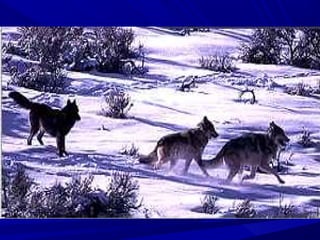
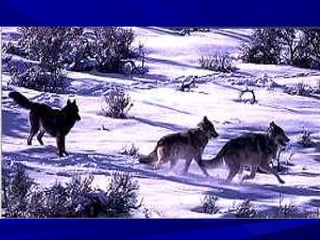
Canis lupus is the scientific
name for a gray wolf.
Canis is the genus name
lupus is the species name
This system uses a binomial
nomenclature
Binomial Nomenclature
Bi means two
Nomen means name
A binomial nomenclature is a
classification system using
two names to identify an
organism
Genus…
A genus consists of a group
of closely related species
Other animals in the Canis
group include dogs and
coyotes
The genus name is always
Capitalized
Species...
A species consists of animals
that can mate and produce
fertile offspring
Only grey wolves are known
as lupus.
The species name is always
lowercase
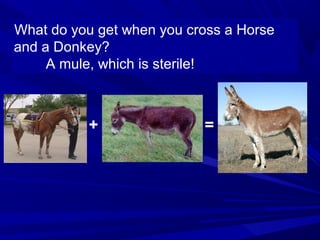
What do you get when you cross a Horse
and a Donkey?
A mule, which is sterile!

+

=
Who is Carolus Linnaeus?
Carolus Linnaeus was a
Swedish botanist
Developed a 7-level (taxa)
classification system based
on similarities between
organisms
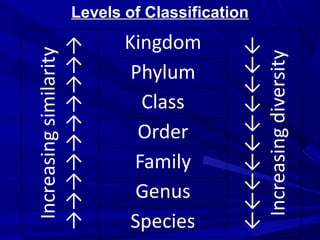
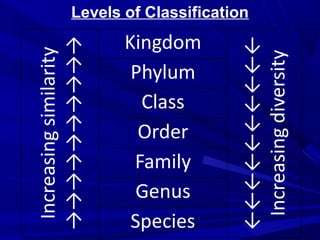
Levels of Classification
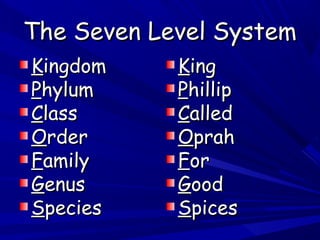
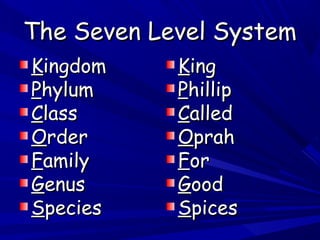
The Seven Level System
Kingdom
Phylum
Class
Order
Family
Genus
Species

King
Phillip
Called
Oprah
For
Good
Spices
How does it work?
There are 6 broad kingdoms
Every living thing that we
know of fits into one of the
six kingdoms
Each level gets more specific
as fewer organisms fit into
any one group
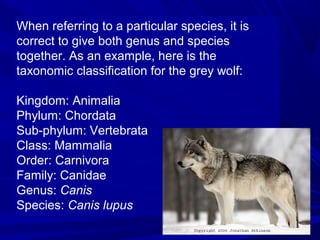
When referring to a particular species, it is
correct to give both genus and species
together. As an example, here is the
taxonomic classification for the grey wolf:
Kingdom: Animalia
Phylum: Chordata
Sub-phylum: Vertebrata
Class: Mammalia
Order: Carnivora
Family: Canidae
Genus: Canis
Species: Canis lupus
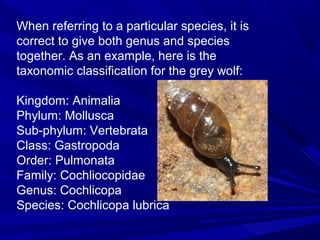
When referring to a particular species, it is
correct to give both genus and species
together. As an example, here is the
taxonomic classification for the grey wolf:
Kingdom: Animalia
Phylum: Mollusca
Sub-phylum: Vertebrata
Class: Gastropoda
Order: Pulmonata
Family: Cochliocopidae
Genus: Cochlicopa
Species: Cochlicopa lubrica
Quick Review
What are the seven taxa or
levels?
Who designed the system?
What taxa are organisms
named with?
Day 1
Read pages 10-12
Do p. 13 #1-6
Do Activity 1.1 on p. 13 – Snake or
Lizard?
Day 2
Dichotomous Keys
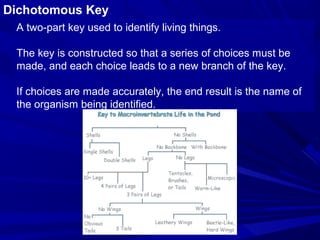
Dichotomous Key
A two-part key used to identify living things.
The key is constructed so that a series of choices must be
made, and each choice leads to a new branch of the key.
If choices are made accurately, the end result is the name of
the organism being identified.
You're Turn
Smiley Face Dichotomous Key
Day 2 Work
Dichotomous Keys
– Smiley Face
– Shark Key

Read p. 13-15
Do p. 15 #1-11
Levels of Classification
The Seven Level System
Kingdom
Phylum
Class
Order
Family
Genus
Species

King
Phillip
Called
Oprah
For
Good
Spices
Kingdom/Phylum Mind Maps
Introduce Assignment
Read p. 24-29
Do p. 30 #1-10

1 taxonomy intro[1][1]

  • 1.
    Hmmm... How about thoseclassifying activities we did? – Was it easy to make up the classification scheme? – Was it easy to follow other people's instructions? – Should it be easy for anyone to follow? – What types of questions make it easier to classify?
  • 2.
    Biodiversity • Scientists haveidentified 1.75 million different species of organisms so far • The number, variety, and genetic variation of different organisms found within a specified geographic region
  • 3.
    QUESTIONS TO CONSIDER: Whyso many organisms? Why should we care? What purpose do they really serve? Does our existence really depend on them?
  • 4.
    How did weget so much Diversity?? EVOLUTION
  • 5.
  • 6.
    What is taxonomy? Taxonomyis the branch of biology concerned with the grouping and naming of organisms Biologists who study this are called taxonomists
  • 7.
    How did itstart? People wanted to organize their world so they began grouping, or classifying everything they saw.
  • 8.
    Things that swim Thingsthat fly Things that crawl Things that walk on four legs Things that chew their food Things that swallow food whole Things that are toxic
  • 9.
    Why classify? To helpus study the earth To help us organize all the species we discover . . .
  • 10.
    To give everyspecies a name based on a standard method so scientists from different countries can talk about the same animal without confusion
  • 12.
    An animal isknown by two names… Canis lupus is the scientific name for a gray wolf. Canis is the genus name lupus is the species name This system uses a binomial nomenclature
  • 13.
    Binomial Nomenclature Bi meanstwo Nomen means name A binomial nomenclature is a classification system using two names to identify an organism
  • 14.
    Genus… A genus consistsof a group of closely related species Other animals in the Canis group include dogs and coyotes The genus name is always Capitalized
  • 15.
    Species... A species consistsof animals that can mate and produce fertile offspring Only grey wolves are known as lupus. The species name is always lowercase
  • 16.
    What do youget when you cross a Horse and a Donkey? A mule, which is sterile! + =
  • 17.
    Who is CarolusLinnaeus? Carolus Linnaeus was a Swedish botanist Developed a 7-level (taxa) classification system based on similarities between organisms
  • 18.
  • 19.
    The Seven LevelSystem Kingdom Phylum Class Order Family Genus Species King Phillip Called Oprah For Good Spices
  • 20.
    How does itwork? There are 6 broad kingdoms Every living thing that we know of fits into one of the six kingdoms Each level gets more specific as fewer organisms fit into any one group
  • 22.
    When referring toa particular species, it is correct to give both genus and species together. As an example, here is the taxonomic classification for the grey wolf: Kingdom: Animalia Phylum: Chordata Sub-phylum: Vertebrata Class: Mammalia Order: Carnivora Family: Canidae Genus: Canis Species: Canis lupus
  • 23.
    When referring toa particular species, it is correct to give both genus and species together. As an example, here is the taxonomic classification for the grey wolf: Kingdom: Animalia Phylum: Mollusca Sub-phylum: Vertebrata Class: Gastropoda Order: Pulmonata Family: Cochliocopidae Genus: Cochlicopa Species: Cochlicopa lubrica
  • 24.
    Quick Review What arethe seven taxa or levels? Who designed the system? What taxa are organisms named with?
  • 25.
    Day 1 Read pages10-12 Do p. 13 #1-6 Do Activity 1.1 on p. 13 – Snake or Lizard?
  • 26.
  • 27.
    Dichotomous Key A two-partkey used to identify living things. The key is constructed so that a series of choices must be made, and each choice leads to a new branch of the key. If choices are made accurately, the end result is the name of the organism being identified.
  • 28.
    You're Turn Smiley FaceDichotomous Key
  • 29.
    Day 2 Work DichotomousKeys – Smiley Face – Shark Key Read p. 13-15 Do p. 15 #1-11
  • 30.
  • 31.
    The Seven LevelSystem Kingdom Phylum Class Order Family Genus Species King Phillip Called Oprah For Good Spices
  • 32.
    Kingdom/Phylum Mind Maps IntroduceAssignment Read p. 24-29 Do p. 30 #1-10