
This document discusses three heterocyclic organic reactions: the Debus-Radziszewski imidazole synthesis, the Knorr pyrazole synthesis, and the Combes quinoline synthesis. The Debus-Radziszewski reaction synthesizes imidazoles from a dicarbonyl, aldehyde, and ammonia. The Knorr reaction synthesizes pyrazoles from hydrazines and 1,3-dicarbonyl compounds using an acid catalyst. The Combes reaction synthesizes quinolines by condensing unsubstituted anilines with β-diketones followed by an acid-catalyzed ring closure.
Debus - RadziszewskiImidazole Synthesis :
The Debus - Radiszewski Imidazole Synthesis is an organic reaction used for the
synthesis of Imidazole from a dicarbonyl, an aldehyde and ammonia.
The reaction is named after Heinrich Debus and Bronistaw Leonard Radziszewski
discovery.
The dicarbonyl component is commonly glyoxal, but can also include various 1,2-
diketones and ketoaldehydes.
It consists of condensing a dicarbonyl compound such as glyoxal, -keto
aldehydes or -diketones with an aldehyde in the presence of ammonia.
Benzil, for instance, with benzaldehyde and two moleules of ammonia reacts to
yield 2, 4, 5-triphenylimidazole.
Formamide often proves a convenient substitution for ammonia.
The method is used commercially to produced several imidazoles.
The process is an example of a multicomponent reaction.
4.
Mechanism of Synthesis:
The reaction can be occurring in two stages –
In the first stage, the dicarbonyl and ammonia condense and give an diimine.
In second stage, this diimine condenses with the aldehyde.
5.
Knorr Pyrazole Synthesis:
The Knorr pyrazole synthesis is an organic reaction used to convert a hydrazine
or its derivatives and a 1,3-dicarbonyl compound to a pyrazole using an acid
catalyst.
The mechanism begins with an acid catalyzed imine formation, where in the
case of hydrazine derivatives the attack can happen on either carbonyl carbon
and result in two possible products.
The other nitrogen of the hydrazine derivative then attacks the other carbonyl
group which has also been protonated by the acid and forms a second imine
group.
This diimine compound gets deprotonated to regenerate the acid catalyst and
provide the final pyrazole product.
6.
Mechanism :
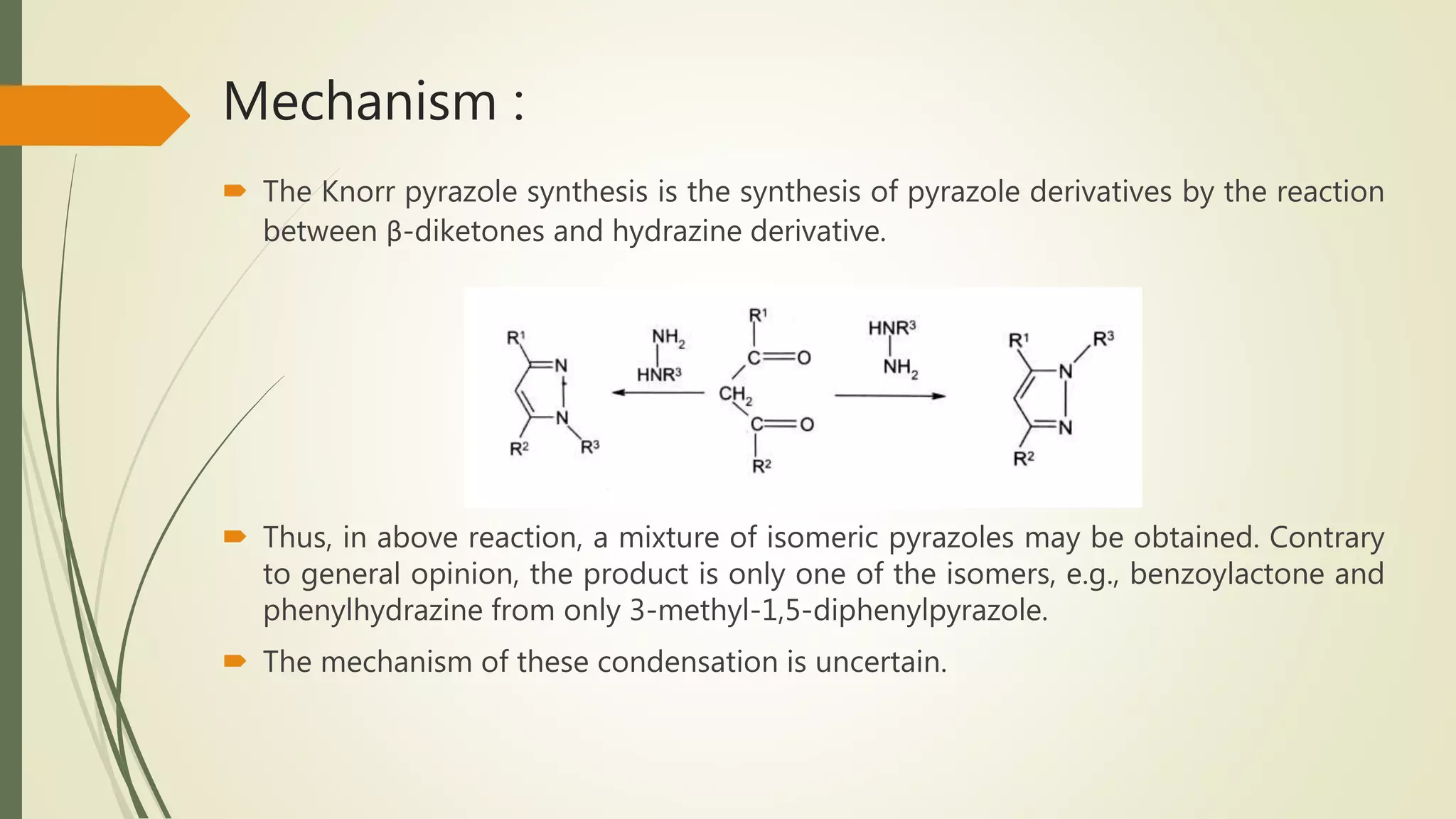
TheKnorr pyrazole synthesis is the synthesis of pyrazole derivatives by the reaction
between β-diketones and hydrazine derivative.
Thus, in above reaction, a mixture of isomeric pyrazoles may be obtained. Contrary
to general opinion, the product is only one of the isomers, e.g., benzoylactone and
phenylhydrazine from only 3-methyl-1,5-diphenylpyrazole.
The mechanism of these condensation is uncertain.
7.
A possiblepathway is as follows :
Since the phenyl group ca conjugate with an adjacent carbonyl group more than methyl
group, nucleophilic attack at the PhCO carbonyl group is decredsed.
In some cases, two isomers have been isolated.
For example 3- -benzoylacetyl-1,5-diphenylpyrazole (1) reacts with phenylhydrazine to
produced a mixture of 11’,5,5’-tetraphenyl-3,5-bipyrazole (2) and 1,1’,3’,5-tetrapphenyl-3,5’-
bipyrazole (3).
In this case conjugation can occure at either end.
8.
Instead ofβ-diketones, β-ketoaldehydes in the form of their vinyl ethers (enol
ethers) can also be used.
In this also, a mixture of isomers may be obtained.
If β-keto-esters are used then pyrazolones are formed.
For example, hydrazine and ethylactoacetate from 3-methylpyrazole-5-one.
Similarly, ethylacetoactate on reaction with phenyl hydrazine gives 3-methyl-1-
phenylpyrazole-5-one.
This on methylation, yields 2,3-dimethyl-1-phenylpyrazole-5-one (antipyrine).
10.
Combos Quinoline Synthesis:
The Combes quinoline synthesis is a chemical reaction, which was first reported
by Combes in 1888.
It involves the condensation of unsubstituted anilines(1) with β-diketones (2) to
form substituted quinolones (4) after an acid-catalyzed ring closure of an
intermediate Schiff base (3).
The Combes quinoline synthesis is often used to prepare the 2,4-
substituted quinoline backbone and is unique in that it uses a β-
diketone substrate, which is different from other quinoline preparations, such as
the Conrad-Limpach synthesis and the Doebner reaction.
The reactionmechanism undergoes three major steps –
The first one being the protonation of the oxygen on the carbonyl in the β-diketone,
which then undergoes a nucleophilic addition reaction with the aniline.
An intramolecular proton transfer is followed by an E2 mechanism, which causes a
molecule of water to leave.
Deprotonation at the nitrogen atom generates a Schiff base, which tautomerizes to
form an enamine that gets protonated via the acid catalyst, which is commonly
concentrated sulfuric acid (H2SO4).
The second major step, which is also the rate-determining step, is the annulation of
the molecule.
Immediately following the annulation, there is a proton transfer, which eliminates
the positive formal charge on the nitrogen atom.
In the third step, the alcohol is then protonated, followed by the dehydration of the
molecule, resulting in the end product of a substituted Quinoline.
13.
Importance of QuinolineSynthesis :
There are multiple ways to synthesize quinoline, one of which is the
Combes quinoline synthesis.
The synthesis of quinoline derivatives has been prevalent in biomedical studies due
to the efficiency of the synthetic methods as well as the relative low-cost production
of these compounds, which can also be produced in large scales.
Quinoline is an important heterocyclic derivative that serves as a building block for
many pharmacological synthetic compounds.
Quinoline and its derivatives are commonly used in antimalarial drugs, fungicides,
antibiotics, dyes, and flavoring agents.
14.
Quinoline andits derivatives also have important roles in other biological
compounds that are involved in cardiovascular, anticancer, and anti-inflammatory
activities.
Additionally, researchers, such as Luo Zai-gang et al., recently looked at the synthesis
and use of quinoline derivatives as HIV-1 integraseinhibitors.
They also looked at how the substituent placement on the quinoline derivatives
affected the primary anti-HIV inhibitory activity.