Theories of Aggression
InstinctTheory
Aggression part II
Recap
In our last lesson we defined aggression and
discussed the differences between aggression and
assertion in a sporting context. You should have a
clear understanding of these differences.
Today we will learn and understand the
causes of aggression with sport and the
theories of aggression: focusing on the
Instinct Theory.
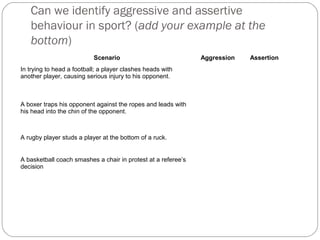
Can we identify aggressive and assertive
behaviour in sport? (add your example at the
bottom)
Scenario Aggression Assertion
In trying to head a football; a player clashes heads with
another player, causing serious injury to his opponent.
A boxer traps his opponent against the ropes and leads with
his head into the chin of the opponent.
A rugby player studs a player at the bottom of a ruck.
A basketball coach smashes a chair in protest at a referee’s
decision
Causes of aggression
Individual performers may act aggressively when:
They are losing (particularly when success has high intrinsic
(pride) or extrinsic value (money) ).
Officiating is seen a unfair e.g. bad decision
Embarrassment e.g. they have made an error which has lead
to opponent scoring a goal
Physical pain e.g. they have been tackled hard previously
Playing below expectations which can lead to
frustration.
General causes of aggression
Over arousal
Proximity of crowd
Home or away match
Increased rewards
Media intervention or comment
Belief that is OK to be aggressive in a sport than in other
life contexts (everyday life)
Competition
Belief that aggressive behaviour will help you win (help
performance outcome)
Why do some performers display more aggression
than others? E.g. Roy Keane & Frank Lampard
Psychologists want to get the root cause of aggressive
behaviour; is aggressive behaviour a result of nature or
nature? Theories of aggression attempt to resolve issues
such as:
Why do some performers find it hard to control
aggression?
Are aggressive individuals born with innate
aggressive characteristics?
 Are they a product of their learning and
environmental influences?
Theories of Aggression
1. Instinct Theory: Psychoanalytical
approach & Ethological approach
2. Social Learning Theory
3. Frustration/Aggression
Hypothesis
4. Aggressive – cue Hypothesis
WHAT DO YOU THINK
THE INSTINCT
THEORY IS?
1. Instinct Theory
Instinct theorists view aggression as something that has
formed in human beings through evolution. It is
seen as inevitable; just as it is in the animal world.
They believe aggression is innate and can be
channelled in to more socially acceptable
behaviour e.g. through sport as a spectator or
performer.
There are two perspectives taken on the instinct
theory:
- Psychoanalytical Approach
- Ethological Approach
1. Instinct Theory
The Psychoanalytical Approach
 Associated with Freud
 Build up of Aggression = destructive
drive
 Aggressive tendencies are innate
 Expressed through self –
destruction or death instinct
 Self destruction balanced by life instincts
1. Instinct Theory
The Psychoanalytical Approach
This theory takes the approach that aggression
builds up win a person; and is then directed
away from ‘the self’ and in to another form of
aggression:
- Acceptable e.g. ........................................
- Unacceptable e.g. crime, brutality or eventually
back to the persons mind leading to suicide.
1. Instinct Theory
The Psychoanalytical Approach
This theory takes the approach that aggression
builds up win a person; and is then directed
away from ‘the self’ and in to another form of
aggression:
- Acceptable e.g. sport, expeditions
- Unacceptable e.g. crime, brutality or eventually
back to the persons mind leading to suicide.
1. Instinct Theory: ego defence
Can you think of a time when you
have felt so frustrated or angry
that you couldn’t stop yourself
from behaving aggressively?
What was the outcome?
1. Instinct Theory
The Psychoanalytical Approach
- ‘Ego defence’: When we want to behave in an
unacceptable way we use ego defence
mechanisms like displacement. E.g. When we are
tackled hard in Rugby we don’t turn and punch our
opponent we go to the side line and kick the bench.
- Redirecting emotional response FROM
dangerous i.e. someone who will punch back
or you get sent off TO a harmless target.
1. Instinct Theory
The Ethological Approach
 Associated with Konrad Lorenz who compared
human behaviour with natural ritualistic behaviour
in animals. E.g. Human attempts at territorial
control like invasion.
 Aggression builds up in human to create a drive
that will lead to some form of destructive or
aggressive behaviour.
 To avoid this the aggression must be
released in a constructive way to achieve
catharsis.
1. Instinct Theory
The Ethological Approach
Lorenz is saying that for you to feel better,
to reduce the drive to behave
aggressively you must release it in a
constructive way e.g. punching
somebody in the face may not reduce
aggressive behaviour in the short or long
term!!
Does channelled aggression in sport lead to
Catharsis? i.e. does releasing your
aggression in sport reduce aggressive
tendencies in everyday life?
Watch the video of Luton vs. Mill Wall
Is aggression in sport drive reducing or
drive enhancing ?
Drive = level of motivation or arousal
towards achieving a specific goal.
Does channelled aggression in sport lead
to Catharsis?
Drive = level of motivation or arousal towards achieving a specific
goal.
Instinct theorists believe that channelling aggression
through socially acceptable behaviour in sport is
drive reducing (releases aggression leading to
catharsis). Research contradicts this and has shown
that as a performer or spectator watching aggressive
behaviour in sport in can be drive enhancing e.g.
Aggression building in the crowd at a football match or a
spectator at a boxing match reproducing the aggression in
everyday life.
Criticisms of Instinct Theory
TASK
What criticisms or weaknesses can you draw from Instinct
Theory of aggression?
 Note down your criticisms of instinct theory
providing an explanation of each.
Consider the following:
- Are all humans innately aggressive?
- Are there other influences that may override an
innate aggression?
- Can you compare humans to animals?
Criticisms of Instinct Theory
 Comparing human behaviour to animal behaviour is to
simple. Humans learn in a social environment in more
cases than animals.
 No innate aggressive drive has ever been indentified;
this theory is based on the view that aggression is
innate in all human beings.
 It is difficult to measure the cathartic effect of
releasing aggression. This theory takes the view that
channelling aggression for example, through sport, is
cathartic.
 Lorenz does not take into account learning and
socialising influences, which are to seen to overide
possible innate aggression.
Criticisms of Instinct Theory
 Early human beings were not warrior but hunter
gatherers; this contradicts Instinct theory as it states
that aggression has been form through evolution and is
inventible.
 Cross cultural studies do not support the view that all
human beings are naturally aggressive.
 Cultural influences are seen as being more important
determinants of human aggression than biological
factors i.e. What is socially acceptable?

Aggression II

  • 1.
  • 2.
    Recap In our lastlesson we defined aggression and discussed the differences between aggression and assertion in a sporting context. You should have a clear understanding of these differences. Today we will learn and understand the causes of aggression with sport and the theories of aggression: focusing on the Instinct Theory.
  • 3.
    Can we identifyaggressive and assertive behaviour in sport? (add your example at the bottom) Scenario Aggression Assertion In trying to head a football; a player clashes heads with another player, causing serious injury to his opponent. A boxer traps his opponent against the ropes and leads with his head into the chin of the opponent. A rugby player studs a player at the bottom of a ruck. A basketball coach smashes a chair in protest at a referee’s decision
  • 4.
    Causes of aggression Individualperformers may act aggressively when: They are losing (particularly when success has high intrinsic (pride) or extrinsic value (money) ). Officiating is seen a unfair e.g. bad decision Embarrassment e.g. they have made an error which has lead to opponent scoring a goal Physical pain e.g. they have been tackled hard previously Playing below expectations which can lead to frustration.
  • 5.
    General causes ofaggression Over arousal Proximity of crowd Home or away match Increased rewards Media intervention or comment Belief that is OK to be aggressive in a sport than in other life contexts (everyday life) Competition Belief that aggressive behaviour will help you win (help performance outcome)
  • 6.
    Why do someperformers display more aggression than others? E.g. Roy Keane & Frank Lampard Psychologists want to get the root cause of aggressive behaviour; is aggressive behaviour a result of nature or nature? Theories of aggression attempt to resolve issues such as: Why do some performers find it hard to control aggression? Are aggressive individuals born with innate aggressive characteristics?  Are they a product of their learning and environmental influences?
  • 7.
    Theories of Aggression 1.Instinct Theory: Psychoanalytical approach & Ethological approach 2. Social Learning Theory 3. Frustration/Aggression Hypothesis 4. Aggressive – cue Hypothesis
  • 8.
    WHAT DO YOUTHINK THE INSTINCT THEORY IS?
  • 9.
    1. Instinct Theory Instincttheorists view aggression as something that has formed in human beings through evolution. It is seen as inevitable; just as it is in the animal world. They believe aggression is innate and can be channelled in to more socially acceptable behaviour e.g. through sport as a spectator or performer. There are two perspectives taken on the instinct theory: - Psychoanalytical Approach - Ethological Approach
  • 10.
    1. Instinct Theory ThePsychoanalytical Approach  Associated with Freud  Build up of Aggression = destructive drive  Aggressive tendencies are innate  Expressed through self – destruction or death instinct  Self destruction balanced by life instincts
  • 11.
    1. Instinct Theory ThePsychoanalytical Approach This theory takes the approach that aggression builds up win a person; and is then directed away from ‘the self’ and in to another form of aggression: - Acceptable e.g. ........................................ - Unacceptable e.g. crime, brutality or eventually back to the persons mind leading to suicide.
  • 12.
    1. Instinct Theory ThePsychoanalytical Approach This theory takes the approach that aggression builds up win a person; and is then directed away from ‘the self’ and in to another form of aggression: - Acceptable e.g. sport, expeditions - Unacceptable e.g. crime, brutality or eventually back to the persons mind leading to suicide.
  • 13.
    1. Instinct Theory:ego defence Can you think of a time when you have felt so frustrated or angry that you couldn’t stop yourself from behaving aggressively? What was the outcome?
  • 14.
    1. Instinct Theory ThePsychoanalytical Approach - ‘Ego defence’: When we want to behave in an unacceptable way we use ego defence mechanisms like displacement. E.g. When we are tackled hard in Rugby we don’t turn and punch our opponent we go to the side line and kick the bench. - Redirecting emotional response FROM dangerous i.e. someone who will punch back or you get sent off TO a harmless target.
  • 15.
    1. Instinct Theory TheEthological Approach  Associated with Konrad Lorenz who compared human behaviour with natural ritualistic behaviour in animals. E.g. Human attempts at territorial control like invasion.  Aggression builds up in human to create a drive that will lead to some form of destructive or aggressive behaviour.  To avoid this the aggression must be released in a constructive way to achieve catharsis.
  • 16.
    1. Instinct Theory TheEthological Approach Lorenz is saying that for you to feel better, to reduce the drive to behave aggressively you must release it in a constructive way e.g. punching somebody in the face may not reduce aggressive behaviour in the short or long term!!
  • 17.
    Does channelled aggressionin sport lead to Catharsis? i.e. does releasing your aggression in sport reduce aggressive tendencies in everyday life? Watch the video of Luton vs. Mill Wall Is aggression in sport drive reducing or drive enhancing ? Drive = level of motivation or arousal towards achieving a specific goal.
  • 18.
    Does channelled aggressionin sport lead to Catharsis? Drive = level of motivation or arousal towards achieving a specific goal. Instinct theorists believe that channelling aggression through socially acceptable behaviour in sport is drive reducing (releases aggression leading to catharsis). Research contradicts this and has shown that as a performer or spectator watching aggressive behaviour in sport in can be drive enhancing e.g. Aggression building in the crowd at a football match or a spectator at a boxing match reproducing the aggression in everyday life.
  • 19.
    Criticisms of InstinctTheory TASK What criticisms or weaknesses can you draw from Instinct Theory of aggression?  Note down your criticisms of instinct theory providing an explanation of each. Consider the following: - Are all humans innately aggressive? - Are there other influences that may override an innate aggression? - Can you compare humans to animals?
  • 20.
    Criticisms of InstinctTheory  Comparing human behaviour to animal behaviour is to simple. Humans learn in a social environment in more cases than animals.  No innate aggressive drive has ever been indentified; this theory is based on the view that aggression is innate in all human beings.  It is difficult to measure the cathartic effect of releasing aggression. This theory takes the view that channelling aggression for example, through sport, is cathartic.  Lorenz does not take into account learning and socialising influences, which are to seen to overide possible innate aggression.
  • 21.
    Criticisms of InstinctTheory  Early human beings were not warrior but hunter gatherers; this contradicts Instinct theory as it states that aggression has been form through evolution and is inventible.  Cross cultural studies do not support the view that all human beings are naturally aggressive.  Cultural influences are seen as being more important determinants of human aggression than biological factors i.e. What is socially acceptable?