Attitude Revision A2 Sports Psychology
What can we remember!! TASK 1: ON A BLANK PIECE OF PAPER; WRITE DOWN ALL THE THINGS  YOU CAN REMEMBER ABOUT ATTITUDES.  How are they formed? What is an attitude? What are the components of an attitude?  YOU CAN DISCUSS WITH THE PERSON SITTING NEXT TO YOU.  SPIDER DIAGRAM/LIST/TITLES/EXPLANATION... FEEDBACK TO THE GROUP
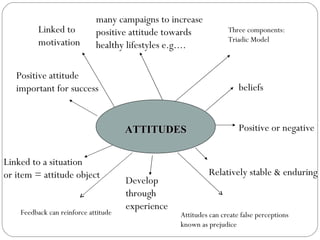
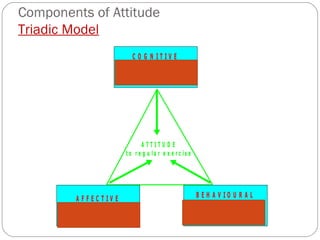
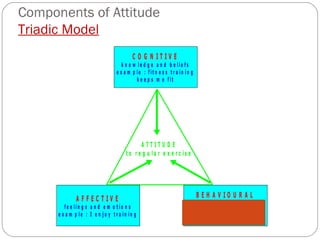
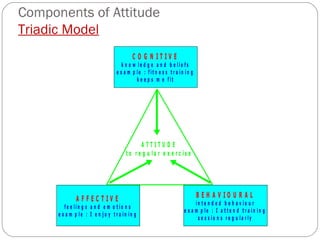
beliefs Linked to  motivation Positive attitude  important for success Linked to a situation  or item = attitude object Develop through experience Relatively stable & enduring Positive or negative ATTITUDES many campaigns to increase  positive attitude towards  healthy lifestyles e.g.... Feedback can reinforce attitude  Attitudes can create false perceptions known as prejudice Three components: Triadic Model
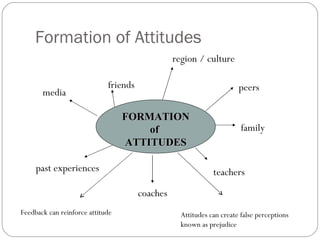
Formation of Attitudes peers friends media past experiences coaches teachers family FORMATION of  ATTITUDES region / culture Feedback can reinforce attitude  Attitudes can create false perceptions known as prejudice
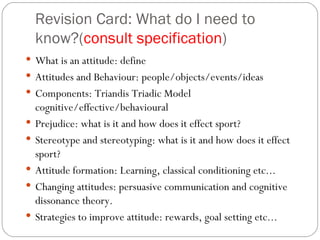
Revision Card: What do I need to know?( consult specification ) What is an attitude: define Attitudes and Behaviour: people/objects/events/ideas Components: Triandis Triadic Model cognitive/effective/behavioural Prejudice: what is it and how does it effect sport? Stereotype and stereotyping: what is it and how does it effect sport? Attitude formation: Learning, classical conditioning etc... Changing attitudes: persuasive communication and cognitive dissonance theory.  Strategies to improve attitude: rewards, goal setting etc...
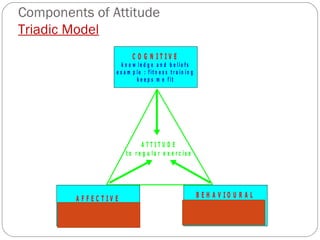
Components of Attitude Triadic Model
TASK 2: Attitude and Behaviour WRITE DOWN  YOUR PLANS FOR YOUR PYSCHOLOGY REVISION ONCE YOU ARE ON STUDY LEAVE.  WRITE DOWN YOUR REASONING.  MAKE YOUR REVISION PLAN WHAT YOU THINK YOU NEED TO DO IN ORDER TO GET THE GRADE YOU NEED.  BE BRIEF: TWO MINUTES.  I.E. HOW MANY HOURS A DAY OR WHICH DAYS OR CERTAIN SUBJECTS ON CERTAIN DAYS...
TASK 3: Attitude and Behaviour IDENTIFY WHICH IS THE COGNITIVE, AFFECTIVE AND BEHAVIOURAL COMPONENTS OF YOUR ATTITUDE TOWARDS YOUR REVISION.  TASK 4: Read through your plans for revision. Now rate the likelihood of you sticking to your plans 100% by circling a statement below.  100% no/Very unlikely/ Unlikely / Likely  / Very likely 100% yes WHAT DO THE RESULTS TELL US THE  LINK  BETWEEN ATTITUDE AND ACTUAL BEHAVIOUR?
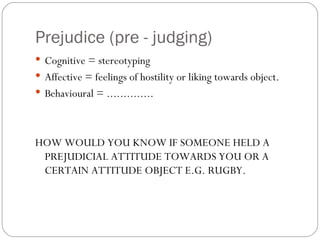
Prejudice (pre - judging) Cognitive = stereotyping Affective = feelings of hostility or liking towards object. Behavioural = .............. HOW WOULD YOU KNOW IF SOMEONE HELD A PREJUDICIAL ATTITUDE TOWARDS YOU OR A CERTAIN ATTITUDE OBJECT E.G. RUGBY.
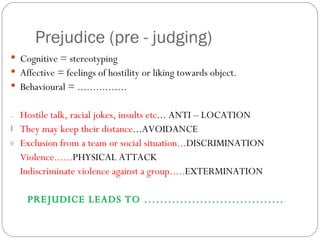
Prejudice (pre - judging) Cognitive = stereotyping Affective = feelings of hostility or liking towards object. Behavioural = ................ Hostile talk, racial jokes, insults etc ... ANTI – LOCATION They may keep their distance ...AVOIDANCE Exclusion from a team or social situation... DISCRIMINATION Violence...... PHYSICAL ATTACK Indiscriminate violence against a group..... EXTERMINATION PREJUDICE LEADS TO ...................................
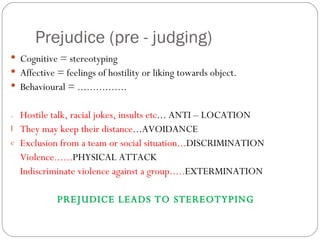
Prejudice (pre - judging) Cognitive = stereotyping Affective = feelings of hostility or liking towards object. Behavioural = ................ Hostile talk, racial jokes, insults etc ... ANTI – LOCATION They may keep their distance ...AVOIDANCE Exclusion from a team or social situation... DISCRIMINATION Violence...... PHYSICAL ATTACK Indiscriminate violence against a group..... EXTERMINATION PREJUDICE LEADS TO STEREOTYPING
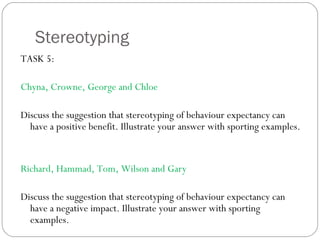
Stereotyping TASK 5:  Chyna, Crowne, George and Chloe Discuss the suggestion that stereotyping of behaviour expectancy can have a positive benefit. Illustrate your answer with sporting examples. Richard, Hammad, Tom, Wilson and Gary Discuss the suggestion that stereotyping of behaviour expectancy can have a negative impact. Illustrate your answer with sporting examples.
Attitude Formation You need to be able to describe and explain how an attitude is formed. Read and revise: Learning Familiarity/availability Classical conditioning Operant conditioning Socialisation Peer groups and social groupings.
Exam question. Use  psychological theory  to describe how a teacher could ensure their student; who has developed a negative attitude towards sport, participates in sport and exercise in order to maintain a balanced, healthy and active lifestyle. THINK ABOUT AND INCLUDE: Persuasive communication Cognitive dissonance theory Strategies to change an attitude Strategies to improve a performers attitude.
Homework Complete exam question below. Does attitude predict behaviour.  Use sporting examples to illustrate your answer.  (15)

Attitude revision

  • 1.
    Attitude Revision A2Sports Psychology
  • 2.
    What can weremember!! TASK 1: ON A BLANK PIECE OF PAPER; WRITE DOWN ALL THE THINGS YOU CAN REMEMBER ABOUT ATTITUDES. How are they formed? What is an attitude? What are the components of an attitude? YOU CAN DISCUSS WITH THE PERSON SITTING NEXT TO YOU. SPIDER DIAGRAM/LIST/TITLES/EXPLANATION... FEEDBACK TO THE GROUP
  • 3.
    beliefs Linked to motivation Positive attitude important for success Linked to a situation or item = attitude object Develop through experience Relatively stable & enduring Positive or negative ATTITUDES many campaigns to increase positive attitude towards healthy lifestyles e.g.... Feedback can reinforce attitude Attitudes can create false perceptions known as prejudice Three components: Triadic Model
  • 4.
    Formation of Attitudespeers friends media past experiences coaches teachers family FORMATION of ATTITUDES region / culture Feedback can reinforce attitude Attitudes can create false perceptions known as prejudice
  • 5.
    Revision Card: Whatdo I need to know?( consult specification ) What is an attitude: define Attitudes and Behaviour: people/objects/events/ideas Components: Triandis Triadic Model cognitive/effective/behavioural Prejudice: what is it and how does it effect sport? Stereotype and stereotyping: what is it and how does it effect sport? Attitude formation: Learning, classical conditioning etc... Changing attitudes: persuasive communication and cognitive dissonance theory. Strategies to improve attitude: rewards, goal setting etc...
  • 6.
  • 7.
  • 8.
  • 9.
  • 10.
    TASK 2: Attitudeand Behaviour WRITE DOWN YOUR PLANS FOR YOUR PYSCHOLOGY REVISION ONCE YOU ARE ON STUDY LEAVE. WRITE DOWN YOUR REASONING. MAKE YOUR REVISION PLAN WHAT YOU THINK YOU NEED TO DO IN ORDER TO GET THE GRADE YOU NEED. BE BRIEF: TWO MINUTES. I.E. HOW MANY HOURS A DAY OR WHICH DAYS OR CERTAIN SUBJECTS ON CERTAIN DAYS...
  • 11.
    TASK 3: Attitudeand Behaviour IDENTIFY WHICH IS THE COGNITIVE, AFFECTIVE AND BEHAVIOURAL COMPONENTS OF YOUR ATTITUDE TOWARDS YOUR REVISION. TASK 4: Read through your plans for revision. Now rate the likelihood of you sticking to your plans 100% by circling a statement below. 100% no/Very unlikely/ Unlikely / Likely / Very likely 100% yes WHAT DO THE RESULTS TELL US THE LINK BETWEEN ATTITUDE AND ACTUAL BEHAVIOUR?
  • 12.
    Prejudice (pre -judging) Cognitive = stereotyping Affective = feelings of hostility or liking towards object. Behavioural = .............. HOW WOULD YOU KNOW IF SOMEONE HELD A PREJUDICIAL ATTITUDE TOWARDS YOU OR A CERTAIN ATTITUDE OBJECT E.G. RUGBY.
  • 13.
    Prejudice (pre -judging) Cognitive = stereotyping Affective = feelings of hostility or liking towards object. Behavioural = ................ Hostile talk, racial jokes, insults etc ... ANTI – LOCATION They may keep their distance ...AVOIDANCE Exclusion from a team or social situation... DISCRIMINATION Violence...... PHYSICAL ATTACK Indiscriminate violence against a group..... EXTERMINATION PREJUDICE LEADS TO ...................................
  • 14.
    Prejudice (pre -judging) Cognitive = stereotyping Affective = feelings of hostility or liking towards object. Behavioural = ................ Hostile talk, racial jokes, insults etc ... ANTI – LOCATION They may keep their distance ...AVOIDANCE Exclusion from a team or social situation... DISCRIMINATION Violence...... PHYSICAL ATTACK Indiscriminate violence against a group..... EXTERMINATION PREJUDICE LEADS TO STEREOTYPING
  • 15.
    Stereotyping TASK 5: Chyna, Crowne, George and Chloe Discuss the suggestion that stereotyping of behaviour expectancy can have a positive benefit. Illustrate your answer with sporting examples. Richard, Hammad, Tom, Wilson and Gary Discuss the suggestion that stereotyping of behaviour expectancy can have a negative impact. Illustrate your answer with sporting examples.
  • 16.
    Attitude Formation Youneed to be able to describe and explain how an attitude is formed. Read and revise: Learning Familiarity/availability Classical conditioning Operant conditioning Socialisation Peer groups and social groupings.
  • 17.
    Exam question. Use psychological theory to describe how a teacher could ensure their student; who has developed a negative attitude towards sport, participates in sport and exercise in order to maintain a balanced, healthy and active lifestyle. THINK ABOUT AND INCLUDE: Persuasive communication Cognitive dissonance theory Strategies to change an attitude Strategies to improve a performers attitude.
  • 18.
    Homework Complete examquestion below. Does attitude predict behaviour. Use sporting examples to illustrate your answer. (15)