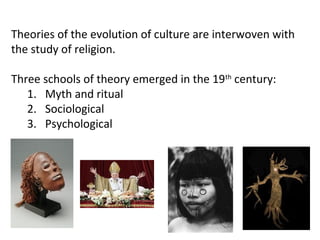


Theories of the evolution of culture are interwoven with
the study of religion.

Three schools of theory emerged in the 19th century:
   1. Myth and ritual
   2. Sociological
   3. Psychological
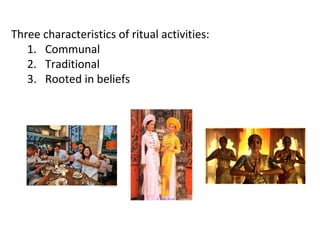
Three characteristics of ritual activities:
   1. Communal
   2. Traditional
   3. Rooted in beliefs
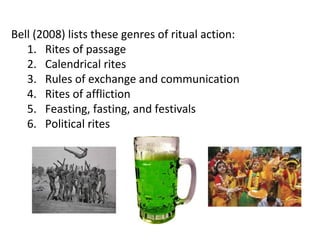
Bell (2008) lists these genres of ritual action:
   1. Rites of passage
   2. Calendrical rites
   3. Rules of exchange and communication
   4. Rites of affliction
   5. Feasting, fasting, and festivals
   6. Political rites
Bell (2008) explains five characteristics of ritual-like
activities:
   1. Formalization
   2. Traditionalism
   3. Invariance
   4. Rule-governance
   5. Sacral symbolism
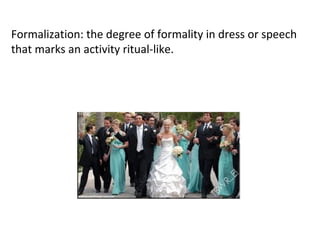
Formalization: the degree of formality in dress or speech
that marks an activity ritual-like.
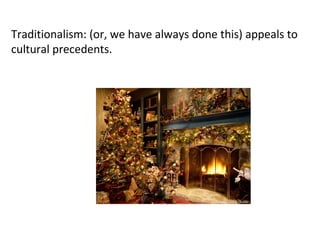
Traditionalism: (or, we have always done this) appeals to
cultural precedents.
Invariance: emphasizes precise repetition and physical
control.
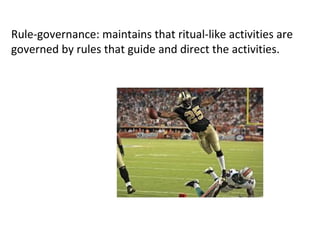
Rule-governance: maintains that ritual-like activities are
governed by rules that guide and direct the activities.
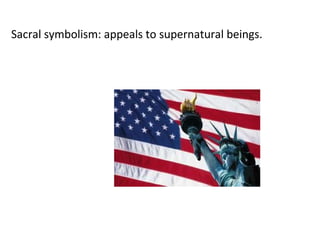
Sacral symbolism: appeals to supernatural beings.
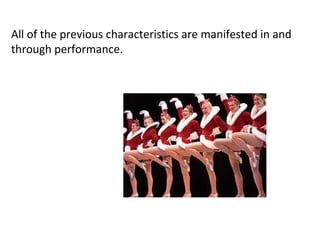
All of the previous characteristics are manifested in and
through performance.
Rituals, and ritual-like actions, abound in our daily lives
as a way to give meaning and significance.
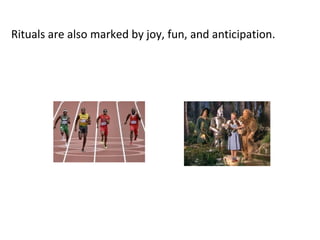
Rituals are also marked by joy, fun, and anticipation.
Now, think about your own rituals and those of
your communities…

Rituals