Angel Sophia S V
Department of Mathematics
INTERVIEW METHOD OF PSYCHOLOGY
INTERVIEW METHOD
.
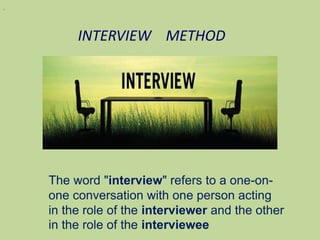
The word "interview" refers to a one-on-
one conversation with one person acting
in the role of the interviewer and the other
in the role of the interviewee
In their words….
P.V. Young:
Interview is a scientific method through which a
person enters into the life of a stranger.
Good & Hatt:
Interview is a process of social interaction between
interviewer and interviewee.
Kerlinger:
A face to face interpersonal situation in which one
ask questions from the other to get answer about a social
problem.
What is an interview method ?
• An interview is a method of conversation
with a specified purpose.
• Psychologists uses interview method in order
to gain information in an efficient and
streamlined manner.
Interview method…..
• Oldest and most widely used method
• The conducting way depends on the
objectives or goals in question.
• Investigate issues in an in depth way
• Discover how individuals think and feel about
a topic and why they hold certain opinions.
Points should be noted while having an
interview ….
• Researchers can ask different types of questions
which in turn generate different types of data.
• Interviews will be recorded by the researcher and
the data written up as a transcript (a written account
of interview questions and answers) which can be
analyzed at a later date.
• The interviewer must ensure to provide special care
when interviewing vulnerable groups, such as the
children.
• The language the interviewer uses should be
appropriate.
• Because an interview is a social interaction the
appearance or behavior of the interviewer may
influence the answers of the respondent.
• The gender, ethnicity, body language, age, and social
status of the interviewer can create an interviewer
effect.
For example :
If a female interviewer interviews a male
interviewee he will try to keep his impression good
and this may leads to interviewer effect.
Merits of interview
 Useful to obtain detailed information about
personal feelings, perceptions and opinions
 Usually achieve a high response rate
 Respondents' own words are recorded
 Interviewees are not influenced by others
 Enable teacher to tackle everyday classroom
problems
 Superior data collecting device
 Creates friendly atmosphere.
Demerits of interview
 This method is very time-consuming for
setting up, interviewing, transcribing, analyzing,
feedback, reporting
 It can be costly
 Different interviewers may understand and
transcribe interviews in different ways.
 Preplanning is important .i.e.)to know who
you are going to interview, when and where.
 It is subjective and artificial
 Interpretation is difficult.
Types of interview
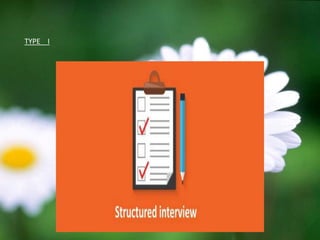
TYPE I
Definition of structured interview
 A structured interview is a type of interview in
which the interviewer asks a particular set
of predetermined questions.
 In structured interviews, questions are planned and
created in advance, which means that all
candidates are asked the same questions in the same
order.
 It uses highly systematized techniques of recording.
 It is a method of quantitative research used for the
purpose of the survey.
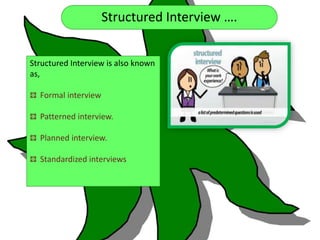
Structured Interview ….
Structured Interview is also known
as,
Formal interview
Patterned interview.
Planned interview.
Standardized interviews
Steps of structured interview
a) Develop and write down interview questions
b) Develop and write down a scale that will be used to
grade candidates answers.
c) Print out your questions and bring them with you
to the interview site.
d) Take detailed notes of each candidate’s answers.
e) Grade your candidate’s answers according to
previously determined scale.
Structured interview questions
Structured interview questions can be open-ended or closed-ended.
Closed-ended questions ask respondents for specific pieces of
information, and often require the respondent to choose from a list of
given alternatives.
E.g. : 'Are you currently taking any drugs ?‘
Here, the respondent can either answer by saying yes or no.
Open-ended questions are those that can be answered in many ways and
allow the respondent to give elaborate, thoughtful answers.
E.g. : ‘Tell about yourself’
Here, the respondent can answer thoughtfully.
Advantages of
structured interview
 Since in structured interviews all the candidates are asked the same
questions, it’s easy to compare their answers
 We can evaluate candidates in a most objective and fair way
 Structured interviews are more legally defensible
 Can reach a large sample
 Can ensure questions are fully understood.
 There is a pre-developed system or guide to check the results.
 These are easy to replicate, as a fixed set of closed questions are used.
 It is easy to test for reliability
 Can take place within a short amount of time.
 Allows generalization of results
Disadvantages of structured interview
 Structure interviews are not flexible. This means new questions
cannot be asked during the interview
 The answers from structured interviews lack detail
 Restrictive questioning leads to restrictive answers
 Structured interviews are harder and more complicated to
develop.
 Before giving questions we have to write them, test them and
make sure interviewers stick to them.
 Interview questions may be leaking out
 The method seem a bit cold and impersonalized
 It is harder to provide an excellent candidate experience
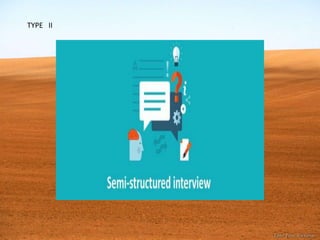
TYPE II
Definition of semi-structured interview
 A semi-structured interview is a type of interview in which the
interviewer asks only a few predetermined questions while the rest
of the questions are not planned in advance.
 In semi-structured interviews, some questions are predetermined and asked
all candidates, while others arise spontaneously in a free-flowing conversation.
 Open –ended questions with answers solicited in writing- typically in
the for of short essays
 Respondents are free to write as much as or as little as they choose
 It has a general set of questions but the interview flows like
conversation and topics are covered as they come up.
Semi-structured
interview….
Semi-structured interviews are also
known as:
# Moderately structured interviews
# Hybrid interviews
# Combined interviews
Steps of Semi-structured interview
a) Write down most important questions that you want to ask all the candidates.
b) Develop a few conversation starters to explore specific interesting points from
your candidate’s resume.
c) Depending on your candidates' answers, ask follow up questions to gain a more
in-depth understanding of their qualifications and motivation.
d) Follow the natural flow of conversation and feel free to explore
Advantages of semi-structured interview
It can secure objective comparison of candidates
It provide a more personalized and spontaneous approach that
allows exploration of interesting points in a specific candidate.
Less prone to interviewer’s bias.
More information can be explored.
Needed data is collected.
Interviewer and the interviewee create the interview together.
Flexibility to follow up interviewee’s responses ad interests.
Provide much more detailed information.
Provide more relaxed atmosphere to collect data.
Disadvantages of semi-structured interview
• Spontaneous questioning makes answers difficult
to evaluate
• The outcome largely depend on the skill of the
interviewer
• The process is highly time consuming
• It is very expensive
• Sees to be un reliable
• Difficult to analyze the relevance of answers
• Some of the information may not be revealed
• Needs preparation
• Semi-structured interviews are less objective
• legally harder to defend.
TYPE III
Definition of unstructured interview
• An unstructured interview is a type of interview in which
the interviewer asks questions which are not prepared in
advance.
• In unstructured interviews, questions arise
spontaneously in a free-flowing conversation, which
means that different candidates are asked different
questions.
• As the interview is unplanned, it has an informal
approach where a friendly conversation takes place
between the interviewer and interviewee.
• They will contain open-ended questions that can be
asked in any order.
Unstructured interview….
Discovery interviews
Guided conservation
Informal interviews
Casual interviews
Free-flowing interviews
Steps of unstructured interview
Keep in mind interview’s purpose and the general experiences and
qualities you are looking to asses in candidates.
The goal is to gather and record important information about
candidates.
Make sure you have a focus
Be flexible to proceed based on the candidate’s responses.
Explore specific interesting points
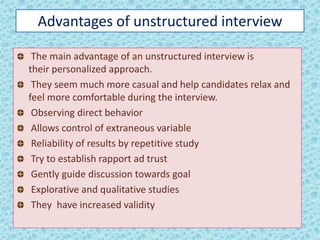
Advantages of unstructured interview
The main advantage of an unstructured interview is
their personalized approach.
They seem much more casual and help candidates relax and
feel more comfortable during the interview.
Observing direct behavior
Allows control of extraneous variable
Reliability of results by repetitive study
Try to establish rapport ad trust
Gently guide discussion towards goal
Explorative and qualitative studies
They have increased validity
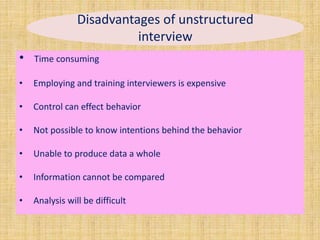
Disadvantages of unstructured
interview
• Time consuming
• Employing and training interviewers is expensive
• Control can effect behavior
• Not possible to know intentions behind the behavior
• Unable to produce data a whole
• Information cannot be compared
• Analysis will be difficult
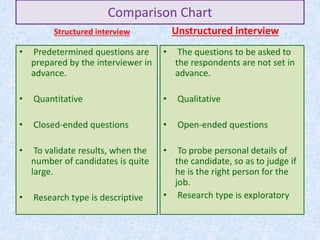
Comparison Chart
Structured interview
• Predetermined questions are
prepared by the interviewer in
advance.
• Quantitative
• Closed-ended questions
• To validate results, when the
number of candidates is quite
large.
• Research type is descriptive
Unstructured interview
• The questions to be asked to
the respondents are not set in
advance.
• Qualitative
• Open-ended questions
• To probe personal details of
the candidate, so as to judge if
he is the right person for the
job.
• Research type is exploratory
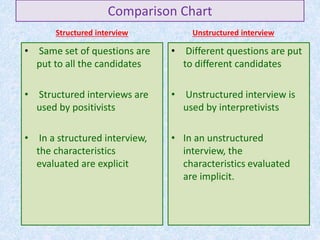
Comparison Chart
Structured interview
• Same set of questions are
put to all the candidates
• Structured interviews are
used by positivists
• In a structured interview,
the characteristics
evaluated are explicit
Unstructured interview
• Different questions are put
to different candidates
• Unstructured interview is
used by interpretivists
• In an unstructured
interview, the
characteristics evaluated
are implicit.
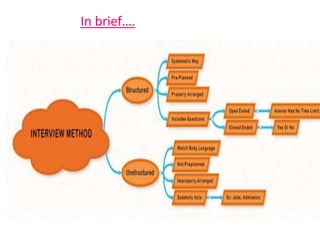
In brief….
Interview Method of Psychology

Interview Method of Psychology

  • 4.
    Angel Sophia SV Department of Mathematics INTERVIEW METHOD OF PSYCHOLOGY
  • 5.
    INTERVIEW METHOD . The word"interview" refers to a one-on- one conversation with one person acting in the role of the interviewer and the other in the role of the interviewee
  • 6.
    In their words…. P.V.Young: Interview is a scientific method through which a person enters into the life of a stranger. Good & Hatt: Interview is a process of social interaction between interviewer and interviewee. Kerlinger: A face to face interpersonal situation in which one ask questions from the other to get answer about a social problem.
  • 7.
    What is aninterview method ? • An interview is a method of conversation with a specified purpose. • Psychologists uses interview method in order to gain information in an efficient and streamlined manner.
  • 8.
    Interview method….. • Oldestand most widely used method • The conducting way depends on the objectives or goals in question. • Investigate issues in an in depth way • Discover how individuals think and feel about a topic and why they hold certain opinions.
  • 9.
    Points should benoted while having an interview …. • Researchers can ask different types of questions which in turn generate different types of data. • Interviews will be recorded by the researcher and the data written up as a transcript (a written account of interview questions and answers) which can be analyzed at a later date. • The interviewer must ensure to provide special care when interviewing vulnerable groups, such as the children. • The language the interviewer uses should be appropriate.
  • 10.
    • Because aninterview is a social interaction the appearance or behavior of the interviewer may influence the answers of the respondent. • The gender, ethnicity, body language, age, and social status of the interviewer can create an interviewer effect. For example : If a female interviewer interviews a male interviewee he will try to keep his impression good and this may leads to interviewer effect.
  • 11.
    Merits of interview Useful to obtain detailed information about personal feelings, perceptions and opinions  Usually achieve a high response rate  Respondents' own words are recorded  Interviewees are not influenced by others  Enable teacher to tackle everyday classroom problems  Superior data collecting device  Creates friendly atmosphere.
  • 12.
    Demerits of interview This method is very time-consuming for setting up, interviewing, transcribing, analyzing, feedback, reporting  It can be costly  Different interviewers may understand and transcribe interviews in different ways.  Preplanning is important .i.e.)to know who you are going to interview, when and where.  It is subjective and artificial  Interpretation is difficult.
  • 13.
  • 14.
  • 15.
    Definition of structuredinterview  A structured interview is a type of interview in which the interviewer asks a particular set of predetermined questions.  In structured interviews, questions are planned and created in advance, which means that all candidates are asked the same questions in the same order.  It uses highly systematized techniques of recording.  It is a method of quantitative research used for the purpose of the survey.
  • 16.
    Structured Interview …. StructuredInterview is also known as, Formal interview Patterned interview. Planned interview. Standardized interviews
  • 17.
    Steps of structuredinterview a) Develop and write down interview questions b) Develop and write down a scale that will be used to grade candidates answers. c) Print out your questions and bring them with you to the interview site. d) Take detailed notes of each candidate’s answers. e) Grade your candidate’s answers according to previously determined scale.
  • 18.
    Structured interview questions Structuredinterview questions can be open-ended or closed-ended. Closed-ended questions ask respondents for specific pieces of information, and often require the respondent to choose from a list of given alternatives. E.g. : 'Are you currently taking any drugs ?‘ Here, the respondent can either answer by saying yes or no. Open-ended questions are those that can be answered in many ways and allow the respondent to give elaborate, thoughtful answers. E.g. : ‘Tell about yourself’ Here, the respondent can answer thoughtfully.
  • 19.
    Advantages of structured interview Since in structured interviews all the candidates are asked the same questions, it’s easy to compare their answers  We can evaluate candidates in a most objective and fair way  Structured interviews are more legally defensible  Can reach a large sample  Can ensure questions are fully understood.  There is a pre-developed system or guide to check the results.  These are easy to replicate, as a fixed set of closed questions are used.  It is easy to test for reliability  Can take place within a short amount of time.  Allows generalization of results
  • 20.
    Disadvantages of structuredinterview  Structure interviews are not flexible. This means new questions cannot be asked during the interview  The answers from structured interviews lack detail  Restrictive questioning leads to restrictive answers  Structured interviews are harder and more complicated to develop.  Before giving questions we have to write them, test them and make sure interviewers stick to them.  Interview questions may be leaking out  The method seem a bit cold and impersonalized  It is harder to provide an excellent candidate experience
  • 21.
  • 22.
    Definition of semi-structuredinterview  A semi-structured interview is a type of interview in which the interviewer asks only a few predetermined questions while the rest of the questions are not planned in advance.  In semi-structured interviews, some questions are predetermined and asked all candidates, while others arise spontaneously in a free-flowing conversation.  Open –ended questions with answers solicited in writing- typically in the for of short essays  Respondents are free to write as much as or as little as they choose  It has a general set of questions but the interview flows like conversation and topics are covered as they come up.
  • 23.
    Semi-structured interview…. Semi-structured interviews arealso known as: # Moderately structured interviews # Hybrid interviews # Combined interviews
  • 24.
    Steps of Semi-structuredinterview a) Write down most important questions that you want to ask all the candidates. b) Develop a few conversation starters to explore specific interesting points from your candidate’s resume. c) Depending on your candidates' answers, ask follow up questions to gain a more in-depth understanding of their qualifications and motivation. d) Follow the natural flow of conversation and feel free to explore
  • 25.
    Advantages of semi-structuredinterview It can secure objective comparison of candidates It provide a more personalized and spontaneous approach that allows exploration of interesting points in a specific candidate. Less prone to interviewer’s bias. More information can be explored. Needed data is collected. Interviewer and the interviewee create the interview together. Flexibility to follow up interviewee’s responses ad interests. Provide much more detailed information. Provide more relaxed atmosphere to collect data.
  • 26.
    Disadvantages of semi-structuredinterview • Spontaneous questioning makes answers difficult to evaluate • The outcome largely depend on the skill of the interviewer • The process is highly time consuming • It is very expensive • Sees to be un reliable • Difficult to analyze the relevance of answers • Some of the information may not be revealed • Needs preparation • Semi-structured interviews are less objective • legally harder to defend.
  • 27.
  • 28.
    Definition of unstructuredinterview • An unstructured interview is a type of interview in which the interviewer asks questions which are not prepared in advance. • In unstructured interviews, questions arise spontaneously in a free-flowing conversation, which means that different candidates are asked different questions. • As the interview is unplanned, it has an informal approach where a friendly conversation takes place between the interviewer and interviewee. • They will contain open-ended questions that can be asked in any order.
  • 29.
    Unstructured interview…. Discovery interviews Guidedconservation Informal interviews Casual interviews Free-flowing interviews
  • 30.
    Steps of unstructuredinterview Keep in mind interview’s purpose and the general experiences and qualities you are looking to asses in candidates. The goal is to gather and record important information about candidates. Make sure you have a focus Be flexible to proceed based on the candidate’s responses. Explore specific interesting points
  • 31.
    Advantages of unstructuredinterview The main advantage of an unstructured interview is their personalized approach. They seem much more casual and help candidates relax and feel more comfortable during the interview. Observing direct behavior Allows control of extraneous variable Reliability of results by repetitive study Try to establish rapport ad trust Gently guide discussion towards goal Explorative and qualitative studies They have increased validity
  • 32.
    Disadvantages of unstructured interview •Time consuming • Employing and training interviewers is expensive • Control can effect behavior • Not possible to know intentions behind the behavior • Unable to produce data a whole • Information cannot be compared • Analysis will be difficult
  • 33.
    Comparison Chart Structured interview •Predetermined questions are prepared by the interviewer in advance. • Quantitative • Closed-ended questions • To validate results, when the number of candidates is quite large. • Research type is descriptive Unstructured interview • The questions to be asked to the respondents are not set in advance. • Qualitative • Open-ended questions • To probe personal details of the candidate, so as to judge if he is the right person for the job. • Research type is exploratory
  • 34.
    Comparison Chart Structured interview •Same set of questions are put to all the candidates • Structured interviews are used by positivists • In a structured interview, the characteristics evaluated are explicit Unstructured interview • Different questions are put to different candidates • Unstructured interview is used by interpretivists • In an unstructured interview, the characteristics evaluated are implicit.
  • 35.