Attribution Theory A2 Sports Psychology
Definition of Attribution... Attributions are the reasons we give for success and failure in physical activity. e.g. I was not fit enough to play a full game.
Why do we provide reasons?... Can you think of recent example where you have attributed success or failure to certain things?
Effects of attribution... What can attributions give by a team or individual to themselves or others affect? . . . .
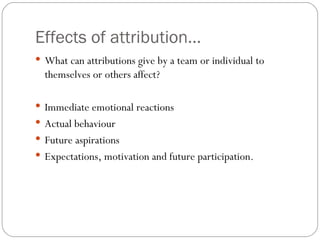
Effects of attribution... What can attributions give by a team or individual to themselves or others affect? Immediate emotional reactions Actual behaviour Future aspirations Expectations, motivation and future participation.
TASK 1 Write a scenario within sport and physical education which illustrates how attribution of success and failure may affect participation.
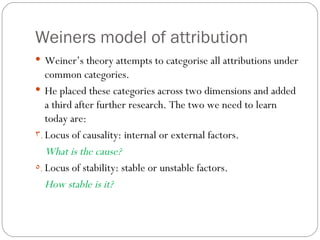
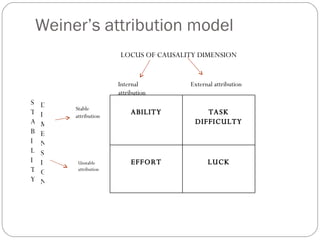
Weiners model of attribution Weiner’s theory attempts to categorise all attributions under common categories.  He placed these categories across two dimensions and added a third after further research. The two we need to learn today are: Locus of causality: internal or external factors.  What is the cause? Locus of stability: stable or unstable factors.  How stable is it?
Causal attributions List the causal attributions you think people may give for their level of success or failure. . . . .
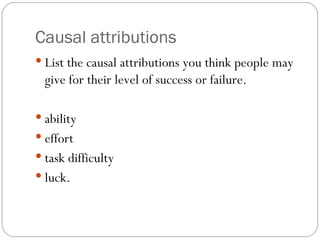
Causal attributions List the causal attributions you think people may give for their level of success or failure. ability effort task difficulty luck.
Weiner’s attribution model LOCUS OF CAUSALITY DIMENSION S T A B I L I T Y D I M E N S I O N Internal attribution External attribution Stable attribution Unstable attribution ABILITY TASK DIFFICULTY EFFORT LUCK
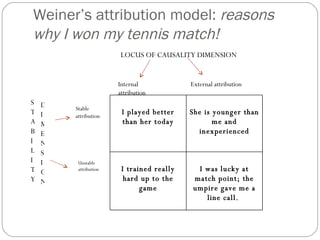
Weiner’s attribution model:  reasons why I won my tennis match! LOCUS OF CAUSALITY DIMENSION S T A B I L I T Y D I M E N S I O N Internal attribution External attribution Stable attribution Unstable attribution I played better than her today She is younger than me and inexperienced I trained really hard up to the game I was lucky at match point; the umpire gave me a line call.
TASK 2: Copy out Weiner’s model and add examples of causal attributions:  reasons why we lost the rugby game!
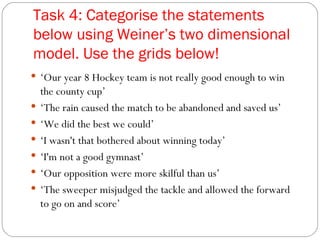
Task 4: Categorise the statements below using Weiner’s two dimensional model. Use the grids below! ‘ Our year 8 Hockey team is not really good enough to win the county cup’ ‘ The rain caused the match to be abandoned and saved us’ ‘ We did the best we could’ ‘ I wasn't that bothered about winning today’ ‘ I'm not a good gymnast’ ‘ Our opposition were more skilful than us’ ‘ The sweeper misjudged the tackle and allowed the forward to go on and score’
TASK 4
TASK 4

Attribution

  • 1.
    Attribution Theory A2Sports Psychology
  • 2.
    Definition of Attribution...Attributions are the reasons we give for success and failure in physical activity. e.g. I was not fit enough to play a full game.
  • 3.
    Why do weprovide reasons?... Can you think of recent example where you have attributed success or failure to certain things?
  • 4.
    Effects of attribution...What can attributions give by a team or individual to themselves or others affect? . . . .
  • 5.
    Effects of attribution...What can attributions give by a team or individual to themselves or others affect? Immediate emotional reactions Actual behaviour Future aspirations Expectations, motivation and future participation.
  • 6.
    TASK 1 Writea scenario within sport and physical education which illustrates how attribution of success and failure may affect participation.
  • 7.
    Weiners model ofattribution Weiner’s theory attempts to categorise all attributions under common categories. He placed these categories across two dimensions and added a third after further research. The two we need to learn today are: Locus of causality: internal or external factors. What is the cause? Locus of stability: stable or unstable factors. How stable is it?
  • 8.
    Causal attributions Listthe causal attributions you think people may give for their level of success or failure. . . . .
  • 9.
    Causal attributions Listthe causal attributions you think people may give for their level of success or failure. ability effort task difficulty luck.
  • 10.
    Weiner’s attribution modelLOCUS OF CAUSALITY DIMENSION S T A B I L I T Y D I M E N S I O N Internal attribution External attribution Stable attribution Unstable attribution ABILITY TASK DIFFICULTY EFFORT LUCK
  • 11.
    Weiner’s attribution model: reasons why I won my tennis match! LOCUS OF CAUSALITY DIMENSION S T A B I L I T Y D I M E N S I O N Internal attribution External attribution Stable attribution Unstable attribution I played better than her today She is younger than me and inexperienced I trained really hard up to the game I was lucky at match point; the umpire gave me a line call.
  • 12.
    TASK 2: Copyout Weiner’s model and add examples of causal attributions: reasons why we lost the rugby game!
  • 13.
    Task 4: Categorisethe statements below using Weiner’s two dimensional model. Use the grids below! ‘ Our year 8 Hockey team is not really good enough to win the county cup’ ‘ The rain caused the match to be abandoned and saved us’ ‘ We did the best we could’ ‘ I wasn't that bothered about winning today’ ‘ I'm not a good gymnast’ ‘ Our opposition were more skilful than us’ ‘ The sweeper misjudged the tackle and allowed the forward to go on and score’
  • 14.
  • 15.