Title Slide: which sport are you observing? ADD SPORT WHICH YOU ARE ANAYSING; IT MUST BE ONE OF THE FOUR SPORTS YOU ARE DEFINATELY USING. YOU CAN ANALYSE A  MEMBER OF YOUR GCSE PE GROUP, A PERFORMER FROM YOUR CLUB OR YOUR OWN PERFORMNACE.
Rules, Regulations and Terminology On this slide discuss rules, regulations and terminology that you have picked up from the video. How did the performance start? Did they break any rules? If they did not, which rule could they have broken and what would happen? Do they have to use a certain technique to stay within the rules? E.g. Swimming. How would the official signal that a rule is broken? How would the game re-start? What terminology would the official use?   Explain general rules of the game e.g. length, number of player, card system, points system, equipment required, facilities required.
Video of the Perfect Model Add a video of the skill you are assessing being performed perfectly. This can be taken from a video of a professional game or another performer that is able.  You can add a hyperlink or a video you have found and downloaded at home. Use an elite/pro athlete for your perfect model. Explain what the video shows e.g. name, level of performance, what speed, distance, rating, ranking do they have and how did they get it?
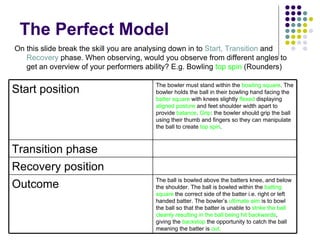
The Perfect Model On this slide break the skill you are analysing down in to  Start, Transition  and  Recovery  phase. When observing, would you observe from different angles to get an overview of your performers ability? E.g. Bowling  top spin  (Rounders) Start position The bowler must stand within the  bowling square . The bowler holds the ball in their bowling hand facing the  batter square  with knees slightly  flexed  displaying  aligned posture  and feet shoulder width apart to provide  balance .  Grip : the bowler should grip the ball using their thumb and fingers so they can manipulate the ball to create  top spin .  Transition phase Recovery position Outcome The ball is bowled above the batters knee, and below the shoulder. The ball is bowled within the  batting square  the correct side of the batter i.e. right or left handed batter. The bowler’s  ultimate aim  is to bowl the ball so that the batter is unable to  strike the ball cleanly resulting in the ball being hit backwards , giving the  backstop  the opportunity to catch the ball meaning the batter is  out.
Video of performance that I am analysing.  Add a video of the performance you are observing for you analysis of performance. Explain what the video shows and add detail like age, level, experience of the performer which will all effect your plans to improve their performance.  If it is a team game identify the formation the team is playing and the position of the player you are observing.
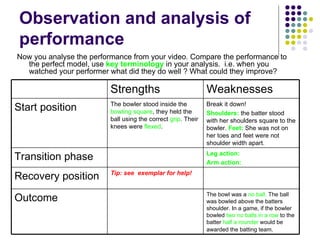
Observation and analysis of performance Now you analyse the performance from your video. Compare the performance to the perfect model, use  key terminology  in your analysis.  i.e. when you watched your performer what did they do well ? What could they improve? Strengths Weaknesses Start position The bowler stood inside the  bowling square , they held the ball using the correct  grip . Their knees were  flexed .  Break it down! Shoulders:  the batter stood with her shoulders square to the bowler.  Feet:  She was not on her toes and feet were not shoulder width apart.  Transition phase Leg action: Arm action: Recovery position Tip: see  exemplar for help! Outcome The bowl was a  no ball.  The ball was bowled above the batters shoulder. In a game, if the bowler bowled  two no balls   in a row  to the batter  half a rounder  would be awarded the batting team.
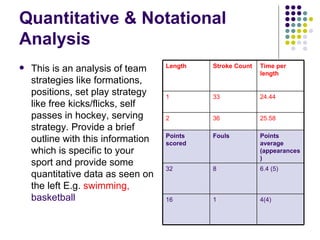
Quantitative & Notational Analysis This is an analysis of team strategies like formations, positions, set play strategy like free kicks/flicks, self passes in hockey, serving strategy. Provide a brief outline with this information which is specific to your sport and provide some quantitative data as seen on the left E.g.  swimming,  basketball 4(4) 1 16 6.4 (5) 8 32 Points average (appearances) Fouls  Points scored  25.58 36 2 24.44 33 1 Time per length Stroke Count Length
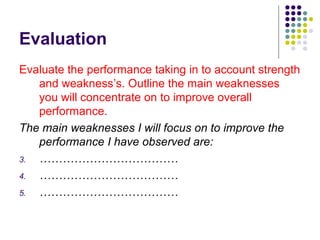
Evaluation Evaluate the performance taking in to account strength and weakness’s. Outline the main weaknesses you will concentrate on to improve overall performance.   The main weaknesses I will focus on to improve the performance I have observed are: ……………………………… ……………………………… ………………………………
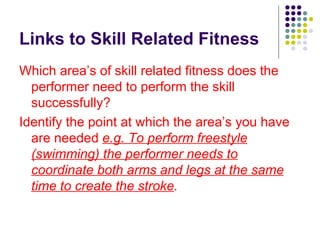
Links to Skill Related Fitness Which area’s of skill related fitness does the performer need to perform the skill successfully? Identify the point at which the area’s you have are needed  e.g. To perform freestyle (swimming) the performer needs to coordinate both arms and legs at the same time to create the stroke .
Links to Health Related Exercise Which area’s of health related exercise does the performer need to perform the skill successfully?
Strategies, tactics and practices to bring about improvement YOU MUST DESIGN A MINIMUM OF  3  PRACTICES THAT WILL HELP YOUR PERFORMER IMPROVE THE SPECIFIC WEAKNESSES YOU OBSERVED.   Now you have observed and analysed the performance, how are you going to help the performer improve performance? Identify the main weaknesses from the performance. Plan a  progressive practice  for each weakness.  Practice 1 :  This practice is designed to help the performer bowl a valid bowl i.e. within batting square below batter shoulders.   Stage 1 : …(make sure you describe what the performer must do before they can move on to the next stage of the practice).  Stage 2 :… N.B. You can include diagrams of the practice you have planned.   RESOURCES?!! INTERNET..BOOKS…YOUR BRAIN
Strategies for improvement linked to a PEP Demonstrate your understanding of personal exercise planning.  What  training method  would the  performer  YOU observed  use to improve their performance? Which  fitness tests  could the  performer  use to assess her current fitness and skill levels? Think about the area’s of SRF and HRE you have identified. Provide an example of how this performer should apply the  principles of training . Demonstrate your knowledge and understanding of  goal setting . i.e. what type of goals should this performer set and how can they ensure the goal is attainable?
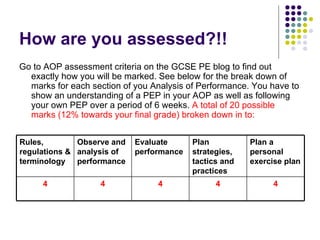
How are you assessed?!! Go to AOP assessment criteria on the GCSE PE blog to find out exactly how you will be marked. See below for the break down of marks for each section of you Analysis of Performance. You have to show an understanding of a PEP in your AOP as well as following your own PEP over a period of 6 weeks.  A total of 20 possible marks (12% towards your final grade) broken down in to: Rules, regulations & terminology Observe and analysis of performance Evaluate performance Plan strategies, tactics and practices Plan a personal exercise plan 4 4 4 4 4

AOP Student Guide

  • 1.
    Title Slide: whichsport are you observing? ADD SPORT WHICH YOU ARE ANAYSING; IT MUST BE ONE OF THE FOUR SPORTS YOU ARE DEFINATELY USING. YOU CAN ANALYSE A MEMBER OF YOUR GCSE PE GROUP, A PERFORMER FROM YOUR CLUB OR YOUR OWN PERFORMNACE.
  • 2.
    Rules, Regulations andTerminology On this slide discuss rules, regulations and terminology that you have picked up from the video. How did the performance start? Did they break any rules? If they did not, which rule could they have broken and what would happen? Do they have to use a certain technique to stay within the rules? E.g. Swimming. How would the official signal that a rule is broken? How would the game re-start? What terminology would the official use? Explain general rules of the game e.g. length, number of player, card system, points system, equipment required, facilities required.
  • 3.
    Video of thePerfect Model Add a video of the skill you are assessing being performed perfectly. This can be taken from a video of a professional game or another performer that is able. You can add a hyperlink or a video you have found and downloaded at home. Use an elite/pro athlete for your perfect model. Explain what the video shows e.g. name, level of performance, what speed, distance, rating, ranking do they have and how did they get it?
  • 4.
    The Perfect ModelOn this slide break the skill you are analysing down in to Start, Transition and Recovery phase. When observing, would you observe from different angles to get an overview of your performers ability? E.g. Bowling top spin (Rounders) Start position The bowler must stand within the bowling square . The bowler holds the ball in their bowling hand facing the batter square with knees slightly flexed displaying aligned posture and feet shoulder width apart to provide balance . Grip : the bowler should grip the ball using their thumb and fingers so they can manipulate the ball to create top spin . Transition phase Recovery position Outcome The ball is bowled above the batters knee, and below the shoulder. The ball is bowled within the batting square the correct side of the batter i.e. right or left handed batter. The bowler’s ultimate aim is to bowl the ball so that the batter is unable to strike the ball cleanly resulting in the ball being hit backwards , giving the backstop the opportunity to catch the ball meaning the batter is out.
  • 5.
    Video of performancethat I am analysing. Add a video of the performance you are observing for you analysis of performance. Explain what the video shows and add detail like age, level, experience of the performer which will all effect your plans to improve their performance. If it is a team game identify the formation the team is playing and the position of the player you are observing.
  • 6.
    Observation and analysisof performance Now you analyse the performance from your video. Compare the performance to the perfect model, use key terminology in your analysis. i.e. when you watched your performer what did they do well ? What could they improve? Strengths Weaknesses Start position The bowler stood inside the bowling square , they held the ball using the correct grip . Their knees were flexed . Break it down! Shoulders: the batter stood with her shoulders square to the bowler. Feet: She was not on her toes and feet were not shoulder width apart. Transition phase Leg action: Arm action: Recovery position Tip: see exemplar for help! Outcome The bowl was a no ball. The ball was bowled above the batters shoulder. In a game, if the bowler bowled two no balls in a row to the batter half a rounder would be awarded the batting team.
  • 7.
    Quantitative & NotationalAnalysis This is an analysis of team strategies like formations, positions, set play strategy like free kicks/flicks, self passes in hockey, serving strategy. Provide a brief outline with this information which is specific to your sport and provide some quantitative data as seen on the left E.g. swimming, basketball 4(4) 1 16 6.4 (5) 8 32 Points average (appearances) Fouls Points scored 25.58 36 2 24.44 33 1 Time per length Stroke Count Length
  • 8.
    Evaluation Evaluate theperformance taking in to account strength and weakness’s. Outline the main weaknesses you will concentrate on to improve overall performance. The main weaknesses I will focus on to improve the performance I have observed are: ……………………………… ……………………………… ………………………………
  • 9.
    Links to SkillRelated Fitness Which area’s of skill related fitness does the performer need to perform the skill successfully? Identify the point at which the area’s you have are needed e.g. To perform freestyle (swimming) the performer needs to coordinate both arms and legs at the same time to create the stroke .
  • 10.
    Links to HealthRelated Exercise Which area’s of health related exercise does the performer need to perform the skill successfully?
  • 11.
    Strategies, tactics andpractices to bring about improvement YOU MUST DESIGN A MINIMUM OF 3 PRACTICES THAT WILL HELP YOUR PERFORMER IMPROVE THE SPECIFIC WEAKNESSES YOU OBSERVED. Now you have observed and analysed the performance, how are you going to help the performer improve performance? Identify the main weaknesses from the performance. Plan a progressive practice for each weakness. Practice 1 : This practice is designed to help the performer bowl a valid bowl i.e. within batting square below batter shoulders. Stage 1 : …(make sure you describe what the performer must do before they can move on to the next stage of the practice). Stage 2 :… N.B. You can include diagrams of the practice you have planned. RESOURCES?!! INTERNET..BOOKS…YOUR BRAIN
  • 12.
    Strategies for improvementlinked to a PEP Demonstrate your understanding of personal exercise planning. What training method would the performer YOU observed use to improve their performance? Which fitness tests could the performer use to assess her current fitness and skill levels? Think about the area’s of SRF and HRE you have identified. Provide an example of how this performer should apply the principles of training . Demonstrate your knowledge and understanding of goal setting . i.e. what type of goals should this performer set and how can they ensure the goal is attainable?
  • 13.
    How are youassessed?!! Go to AOP assessment criteria on the GCSE PE blog to find out exactly how you will be marked. See below for the break down of marks for each section of you Analysis of Performance. You have to show an understanding of a PEP in your AOP as well as following your own PEP over a period of 6 weeks. A total of 20 possible marks (12% towards your final grade) broken down in to: Rules, regulations & terminology Observe and analysis of performance Evaluate performance Plan strategies, tactics and practices Plan a personal exercise plan 4 4 4 4 4