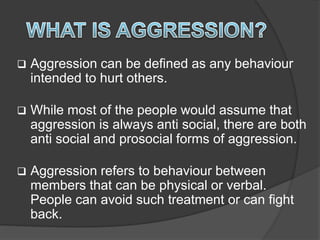
 Aggression can be defined as any behaviour
intended to hurt others.
 While most of the people would assume that
aggression is always anti social, there are both
anti social and prosocial forms of aggression.
 Aggression refers to behaviour between
members that can be physical or verbal.
People can avoid such treatment or can fight
back.
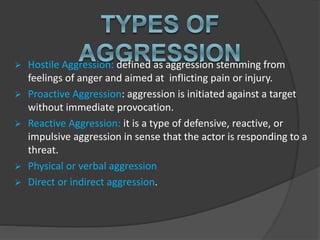
 Hostile Aggression: defined as aggression stemming from
feelings of anger and aimed at inflicting pain or injury.
 Proactive Aggression: aggression is initiated against a target
without immediate provocation.
 Reactive Aggression: it is a type of defensive, reactive, or
impulsive aggression in sense that the actor is responding to a
threat.
 Physical or verbal aggression
 Direct or indirect aggression.
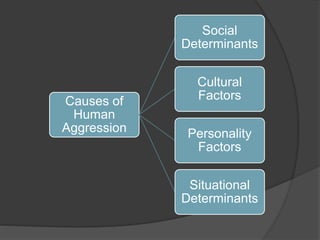
Causes of
Human
Aggression
Social
Determinants
Cultural
Factors
Personality
Factors
Situational
Determinants
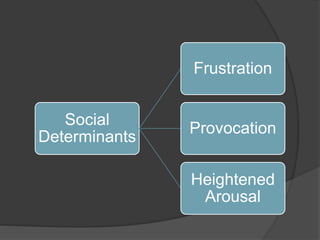
Social
Determinants
Frustration
Provocation
Heightened
Arousal
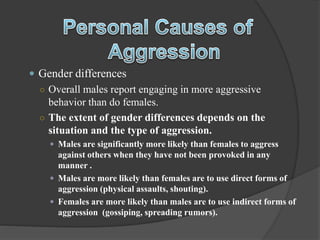
 Gender differences
○ Overall males report engaging in more aggressive
behavior than do females.
○ The extent of gender differences depends on the
situation and the type of aggression.
 Males are significantly more likely than females to aggress
against others when they have not been provoked in any
manner .
 Males are more likely than females are to use direct forms of
aggression (physical assaults, shouting).
 Females are more likely than males are to use indirect forms of
aggression (gossiping, spreading rumors).
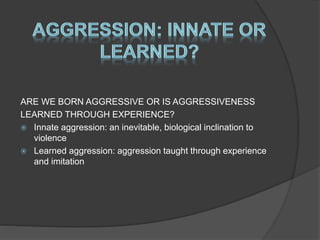
ARE WE BORN AGGRESSIVE OR IS AGGRESSIVENESS
LEARNED THROUGH EXPERIENCE?
 Innate aggression: an inevitable, biological inclination to
violence
 Learned aggression: aggression taught through experience
and imitation
Aggression is Innate...
 Freud and Lorenz argued that aggression is an innate, natural,
and biological characteristic
 Freud described his theory of the ‘death instinct’ as a being a
method of escaping life by playing dead whereas the ‘life
instinct’ is meant to preserve life and reproduce. Lorenz stated
that the will to live and aggression are compatible in the fact that
both are directed at securing the advantages necessary to
survival and reproduction
 However, these theories of innate aggression are cyclical in the
fact that they are shut off from testable alternatives and linear
reasoning (Humans are aggressive because its instinctual and
we know its instinctual because humans behave aggressively)
(Brehm et al. 2008)
 When children are socially taught to
be aggressive to get what they want,
they tend to be aggressive adults
 If it is learned at a young age that
aggressive behavior has a positive
result this method of obtaining such
effects will continue (De Souza 2007).
 Rewards will increase violent behavior
(a kid hits another and gets his candy)
whereas negative results can stop
aggressive and violent behavior
 Punishment is most effective when it
is administered immediately after
unwanted behavior occurs, is strong
enough to stop the behavior, and is
consistently fair. Punishment can also
instigate retaliation however, and act
as a model to imitate.
Negative Affect
 A wide variety of noxious stimuli can create
negative feelings and increase aggression
 Hot temperatures are associated with
increased aggression and violence
 Positive emotional responses are
incompatible with negative affect and
reduce retaliatory aggression
Some Useful Techniques
 Punishment:
Delivery Aversive Consequences is a major technique for
reducing aggression.
○ Two beliefs regarding its implementation
 Aggressive behavior deserves to be punished.
 Punishment of aggressive behavior deters(Discourage) future
aggression
Punishment can reduce aggression ,but only if it meets
four basic requirements
 Prompt: It must follow aggressive actions as quickly as
possible.
 Certain to Occur : The probability that it will follow
aggression must be high.
 Must be Strong: Strong enough to be highly unpleasant
to potential recipients.
 Justified or Deserved: It must be perceived by
recipients as justified or deserved
Aggressionppt final  faheem

Aggressionppt final faheem

  • 4.
     Aggression canbe defined as any behaviour intended to hurt others.  While most of the people would assume that aggression is always anti social, there are both anti social and prosocial forms of aggression.  Aggression refers to behaviour between members that can be physical or verbal. People can avoid such treatment or can fight back.
  • 5.
     Hostile Aggression:defined as aggression stemming from feelings of anger and aimed at inflicting pain or injury.  Proactive Aggression: aggression is initiated against a target without immediate provocation.  Reactive Aggression: it is a type of defensive, reactive, or impulsive aggression in sense that the actor is responding to a threat.  Physical or verbal aggression  Direct or indirect aggression.
  • 7.
  • 8.
  • 9.
     Gender differences ○Overall males report engaging in more aggressive behavior than do females. ○ The extent of gender differences depends on the situation and the type of aggression.  Males are significantly more likely than females to aggress against others when they have not been provoked in any manner .  Males are more likely than females are to use direct forms of aggression (physical assaults, shouting).  Females are more likely than males are to use indirect forms of aggression (gossiping, spreading rumors).
  • 10.
    ARE WE BORNAGGRESSIVE OR IS AGGRESSIVENESS LEARNED THROUGH EXPERIENCE?  Innate aggression: an inevitable, biological inclination to violence  Learned aggression: aggression taught through experience and imitation
  • 11.
    Aggression is Innate... Freud and Lorenz argued that aggression is an innate, natural, and biological characteristic  Freud described his theory of the ‘death instinct’ as a being a method of escaping life by playing dead whereas the ‘life instinct’ is meant to preserve life and reproduce. Lorenz stated that the will to live and aggression are compatible in the fact that both are directed at securing the advantages necessary to survival and reproduction  However, these theories of innate aggression are cyclical in the fact that they are shut off from testable alternatives and linear reasoning (Humans are aggressive because its instinctual and we know its instinctual because humans behave aggressively) (Brehm et al. 2008)
  • 12.
     When childrenare socially taught to be aggressive to get what they want, they tend to be aggressive adults  If it is learned at a young age that aggressive behavior has a positive result this method of obtaining such effects will continue (De Souza 2007).  Rewards will increase violent behavior (a kid hits another and gets his candy) whereas negative results can stop aggressive and violent behavior  Punishment is most effective when it is administered immediately after unwanted behavior occurs, is strong enough to stop the behavior, and is consistently fair. Punishment can also instigate retaliation however, and act as a model to imitate.
  • 13.
    Negative Affect  Awide variety of noxious stimuli can create negative feelings and increase aggression  Hot temperatures are associated with increased aggression and violence  Positive emotional responses are incompatible with negative affect and reduce retaliatory aggression
  • 14.
    Some Useful Techniques Punishment: Delivery Aversive Consequences is a major technique for reducing aggression. ○ Two beliefs regarding its implementation  Aggressive behavior deserves to be punished.  Punishment of aggressive behavior deters(Discourage) future aggression Punishment can reduce aggression ,but only if it meets four basic requirements
  • 15.
     Prompt: Itmust follow aggressive actions as quickly as possible.  Certain to Occur : The probability that it will follow aggression must be high.  Must be Strong: Strong enough to be highly unpleasant to potential recipients.  Justified or Deserved: It must be perceived by recipients as justified or deserved