NAME : ZAIGHUM SHAHBEEB BUTT
PRESENTED TO DR. TANVEER
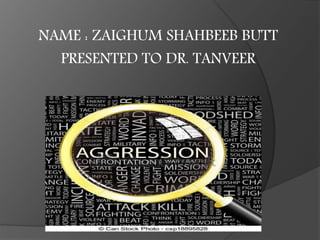
Hurting others: Aggression
 We need to look no further than the daily
newspaper or the nightly news to be
bombarded with examples of aggression
both on the societal level ( war , invasion ,
assassination) and on the individual level (
crime ,child abuse ).
 Aggression is intentional injury or harm to
another person .
 By this definition , the rapist is clearly
acting aggressively , whereas the physician
causing pain during a medical procedure is
not
Instinct approaches : aggression as
a release
 If u have ever punished on an adversary in
the nose, you have experienced a certain
satisfaction despite your better judgment .
Instinct theories which note the prevalence
of aggression not only in humans but in
animals too , propose that aggression is
primarily the outcome of innate –or inborn
urges
 Sigmund freud was one of the first to
suggest , as a part of his theory of
personality that aggression is a primary
instinctual drive .
 Konrad loranz an ethologist ,expanded
freud notions by arguing that humans
along with the member of other species
have a fighting instinct which in earlier
times ensured protection of food supplies .
 Lorenz instinct approach lead to the
controversial notion that aggressive
energy constantly builds up in an individual
until a person finally discharges it is in a
process called catharsis
 The longer the energy builds up , says lorenz
, the greater the amount of aggression
displayed when it is discharged
 Lorenz believed that society should offer
people acceptable ways of permitting
catharsis . For example he suggested that
participation in aggressive sports and games
would prevent the discharge of aggression in
less socially desirable ways
 In fact, some studies flatly contradict the
notion of catharsis which leads psychologist
to look for other explanations of aggression
Frustration aggression approaches :
aggression as a reaction to frustration
 Suppose you have been working on a paper that
is due for a class early the next morning , and your
computer printer runs out of ink just before you
can print out the paper . You rush to the store to
buy more ink only to find sales clerk locking the
door for the day . Even though the clerk can see
you gesturing and begging him to open the door ,
he refuses , shrugs his shoulders , and points to a
sign that indicates when the store will open the
next day. At that moment , the feelings you
experience towards the sales clerk probably place
you on the verge of real aggression and you are
undoubtedly seething inside
 Frustration aggression theory tries to
explain aggression in terms of events
like this one . It suggests that frustration
( blocking of goal directed behaviour)
produces anger , which leads to
readiness to act aggressively
Observational learning approaches :
learning to hurt others
 Do we learn to be aggressive ?the
observational learning ( social learning )
approach to aggression says that we do .
Taking an almost opposite view from instinct
theory , which focus on innate explanation of
aggression , observational learning theory
emphasizes that social and environmental
conditions can teach individuals to be
aggressive . The theory sees aggression not
as an inevitable , but rather than a learned
response that can be understood in term of
rewards and punishments
 Observational learning theory particularly
pays attention not only to direct rewards
and punishments that individuals
themselves receive , but also to rewards
and punishments that models-individuals
who provide guide top appropriate
behaviour – receive for their aggressive
behaviour . According to observational
learning theory , people observe the
behaviour of models as the sub sequent
consequences of that behaviour . If the
consequences are positive ,the behavior is
likely to be imitated when observer find
themselves in a similar situation
 Suppose , for instance , a girl hits her
younger brother when he damages one of
her new toys . Whereas instinct theory
would suggest that the aggression had
been pent up and was now being
discharged , and frustration aggression
theory would examine girl frustration at no
longer being able to use her new toy ,
observational learning theory would look to
previous situations in which the girl had
viewed others being rewarded for their
aggression
 For example, perhaps she had watched a
friend get to p-lay with a toy after he painfully
twisted it out of the hand of another child
 Observational learning theory had received
wide research support . For example ,
children of nursery school age who have
watched an adult model behave aggressively
and then receive reinforcement for it later
displays similar behaviour themselves if they
have been angered , insulted , or frustrated
after exposure . Further more a significant
amount of research links watching t.v shows
containing voilence with subsequent viewer
aggression
Dealing effectively with anger
 At one time or another , almost
everyone feels angry .the anger may
result from frustrating situation or it may
be due to another individuals behaviour .
The way we deal with anger may
determine the difference between a
promotion and a lost job or a broken
relationship
Social psychologists who have studied the
topic suggests several good strategies
to deal with anger that maximize the
potential for positive consequences
 Calm down: take a walk or engage in
some physical activity in order to cool
down your emotional arousal
 Look again at the anger –provoking
situation from the perspective of others .
By taking others point of view , you may
be able to understand the situation
better , and with increased
understanding you may become more
tolerant of the apparent short comings of
others
 Minimize the importance of the situation .
Does it really matters that someone is
driving too slowly and that you will be able
to late to an appointment as a result ?
 Reinterpret the situation in a way that is
less bothersome
 Use language effectively by saying “I” not
“you” . “you did___ wrong “, instead say “I
felt hurt when you did ______”. When you
accuse people for being wrong ,they are
likely to feel the need to fight back
 Fantasizing about getting even-but don’t
act on it . Fantasy provides a safety value .
In your fantasies , you can yell at their
unfair professor all you want and suffer no
consequences at all, however, don’t spend
too much time brooding: fantasize , but
then move on .
 Relax . By teaching yourself the relaxation
techniques used in systematic
desensitization ,you can help reduce your
reactions to anger . In turn, your anger may
dissipate
Conclusion
No matter which of these strategies you try
, above all, don’t ignore your anger .
People who always try to suppress their
anger may experience a variety of
consequences such as frustration and
even physical illness
Aggression

Aggression

  • 2.
    NAME : ZAIGHUMSHAHBEEB BUTT PRESENTED TO DR. TANVEER
  • 3.
    Hurting others: Aggression We need to look no further than the daily newspaper or the nightly news to be bombarded with examples of aggression both on the societal level ( war , invasion , assassination) and on the individual level ( crime ,child abuse ).  Aggression is intentional injury or harm to another person .  By this definition , the rapist is clearly acting aggressively , whereas the physician causing pain during a medical procedure is not
  • 5.
    Instinct approaches :aggression as a release  If u have ever punished on an adversary in the nose, you have experienced a certain satisfaction despite your better judgment . Instinct theories which note the prevalence of aggression not only in humans but in animals too , propose that aggression is primarily the outcome of innate –or inborn urges  Sigmund freud was one of the first to suggest , as a part of his theory of personality that aggression is a primary instinctual drive .
  • 6.
     Konrad loranzan ethologist ,expanded freud notions by arguing that humans along with the member of other species have a fighting instinct which in earlier times ensured protection of food supplies .  Lorenz instinct approach lead to the controversial notion that aggressive energy constantly builds up in an individual until a person finally discharges it is in a process called catharsis
  • 7.
     The longerthe energy builds up , says lorenz , the greater the amount of aggression displayed when it is discharged  Lorenz believed that society should offer people acceptable ways of permitting catharsis . For example he suggested that participation in aggressive sports and games would prevent the discharge of aggression in less socially desirable ways  In fact, some studies flatly contradict the notion of catharsis which leads psychologist to look for other explanations of aggression
  • 8.
    Frustration aggression approaches: aggression as a reaction to frustration  Suppose you have been working on a paper that is due for a class early the next morning , and your computer printer runs out of ink just before you can print out the paper . You rush to the store to buy more ink only to find sales clerk locking the door for the day . Even though the clerk can see you gesturing and begging him to open the door , he refuses , shrugs his shoulders , and points to a sign that indicates when the store will open the next day. At that moment , the feelings you experience towards the sales clerk probably place you on the verge of real aggression and you are undoubtedly seething inside
  • 10.
     Frustration aggressiontheory tries to explain aggression in terms of events like this one . It suggests that frustration ( blocking of goal directed behaviour) produces anger , which leads to readiness to act aggressively
  • 11.
    Observational learning approaches: learning to hurt others  Do we learn to be aggressive ?the observational learning ( social learning ) approach to aggression says that we do . Taking an almost opposite view from instinct theory , which focus on innate explanation of aggression , observational learning theory emphasizes that social and environmental conditions can teach individuals to be aggressive . The theory sees aggression not as an inevitable , but rather than a learned response that can be understood in term of rewards and punishments
  • 12.
     Observational learningtheory particularly pays attention not only to direct rewards and punishments that individuals themselves receive , but also to rewards and punishments that models-individuals who provide guide top appropriate behaviour – receive for their aggressive behaviour . According to observational learning theory , people observe the behaviour of models as the sub sequent consequences of that behaviour . If the consequences are positive ,the behavior is likely to be imitated when observer find themselves in a similar situation
  • 13.
     Suppose ,for instance , a girl hits her younger brother when he damages one of her new toys . Whereas instinct theory would suggest that the aggression had been pent up and was now being discharged , and frustration aggression theory would examine girl frustration at no longer being able to use her new toy , observational learning theory would look to previous situations in which the girl had viewed others being rewarded for their aggression
  • 14.
     For example,perhaps she had watched a friend get to p-lay with a toy after he painfully twisted it out of the hand of another child  Observational learning theory had received wide research support . For example , children of nursery school age who have watched an adult model behave aggressively and then receive reinforcement for it later displays similar behaviour themselves if they have been angered , insulted , or frustrated after exposure . Further more a significant amount of research links watching t.v shows containing voilence with subsequent viewer aggression
  • 15.
    Dealing effectively withanger  At one time or another , almost everyone feels angry .the anger may result from frustrating situation or it may be due to another individuals behaviour . The way we deal with anger may determine the difference between a promotion and a lost job or a broken relationship
  • 16.
    Social psychologists whohave studied the topic suggests several good strategies to deal with anger that maximize the potential for positive consequences  Calm down: take a walk or engage in some physical activity in order to cool down your emotional arousal
  • 17.
     Look againat the anger –provoking situation from the perspective of others . By taking others point of view , you may be able to understand the situation better , and with increased understanding you may become more tolerant of the apparent short comings of others
  • 18.
     Minimize theimportance of the situation . Does it really matters that someone is driving too slowly and that you will be able to late to an appointment as a result ?  Reinterpret the situation in a way that is less bothersome  Use language effectively by saying “I” not “you” . “you did___ wrong “, instead say “I felt hurt when you did ______”. When you accuse people for being wrong ,they are likely to feel the need to fight back
  • 19.
     Fantasizing aboutgetting even-but don’t act on it . Fantasy provides a safety value . In your fantasies , you can yell at their unfair professor all you want and suffer no consequences at all, however, don’t spend too much time brooding: fantasize , but then move on .  Relax . By teaching yourself the relaxation techniques used in systematic desensitization ,you can help reduce your reactions to anger . In turn, your anger may dissipate
  • 20.
    Conclusion No matter whichof these strategies you try , above all, don’t ignore your anger . People who always try to suppress their anger may experience a variety of consequences such as frustration and even physical illness