AGGRESSION
CHAPTER NO.10
Definition of Aggression
Behavior that is intended to hurt another
person or group
Behavior that results in personal injury or
destruction of property
Aggression is any behavior intended to
harm another individual or object by
physical or verbal means
For example: hitting, pushing , verbal threats
Violence
Definition: Extreme, unjustifiable aggression
causing destruction. Violence is physically or
psychologically harmful human aggression
that involves the threat or use of force .
 some examples are: slapping, hitting, biting,
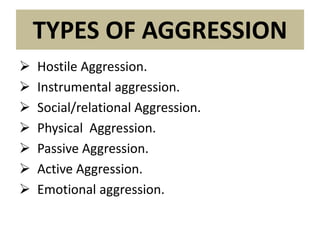
TYPES OF AGGRESSION
 Hostile Aggression.
 Instrumental aggression.
 Social/relational Aggression.
 Physical Aggression.
 Passive Aggression.
 Active Aggression.
 Emotional aggression.
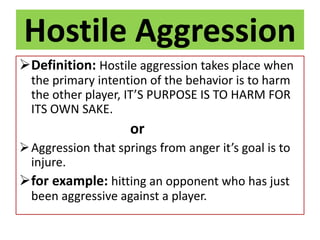
Hostile Aggression
Definition: Hostile aggression takes place when
the primary intention of the behavior is to harm
the other player, IT’S PURPOSE IS TO HARM FOR
ITS OWN SAKE.
or
Aggression that springs from anger it’s goal is to
injure.
for example: hitting an opponent who has just
been aggressive against a player.
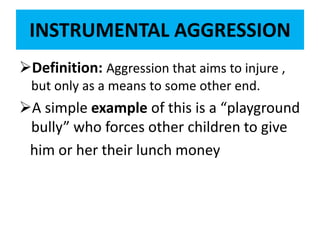
INSTRUMENTAL AGGRESSION
Definition: Aggression that aims to injure ,
but only as a means to some other end.
A simple example of this is a “playground
bully” who forces other children to give
him or her their lunch money
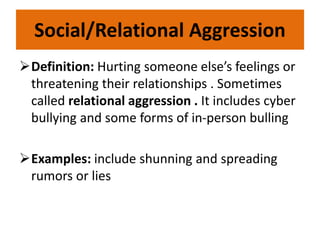
Social/Relational Aggression
Definition: Hurting someone else’s feelings or
threatening their relationships . Sometimes
called relational aggression . It includes cyber
bullying and some forms of in-person bulling
Examples: include shunning and spreading
rumors or lies
Physical Aggression
Definition : Hurting someone else’s body
or
Physical aggression is behavior causing or
threatening physical harm towards others
Examples of Physical aggression are :
Physical violence, such as biting, hitting, and
kicking.
Passive aggression : Harming others
by withholding a behavior (Example :
purposely failing to convey an important
message).
Active aggression : Harming others
by performing a behavior (Example :
spreading vicious rumors).
Emotional Aggression
Definition: Emotional aggression is reactive
and impulsive . Aggression is driven by
feelings (Example : anger)often in the absence
of a rational cost-benefit analysis.
There are three common ways of causing
aggression in our society:
1. Hostility.
2. Verbal and physical.
3. Aggression that break human relations by
circulating rumors.
How to reduce aggression
• Catharsis:
Definition : A Catharsis is an emotional
discharge through which one can achieve a
state of moral or spiritual renewal, or achieve
a state of liberation from anxiety and stress.
Catharsis is a Greek word meaning
“cleansing.” In literature, it is used for the
cleansing of emotions of the characters.
Another definition of catharsis :
Emotional release . The catharsis view
of aggression is that the aggressive
drive is reduced when one releases
aggressive energy . Either by acting
aggressively or by fantasizing
aggression
Example of catharsis:
•At the end of Romeo and Juliet, the two lovers
have sought release from their "crossed" love
by killing themselves.
•Social learning theory :
Definition : it is a theory of learning process
and social behavior which proposes that new
behaviors can be acquired by observing and
imitating others. It states that learning is
a cognitive process that takes place in a social
context and can occur purely through
observation or direct instruction
For example : A child might see that a sibling receive a
lollipop for behaving politely. And this event imitates the
other siblings to get a treat by doing the same.
Ways to reduce aggression:
1. Be solicitous and understanding of others
2. Avoid negativity
3. By being positive and encouraging others
4. By avoiding assumptions and rash judgments
5. By avoiding unhealthy competition
6. By managing problems quickly
7. Be aware of remarks and actions that trigger
aggression
8. Avoid to talk negatively about any culture
9. Try to be patience and avoid the situations that cause
fights
10. Try to behave nice
11. By keeping firm control on your anger and fear
12. Professional counseling is also helpful
13. Sharing feelings with friends and family often helps
14. Choosing to express the emotion in a way other than
aggression
15. Knowing what causes the aggression
16. Aggression can be reduced effectively in
highly aggressive boys by allowing them to observe
models who behave in a restrained and non-
aggressive manner in the face of provocation. This can be
effectively done by the television and movie industries.
17.Punishment
18.Role modeling
Therapy needed to reduce aggression
• Talking therapy
• Writing therapy
• Displacement
• Training to tolerate frustration
• Teaching of Discipline and Morality
• Judicious Early Childhood Training
Theories of aggression
• Aggression as a biological phenomenon
• Aggression as a response to frustration
• Aggression as learned social behavior
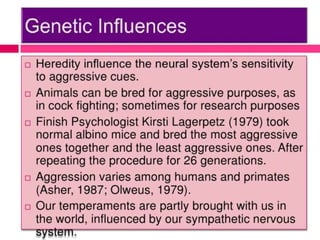
1. Aggression as a biological phenomenon :
INSTICT THEORY (AGGRESSION IS INSTINCTIVE. (An instinct
is an innate tendency to behave in a certain way) we
are born with two opposing instincts, the life instinct
and the death instinct. Our death instinct leads us to be
aggressive. It is manageable and we can, to some
extent, exert conscious control over it. sport is a
healthy way of expressing our death instinct
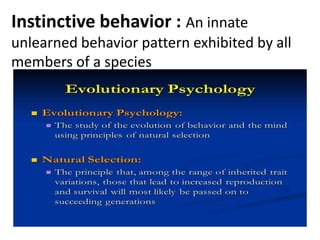
Instinctive behavior : An innate
unlearned behavior pattern exhibited by all
members of a species
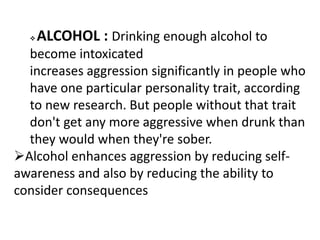
 ALCOHOL : Drinking enough alcohol to
become intoxicated
increases aggression significantly in people who
have one particular personality trait, according
to new research. But people without that trait
don't get any more aggressive when drunk than
they would when they're sober.
Alcohol enhances aggression by reducing self-
awareness and also by reducing the ability to
consider consequences
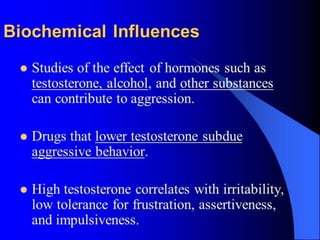
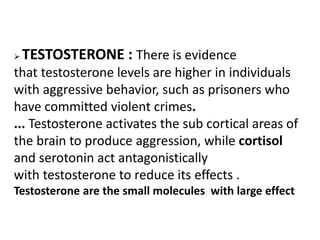
 TESTOSTERONE : There is evidence
that testosterone levels are higher in individuals
with aggressive behavior, such as prisoners who
have committed violent crimes.
... Testosterone activates the sub cortical areas of
the brain to produce aggression, while cortisol
and serotonin act antagonistically
with testosterone to reduce its effects .
Testosterone are the small molecules with large effect
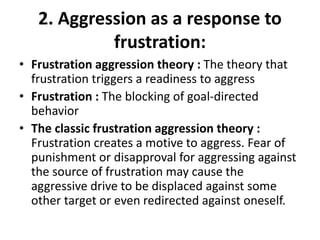
2. Aggression as a response to
frustration:
• Frustration aggression theory : The theory that
frustration triggers a readiness to aggress
• Frustration : The blocking of goal-directed
behavior
• The classic frustration aggression theory :
Frustration creates a motive to aggress. Fear of
punishment or disapproval for aggressing against
the source of frustration may cause the
aggressive drive to be displaced against some
other target or even redirected against oneself.
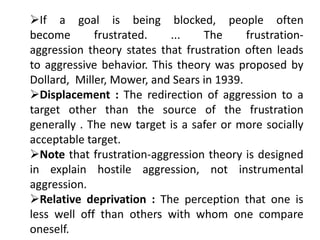
If a goal is being blocked, people often
become frustrated. ... The frustration-
aggression theory states that frustration often leads
to aggressive behavior. This theory was proposed by
Dollard, Miller, Mower, and Sears in 1939.
Displacement : The redirection of aggression to a
target other than the source of the frustration
generally . The new target is a safer or more socially
acceptable target.
Note that frustration-aggression theory is designed
in explain hostile aggression, not instrumental
aggression.
Relative deprivation : The perception that one is
less well off than others with whom one compare
oneself.
3. Aggression as learned social
behavior :
 Social learning theory : The theory that we learn from
social behavior by observing and imitating and by
being rewarded and punished.
 aggression, like other social behavior, is learnt by
imitation and reinforcement .
 Children witness aggression in sports Children may
also witness highly assertive acts and in-correctly
imitate them in an aggressive form .
 Aggression can be reinforced. An act of aggression
might result directly in scoring or preventing the
opposition from doing so. Watchers might cheer; the
coach and parents might praise the aggressive child .
 Albert Bandura’s famous Bobo doll study greatly
contributed towards the formation of this theory.
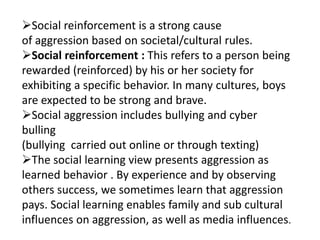
Social reinforcement is a strong cause
of aggression based on societal/cultural rules.
Social reinforcement : This refers to a person being
rewarded (reinforced) by his or her society for
exhibiting a specific behavior. In many cultures, boys
are expected to be strong and brave.
Social aggression includes bullying and cyber
bulling
(bullying carried out online or through texting)
The social learning view presents aggression as
learned behavior . By experience and by observing
others success, we sometimes learn that aggression
pays. Social learning enables family and sub cultural
influences on aggression, as well as media influences.

Aggression

  • 1.
  • 2.
    Definition of Aggression Behaviorthat is intended to hurt another person or group Behavior that results in personal injury or destruction of property Aggression is any behavior intended to harm another individual or object by physical or verbal means For example: hitting, pushing , verbal threats
  • 3.
    Violence Definition: Extreme, unjustifiableaggression causing destruction. Violence is physically or psychologically harmful human aggression that involves the threat or use of force .  some examples are: slapping, hitting, biting,
  • 4.
    TYPES OF AGGRESSION Hostile Aggression.  Instrumental aggression.  Social/relational Aggression.  Physical Aggression.  Passive Aggression.  Active Aggression.  Emotional aggression.
  • 5.
    Hostile Aggression Definition: Hostileaggression takes place when the primary intention of the behavior is to harm the other player, IT’S PURPOSE IS TO HARM FOR ITS OWN SAKE. or Aggression that springs from anger it’s goal is to injure. for example: hitting an opponent who has just been aggressive against a player.
  • 6.
    INSTRUMENTAL AGGRESSION Definition: Aggressionthat aims to injure , but only as a means to some other end. A simple example of this is a “playground bully” who forces other children to give him or her their lunch money
  • 7.
    Social/Relational Aggression Definition: Hurtingsomeone else’s feelings or threatening their relationships . Sometimes called relational aggression . It includes cyber bullying and some forms of in-person bulling Examples: include shunning and spreading rumors or lies
  • 8.
    Physical Aggression Definition :Hurting someone else’s body or Physical aggression is behavior causing or threatening physical harm towards others Examples of Physical aggression are : Physical violence, such as biting, hitting, and kicking.
  • 9.
    Passive aggression :Harming others by withholding a behavior (Example : purposely failing to convey an important message). Active aggression : Harming others by performing a behavior (Example : spreading vicious rumors).
  • 10.
    Emotional Aggression Definition: Emotionalaggression is reactive and impulsive . Aggression is driven by feelings (Example : anger)often in the absence of a rational cost-benefit analysis. There are three common ways of causing aggression in our society: 1. Hostility. 2. Verbal and physical. 3. Aggression that break human relations by circulating rumors.
  • 11.
    How to reduceaggression • Catharsis: Definition : A Catharsis is an emotional discharge through which one can achieve a state of moral or spiritual renewal, or achieve a state of liberation from anxiety and stress. Catharsis is a Greek word meaning “cleansing.” In literature, it is used for the cleansing of emotions of the characters.
  • 12.
    Another definition ofcatharsis : Emotional release . The catharsis view of aggression is that the aggressive drive is reduced when one releases aggressive energy . Either by acting aggressively or by fantasizing aggression
  • 13.
    Example of catharsis: •Atthe end of Romeo and Juliet, the two lovers have sought release from their "crossed" love by killing themselves. •Social learning theory : Definition : it is a theory of learning process and social behavior which proposes that new behaviors can be acquired by observing and imitating others. It states that learning is a cognitive process that takes place in a social context and can occur purely through observation or direct instruction
  • 14.
    For example :A child might see that a sibling receive a lollipop for behaving politely. And this event imitates the other siblings to get a treat by doing the same. Ways to reduce aggression: 1. Be solicitous and understanding of others 2. Avoid negativity 3. By being positive and encouraging others 4. By avoiding assumptions and rash judgments 5. By avoiding unhealthy competition 6. By managing problems quickly 7. Be aware of remarks and actions that trigger aggression 8. Avoid to talk negatively about any culture 9. Try to be patience and avoid the situations that cause fights
  • 15.
    10. Try tobehave nice 11. By keeping firm control on your anger and fear 12. Professional counseling is also helpful 13. Sharing feelings with friends and family often helps 14. Choosing to express the emotion in a way other than aggression 15. Knowing what causes the aggression 16. Aggression can be reduced effectively in highly aggressive boys by allowing them to observe models who behave in a restrained and non- aggressive manner in the face of provocation. This can be effectively done by the television and movie industries. 17.Punishment 18.Role modeling
  • 16.
    Therapy needed toreduce aggression • Talking therapy • Writing therapy • Displacement • Training to tolerate frustration • Teaching of Discipline and Morality • Judicious Early Childhood Training
  • 17.
    Theories of aggression •Aggression as a biological phenomenon • Aggression as a response to frustration • Aggression as learned social behavior 1. Aggression as a biological phenomenon : INSTICT THEORY (AGGRESSION IS INSTINCTIVE. (An instinct is an innate tendency to behave in a certain way) we are born with two opposing instincts, the life instinct and the death instinct. Our death instinct leads us to be aggressive. It is manageable and we can, to some extent, exert conscious control over it. sport is a healthy way of expressing our death instinct
  • 18.
    Instinctive behavior :An innate unlearned behavior pattern exhibited by all members of a species
  • 22.
     ALCOHOL :Drinking enough alcohol to become intoxicated increases aggression significantly in people who have one particular personality trait, according to new research. But people without that trait don't get any more aggressive when drunk than they would when they're sober. Alcohol enhances aggression by reducing self- awareness and also by reducing the ability to consider consequences
  • 23.
     TESTOSTERONE :There is evidence that testosterone levels are higher in individuals with aggressive behavior, such as prisoners who have committed violent crimes. ... Testosterone activates the sub cortical areas of the brain to produce aggression, while cortisol and serotonin act antagonistically with testosterone to reduce its effects . Testosterone are the small molecules with large effect
  • 24.
    2. Aggression asa response to frustration: • Frustration aggression theory : The theory that frustration triggers a readiness to aggress • Frustration : The blocking of goal-directed behavior • The classic frustration aggression theory : Frustration creates a motive to aggress. Fear of punishment or disapproval for aggressing against the source of frustration may cause the aggressive drive to be displaced against some other target or even redirected against oneself.
  • 25.
    If a goalis being blocked, people often become frustrated. ... The frustration- aggression theory states that frustration often leads to aggressive behavior. This theory was proposed by Dollard, Miller, Mower, and Sears in 1939. Displacement : The redirection of aggression to a target other than the source of the frustration generally . The new target is a safer or more socially acceptable target. Note that frustration-aggression theory is designed in explain hostile aggression, not instrumental aggression. Relative deprivation : The perception that one is less well off than others with whom one compare oneself.
  • 26.
    3. Aggression aslearned social behavior :  Social learning theory : The theory that we learn from social behavior by observing and imitating and by being rewarded and punished.  aggression, like other social behavior, is learnt by imitation and reinforcement .  Children witness aggression in sports Children may also witness highly assertive acts and in-correctly imitate them in an aggressive form .  Aggression can be reinforced. An act of aggression might result directly in scoring or preventing the opposition from doing so. Watchers might cheer; the coach and parents might praise the aggressive child .  Albert Bandura’s famous Bobo doll study greatly contributed towards the formation of this theory.
  • 27.
    Social reinforcement isa strong cause of aggression based on societal/cultural rules. Social reinforcement : This refers to a person being rewarded (reinforced) by his or her society for exhibiting a specific behavior. In many cultures, boys are expected to be strong and brave. Social aggression includes bullying and cyber bulling (bullying carried out online or through texting) The social learning view presents aggression as learned behavior . By experience and by observing others success, we sometimes learn that aggression pays. Social learning enables family and sub cultural influences on aggression, as well as media influences.