Copyright 2016 © McGraw-Hill Education. Permission required for reproduction or display
AP Images/Pat Roque
What Is Aggression?
 Aggression
 Physical or verbal behavior intended to cause harm
 The definition excludes unintentional harm
 Hostile Aggression
 Aggression that springs from anger; its goal is to injure
 Instrumental Aggression
 Aggression that is a means to some other end
Copyright 2016 © McGraw-Hill Education. Permission required for reproduction or display.
Philosophical Views of Aggression
 Philosophers have debated whether our human nature
is fundamentally bad or fundamentally good.
 The 18th century Jean-Jacques Rousseau had argued
that we are basically good, and society is to blame for
social evils
 The British philosopher Thomas Hobbes (1588-1679)
had argued that we are basically evil and need to be
restrained by society.
 The idea that aggressive drive is innate and thus
inevitable was promoted by Freud and Konard
Lorenz.
Freud and Lorenz
 Freud saw aggression as the expression of the death
instinct, the Thanatos, that is directed outwardly
 Lorenz, and animal expert, saw aggression as adaptive-
the member of the species who is more aggressive
controls more resources and have higher lieklihood to
survive
 Aggressive energy is seen by Freud and Lorenz as
instinctive, that is, unlearned and universal; if not
discharged, it build up until “explosion”
 Instinct theory fails to account for the variation of
aggressiveness' from person to person and from culture to
culture
•Study well the section on gender similarities and differences. Why were social psychologists reluctant to explore this area in th
•Note areas of gender differences, such as independence (male), and connectedness (female), social dominance, aggression, and se
•Note how males and females differ in their mating preferences. Give examples. Pp. 176-178
• Note impact of sex hormones, especially testosterone. P. 180
•Note issue of gender roles and how they vary with culture and over time. 182-184
•Note Harris’ ideas of peer-transmitted culture. 184-185
What Are Some Theories of
Aggression?
 Aggression as a Biological Phenomenon
 Instinct theory and evolutionary psychology
 Innate, unlearned behavior pattern exhibited by all members
of a species
 Evolutionary psychology sees aggression as a strategy for
gaining resources, defending against attacks, etc
 Neural influences
 Abnormal brains can contribute to abnormally aggressive
behavior
 Genetic Influences
 Heredity influences the neural system’s sensitivity to
aggressive cues
Copyright 2016 © McGraw-Hill Education. Permission required for reproduction or display.
What Are Some Theories of
Aggression?
 Aggression as a Biological Phenomenon
 Biochemical influences
 Alcohol: Unleashes aggression when people are
provoked. Alcohol enhances aggression by reducing self-
awareness and by focusing attention on the provocation
 Testosterone
 Poor diet
 Biology and behavior interact
Copyright 2016 © McGraw-Hill Education. Permission required for reproduction or display.
Biochemical (cont-d)
 Testosterone: Hormonal influences appear to be much
stronger in animals than in humans, but aggressive
behavior does correlate with the male hormone
testosterone
 Drugs that diminish levels of testosterone in violent
human males will subdue their aggressive tendencies
 After age 25 the testosterone levels diminish and so
does violent behavior
 Testosterones levels tend to be higher in violent
criminals
Testosterone (cont-d)
 Testosterone levels tend to be higher among prisoners
convicted of planned and unprovoked violent crimes
 High testosterone levels in men are related to
delinquency, hard drug use, and aggressive responses
to provocation
 In men, testosterone increases the width of the face
relative to the length of the face, and men with
relatively wider faces display more aggression
Low levels of Serotonin
 Serotonin is one of the brain’s neurotransmitters
 Low levels of serotonin were found to be related to
difficulties in impulse- control
 Biology and behavior interact: Testosterone may
facilitate aggressive and dominant behaviors, but
dominating behavior (such as winning a soccer
match) boosts testosterone levels.
What Are Some Theories of
Aggression?
 Aggression as a Response to Frustration
 Frustration
 Blocking of goal-directed behavior
 Frustration-aggression theory
 Theory that frustration triggers a readiness to aggress
 Displacement because of fear of punishment
Copyright 2016 © McGraw-Hill Education. Permission required for reproduction or display.
What Are Some Theories of
Aggression?
 Frustration-Aggression Theory Revised
 Original theory overstated the frustration-aggression
connection
 Frustration produces anger, an emotional readiness to
aggress
 Theory is designed to explain hostile aggression, not
instrumental aggression
Copyright 2016 © McGraw-Hill Education. Permission required for reproduction or display.
What Are Some Theories of
Aggression?
 Aggression as a Response to Frustration
 Relative Deprivation
 Perception that one is less well off than others with whom one
compares oneself
 Explains why happiness tends to be lower and crime rates
higher in communities and nations with large income
inequality
Copyright 2016 © McGraw-Hill Education. Permission required for reproduction or display.
What Are Some Theories of
Aggression?
 Aggression as Learned Social Behavior
 Rewards of Aggression
 Through experience and by observing others, we learn that
aggression often pays
Copyright 2016 © McGraw-Hill Education. Permission required for reproduction or display.
What Are Some Theories of
Aggression?
 Observational Learning
 Social learning theory
 We learn social behavior by observing and imitating and by
being rewarded and punished
 Family
 Culture
Copyright 2016 © McGraw-Hill Education. Permission required for reproduction or display.
What Are Some Influences on
Aggression?
 Aversive Incidents increase the likelihoods of acting
aggressively
 Pain: aversive stimuli
 Heat: as well as offensive odors, cigarette smoke, air
pollution
 Studies found that when the weather is hot, violent
crime is more likely
 Attacks
 Includes insults
 Over-crowding
Copyright 2016 © McGraw-Hill Education. Permission required for reproduction or display.
What Are Some Influences on
Aggression?
 Arousal
 A given state of bodily arousal feeds one emotion or
another, depending on how the person interprets and
labels the arousal
 This is the Two-Factor Theory of Emotion (Schachter
and Singer, 1962)
Copyright 2016 © McGraw-Hill Education. Permission required for reproduction or display.
What Are Some Influences on
Aggression?
Copyright 2016 © McGraw-Hill Education. Permission required for reproduction or display.
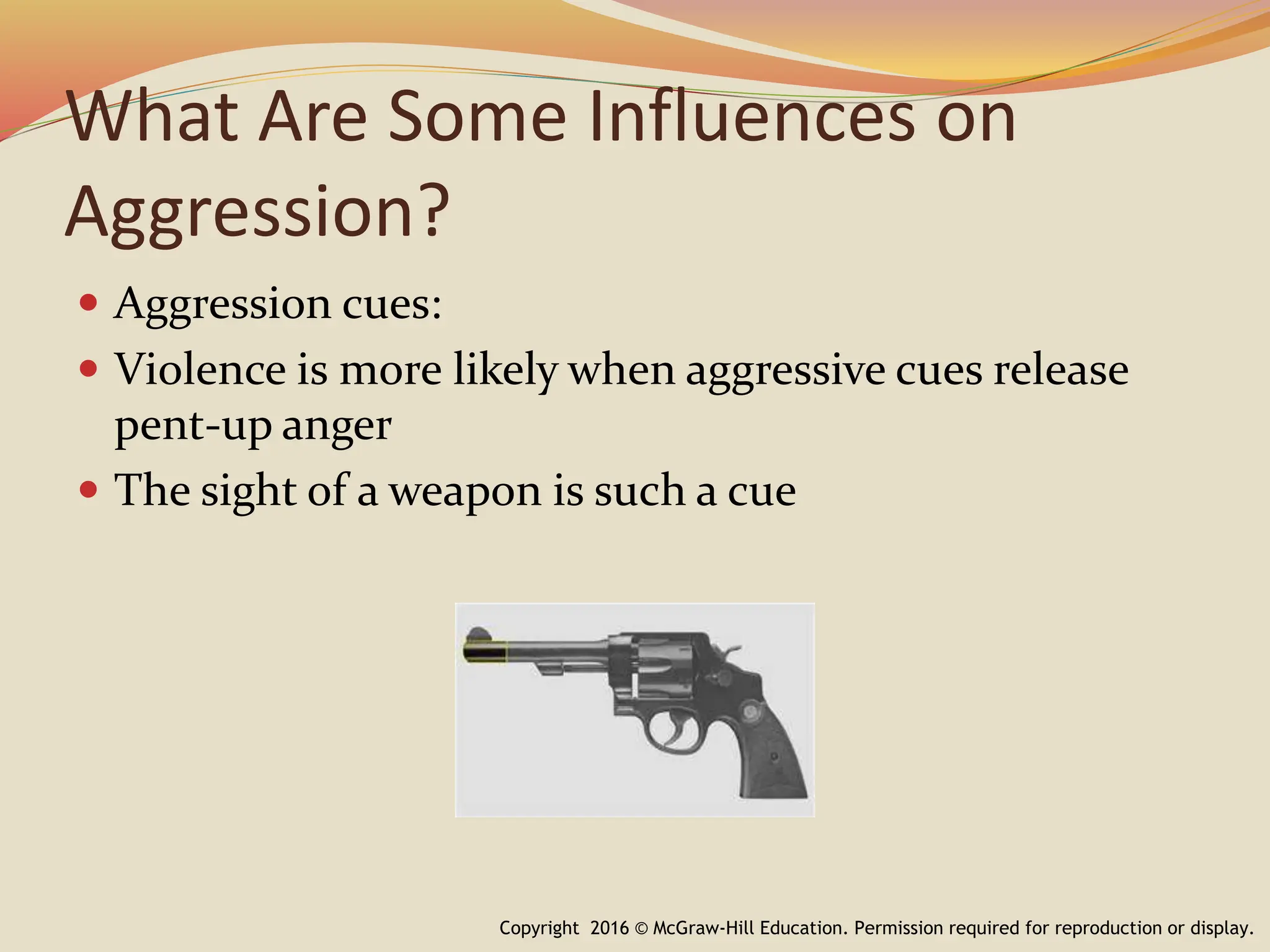
 Aggression cues:
 Violence is more likely when aggressive cues release
pent-up anger
 The sight of a weapon is such a cue
What Are Some Influences on
Aggression?
 Media Influences: Pornography and Sexual Violence
 Distorted Perceptions of Sexual Reality
 Studies confirm that exposure to pornography increases
acceptance of the rape myth
Copyright 2016 © McGraw-Hill Education. Permission required for reproduction or display.
What Are Some Influences on
Aggression?
 Media Influences: Pornography and Sexual Violence
 Distorted Perceptions of Sexual Reality
 Aggression Against Women
 Studies suggest that the exposure to violent pornography
increase punitive behavior toward women
Copyright 2016 © McGraw-Hill Education. Permission required for reproduction or display.
What Are Some Influences on
Aggression?
 Media Influences: Television and the Internet
 Media’s Effects on Behavior
 Correlating Media Viewing and Behavior
 Frequent result of correlating children’s TV viewing with
aggressiveness is the more violent the content the more
aggressive the child
 Extends to indirect aggression
Copyright 2016 © McGraw-Hill Education. Permission required for reproduction or display.
What Are Some Influences on
Aggression?
 Media Influences: Television and the Internet
 Media’s Effects on Behavior
 Violence Viewing Experiments
 Anderson (2003) and Coyne (2008)
 Showed college students and girls exposed to more violence
led to an increase in viewer aggression
Copyright 2016 © McGraw-Hill Education. Permission required for reproduction or display.
What Are Some Influences on
Aggression?
 Media Influences: Television and the Internet
 Media’s Effects on Behavior
 Why Does Media Viewing Affect Behavior?
 The arousal that it produces
 Viewing violence disinhibits
 Media portrayals evoke imitation
Copyright 2016 © McGraw-Hill Education. Permission required for reproduction or display.
What Are Some Influences on
Aggression?
 Media Influences: Television and the Internet
 Media’s Effects on Thinking
 Desensitization
 Social Scripts
 Culturally provided mental instructions for how to act in
various situations
 Altered Perceptions
 Media portrayals shape perceptions of reality
 Cognitive Priming
 Media portrayals prime thinking
Copyright 2016 © McGraw-Hill Education. Permission required for reproduction or display.
What Are Some Influences on
Aggression?
 Another Media Influence: Video Games
 Effects of Video Games
 Games are becoming more violent and sometimes include
 Carjacking
 Shooting
 Sex
 Murder
 Games that are rated “M” for mature are often marketed to
those younger
Copyright 2016 © McGraw-Hill Education. Permission required for reproduction or display.
What Are Some Influences on
Aggression?
 Another Media Influence: Video Games
 Effects of the games kids play
 Increases aggressive behaviors
 Increases aggressive thoughts
 Increases aggressive feelings
 Habituation in the brain
 Greater likelihood of carrying a weapon
 Decreases in self-control and increases in antisocial behavior
 Decreases in helping others and in empathy for others
Copyright 2016 © McGraw-Hill Education. Permission required for reproduction or display.
What Are Some Influences on
Aggression?
 Group Influences
 Can amplify aggressive reactions partly by diffusing
responsibility
 Increases with distance and number
 Social contagion
Copyright 2016 © McGraw-Hill Education. Permission required for reproduction or display.
How Can Aggression Be Reduced?
 Catharsis?
 Contrary to the catharsis hypothesis, expressing
aggression by catharsis tends to breed further
aggression, not reduce it
Copyright 2016 © McGraw-Hill Education. Permission required for reproduction or display.
How Can Aggression Be Reduced?
 A Social Learning Approach
 Controlling aggression by counteracting the factors that
provoke it
 Reducing aversive stimulation
 Rewarding nonaggression
 Modeling nonaggression
 Eliciting reactions incompatible with aggression
Copyright 2016 © McGraw-Hill Education. Permission required for reproduction or display.
How Can Aggression Be
Reduced?
 Culture Change and World Violence
 Cultures can change
Copyright 2016 © McGraw-Hill Education. Permission required for reproduction or display.

Aggression about aggression definition types control .ppt

  • 1.
    Copyright 2016 ©McGraw-Hill Education. Permission required for reproduction or display AP Images/Pat Roque
  • 2.
    What Is Aggression? Aggression  Physical or verbal behavior intended to cause harm  The definition excludes unintentional harm  Hostile Aggression  Aggression that springs from anger; its goal is to injure  Instrumental Aggression  Aggression that is a means to some other end Copyright 2016 © McGraw-Hill Education. Permission required for reproduction or display.
  • 3.
    Philosophical Views ofAggression  Philosophers have debated whether our human nature is fundamentally bad or fundamentally good.  The 18th century Jean-Jacques Rousseau had argued that we are basically good, and society is to blame for social evils  The British philosopher Thomas Hobbes (1588-1679) had argued that we are basically evil and need to be restrained by society.  The idea that aggressive drive is innate and thus inevitable was promoted by Freud and Konard Lorenz.
  • 4.
    Freud and Lorenz Freud saw aggression as the expression of the death instinct, the Thanatos, that is directed outwardly  Lorenz, and animal expert, saw aggression as adaptive- the member of the species who is more aggressive controls more resources and have higher lieklihood to survive  Aggressive energy is seen by Freud and Lorenz as instinctive, that is, unlearned and universal; if not discharged, it build up until “explosion”  Instinct theory fails to account for the variation of aggressiveness' from person to person and from culture to culture •Study well the section on gender similarities and differences. Why were social psychologists reluctant to explore this area in th •Note areas of gender differences, such as independence (male), and connectedness (female), social dominance, aggression, and se •Note how males and females differ in their mating preferences. Give examples. Pp. 176-178 • Note impact of sex hormones, especially testosterone. P. 180 •Note issue of gender roles and how they vary with culture and over time. 182-184 •Note Harris’ ideas of peer-transmitted culture. 184-185
  • 5.
    What Are SomeTheories of Aggression?  Aggression as a Biological Phenomenon  Instinct theory and evolutionary psychology  Innate, unlearned behavior pattern exhibited by all members of a species  Evolutionary psychology sees aggression as a strategy for gaining resources, defending against attacks, etc  Neural influences  Abnormal brains can contribute to abnormally aggressive behavior  Genetic Influences  Heredity influences the neural system’s sensitivity to aggressive cues Copyright 2016 © McGraw-Hill Education. Permission required for reproduction or display.
  • 6.
    What Are SomeTheories of Aggression?  Aggression as a Biological Phenomenon  Biochemical influences  Alcohol: Unleashes aggression when people are provoked. Alcohol enhances aggression by reducing self- awareness and by focusing attention on the provocation  Testosterone  Poor diet  Biology and behavior interact Copyright 2016 © McGraw-Hill Education. Permission required for reproduction or display.
  • 7.
    Biochemical (cont-d)  Testosterone:Hormonal influences appear to be much stronger in animals than in humans, but aggressive behavior does correlate with the male hormone testosterone  Drugs that diminish levels of testosterone in violent human males will subdue their aggressive tendencies  After age 25 the testosterone levels diminish and so does violent behavior  Testosterones levels tend to be higher in violent criminals
  • 8.
    Testosterone (cont-d)  Testosteronelevels tend to be higher among prisoners convicted of planned and unprovoked violent crimes  High testosterone levels in men are related to delinquency, hard drug use, and aggressive responses to provocation  In men, testosterone increases the width of the face relative to the length of the face, and men with relatively wider faces display more aggression
  • 9.
    Low levels ofSerotonin  Serotonin is one of the brain’s neurotransmitters  Low levels of serotonin were found to be related to difficulties in impulse- control  Biology and behavior interact: Testosterone may facilitate aggressive and dominant behaviors, but dominating behavior (such as winning a soccer match) boosts testosterone levels.
  • 10.
    What Are SomeTheories of Aggression?  Aggression as a Response to Frustration  Frustration  Blocking of goal-directed behavior  Frustration-aggression theory  Theory that frustration triggers a readiness to aggress  Displacement because of fear of punishment Copyright 2016 © McGraw-Hill Education. Permission required for reproduction or display.
  • 11.
    What Are SomeTheories of Aggression?  Frustration-Aggression Theory Revised  Original theory overstated the frustration-aggression connection  Frustration produces anger, an emotional readiness to aggress  Theory is designed to explain hostile aggression, not instrumental aggression Copyright 2016 © McGraw-Hill Education. Permission required for reproduction or display.
  • 12.
    What Are SomeTheories of Aggression?  Aggression as a Response to Frustration  Relative Deprivation  Perception that one is less well off than others with whom one compares oneself  Explains why happiness tends to be lower and crime rates higher in communities and nations with large income inequality Copyright 2016 © McGraw-Hill Education. Permission required for reproduction or display.
  • 13.
    What Are SomeTheories of Aggression?  Aggression as Learned Social Behavior  Rewards of Aggression  Through experience and by observing others, we learn that aggression often pays Copyright 2016 © McGraw-Hill Education. Permission required for reproduction or display.
  • 14.
    What Are SomeTheories of Aggression?  Observational Learning  Social learning theory  We learn social behavior by observing and imitating and by being rewarded and punished  Family  Culture Copyright 2016 © McGraw-Hill Education. Permission required for reproduction or display.
  • 15.
    What Are SomeInfluences on Aggression?  Aversive Incidents increase the likelihoods of acting aggressively  Pain: aversive stimuli  Heat: as well as offensive odors, cigarette smoke, air pollution  Studies found that when the weather is hot, violent crime is more likely  Attacks  Includes insults  Over-crowding Copyright 2016 © McGraw-Hill Education. Permission required for reproduction or display.
  • 16.
    What Are SomeInfluences on Aggression?  Arousal  A given state of bodily arousal feeds one emotion or another, depending on how the person interprets and labels the arousal  This is the Two-Factor Theory of Emotion (Schachter and Singer, 1962) Copyright 2016 © McGraw-Hill Education. Permission required for reproduction or display.
  • 17.
    What Are SomeInfluences on Aggression? Copyright 2016 © McGraw-Hill Education. Permission required for reproduction or display.  Aggression cues:  Violence is more likely when aggressive cues release pent-up anger  The sight of a weapon is such a cue
  • 18.
    What Are SomeInfluences on Aggression?  Media Influences: Pornography and Sexual Violence  Distorted Perceptions of Sexual Reality  Studies confirm that exposure to pornography increases acceptance of the rape myth Copyright 2016 © McGraw-Hill Education. Permission required for reproduction or display.
  • 19.
    What Are SomeInfluences on Aggression?  Media Influences: Pornography and Sexual Violence  Distorted Perceptions of Sexual Reality  Aggression Against Women  Studies suggest that the exposure to violent pornography increase punitive behavior toward women Copyright 2016 © McGraw-Hill Education. Permission required for reproduction or display.
  • 20.
    What Are SomeInfluences on Aggression?  Media Influences: Television and the Internet  Media’s Effects on Behavior  Correlating Media Viewing and Behavior  Frequent result of correlating children’s TV viewing with aggressiveness is the more violent the content the more aggressive the child  Extends to indirect aggression Copyright 2016 © McGraw-Hill Education. Permission required for reproduction or display.
  • 21.
    What Are SomeInfluences on Aggression?  Media Influences: Television and the Internet  Media’s Effects on Behavior  Violence Viewing Experiments  Anderson (2003) and Coyne (2008)  Showed college students and girls exposed to more violence led to an increase in viewer aggression Copyright 2016 © McGraw-Hill Education. Permission required for reproduction or display.
  • 22.
    What Are SomeInfluences on Aggression?  Media Influences: Television and the Internet  Media’s Effects on Behavior  Why Does Media Viewing Affect Behavior?  The arousal that it produces  Viewing violence disinhibits  Media portrayals evoke imitation Copyright 2016 © McGraw-Hill Education. Permission required for reproduction or display.
  • 23.
    What Are SomeInfluences on Aggression?  Media Influences: Television and the Internet  Media’s Effects on Thinking  Desensitization  Social Scripts  Culturally provided mental instructions for how to act in various situations  Altered Perceptions  Media portrayals shape perceptions of reality  Cognitive Priming  Media portrayals prime thinking Copyright 2016 © McGraw-Hill Education. Permission required for reproduction or display.
  • 24.
    What Are SomeInfluences on Aggression?  Another Media Influence: Video Games  Effects of Video Games  Games are becoming more violent and sometimes include  Carjacking  Shooting  Sex  Murder  Games that are rated “M” for mature are often marketed to those younger Copyright 2016 © McGraw-Hill Education. Permission required for reproduction or display.
  • 25.
    What Are SomeInfluences on Aggression?  Another Media Influence: Video Games  Effects of the games kids play  Increases aggressive behaviors  Increases aggressive thoughts  Increases aggressive feelings  Habituation in the brain  Greater likelihood of carrying a weapon  Decreases in self-control and increases in antisocial behavior  Decreases in helping others and in empathy for others Copyright 2016 © McGraw-Hill Education. Permission required for reproduction or display.
  • 26.
    What Are SomeInfluences on Aggression?  Group Influences  Can amplify aggressive reactions partly by diffusing responsibility  Increases with distance and number  Social contagion Copyright 2016 © McGraw-Hill Education. Permission required for reproduction or display.
  • 27.
    How Can AggressionBe Reduced?  Catharsis?  Contrary to the catharsis hypothesis, expressing aggression by catharsis tends to breed further aggression, not reduce it Copyright 2016 © McGraw-Hill Education. Permission required for reproduction or display.
  • 28.
    How Can AggressionBe Reduced?  A Social Learning Approach  Controlling aggression by counteracting the factors that provoke it  Reducing aversive stimulation  Rewarding nonaggression  Modeling nonaggression  Eliciting reactions incompatible with aggression Copyright 2016 © McGraw-Hill Education. Permission required for reproduction or display.
  • 29.
    How Can AggressionBe Reduced?  Culture Change and World Violence  Cultures can change Copyright 2016 © McGraw-Hill Education. Permission required for reproduction or display.