INTRODUCTION

Hans J. Eysenck was born in Germany in 1916. He left Germany for France in 1934 and eventually established a life for himself in Britain. Eysenck was one of
the first psychologists to relate biology to personality and has developed an extensive range of theories on many topics and published over 40 books, many of
which he has co-written with his wife Sybil B.G. Eysenck. He has also completed publications with his son Michael W. Eysenck; a psychologist who specialises in
memory. Hans Eysenck decided to retire in 1983 but continued writing until he died in September 1997. Eysenck’s Trait Personality Theory is based on
biological explanations (Eysenck, 1990). Eysenck believed that an individual’s personality traits, or what Eysenck referred to as ‘temperament’, are caused
directly by a person’s genetic make-up (Chamorro-Premuzic & Furnham, 2005). There have been many studies that support biological explanations of Eysenck’s
trait personality theory; these include, twin studies (Eaves & Eysenck, 1975, and Eysenck, 1990) and brain imaging (Canli et al., 2001).

                                                                                                                                               STABILITY
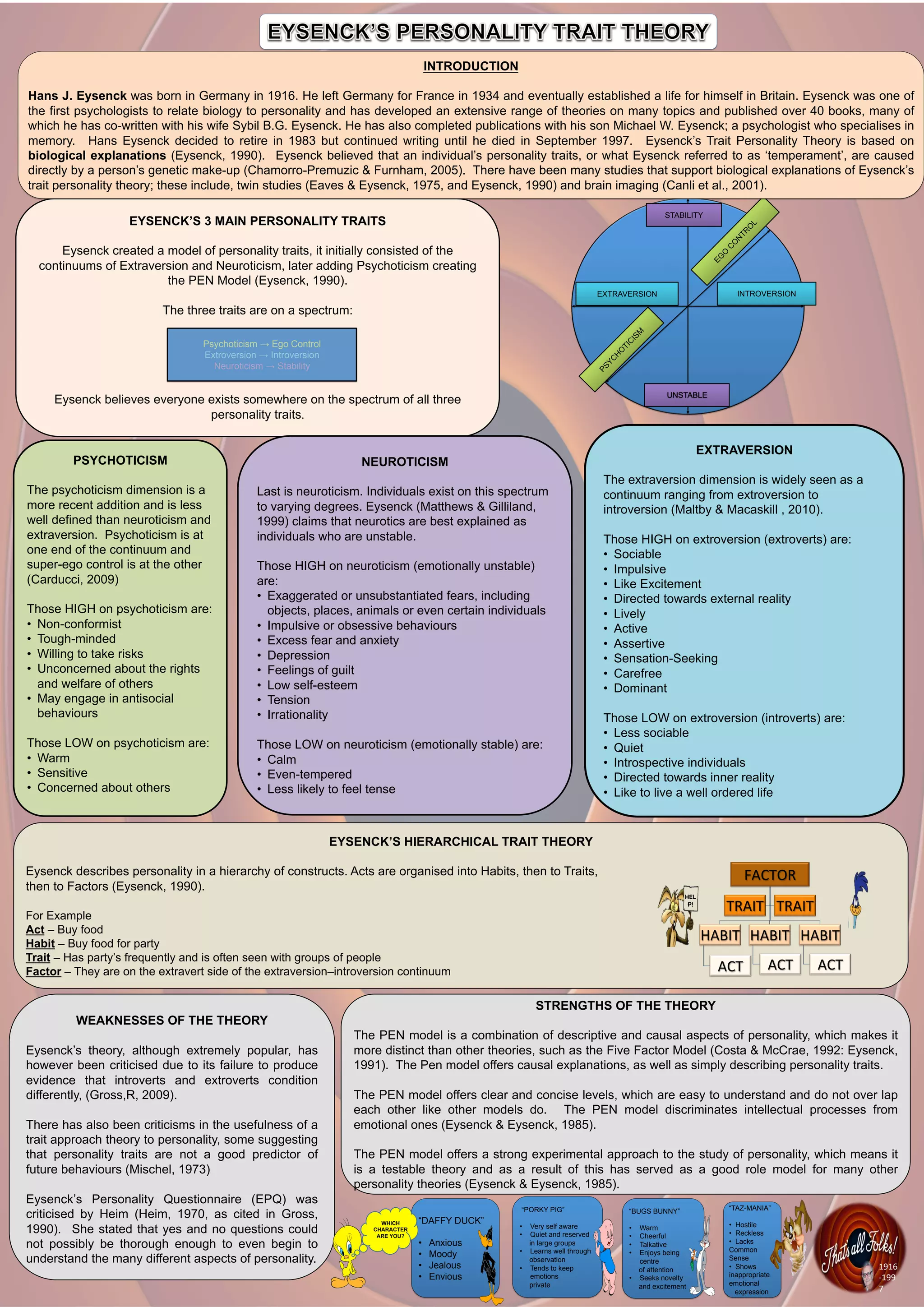
                   EYSENCK’S 3 MAIN PERSONALITY TRAITS

      Eysenck created a model of personality traits, it initially consisted of the
  continuums of Extraversion and Neuroticism, later adding Psychoticism creating
                        the PEN Model (Eysenck, 1990).
                                                                                                                               EXTRAVERSION                       INTROVERSION

                          The three traits are on a spectrum:

                                  Psychoticism → Ego Control
                                  Extroversion → Introversion
                                    Neuroticism → Stability


                                                                                                                                                UNSTABLE
     Eysenck believes everyone exists somewhere on the spectrum of all three
                               personality traits.

                                                                                                                                                         EXTRAVERSION
         PSYCHOTICISM                                               NEUROTICISM
                                                                                                                                The extraversion dimension is widely seen as a
The psychoticism dimension is a               Last is neuroticism. Individuals exist on this spectrum                           continuum ranging from extroversion to
more recent addition and is less              to varying degrees. Eysenck (Matthews & Gilliland,                                introversion (Maltby & Macaskill , 2010).
well defined than neuroticism and             1999) claims that neurotics are best explained as
extraversion. Psychoticism is at              individuals who are unstable.                                                     Those HIGH on extroversion (extroverts) are:
one end of the continuum and                                                                                                    •  Sociable
super-ego control is at the other             Those HIGH on neuroticism (emotionally unstable)                                  •  Impulsive
(Carducci, 2009)                              are:                                                                              •  Like Excitement
                                              •  Exaggerated or unsubstantiated fears, including                                •  Directed towards external reality
Those HIGH on psychoticism are:                  objects, places, animals or even certain individuals                           •  Lively
•  Non-conformist                             •  Impulsive or obsessive behaviours                                              •  Active
•  Tough-minded                               •  Excess fear and anxiety                                                        •  Assertive
•  Willing to take risks                      •  Depression                                                                     •  Sensation-Seeking
•  Unconcerned about the rights               •  Feelings of guilt                                                              •  Carefree
   and welfare of others                      •  Low self-esteem                                                                •  Dominant
•  May engage in antisocial                   •  Tension
   behaviours                                 •  Irrationality                                                                  Those LOW on extroversion (introverts) are:
                                                                                                                                •  Less sociable
Those LOW on psychoticism are:                Those LOW on neuroticism (emotionally stable) are:                                •  Quiet
•  Warm                                       •  Calm                                                                           •  Introspective individuals
•  Sensitive                                  •  Even-tempered                                                                  •  Directed towards inner reality
•  Concerned about others                     •  Less likely to feel tense                                                      •  Like to live a well ordered life


                                                                EYSENCK’S HIERARCHICAL TRAIT THEORY

Eysenck describes personality in a hierarchy of constructs. Acts are organised into Habits, then to Traits,                                                         FACTOR	
  
then to Factors (Eysenck, 1990).
                                                                                                                                                     HEL
                                                                                                                                                      P!
                                                                                                                                                                TRAIT	
   TRAIT	
  
For Example
Act – Buy food
Habit – Buy food for party
                                                                                                                                                           HABIT	
   HABIT	
   HABIT	
  
Trait – Has party’s frequently and is often seen with groups of people
Factor – They are on the extravert side of the extraversion–introversion continuum                                                                            ACT	
         ACT	
     ACT	
  

                                                                                                           STRENGTHS OF THE THEORY
         WEAKNESSES OF THE THEORY
                                                                   The PEN model is a combination of descriptive and causal aspects of personality, which makes it
Eysenck’s theory, although extremely popular, has                  more distinct than other theories, such as the Five Factor Model (Costa & McCrae, 1992: Eysenck,
however been criticised due to its failure to produce              1991). The Pen model offers causal explanations, as well as simply describing personality traits.
evidence that introverts and extroverts condition
differently, (Gross,R, 2009).                                      The PEN model offers clear and concise levels, which are easy to understand and do not over lap
                                                                   each other like other models do. The PEN model discriminates intellectual processes from
There has also been criticisms in the usefulness of a              emotional ones (Eysenck & Eysenck, 1985).
trait approach theory to personality, some suggesting
that personality traits are not a good predictor of                The PEN model offers a strong experimental approach to the study of personality, which means it
future behaviours (Mischel, 1973)                                  is a testable theory and as a result of this has served as a good role model for many other
                                                                   personality theories (Eysenck & Eysenck, 1985).
Eysenck’s Personality Questionnaire (EPQ) was
                                                                                                       “PORKY PIG”                                              “TAZ-MANIA”
criticised by Heim (Heim, 1970, as cited in Gross,                                “DAFFY DUCK”
                                                                                                                                     “BUGS BUNNY”
                                                                        WHICH                                                                                   •  Hostile
1990). She stated that yes and no questions could                     CHARACTER
                                                                       ARE YOU?
                                                                                                      • 
                                                                                                      • 
                                                                                                         Very self aware
                                                                                                         Quiet and reserved
                                                                                                                                     • 
                                                                                                                                     • 
                                                                                                                                        Warm
                                                                                                                                        Cheerful                •  Reckless
not possibly be thorough enough to even begin to                                  •    Anxious           in large groups
                                                                                                      •  Learns well through
                                                                                                                                     •  Talkative               •  Lacks
                                                                                                                                                                Common
                                                                                  •    Moody                                         •  Enjoys being
understand the many different aspects of personality.                             •    Jealous
                                                                                                         observation                    centre                  Sense
                                                                                                      •  Tends to keep                  of attention            •  Shows                        1916
                                                                                  •    Envious           emotions                    •  Seeks novelty           inappropriate                   -­‐199
                                                                                                         private                        and excitement          emotional
                                                                                                                                                                   expression                   7	


Eysenck three personality trait theory

  • 1.
    INTRODUCTION Hans J. Eysenckwas born in Germany in 1916. He left Germany for France in 1934 and eventually established a life for himself in Britain. Eysenck was one of the first psychologists to relate biology to personality and has developed an extensive range of theories on many topics and published over 40 books, many of which he has co-written with his wife Sybil B.G. Eysenck. He has also completed publications with his son Michael W. Eysenck; a psychologist who specialises in memory. Hans Eysenck decided to retire in 1983 but continued writing until he died in September 1997. Eysenck’s Trait Personality Theory is based on biological explanations (Eysenck, 1990). Eysenck believed that an individual’s personality traits, or what Eysenck referred to as ‘temperament’, are caused directly by a person’s genetic make-up (Chamorro-Premuzic & Furnham, 2005). There have been many studies that support biological explanations of Eysenck’s trait personality theory; these include, twin studies (Eaves & Eysenck, 1975, and Eysenck, 1990) and brain imaging (Canli et al., 2001). STABILITY EYSENCK’S 3 MAIN PERSONALITY TRAITS Eysenck created a model of personality traits, it initially consisted of the continuums of Extraversion and Neuroticism, later adding Psychoticism creating the PEN Model (Eysenck, 1990). EXTRAVERSION INTROVERSION The three traits are on a spectrum: Psychoticism → Ego Control Extroversion → Introversion Neuroticism → Stability UNSTABLE Eysenck believes everyone exists somewhere on the spectrum of all three personality traits. EXTRAVERSION PSYCHOTICISM NEUROTICISM The extraversion dimension is widely seen as a The psychoticism dimension is a Last is neuroticism. Individuals exist on this spectrum continuum ranging from extroversion to more recent addition and is less to varying degrees. Eysenck (Matthews & Gilliland, introversion (Maltby & Macaskill , 2010). well defined than neuroticism and 1999) claims that neurotics are best explained as extraversion. Psychoticism is at individuals who are unstable. Those HIGH on extroversion (extroverts) are: one end of the continuum and •  Sociable super-ego control is at the other Those HIGH on neuroticism (emotionally unstable) •  Impulsive (Carducci, 2009) are: •  Like Excitement •  Exaggerated or unsubstantiated fears, including •  Directed towards external reality Those HIGH on psychoticism are: objects, places, animals or even certain individuals •  Lively •  Non-conformist •  Impulsive or obsessive behaviours •  Active •  Tough-minded •  Excess fear and anxiety •  Assertive •  Willing to take risks •  Depression •  Sensation-Seeking •  Unconcerned about the rights •  Feelings of guilt •  Carefree and welfare of others •  Low self-esteem •  Dominant •  May engage in antisocial •  Tension behaviours •  Irrationality Those LOW on extroversion (introverts) are: •  Less sociable Those LOW on psychoticism are: Those LOW on neuroticism (emotionally stable) are: •  Quiet •  Warm •  Calm •  Introspective individuals •  Sensitive •  Even-tempered •  Directed towards inner reality •  Concerned about others •  Less likely to feel tense •  Like to live a well ordered life EYSENCK’S HIERARCHICAL TRAIT THEORY Eysenck describes personality in a hierarchy of constructs. Acts are organised into Habits, then to Traits, FACTOR   then to Factors (Eysenck, 1990). HEL P! TRAIT   TRAIT   For Example Act – Buy food Habit – Buy food for party HABIT   HABIT   HABIT   Trait – Has party’s frequently and is often seen with groups of people Factor – They are on the extravert side of the extraversion–introversion continuum ACT   ACT   ACT   STRENGTHS OF THE THEORY WEAKNESSES OF THE THEORY The PEN model is a combination of descriptive and causal aspects of personality, which makes it Eysenck’s theory, although extremely popular, has more distinct than other theories, such as the Five Factor Model (Costa & McCrae, 1992: Eysenck, however been criticised due to its failure to produce 1991). The Pen model offers causal explanations, as well as simply describing personality traits. evidence that introverts and extroverts condition differently, (Gross,R, 2009). The PEN model offers clear and concise levels, which are easy to understand and do not over lap each other like other models do. The PEN model discriminates intellectual processes from There has also been criticisms in the usefulness of a emotional ones (Eysenck & Eysenck, 1985). trait approach theory to personality, some suggesting that personality traits are not a good predictor of The PEN model offers a strong experimental approach to the study of personality, which means it future behaviours (Mischel, 1973) is a testable theory and as a result of this has served as a good role model for many other personality theories (Eysenck & Eysenck, 1985). Eysenck’s Personality Questionnaire (EPQ) was “PORKY PIG” “TAZ-MANIA” criticised by Heim (Heim, 1970, as cited in Gross, “DAFFY DUCK” “BUGS BUNNY” WHICH •  Hostile 1990). She stated that yes and no questions could CHARACTER ARE YOU? •  •  Very self aware Quiet and reserved •  •  Warm Cheerful •  Reckless not possibly be thorough enough to even begin to •  Anxious in large groups •  Learns well through •  Talkative •  Lacks Common •  Moody •  Enjoys being understand the many different aspects of personality. •  Jealous observation centre Sense •  Tends to keep of attention •  Shows 1916 •  Envious emotions •  Seeks novelty inappropriate -­‐199 private and excitement emotional expression 7