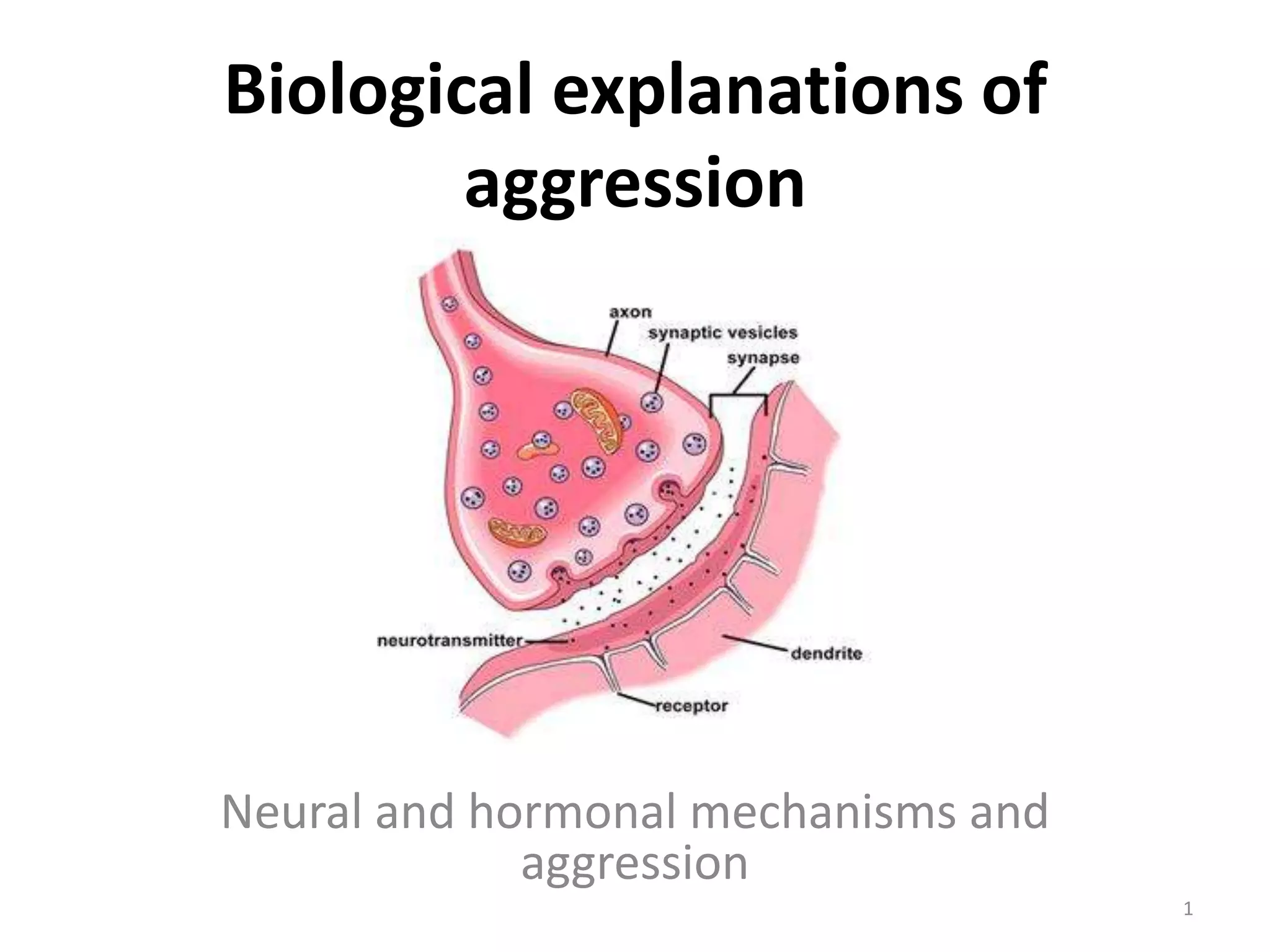
Biological explanations of aggressionNeural and hormonal mechanisms and aggression1
Neural and Hormonal Mechanisms in AggressionBATsA01 -Outline biochemical influences on aggressive behaviour (hormones and neurotransmitters) - Outline how brain structure can affect aggressive behaviourA02/3 Evaluate the effectiveness of biological explanations of the cause of aggressionP66-67
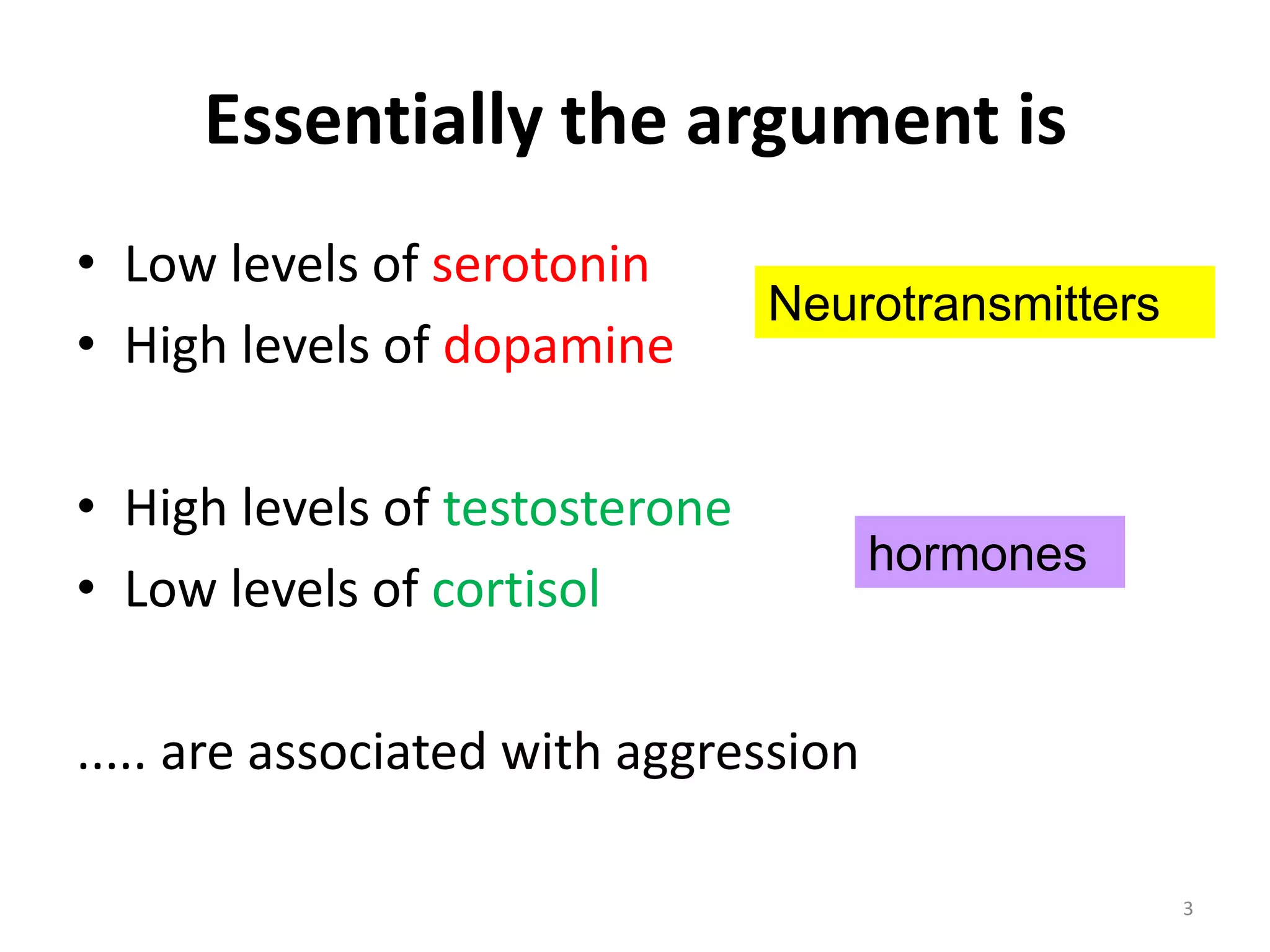
Essentially the argument isLow levels of serotoninHigh levels of dopamineHigh levels of testosteroneLow levels of cortisol..... are associated with aggression3Neurotransmittershormones
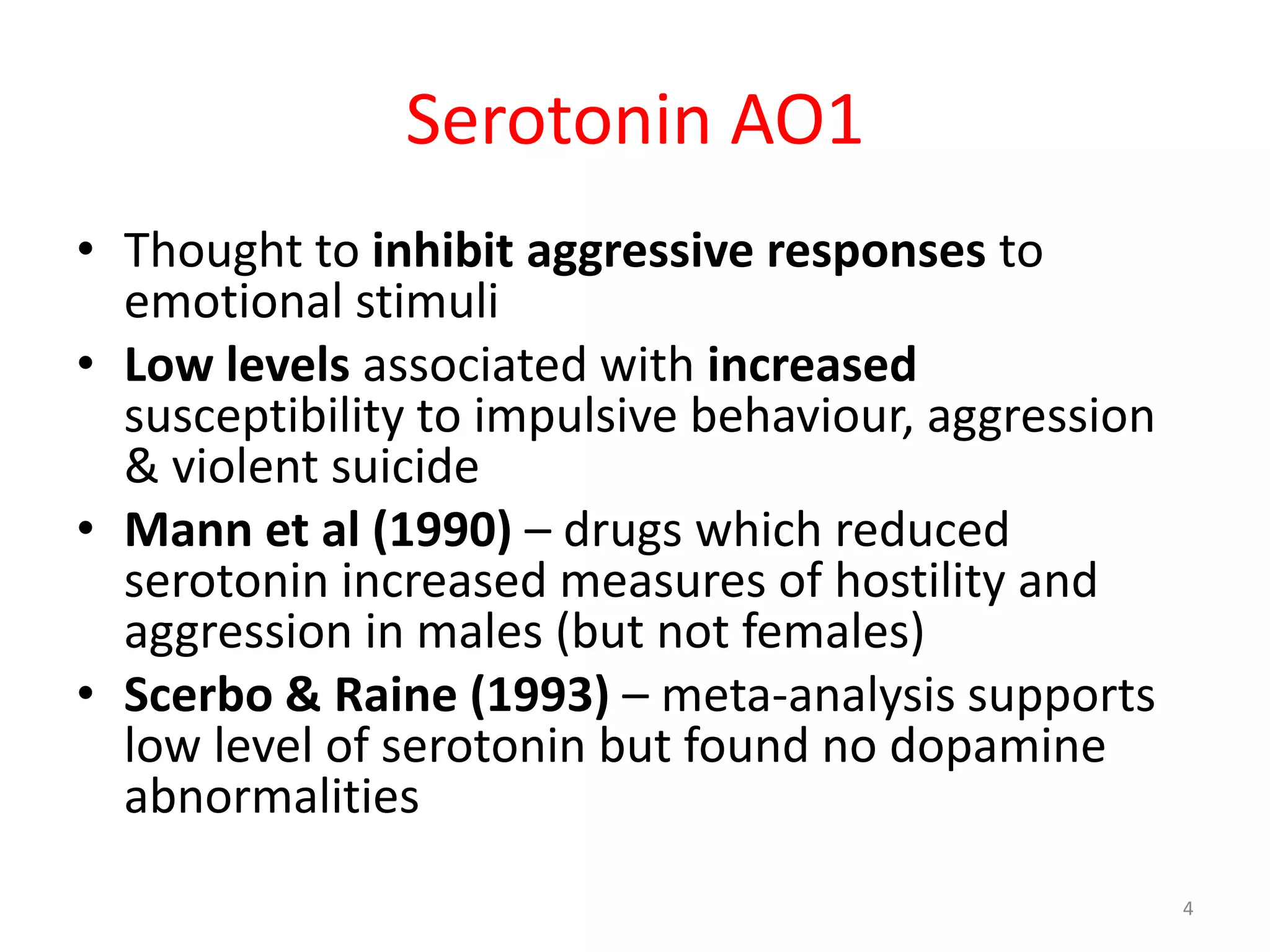
Serotonin AO1 Thought to inhibit aggressive responses to emotional stimuliLow levels associated with increased susceptibility to impulsive behaviour, aggression & violent suicideMann et al (1990) – drugs which reduced serotonin increased measures of hostility and aggression in males (but not females)Scerbo & Raine (1993) – meta-analysis supports low level of serotonin but found no dopamine abnormalities4
Dopamine AO1 Link less well established than serotoninLavine (1997) – giving amphetamines (which increase dopamine) increases aggressive behaviourBuitelaar (2003) – giving anti-psychotics (which reduce dopamine) reduced aggressive behaviour in violent delinquents5
Testosterone AO1Thought to act on areas of brain which control aggression from young adulthood onwardsThought to be primary biochemical influence on aggressionDabbs et al (1987) – salivary testosterone levels were able to differentiate between violent and non-violent crimesLindman et al (1987) – aggressive behaviour in drunk males positively correlated with testosterone levelsWagner et al (1979) castrated male mice showed decreased aggression which then increased when given testosterone againArcher (1991) and Book et al (2001) – meta analyses with weak but positive correlation between testosterone and aggressionWingfield et al (1990) – argue that testosterone levels rise in monogamous species in response to social challenges6
Cortisol AO1 Cortisol mediates other hormones such as testosteroneHigh levels of cortisol inhibit testosterone and so inhibit aggressionSo low levels of cortisol associated with increased aggressionVirkuunen (1985) found low levels of cortisol in habitual violent offenders;Tennes & Kreye (1985) same in violent schoolchildren7
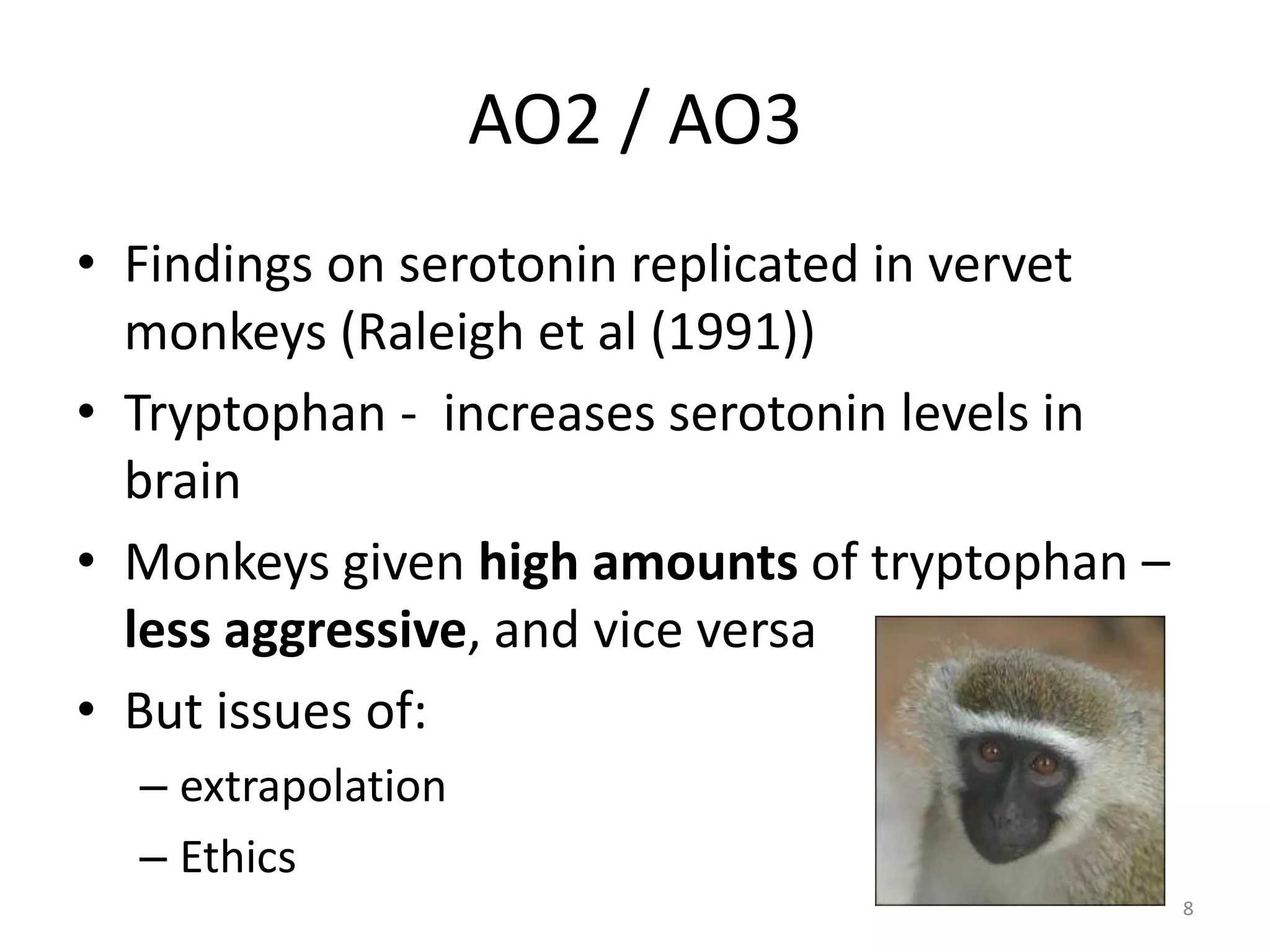
AO2 / AO3Findings on serotonin replicated in vervet monkeys (Raleigh et al (1991))Tryptophan -  increases serotonin levels in brainMonkeys given high amounts of tryptophan – less aggressive, and vice versaBut issues of: extrapolationEthics8
AO2Findings on serotonin also confirmed via studies on anti-depressantsBond (2005) – anti-depressant drugs that elevate Serotonin – reduce irritability and impulsive aggressionHowever Lenard (2008) cautions that serotonin not just linked to aggression: also to impulsive behaviour, depression, over-eating, alcohol abuse; violent suicide9
AO2Causal role of dopamine unclearPerhaps high levels of dopamine are an effect rather than a cause?Couppis and Kennedy (2008) – mice - reward pathway in brain activated in response to an aggressive event – dopamine acts as a positive reinforcer.Seek out aggressive encounter because they get a rewarding sensation from it.10
AO2 / AO3Evidence conflicting on role of testosteroneStudies showing positive correlation - small samples, mostly males in prisons and self-report measures.Studies mainly correlational (eg. Wagner) so not possible to conclude that testosterone causes aggressionAlso testosterone not always associated with negative characteristics: improved sporting and spatial abilities also been found11
AO2 clarification neededMazur (1985) - Need to distinguish between aggression & dominanceIssue relates to the internal validity if the research as studies may be measuring different things, making comparison of results difficult12
AO2 issuesGender bias evident as most research done on males (animals and humans) whereas it is known that there are differences between the genders in androgensAlso cultural bias as most research conducted in western countriesAnimal research – can’t generalise to humans, ethics13
AO2 debatesPhysiologically reductionistic to just consider role of biochemistry aloneAlso need to consider genetic factors and brain structure Eg. Phineas Gage suffered brain injury and showed heightened levels of aggressionAlso need to consider the contribution of environmental factors such as situational cues, temperature, noise, overcrowding, and the role of learning14
AO2 applicationClearly a very important & useful area of biopsychological research and theory as aggression associated with many anti-social phenomena in society, eg. numerous forms of crime, violence
If the role of biochemistry can be understood it can perhaps be treated or managed
Although there would be ethical issues associated with giving people drugs simply to alleviate aggression (ie. for social control) , or male castration, even if it may be in the interests of multiple parties
Could perhaps be treated  more ethically through diet (tryptophan) and exercise15
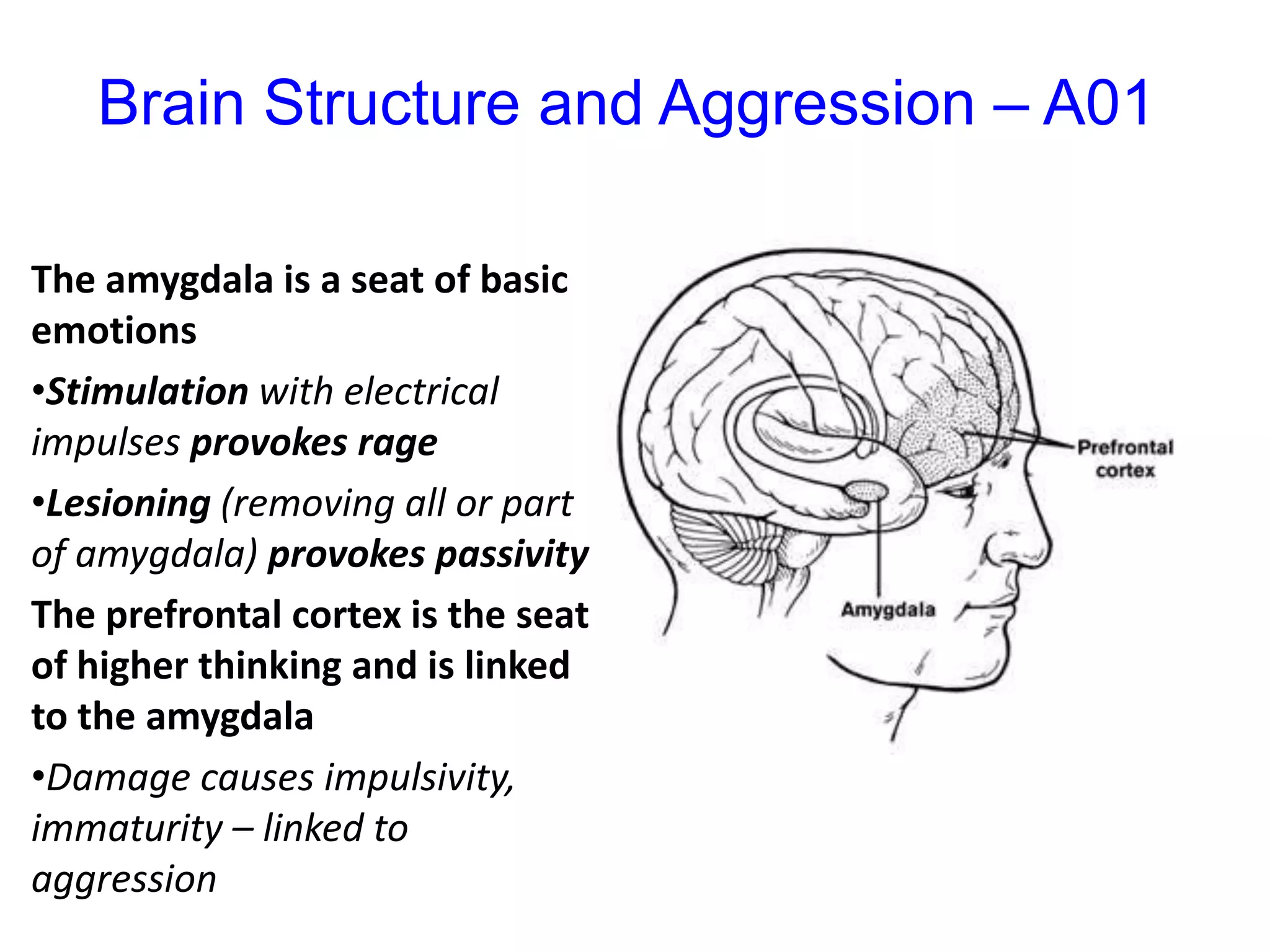
Brain Structure and Aggression – A01The amygdala is a seat of basic emotionsStimulation with electrical impulses provokes rageLesioning (removing all or part of amygdala) provokes passivityThe prefrontal cortex is the seat of higher thinking and is linked to the amygdalaDamage causes impulsivity, immaturity – linked to aggression

Biological expl of aggression

  • 1.
    Biological explanations ofaggressionNeural and hormonal mechanisms and aggression1
  • 2.
    Neural and HormonalMechanisms in AggressionBATsA01 -Outline biochemical influences on aggressive behaviour (hormones and neurotransmitters) - Outline how brain structure can affect aggressive behaviourA02/3 Evaluate the effectiveness of biological explanations of the cause of aggressionP66-67
  • 3.
    Essentially the argumentisLow levels of serotoninHigh levels of dopamineHigh levels of testosteroneLow levels of cortisol..... are associated with aggression3Neurotransmittershormones
  • 4.
    Serotonin AO1 Thoughtto inhibit aggressive responses to emotional stimuliLow levels associated with increased susceptibility to impulsive behaviour, aggression & violent suicideMann et al (1990) – drugs which reduced serotonin increased measures of hostility and aggression in males (but not females)Scerbo & Raine (1993) – meta-analysis supports low level of serotonin but found no dopamine abnormalities4
  • 5.
    Dopamine AO1 Linkless well established than serotoninLavine (1997) – giving amphetamines (which increase dopamine) increases aggressive behaviourBuitelaar (2003) – giving anti-psychotics (which reduce dopamine) reduced aggressive behaviour in violent delinquents5
  • 6.
    Testosterone AO1Thought toact on areas of brain which control aggression from young adulthood onwardsThought to be primary biochemical influence on aggressionDabbs et al (1987) – salivary testosterone levels were able to differentiate between violent and non-violent crimesLindman et al (1987) – aggressive behaviour in drunk males positively correlated with testosterone levelsWagner et al (1979) castrated male mice showed decreased aggression which then increased when given testosterone againArcher (1991) and Book et al (2001) – meta analyses with weak but positive correlation between testosterone and aggressionWingfield et al (1990) – argue that testosterone levels rise in monogamous species in response to social challenges6
  • 7.
    Cortisol AO1 Cortisolmediates other hormones such as testosteroneHigh levels of cortisol inhibit testosterone and so inhibit aggressionSo low levels of cortisol associated with increased aggressionVirkuunen (1985) found low levels of cortisol in habitual violent offenders;Tennes & Kreye (1985) same in violent schoolchildren7
  • 8.
    AO2 / AO3Findingson serotonin replicated in vervet monkeys (Raleigh et al (1991))Tryptophan - increases serotonin levels in brainMonkeys given high amounts of tryptophan – less aggressive, and vice versaBut issues of: extrapolationEthics8
  • 9.
    AO2Findings on serotoninalso confirmed via studies on anti-depressantsBond (2005) – anti-depressant drugs that elevate Serotonin – reduce irritability and impulsive aggressionHowever Lenard (2008) cautions that serotonin not just linked to aggression: also to impulsive behaviour, depression, over-eating, alcohol abuse; violent suicide9
  • 10.
    AO2Causal role ofdopamine unclearPerhaps high levels of dopamine are an effect rather than a cause?Couppis and Kennedy (2008) – mice - reward pathway in brain activated in response to an aggressive event – dopamine acts as a positive reinforcer.Seek out aggressive encounter because they get a rewarding sensation from it.10
  • 11.
    AO2 / AO3Evidenceconflicting on role of testosteroneStudies showing positive correlation - small samples, mostly males in prisons and self-report measures.Studies mainly correlational (eg. Wagner) so not possible to conclude that testosterone causes aggressionAlso testosterone not always associated with negative characteristics: improved sporting and spatial abilities also been found11
  • 12.
    AO2 clarification neededMazur(1985) - Need to distinguish between aggression & dominanceIssue relates to the internal validity if the research as studies may be measuring different things, making comparison of results difficult12
  • 13.
    AO2 issuesGender biasevident as most research done on males (animals and humans) whereas it is known that there are differences between the genders in androgensAlso cultural bias as most research conducted in western countriesAnimal research – can’t generalise to humans, ethics13
  • 14.
    AO2 debatesPhysiologically reductionisticto just consider role of biochemistry aloneAlso need to consider genetic factors and brain structure Eg. Phineas Gage suffered brain injury and showed heightened levels of aggressionAlso need to consider the contribution of environmental factors such as situational cues, temperature, noise, overcrowding, and the role of learning14
  • 15.
    AO2 applicationClearly avery important & useful area of biopsychological research and theory as aggression associated with many anti-social phenomena in society, eg. numerous forms of crime, violence
  • 16.
    If the roleof biochemistry can be understood it can perhaps be treated or managed
  • 17.
    Although there wouldbe ethical issues associated with giving people drugs simply to alleviate aggression (ie. for social control) , or male castration, even if it may be in the interests of multiple parties
  • 18.
    Could perhaps betreated more ethically through diet (tryptophan) and exercise15
  • 19.
    Brain Structure andAggression – A01The amygdala is a seat of basic emotionsStimulation with electrical impulses provokes rageLesioning (removing all or part of amygdala) provokes passivityThe prefrontal cortex is the seat of higher thinking and is linked to the amygdalaDamage causes impulsivity, immaturity – linked to aggression
  • 20.
    Animal Studies –1930’s - removal of amygdala in aggressive animals – taming effectLeDoux 1996 – sustained stimulation of amygdala in lab animals resulted in fear and rageHuman studies – Narabayashi et al (1972) – 43/51 patients who hd amygdala removed showed reduced aggression, Heimberger (1978) 48/58 patients showed improvement in aggressive behaviourTemporal lobe epilepsy – Ashford (1980) – become aggressive to people close byParts of amygdala ‘wired’ to produce aggression, whereas prefontal cortex offers control of aggressionBrain Structure and Aggression – A02
  • 21.
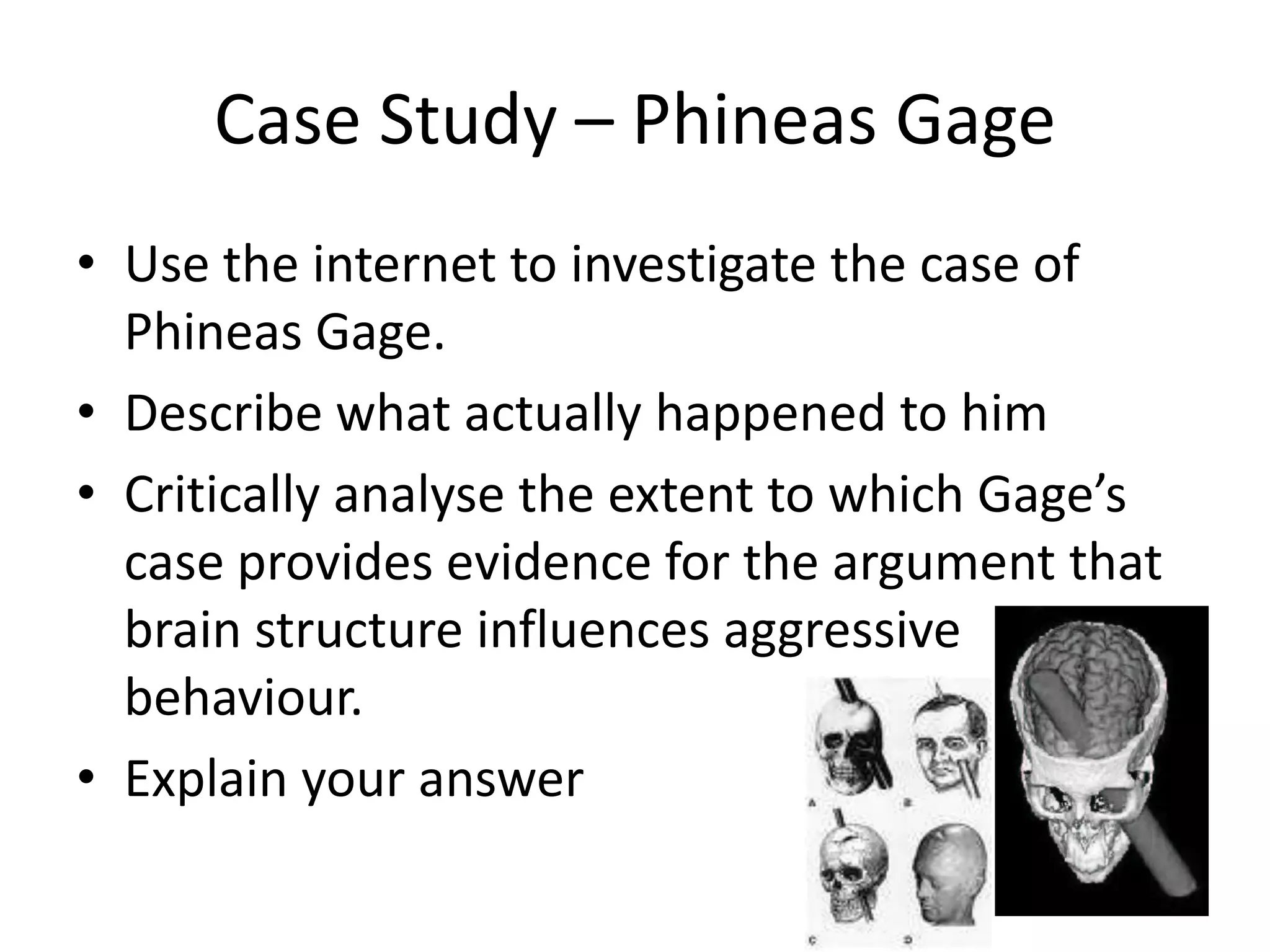
    Case Study –Phineas GageUse the internet to investigate the case of Phineas Gage.Describe what actually happened to himCritically analyse the extent to which Gage’s case provides evidence for the argument that brain structure influences aggressive behaviour.Explain your answer
  • 22.
    Brain Structure andAggression – A03Phineas Gage - case study – relying on notes made by Dr Harlow. Can’t generalise.Animal research – can’t generalise. Humans more complexSynoptic Points – Animal Research - Does the end result of animal research justify the means? Bateson 1986 – need to maintain a balance between advancing psychological understanding and keeping suffering to a minimum.