
Agents Used in Coagulation Disorders
 
Clot Risk Factors Over 40 years old Obese Best rest > 4 days Estrogen & estrogen with nicotine Pregnancy, surgery, major illness
Blood Coagulation Mechanism Definitions GUT Vitamin K role Circulation Clotting factors  Prothrombin – Thrombin Fibrinogen -- Fibrin
Indications Venous thrombosis Pulmonary Embolism (PE) Prosthetic Heart Valve Myocardial Infarction (MI) Cerebral Vascular Disease Coronary Heart Disease
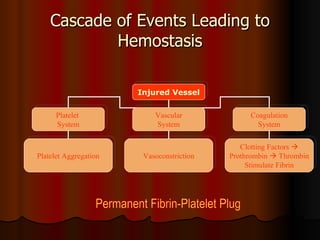
Cascade of Events Leading to Hemostasis Injured Vessel Platelet  System Vascular System Coagulation System Clotting Factors   Prothrombin    Thrombin Stimulate Fibrin Vasoconstriction Platelet Aggregation Permanent Fibrin-Platelet Plug
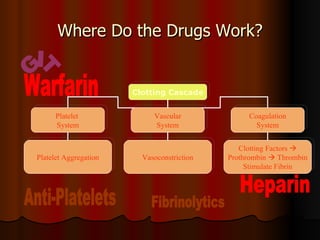
Where Do the Drugs Work? Clotting Cascade Platelet  System Vascular System Coagulation System Clotting Factors   Prothrombin    Thrombin Stimulate Fibrin Vasoconstriction Platelet Aggregation Heparin Warfarin GIT Anti-Platelets Fibrinolytics
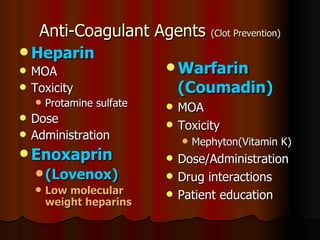
Anti-Coagulant Agents  (Clot Prevention) Heparin MOA Toxicity Protamine sulfate Dose Administration Enoxaprin (Lovenox) Low molecular weight heparins Warfarin (Coumadin) MOA Toxicity Mephyton(Vitamin K) Dose/Administration Drug interactions Patient education
Fibrinolytic Agents  (Clot Busters) Pharmacology Streptokinase/Urokinase Anistreplase/TPA (Activase) Indications Pulmonary Emboli (PE) Deep Venous Thrombosis (DVT) Acute Myocardial Infarction (MI)
 
Anti-Platelets (Glide & Slide) Indications Pharmacology ASA Clopidogrel (Plavix) Ticlopidine (Ticlid) Toxicity Patient Education
Stroke Recognize the signs Ask three questions Ask the individual to SMILE Ask him or her to RAISE both arms Ask the person to SPEAK a simple sentence Trouble with any task call 9-1-1
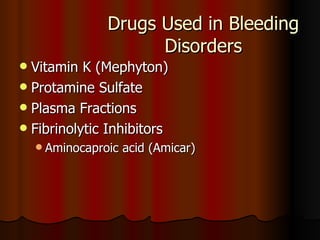
Drugs Used in Bleeding Disorders Vitamin K (Mephyton) Protamine Sulfate Plasma Fractions Fibrinolytic Inhibitors Aminocaproic acid (Amicar)
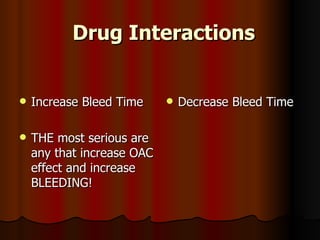
Drug Interactions Increase Bleed Time THE most serious are any that increase OAC effect and increase BLEEDING! Decrease Bleed Time
Summary Slide Blood Coagulation Mechanism Clot Risk Factors Anti-Coagulant Agents (Clot Prevention) Fibrinolytic Agents  (Clot Busters) Anti-Platelets (Glide & Slide) Drug Interactions Drugs Used in Bleeding Disorders
Case Study
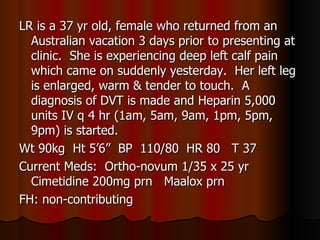
LR is a 37 yr old, female who returned from an Australian vacation 3 days prior to presenting at clinic.  She is experiencing deep left calf pain which came on suddenly yesterday.  Her left leg is enlarged, warm & tender to touch.  A diagnosis of DVT is made and Heparin 5,000 units IV q 4 hr (1am, 5am, 9am, 1pm, 5pm, 9pm) is started. Wt 90kg  Ht 5’6”  BP  110/80  HR 80  T 37 Current Meds:  Ortho-novum 1/35 x 25 yr  Cimetidine 200mg prn  Maalox prn FH: non-contributing
Points to Ponder Assess patient condition and etiology. Discuss initial treatment, monitoring and side effects. Discuss chronic treatment, monitoring and side effects. Comments regarding patient education.

Agents used in coagulation disorders

  • 1.
    Agents Used inCoagulation Disorders
  • 2.
  • 3.
    Clot Risk FactorsOver 40 years old Obese Best rest > 4 days Estrogen & estrogen with nicotine Pregnancy, surgery, major illness
  • 4.
    Blood Coagulation MechanismDefinitions GUT Vitamin K role Circulation Clotting factors Prothrombin – Thrombin Fibrinogen -- Fibrin
  • 5.
    Indications Venous thrombosisPulmonary Embolism (PE) Prosthetic Heart Valve Myocardial Infarction (MI) Cerebral Vascular Disease Coronary Heart Disease
  • 6.
    Cascade of EventsLeading to Hemostasis Injured Vessel Platelet System Vascular System Coagulation System Clotting Factors  Prothrombin  Thrombin Stimulate Fibrin Vasoconstriction Platelet Aggregation Permanent Fibrin-Platelet Plug
  • 7.
    Where Do theDrugs Work? Clotting Cascade Platelet System Vascular System Coagulation System Clotting Factors  Prothrombin  Thrombin Stimulate Fibrin Vasoconstriction Platelet Aggregation Heparin Warfarin GIT Anti-Platelets Fibrinolytics
  • 8.
    Anti-Coagulant Agents (Clot Prevention) Heparin MOA Toxicity Protamine sulfate Dose Administration Enoxaprin (Lovenox) Low molecular weight heparins Warfarin (Coumadin) MOA Toxicity Mephyton(Vitamin K) Dose/Administration Drug interactions Patient education
  • 9.
    Fibrinolytic Agents (Clot Busters) Pharmacology Streptokinase/Urokinase Anistreplase/TPA (Activase) Indications Pulmonary Emboli (PE) Deep Venous Thrombosis (DVT) Acute Myocardial Infarction (MI)
  • 10.
  • 11.
    Anti-Platelets (Glide &Slide) Indications Pharmacology ASA Clopidogrel (Plavix) Ticlopidine (Ticlid) Toxicity Patient Education
  • 12.
    Stroke Recognize thesigns Ask three questions Ask the individual to SMILE Ask him or her to RAISE both arms Ask the person to SPEAK a simple sentence Trouble with any task call 9-1-1
  • 13.
    Drugs Used inBleeding Disorders Vitamin K (Mephyton) Protamine Sulfate Plasma Fractions Fibrinolytic Inhibitors Aminocaproic acid (Amicar)
  • 14.
    Drug Interactions IncreaseBleed Time THE most serious are any that increase OAC effect and increase BLEEDING! Decrease Bleed Time
  • 15.
    Summary Slide BloodCoagulation Mechanism Clot Risk Factors Anti-Coagulant Agents (Clot Prevention) Fibrinolytic Agents (Clot Busters) Anti-Platelets (Glide & Slide) Drug Interactions Drugs Used in Bleeding Disorders
  • 16.
  • 17.
    LR is a37 yr old, female who returned from an Australian vacation 3 days prior to presenting at clinic. She is experiencing deep left calf pain which came on suddenly yesterday. Her left leg is enlarged, warm & tender to touch. A diagnosis of DVT is made and Heparin 5,000 units IV q 4 hr (1am, 5am, 9am, 1pm, 5pm, 9pm) is started. Wt 90kg Ht 5’6” BP 110/80 HR 80 T 37 Current Meds: Ortho-novum 1/35 x 25 yr Cimetidine 200mg prn Maalox prn FH: non-contributing
  • 18.
    Points to PonderAssess patient condition and etiology. Discuss initial treatment, monitoring and side effects. Discuss chronic treatment, monitoring and side effects. Comments regarding patient education.