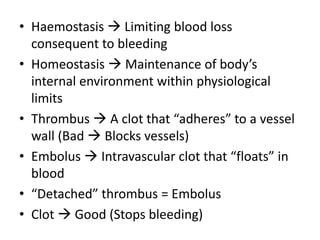
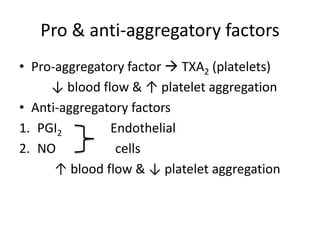
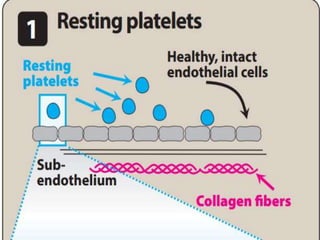
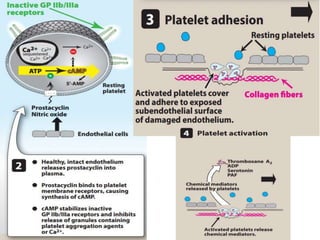
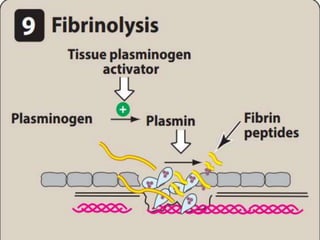
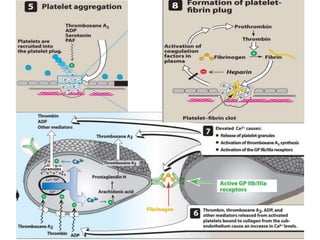
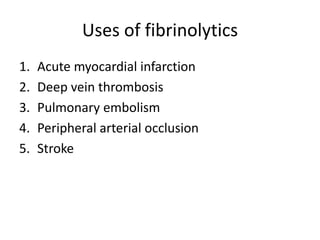
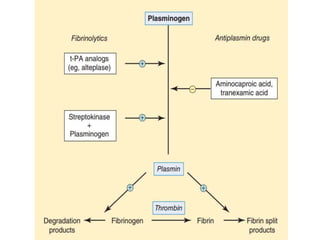
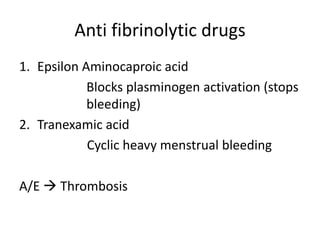
• Haemostasis Limiting blood loss
consequent to bleeding
• Homeostasis Maintenance of body’s
internal environment within physiological
limits
• Thrombus A clot that “adheres” to a vessel
wall (Bad Blocks vessels)
• Embolus Intravascular clot that “floats” in
blood
• “Detached” thrombus = Embolus
• Clot Good (Stops bleeding)
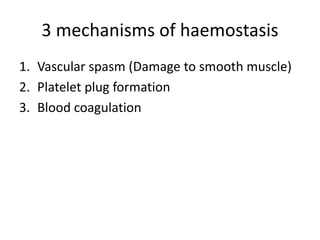
3.
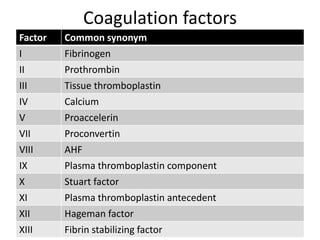
Coagulation factors
Factor Commonsynonym
I Fibrinogen
II Prothrombin
III Tissue thromboplastin
IV Calcium
V Proaccelerin
VII Proconvertin
VIII AHF
IX Plasma thromboplastin component
X Stuart factor
XI Plasma thromboplastin antecedent
XII Hageman factor
XIII Fibrin stabilizing factor
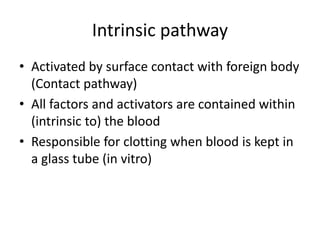
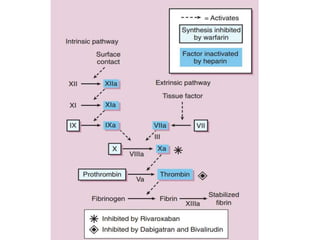
Intrinsic pathway
• Activatedby surface contact with foreign body
(Contact pathway)
• All factors and activators are contained within
(intrinsic to) the blood
• Responsible for clotting when blood is kept in
a glass tube (in vitro)
6.
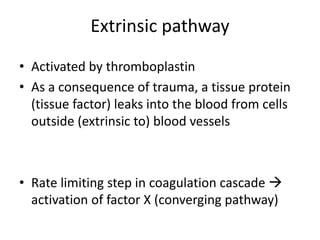
Extrinsic pathway
• Activatedby thromboplastin
• As a consequence of trauma, a tissue protein
(tissue factor) leaks into the blood from cells
outside (extrinsic to) blood vessels
• Rate limiting step in coagulation cascade
activation of factor X (converging pathway)
Coagulants
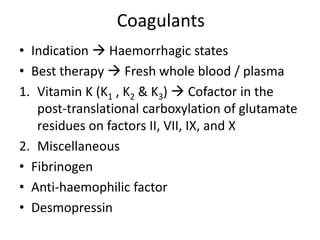
• Indication Haemorrhagic states
• Best therapy Fresh whole blood / plasma
1. Vitamin K (K1 , K2 & K3) Cofactor in the
post-translational carboxylation of glutamate
residues on factors II, VII, IX, and X
2. Miscellaneous
• Fibrinogen
• Anti-haemophilic factor
• Desmopressin
Classification
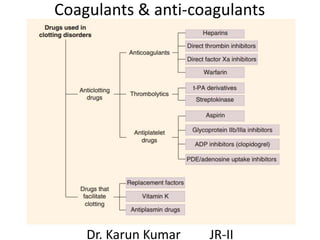
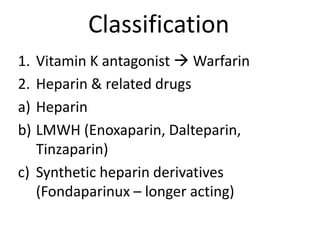
1. Vitamin Kantagonist Warfarin
2. Heparin & related drugs
a) Heparin
b) LMWH (Enoxaparin, Dalteparin,
Tinzaparin)
c) Synthetic heparin derivatives
(Fondaparinux – longer acting)
17.
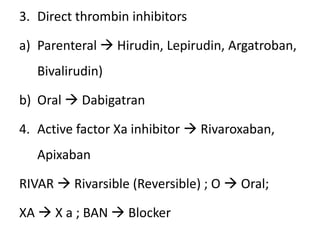
3. Direct thrombininhibitors
a) Parenteral Hirudin, Lepirudin, Argatroban,
Bivalirudin)
b) Oral Dabigatran
4. Active factor Xa inhibitor Rivaroxaban,
Apixaban
RIVAR Rivarsible (Reversible) ; O Oral;
XA X a ; BAN Blocker
18.
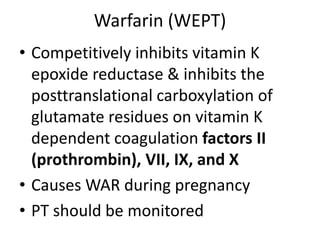
Warfarin (WEPT)
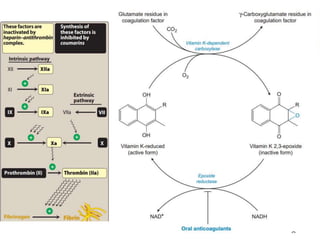
• Competitivelyinhibits vitamin K
epoxide reductase & inhibits the
posttranslational carboxylation of
glutamate residues on vitamin K
dependent coagulation factors II
(prothrombin), VII, IX, and X
• Causes WAR during pregnancy
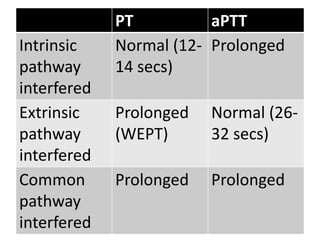
• PT should be monitored
21.
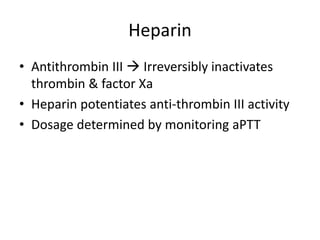
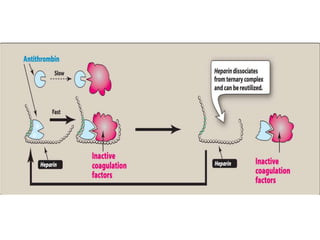
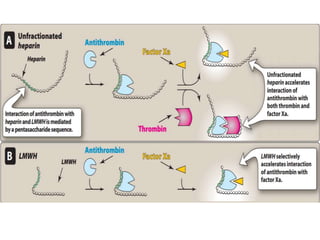
Heparin
• Antithrombin III Irreversibly inactivates
thrombin & factor Xa
• Heparin potentiates anti-thrombin III activity
• Dosage determined by monitoring aPTT
24.
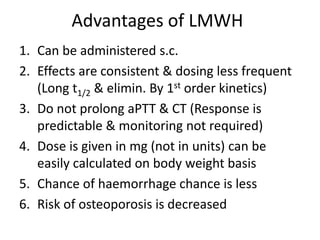
Advantages of LMWH
1.Can be administered s.c.
2. Effects are consistent & dosing less frequent
(Long t1/2 & elimin. By 1st order kinetics)
3. Do not prolong aPTT & CT (Response is
predictable & monitoring not required)
4. Dose is given in mg (not in units) can be
easily calculated on body weight basis
5. Chance of haemorrhage chance is less
6. Risk of osteoporosis is decreased
25.
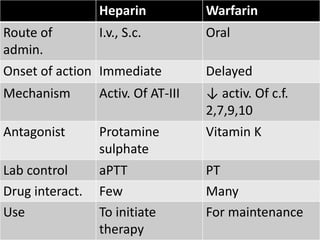
Heparin Warfarin
Route of
admin.
I.v.,S.c. Oral
Onset of action Immediate Delayed
Mechanism Activ. Of AT-III ↓ activ. Of c.f.
2,7,9,10
Antagonist Protamine
sulphate
Vitamin K
Lab control aPTT PT
Drug interact. Few Many
Use To initiate
therapy
For maintenance
26.
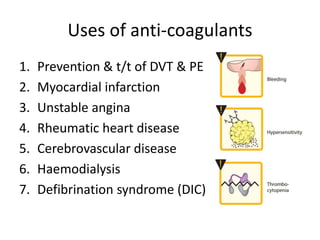
Uses of anti-coagulants
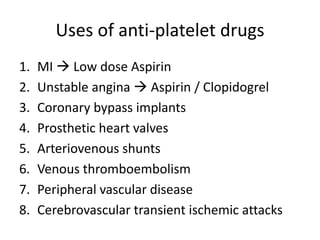
1.Prevention & t/t of DVT & PE
2. Myocardial infarction
3. Unstable angina
4. Rheumatic heart disease
5. Cerebrovascular disease
6. Haemodialysis
7. Defibrination syndrome (DIC)
27.
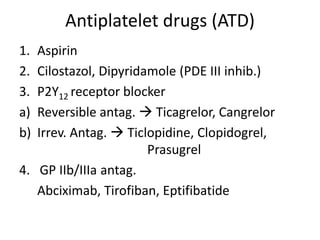
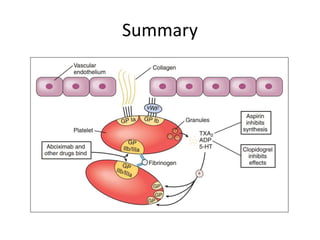
Antiplatelet drugs (ATD)
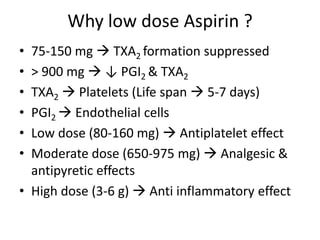
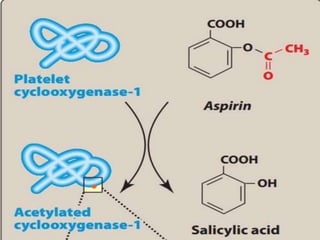
1.Aspirin
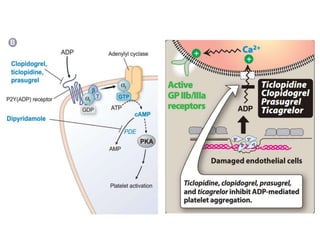
2. Cilostazol, Dipyridamole (PDE III inhib.)
3. P2Y12 receptor blocker
a) Reversible antag. Ticagrelor, Cangrelor
b) Irrev. Antag. Ticlopidine, Clopidogrel,
Prasugrel
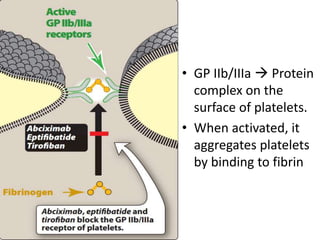
4. GP IIb/IIIa antag.
Abciximab, Tirofiban, Eptifibatide
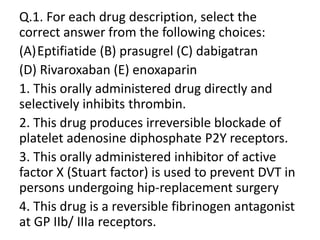
Q.1. For eachdrug description, select the
correct answer from the following choices:
(A)Eptifiatide (B) prasugrel (C) dabigatran
(D) Rivaroxaban (E) enoxaparin
1. This orally administered drug directly and
selectively inhibits thrombin.
2. This drug produces irreversible blockade of
platelet adenosine diphosphate P2Y receptors.
3. This orally administered inhibitor of active
factor X (Stuart factor) is used to prevent DVT in
persons undergoing hip-replacement surgery
4. This drug is a reversible fibrinogen antagonist
at GP IIb/ IIIa receptors.
41.
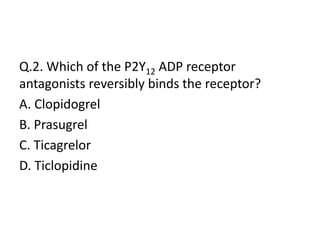
Q.2. Which ofthe P2Y12 ADP receptor
antagonists reversibly binds the receptor?
A. Clopidogrel
B. Prasugrel
C. Ticagrelor
D. Ticlopidine
42.
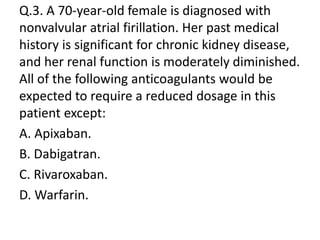
Q.3. A 70-year-oldfemale is diagnosed with
nonvalvular atrial firillation. Her past medical
history is significant for chronic kidney disease,
and her renal function is moderately diminished.
All of the following anticoagulants would be
expected to require a reduced dosage in this
patient except:
A. Apixaban.
B. Dabigatran.
C. Rivaroxaban.
D. Warfarin.
43.
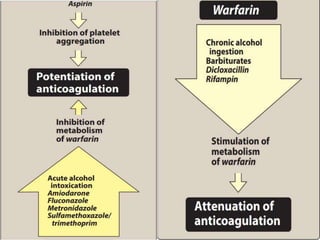
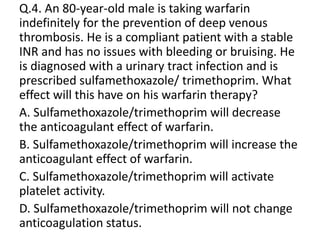
Q.4. An 80-year-oldmale is taking warfarin
indefinitely for the prevention of deep venous
thrombosis. He is a compliant patient with a stable
INR and has no issues with bleeding or bruising. He
is diagnosed with a urinary tract infection and is
prescribed sulfamethoxazole/ trimethoprim. What
effect will this have on his warfarin therapy?
A. Sulfamethoxazole/trimethoprim will decrease
the anticoagulant effect of warfarin.
B. Sulfamethoxazole/trimethoprim will increase the
anticoagulant effect of warfarin.
C. Sulfamethoxazole/trimethoprim will activate
platelet activity.
D. Sulfamethoxazole/trimethoprim will not change
anticoagulation status.
44.
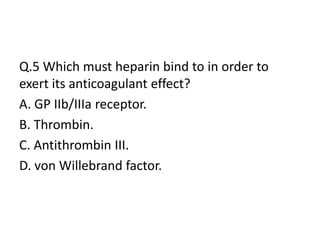
Q.5 Which mustheparin bind to in order to
exert its anticoagulant effect?
A. GP IIb/IIIa receptor.
B. Thrombin.
C. Antithrombin III.
D. von Willebrand factor.
45.
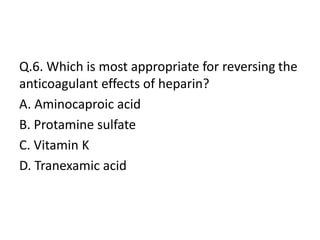
Q.6. Which ismost appropriate for reversing the
anticoagulant effects of heparin?
A. Aminocaproic acid
B. Protamine sulfate
C. Vitamin K
D. Tranexamic acid
46.
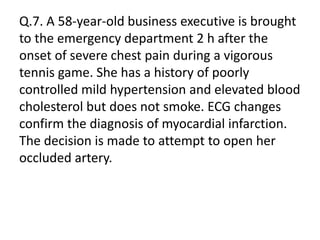
Q.7. A 58-year-oldbusiness executive is brought
to the emergency department 2 h after the
onset of severe chest pain during a vigorous
tennis game. She has a history of poorly
controlled mild hypertension and elevated blood
cholesterol but does not smoke. ECG changes
confirm the diagnosis of myocardial infarction.
The decision is made to attempt to open her
occluded artery.
47.
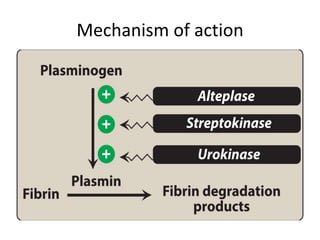
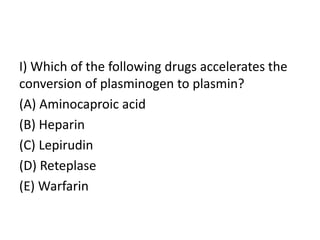
I) Which ofthe following drugs accelerates the
conversion of plasminogen to plasmin?
(A) Aminocaproic acid
(B) Heparin
(C) Lepirudin
(D) Reteplase
(E) Warfarin
48.
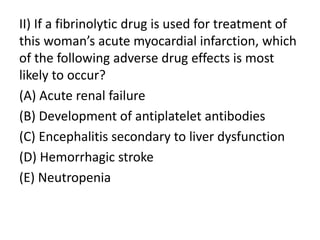
II) If afibrinolytic drug is used for treatment of
this woman’s acute myocardial infarction, which
of the following adverse drug effects is most
likely to occur?
(A) Acute renal failure
(B) Development of antiplatelet antibodies
(C) Encephalitis secondary to liver dysfunction
(D) Hemorrhagic stroke
(E) Neutropenia
49.
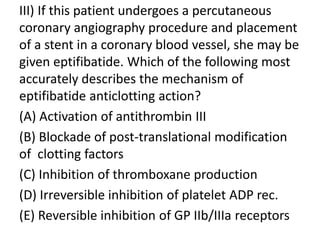
III) If thispatient undergoes a percutaneous
coronary angiography procedure and placement
of a stent in a coronary blood vessel, she may be
given eptifibatide. Which of the following most
accurately describes the mechanism of
eptifibatide anticlotting action?
(A) Activation of antithrombin III
(B) Blockade of post-translational modification
of clotting factors
(C) Inhibition of thromboxane production
(D) Irreversible inhibition of platelet ADP rec.
(E) Reversible inhibition of GP IIb/IIIa receptors
50.
Q. 8. A65-year-old man is brought to the
emergency department 30 min after the onset
of right-sided weakness and aphasia (difficulty
speaking). Imaging studies ruled out cerebral
hemorrhage as the cause of his acute symptoms
of stroke.
51.
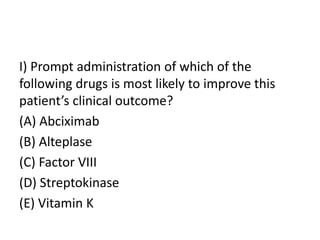
I) Prompt administrationof which of the
following drugs is most likely to improve this
patient’s clinical outcome?
(A) Abciximab
(B) Alteplase
(C) Factor VIII
(D) Streptokinase
(E) Vitamin K
52.
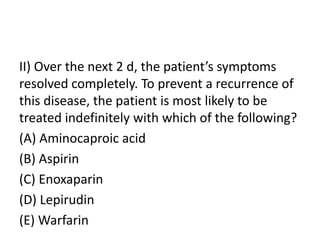
II) Over thenext 2 d, the patient’s symptoms
resolved completely. To prevent a recurrence of
this disease, the patient is most likely to be
treated indefinitely with which of the following?
(A) Aminocaproic acid
(B) Aspirin
(C) Enoxaparin
(D) Lepirudin
(E) Warfarin
53.
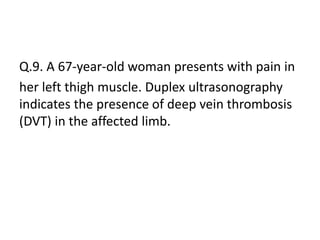
Q.9. A 67-year-oldwoman presents with pain in
her left thigh muscle. Duplex ultrasonography
indicates the presence of deep vein thrombosis
(DVT) in the affected limb.
54.
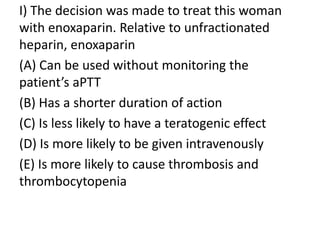
I) The decisionwas made to treat this woman
with enoxaparin. Relative to unfractionated
heparin, enoxaparin
(A) Can be used without monitoring the
patient’s aPTT
(B) Has a shorter duration of action
(C) Is less likely to have a teratogenic effect
(D) Is more likely to be given intravenously
(E) Is more likely to cause thrombosis and
thrombocytopenia
55.
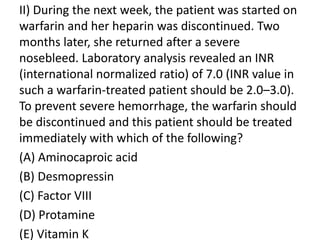
II) During thenext week, the patient was started on
warfarin and her heparin was discontinued. Two
months later, she returned after a severe
nosebleed. Laboratory analysis revealed an INR
(international normalized ratio) of 7.0 (INR value in
such a warfarin-treated patient should be 2.0–3.0).
To prevent severe hemorrhage, the warfarin should
be discontinued and this patient should be treated
immediately with which of the following?
(A) Aminocaproic acid
(B) Desmopressin
(C) Factor VIII
(D) Protamine
(E) Vitamin K
56.
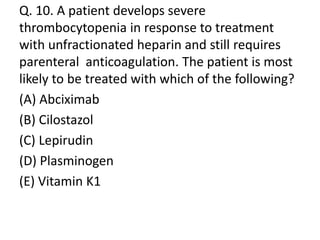
Q. 10. Apatient develops severe
thrombocytopenia in response to treatment
with unfractionated heparin and still requires
parenteral anticoagulation. The patient is most
likely to be treated with which of the following?
(A) Abciximab
(B) Cilostazol
(C) Lepirudin
(D) Plasminogen
(E) Vitamin K1
Editor's Notes
#32 ADP activates platelets through P2X1 Ion channel P2Y1 Gq P2Y12 Gi
#33 GP Iib/IIIA adhesive receptor (integrin) on platelet surface for platelet aggregation