Drugs used in Treatment of
Gout
Dr. Pravin Prasad
M.B.B.S., MD Clinical Pharmacology
Lecturer, Lumbini Medical College & TH
22 March 2019 (8 Chaitra 2075), Friday
By the end of this class, MBBS 1st
Sem students will be able to:
 Classify drugs used in the treatment of
gouty arthritis
 Discuss the pharmacology of drugs used in
gouty arthritis
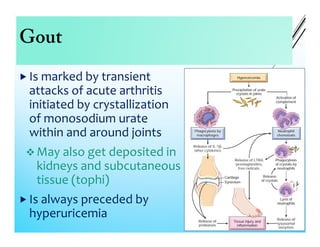
Gout
 Is marked by transient
attacks of acute arthritis
initiated by crystallization
of monosodium urate
within and around joints
 May also get deposited in
kidneys and subcutaneous
tissue (tophi)
 Is always preceded by
hyperuricemia
Drugs useful in gout
Objective of treatment Drugs
Relieve inflammation
and pain
NSAIDs, colchicine,
glucocorticoids
Prevent inflammatory
responses
NSAIDs, colchicine
Inhibit urate formation Allopurinol, febuxostat
Augment urate
excretion
Probenecid
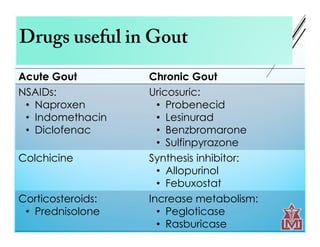
Drugs useful in Gout
Acute Gout Chronic Gout
NSAIDs:
• Naproxen
• Indomethacin
• Diclofenac
Uricosuric:
• Probenecid
• Lesinurad
• Benzbromarone
• Sulfinpyrazone
Colchicine Synthesis inhibitor:
• Allopurinol
• Febuxostat
Corticosteroids:
• Prednisolone
Increase metabolism:
• Pegloticase
• Rasburicase
Colchicine
 Alkaloid derived from C. autumnale
 Specifically suppresses gouty
inflammation
 Faster acting than NSAIDs
 Control of attack 6-12 hrs
 Complete resolution 3-5 days
 Higher toxicity than NSAIDs
Colchicine: Mechanism of action
 Acts by:
 Inhibiting release of
chemotactic factors and
glycoproteins
 Binds to fibrillar protein
and inhibits granulocyte
migration to joints
 Also has amitotic action and
increases gut motility
• Subsequent
steps Inhibited
• Vicious cycle
interrupted
Colchicine: Pharmacokinetics
 Rapidly absorbed orally
 Partly metabolised by liver and excreted in bile
 Undergoes hepatic circulation
 Takes long to get eliminated
 Metabolised by CYP3A4 isoenzymes
 Drug interactions with enzyme inhibitors/inducers
 Gets eliminated in urine and faeces
 Dose reduction in renal impairment
Colchicine: Adverse effects
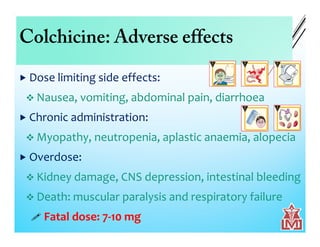
 Dose limiting side effects:
 Nausea, vomiting, abdominal pain, diarrhoea
 Chronic administration:
 Myopathy, neutropenia, aplastic anaemia, alopecia
 Overdose:
 Kidney damage, CNS depression, intestinal bleeding
 Death: muscular paralysis and respiratory failure
 Fatal dose: 7-10 mg
Colchicine: Uses
 To abort an attack of gout:
 0.5-1.5 mg stat
 To control an acute attack of gout:
 Second line, fastest acting
 0.5 mg 1-3 hourly, 4 doses in a day
 Maximum dose: 6 mg over 3-4 days
 As maintenance dose in gout:
 0.5-1 mg/d (4-8 weeks)
Probenecid
 Enhances excretion of uric acid by:
 Blocking Urate transporter-1 (URAT-1)
 A type of organic anion transport
protein (OATP)
 Predominant reabsorption of uric acid
in kidney (PCTs)
 Reabsorption of uric acid in PCT
inhibited
 Excretion enhanced, blood urate level
falls
Probenecid: Interactions
 Inhibits urinary excretion of:
 Indomethacin, naproxen
 Penicillin, sulphonamides, methotrexate
 Inhibits biliary excretion of rifampicin
 Inhibits tubular excretion of nitrofurantoin
 Action of probenecid decreased by:
 Pyrazinamide, ethambutol
 Aspirin
Probenecid: Indications
 Chronic gout and hyperuricaemia
 Second line drug
 0.25 mg twice daily  0.5 mg twice daily
 Colchicine/NSAIDs cover needed
 Prolong action of penicillin
 Gonorrhoea, Sub Acute Bacterial Endocarditis
 Prevent cidofovir induced nephrotoxicity
 CMV retinitis
Probenecid
 Adverse effects:
 Generally well tolerated
 Dyspepsia
 Caution in patients with peptic ulcer disease
 Rashes, other hypersensitivity reaction
 Avoid in patients with renal insufficiency, renal
calculi
 Advice to drink plenty of fluids
Allopurinol
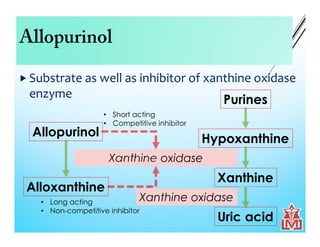
 Substrate as well as inhibitor of xanthine oxidase
enzyme Purines
Hypoxanthine
Xanthine
Uric acid
Xanthine oxidase
Xanthine oxidase
Allopurinol
Alloxanthine
• Short acting
• Competitive inhibitor
• Long acting
• Non-competitive inhibitor
Allopurinol: Mechanism of action
 Inhibits xanthine oxidase (XO)
 Directly
 By getting converted to alloxanthine
 Decreased concentration of uric acid in plasma
 Hypoxanthine and xanthine concentration
increased
 All three metabolites excreted in urine
 Increase hypoxanthine and xanthine leads to
feedback inhibition of de novo purine synthesis as
well
Allupurinol
 Pharmacokinetics:
 Metabolised largely to alloxanthine
 Metabolism inhibited on chronic
administration
 Interactions:
 Inhibits degradation of 6-mercaptopurine,
azathioprine, warfarin, theophylline
 Complex interaction with probenecid
Allopurinol: Indications
 Chronic gout
 First line drug
 Given for long duration
 100 mg/d  300 mg/d; maximum 600 mg/d
 Patients advised to drink plenty of water
 Secondary hyperuricaemia
 Potentiate 6-MP, azathioprine
Allopurinol: Adverse effects
 Attacks of acute gout during start of therapy
 NSAIDs/Colchicine cover required
 Hypersensitivity reaction, Steven-Johnson
syndrome
 Contraindicated
 Gastric irritation, headache, nausea, dizziness
 Liver damage
Febuxostat
 Non-purine XO inhibitor
 Adverse effect:
 Liver damage
 Hypersensitivity reaction
 Diarrhoea, nausea, headache
 Used as an alternative to allopurinol
 Not to be combined with allopurinol
 Dose: 40 mg/d  80 mg/d; maximum 120 mg/d
Pegloticase
 Recombinant uricase
 Oxidises uric acid to allantoin
 Highly soluble
 Coupled to methoxy polyethylene glycol
 Refractory symptomatic gout
 Given intravenously, every 2 weeks
 ADRs: infusion reactions, development of
antibodies
Pegylated
For uric acid
Metabolising enzyme
NSAIDs in Gout
 Naproxen, indomethacin, diclofenac, etoricoxib
 Better tolerated than colchicine
 Uses:
 To terminate the attack of acute gout
 Frequent high doses
 Takes 12-24 hours, complete resolution in 5-10
days
 As a cover till effects of other anti-gout drug
effects develops
NSAIDs in gout
Drug Dose
Naproxen 750 mg stat  250 mg, three
times a day till attack
subsides
Indomethacin 50 mg, three time a day till
attack subsides  25 mg
three time a day for 5-7 days
Diclofenac 50-75 mg, three times a day
Etoricoxib 60-120 mg, once daily
Corticosteroids in gout
 Suppress symptoms of acute gout
 Can be given by:
 Intraarterial injection
 Triamcinolone 10-30 mg
 Avoid crystalline preparation
 Indicated when few joints are involved, those
not tolerating NSAIDs/colchicine
Corticosteroids in gout
 Suppress symptoms of acute gout
 Can be given by:
 Systemic administration (oral)
 Indicated for patients with renal failure/peptic
ulcer, non-responders, not tolerating
 Prednisolone 40-60 mg  tapered over 1-2
weeks
Conclusion
 NSAIDs are the drug of choice for treatment of
acute gout
 Indomethacin, naproxen
 Allopurinol is the drug of choice for treatment of
chronic gout
 Probenecid cannot be used in patients with
renal impairment, and is associated with risk of
renal stones
Let’s have a break…
 Any queries?
 Next class:
 Skeletal muscle relaxants
 Thank you